

Event Planning Mistakes to Avoid: A Meticulous Checklist for Composed Excellence
- Ever After Expo
- 16 hours ago
- 11 min read
Picture a corporate gala in Sydney where the main course is delayed because a single vendor's loading dock access wasn't confirmed. Within minutes, the keynote speaker's slot is pushed back, the AV crew is scrambling, and the polished atmosphere begins to fray. It's a clear example of how a small oversight can ripple through an entire day. You're likely well aware that in high-pressure environments, there's no room for guesswork when identifying event planning mistakes to avoid. Managing multiple Australian vendors and navigating budgetary uncertainty requires a level of precision that feels almost architectural.
This guide identifies the critical logistical and strategic errors that threaten the success of your next activation or community festival. We'll provide a meticulous roadmap for risk mitigation and strategic oversight, moving beyond simple checklists to genuine logistical mastery. By following this structured approach, you'll neutralise friction points before they manifest on-site. We'll explore how to coordinate stallholders in NSW and QLD while maintaining the high standards expected in Melbourne's professional circles. This is your path to a frictionless execution that secures positive stakeholder feedback and reinforces your reputation for reliability.
Table of Contents
The Strategic Foundation: Avoiding Budgetary and Objective Misalignment
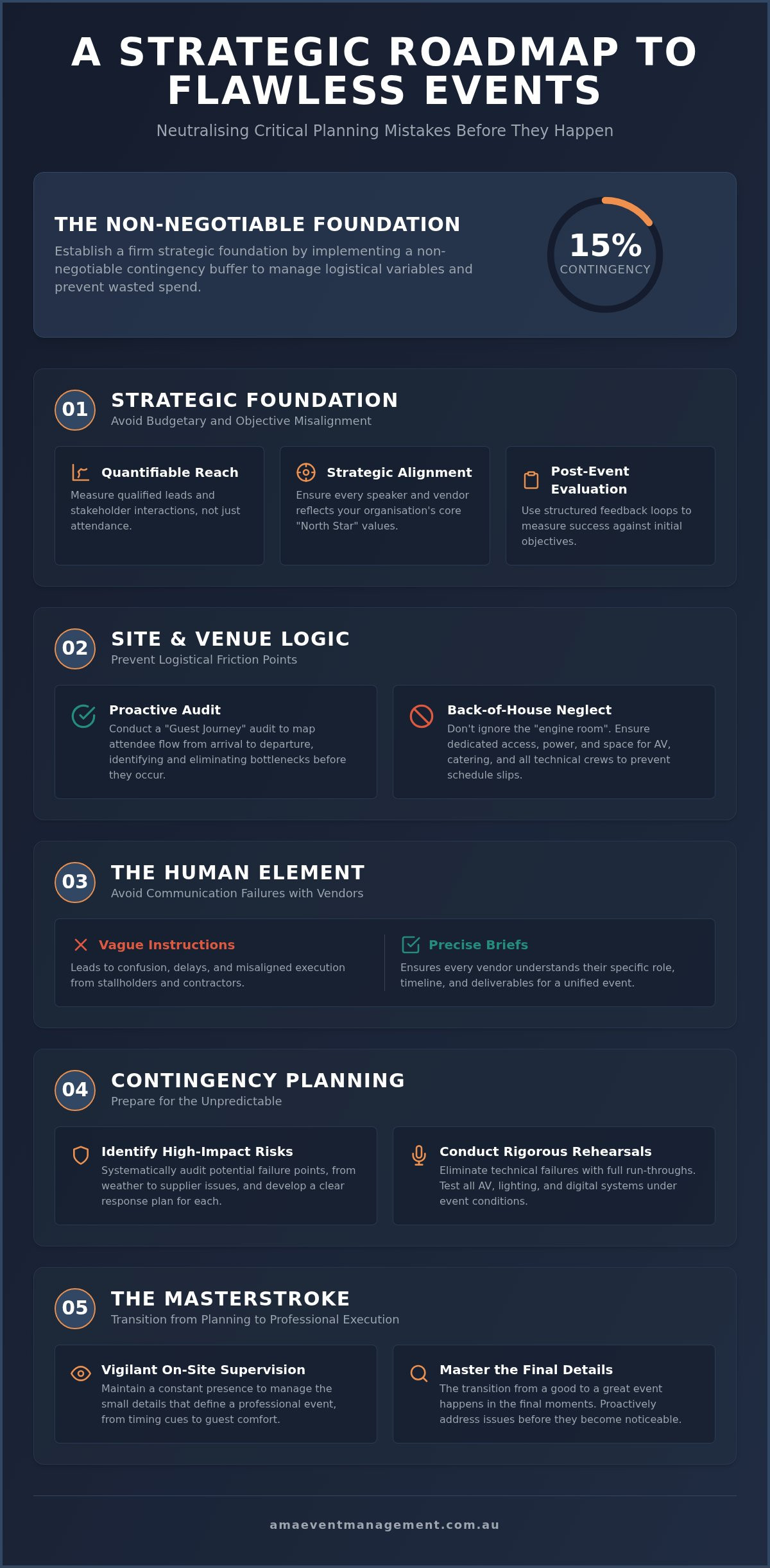
The blueprint of a successful event is drafted during the discovery phase, where the architect identifies potential friction points before they manifest. One of the most pervasive event planning mistakes to avoid is the belief that a budget can remain flexible throughout the process. In reality, a lack of early fiscal discipline often leads to muddled messaging and wasted spend. Precise event management requires a non-negotiable 15% contingency buffer. This isn't merely a safety net; it's a strategic tool to manage the logistical variables inherent in Australian corporate gala environments and community festivals. When stakeholder expectations aren't aligned from the outset, even the most polished execution can feel like a failure if it doesn't meet the unspoken "North Star" of the organisation.
Establishing Rigid Budgetary Parameters
Effective cost control begins with a meticulous audit of invisible logistics. It's easy to over-allocate funds to high-visibility items like floral arrangements while neglecting site infrastructure or essential safety permits. In Sydney and Melbourne, fluctuating labour costs can impact your bottom line if you haven't locked in your primary service providers early. You should always secure your critical vendor procurement, such as AV technicians and site supervisors, before committing to secondary styling elements. This disciplined approach ensures that the structural integrity of your event remains intact, regardless of market shifts.
Defining Measurable Event Objectives
Vague objectives are the precursors to muddled execution. Moving beyond broad terms like "engagement" is vital for corporate conferences and themed activations. You need specific, trackable KPIs to justify the investment. Every element of the day should serve a distinct brand storytelling goal. Consider the following when setting your parameters:
Quantifiable Reach: Measure the specific number of qualified leads or stakeholder interactions during a brand activation.
Strategic Alignment: Ensure every speaker or stallholder reflects the core values of the community festival.
Post-Event Evaluation: Use structured feedback loops to measure success against your initial "North Star" objectives.
By defining these metrics early, you create a stabilising force that guides every subsequent decision. This clarity prevents the "scope creep" that often derails complex projects. When you treat the discovery phase as a period of rigorous engineering rather than just a brainstorming session, you set the stage for a frictionless, professional outcome that resonates with your audience and satisfies your stakeholders.
Site and Venue Logic: Preventing Logistical Friction Points
Once the strategic foundation is set, the focus shifts to the physical environment. A common oversight in the industry is treating a venue as a static backdrop rather than a living machine. Conducting a "Guest Journey" audit is essential for identifying bottlenecks before they occur. In Sydney's high-traffic venues, a poorly designed check-in area can lead to congestion that sours the attendee experience within the first ten minutes. This level of foresight is what separates a standard booking from a meticulously engineered event.
Ignoring back-of-house requirements is among the most critical event planning mistakes to avoid. If your AV crew lacks dedicated access or your catering team is fighting for lift space with guests, the schedule will inevitably slip. While a hotel gala offers a predictable infrastructure, bespoke private celebrations in non-traditional spaces require a far more rigorous site survey. You must account for everything from load-bearing limits to the proximity of power outlets, ensuring the "engine room" of the event remains invisible to your guests.
The Architecture of Attendee Flow
Mapping the physical movement of guests from arrival to departure ensures a seamless experience. In Melbourne's heritage buildings or modern Sydney galleries, this often means balancing immersive styling with the practical necessity of clear exits and accessible paths. Digital check-in systems and logical floorplans are your best tools for maintaining a steady flow. By visualising the crowd's density at peak times, you can position bars and activation points to encourage movement rather than clusters, keeping the event's rhythm consistent and professional.
Logistical Infrastructure for Stallholders
Community festivals and outdoor fairs introduce a unique set of challenges, particularly regarding power, water, and waste. Success in community market management Australia depends on a precise understanding of vendor load-in requirements. Food vendors and high-end AV equipment place heavy demands on site power that can trip circuits if not meticulously planned. Managing "invisible" services like waste removal and site security ensures the public fair remains clean and secure. For complex sites, engaging a professional site supervisor ensures these technical details are managed with composed authority, preventing small errors from escalating into operational failures.
The Human Element: Avoiding Engagement and Communication Failures
While technical logistics form the skeleton of an event, the human element provides its pulse. A common error is assuming that a well-booked venue automatically translates to a well-engaged audience. One of the most significant event planning mistakes to avoid is falling into the "Dry Agenda" trap. Overloading a programme with back-to-back presentations is the quickest way to lose a crowd. Instead, professional execution requires a deliberate balance between information delivery and sensory experience. When you prioritise the comfort and engagement of your guests, you create an environment where messaging can actually land.
Mastering Vendor and Stakeholder Communication
Precision in communication is the only effective antidote to operational chaos. Vague vendor briefs create a ripple effect that often results in on-site friction and missed cues. For corporate gala planners Sydney, establishing a single point of contact is essential for maintaining order across multiple teams. A meticulous Run Sheet acts as the definitive logistical anchor, ensuring every vendor, from the AV technician to the floor manager, moves in perfect synchronisation. This document must be granular, detailing every transition and cue to eliminate assumptions. During the live phase, the ability to manage the emotional climate through composed leadership is as vital as managing the schedule. Expert on-site supervision acts as a stabilising force, ensuring that any unforeseen challenges are neutralised before they ripple through the guest experience.
Designing for Authentic Attendee Engagement
Engagement is a deliberate design choice rather than a byproduct of attendance. Avoiding "death by PowerPoint" in corporate conferences involves replacing static slides with interactive elements that encourage participation. When orchestrating a themed brand activation Sydney, the primary objective is to build emotional resonance through immersive storytelling. Bespoke styling is the key to this transformation. It elevates a standard hotel ballroom or warehouse into a tailored environment that reflects the brand's unique narrative. This level of attention to detail ensures the styling feels authentic rather than generic, which is essential for leaving a lasting impression on stakeholders. By focusing on these high-touch elements, you move from simple planning to the creation of a truly memorable experience.
Technical and Environmental Contingency: Preparing for the Unpredictable
A professional event is defined by how it handles the unexpected. While strategic planning provides the route, a robust contingency framework ensures you don't veer off course when variables shift. One of the most avoidable event planning mistakes to avoid is the "it'll be right on the night" mentality. Composed excellence requires a systematic "What-If" Framework. This five-step process involves identifying potential failures, assessing their impact, ranking them by probability, creating a mitigation strategy, and monitoring the environment in real-time. By treating risk as a manageable data point rather than a source of anxiety, you maintain control over the event's trajectory.
In Australia, the environment is often the most volatile variable. Sydney's sudden East Coast Lows or Melbourne's extreme heatwaves can derail an outdoor festival if a "Plan B" only exists as a vague concept. Regulatory compliance is equally critical. Missing a specific NSW or QLD permit can lead to a last-minute crisis that no amount of styling can mask. Ensuring all documentation is finalised months in advance allows you to focus on the technical nuances of the day. To ensure your logistical framework is resilient, consider partnering with a specialist in end-to-end event management who understands these local complexities.
A Systematic Approach to Risk Mitigation
The Contingency Matrix is a professional tool for ranking risks by probability and impact, allowing you to allocate resources where they are most needed. For outdoor community festivals in Sydney and Melbourne, developing specific "Weather Triggers" is non-negotiable. These are pre-determined thresholds, such as wind speeds or temperature peaks, that automatically activate alternative logistical plans. This structured approach extends to your vendors. Every stallholder must meet rigorous insurance and safety standards, including current 2026 NSW and QLD requirements, before they are permitted on-site. This discipline protects the organisation and ensures a secure environment for all attendees.
Technical Reliability and AV Redundancy
Technical rehearsals are the architect's final check. "Winging it" with AV equipment is a recipe for public embarrassment, especially in high-stakes corporate environments. Every keynote speaker requires a secondary technical check-in at least 60 minutes prior to their session to confirm microphone levels and slide transitions. Managing hybrid event logistics adds another layer of complexity. You must maintain the "in-room" energy while ensuring the digital stream remains stable. This requires on-site technical support that remains unfazed by equipment glitches. By building redundancy into your AV plan, you ensure that a single faulty cable doesn't silence your brand's message.
The Masterstroke: Transitioning from Planning to Professional Execution
The transition from the planning phase to the live event is where the most sophisticated logistical frameworks are tested. It's often said that the final 2% of execution requires 100% of your focus. This is the moment where the meticulous architect must evolve into a composed guide. One of the most critical event planning mistakes to avoid is the assumption that a comprehensive run sheet can execute itself without active oversight. Success depends on the seamless integration of every moving logistical part, from the first vendor load-in to the final guest departure. When you maintain this level of discipline, you position your brand as a reliable and sophisticated force in the industry.
The Role of On-site Supervision
A professional manager acts as a stabilising anchor during the live phase of an event. Their primary role is to neutralise potential crises before they become visible to your attendees. This involves active, methodical oversight of vendor compliance with the established run sheet. For community festival organisers Australia, maintaining a "calm under pressure" aura is essential for managing the complex dynamics of public fairs and large-scale activations. By being several steps ahead of the schedule, a site supervisor ensures that transitions are frictionless and that the professional atmosphere remains undisturbed.
The Post-Event Strategic Review
Avoiding the "Post-Event Void" is as important as the initial launch. Once the guests have departed, the final phase of professional execution begins with a strategic debrief. This is the time to analyse data and feedback to refine the logic for your next major activation or gala. Closing the loop with stakeholders through professional reporting and ROI analysis reinforces the value of the project. A disciplined review process should include:
Quantitative Analysis: Reviewing attendee numbers and engagement metrics against your initial KPIs.
Stakeholder Feedback: Gathering insights from vendors and partners to identify areas for logistical refinement.
Fiscal Finalisation: Finalising stallholder and vendor accounts with the same precision used during the procurement phase.
By treating the debrief as a strategic tool rather than an afterthought, you ensure that every event serves as a stepping stone toward even higher standards of excellence. This methodical approach ensures that the knowledge gained on-site is captured and applied to future projects, maintaining your reputation for reliability and sophisticated competence.
Mastering the Logistical Blueprint for Future Success
Achieving a frictionless event requires moving beyond simple checklists to a state of engineered precision. By establishing a rigid strategic foundation and auditing the guest journey, you neutralise the most common event planning mistakes to avoid. Success isn't found in luck; it's the result of a methodical transition from architect to composed guide during the live phase. This structured approach ensures that every moving part, from vendor procurement to site safety, functions in perfect synchronisation. When you prioritise order and strategic foresight, you create a lasting legacy of excellence for every stakeholder involved.
With over 20 years of end-to-end event management experience, we've refined the art of stabilising complex, high-pressure environments. We specialise in large-scale community festivals across NSW and Queensland while delivering composed, professional execution for Sydney and Melbourne's elite brands. Partner with the meticulous architects at AMA Event Management for your next high-stakes event. Your vision deserves the security of professional oversight and a roadmap for genuine excellence. We look forward to helping you deliver an event that is as seamless as it is memorable.
Frequently Asked Questions
What is the most common mistake made in event planning?
The most frequent error is the lack of a clear "North Star" or defined objectives, which leads to muddled messaging. Without a strategic anchor, decisions become reactive rather than proactive. This lack of clarity often results in misallocated resources and a disjointed guest experience. Ensuring every stakeholder is aligned on the primary goal before procurement begins is a vital step in identifying event planning mistakes to avoid.
How much should I set aside for an event contingency fund in Australia?
You should allocate a non-negotiable 15% of your total budget to a contingency fund. This buffer is essential for managing the fluctuating labour costs and logistical variables inherent in the Australian market. It's a strategic tool, not just a safety net, allowing you to handle unforeseen infrastructure requirements or permit adjustments without compromising the quality of your corporate gala or community festival.
Is it worth hiring an event management agency for a small corporate retreat?
Yes, engaging professional management for a small retreat ensures that the human element is handled with precision. Even small events face engagement failures if the programme is overloaded or the vendor briefs are vague. An agency provides a stabilising force, allowing you to focus on stakeholder relationships while they manage the technical logistics and on-site transitions that define a professional and memorable brand activation.
Can I manage a community festival without professional on-site supervision?
Managing a community festival without professional on-site supervision is a high-risk strategy that often leads to operational friction. Coordination of multiple stallholders, managing site power, and ensuring waste removal requires a dedicated supervisor who remains unfazed by challenges. Professional oversight neutralises small errors before they escalate, ensuring a secure and frictionless experience for the public while protecting the organiser's reputation and bottom line.
How do I avoid overspending on event styling and themed activations?
To avoid overspending, you must secure your critical logistical vendors before committing to secondary styling elements. Start by defining the brand storytelling goals for your themed activation. By focusing on bespoke, high-impact styling rather than generic decorations, you ensure every dollar spent contributes directly to the immersive experience. This disciplined approach prevents scope creep and keeps the project within its rigid budgetary parameters from start to finish.
What happens if it rains during my outdoor market event in Sydney?
In Sydney, managing inclement weather requires a robust "What-If" framework and pre-determined weather triggers. These triggers are specific thresholds, such as predicted millimetres of rain or wind speeds, that automatically activate your Plan B logistics. Having a pre-arranged indoor alternative or specialised site infrastructure ensures the event remains professional and safe, regardless of sudden shifts in the local environment or unexpected East Coast Lows.
How early should I start planning a large-scale corporate gala in Melbourne?
For a large-scale corporate gala in Melbourne, you should ideally begin the planning process 9 to 12 months in advance. This lead time is necessary to secure high-demand venues and the best local vendors. Early phase discovery acts as your most critical tool for cost control, allowing you to lock in labour rates and navigate the complex permit requirements of Victorian local councils with composed authority.
What are the essential NSW council permits for public events?
Public events in NSW typically require several essential permits, including a Development Application or a Section 68 approval for activities on community land. You may also need specific traffic management plans and noise permits depending on the location. It's vital to consult with the relevant local council early to verify the current 2026 requirements, as missing these documents can lead to a last-minute crisis that threatens the entire event.


Comments