

Street Festival Management in Sydney: A Guide to Composed Excellence
- Ever After Expo
- 10 minutes ago
- 11 min read
A successful street festival isn't born from high-energy hype, but from the quiet, methodical discipline of logistical architecture. When you're standing in the centre of a bustling precinct, the difference between a landmark event and a chaotic afternoon rests entirely on the quality of your preparation. You likely feel the pressure of balancing public safety with the need for a vibrant atmosphere, all while managing the intricate requirements of various NSW government agencies.
Effective street festival management Sydney requires a composed authority that remains unfazed by the complexity of road closures or vendor coordination. You deserve to feel confident that every compliance standard is met and every logistical detail is secured. This guide reveals the methodical approach needed to plan and execute high-impact festivals with precision. We will outline the essential festival timeline, provide clarity on regulatory navigation, and explain how to maintain seamless site control. By the end, you'll have a structured path toward creating a safe, immersive community experience that reflects the highest professional standards.
Table of Contents
The Landscape of Street Festival Management in Sydney
A Sydney street festival represents a sophisticated, temporary transformation of public space. It isn't merely a collection of stalls; it's the deliberate conversion of a functional thoroughfare into a vibrant community centre. In recent years, Sydney’s outdoor culture has shifted toward pedestrian-centric events that prioritise local interaction over vehicular flow. This evolution reflects a growing appetite for shared public experiences that celebrate the unique identity of our suburbs.
It's vital to distinguish between recurring community markets and one-off street closures. While a market might operate within a park or a permanent plaza, a full street closure demands a significantly higher level of logistical precision. Successful street festival management Sydney relies on a "meticulous architect" approach. This perspective views the event as a complex structure where every component, from traffic barriers to power distribution, must be integrated with absolute certainty. By applying fundamental event management principles, organisers can ensure that this temporary transformation remains stable, safe, and professional.
The Economic and Social Impact on Sydney Precincts
The benefits of a well-executed street festival extend far beyond the event date. These activations serve as powerful economic catalysts, driving significant foot traffic to local brick-and-mortar businesses that form the backbone of our high streets. When a precinct is revitalised through a themed festival, it creates a lasting impression that encourages repeat visitation. Socially, these events foster genuine community engagement. They provide a rare opportunity for residents to reclaim their streets, transforming a daily commute into a shared experience that strengthens local social ties.
Key Stakeholders in the Sydney Event Ecosystem
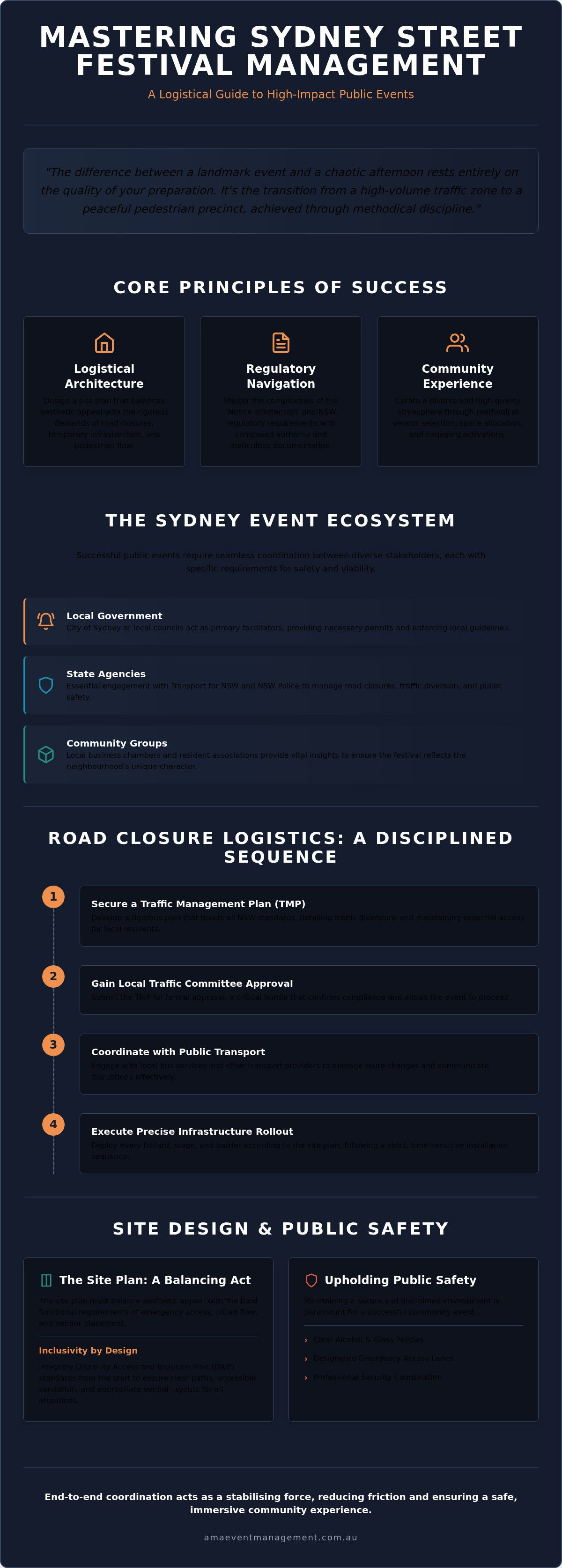
Managing the Sydney event landscape involves coordinating a diverse range of stakeholders. Each group has specific requirements that must be met to ensure the event's viability and safety. Key partners typically include:
Local Government: The City of Sydney or neighbouring local councils provide the necessary permits and often act as primary facilitators.
State Agencies: Engaging with Transport for NSW and NSW Police is essential for managing road closures and ensuring public safety.
Community Groups: Local business chambers and resident associations offer vital insights and help ensure the festival reflects the neighbourhood's character.
Managing these relationships requires a composed guide who understands the regulatory maze. When stakeholders feel heard and their requirements are meticulously addressed, the entire ecosystem functions with greater efficiency and less friction. This structured approach to stakeholder engagement is the foundation of any successful public event in a busy urban environment.
The Logistical Architecture: Managing Road Closures and Infrastructure
A successful site plan for street festival management Sydney is a study in precision. It requires the designer to view the street not as a thoroughfare, but as a blank canvas with fixed constraints. You must balance the aesthetic appeal of a welcoming community space with the hard functional requirements of emergency access and pedestrian flow. This transition from a high-volume traffic zone to a peaceful pedestrian precinct happens in a matter of hours. It requires a disciplined sequence of actions where every bollard, stage, and barrier has a predetermined location and a specific time for installation.
Accessibility isn't an afterthought; it's a foundational requirement. Integrating Disability Access and Inclusion Plan (DAip) standards into the initial design ensures that everyone can navigate the site safely and with dignity. This includes providing clear paths of travel, accessible sanitation, and appropriate counter heights for vendors. Following the City of Sydney event guidelines provides a reliable framework for meeting these compliance standards and ensuring your festival is truly inclusive.
Step-by-Step Road Closure Logistics
Securing a Traffic Management Plan (TMP) is the first major hurdle. This document must meet rigorous NSW standards and gain approval from the Local Traffic Committee. It details exactly how traffic will be diverted and how local residents will maintain essential access. Coordination with local bus services is particularly sensitive. You must ensure that temporary stops are clearly marked and that the public is informed well in advance of any route changes. On the day, professional site crews implement these plans with physical barriers and clear signage, acting as a stabilising force during the high-pressure bump-in phase.
Essential Site Infrastructure and Utilities
The hierarchy of infrastructure begins with power. Sourcing reliable temporary power for dozens of stallholders and performance stages requires a detailed load assessment. Relying on silent, high-capacity generators is often more predictable than trying to tap into existing street infrastructure. Waste management is equally critical. A structured plan for bin placement and regular collections ensures the site remains clean and safe during the event, preventing the "overflow" issues that can detract from the visitor experience.
Finally, the hand-back to council must be seamless. This involves a comprehensive post-event clean that returns the street to its original state, often within a tight two-hour window. Managing these moving parts requires a partner who understands the value of end-to-end event logistics to ensure no detail is overlooked. When the infrastructure is handled with composed authority, the festival can truly thrive.
Navigating Regulatory Compliance and Stakeholder Engagement
Securing approval for a large-scale public event is a test of patience and precision. You'll need to submit a "Notice of Intention" to the local council well in advance to start the formal review process. While the Cultural State Environmental Planning Policy has reduced some red tape for exempt developments, many street festivals still require a formal Development Application (DA). This ensures the event aligns with local environmental and community standards. Integrating the City of Sydney event guidelines early in your planning phase helps you avoid common pitfalls and provides a clear map of the bureaucratic landscape.
Managing alcohol and glass policies is another critical layer of street festival management Sydney. Sydney’s public spaces are often subject to strict Alcohol-Free Zones. If your event includes licensed areas, you must coordinate closely with Liquor & Gaming NSW to secure the appropriate limited licences. Beyond licensing, adhering to Risk Management standards like ISO 31000 is essential. It isn't just about ticking boxes. It's about creating a disciplined framework that anticipates every potential hazard, from electrical faults to crowd surges, ensuring a stable environment for all attendees.
Council Liaison and Permit Acquisition
Timelines are non-negotiable in the Sydney event ecosystem. For major events on City of Sydney land, applications must be submitted at least 16 weeks before the event date. This lead time allows for the assessment of noise permits and EPA requirements, particularly if you're featuring live entertainment stages. You also need to negotiate with local shops regarding footpath usage and outdoor trading extensions. When local businesses feel their interests are protected and their trade is enhanced, they become active partners in the festival's success.
Public Safety and Risk Mitigation
A detailed Emergency Management Plan (EMP) acts as the event's stabilising force. It should outline clear protocols for high-density crowds, evacuation routes, and medical emergencies. Professional security teams and experienced on-site event supervisors are vital during the live phase. They monitor everything from sudden weather-related risks to the safety of stallholders during the high-pressure "bump-in" and "bump-out" periods. Every stallholder must provide proof of public liability insurance and meet NSW food safety standards before they're allowed on-site. This level of oversight ensures a seamless experience for the public and protects the organisers from unnecessary liability.
Curating the Atmosphere: Vendor Selection and Activations
The atmosphere of a festival is the emotional return on your logistical investment. While the infrastructure provides the skeleton, the curation of vendors and activations provides the heart of the event. Effective street festival management Sydney involves more than just filling empty spaces. It requires a deliberate selection process that ensures the vendor mix mirrors the local precinct's identity. A festival in Marrickville should feel distinct from one in Double Bay. This authenticity is achieved by balancing established commercial operators with local community-led initiatives that ground the event in its neighbourhood.
Managing the flow of market stallholder applications is a high-volume task that demands absolute order. You must assess each applicant not only on their product quality but also on their ability to comply with the rigorous safety standards established in previous planning phases. Space allocation must be precise. It's vital to ensure that high-traffic brand activations don't create bottlenecks, while quieter community-led stalls maintain sufficient visibility to engage with attendees. This methodical approach to site mapping prevents the chaos often associated with large-scale public gatherings.
Bespoke Styling and Themed Activations
Styling transforms a standard bitumen road into an immersive environment. It involves the use of bespoke event styling and interactive decor that aligns with the overall event narrative. These elements aren't just decorative. They drive digital engagement by providing specific moments that attendees want to share online, extending the festival's reach far beyond the physical site. When activations are consistent with the event's theme, they reinforce the precinct's branding and create a professional, polished experience for every visitor.
Effective Vendor Coordination and Management
Coordination begins long before the first marquee is erected. Streamlining the application process for local artisans and food vendors ensures you attract high-quality participants who are prepared for the unique demands of a street closure. Providing clear stallholder guidelines for site access and presentation reduces friction on the day. Load-in schedules must be timed to the minute. This prevents precinct congestion during the narrow windows allowed by road closure permits, ensuring a stabilising influence during the high-pressure bump-in phase.
If you're seeking a partner to oversee these complex moving parts with composed authority, explore our bespoke festival and vendor management services. When the curation is handled with discipline, the community experience remains seamless and engaging from start to finish.
The Value of End-to-End Coordination for Public Events
Effective street festival management Sydney requires a single point of contact to act as a stabilising anchor. When an event involves multiple NSW government agencies, local councils, and hundreds of private vendors, the potential for communication friction is high. A centralised management structure ensures that every stakeholder receives consistent information and that every regulatory requirement is met with precision. This oversight reduces the burden on the organiser, allowing the strategic vision of the festival to remain the primary focus.
The role of a community festival organiser is to serve as this disciplined guide. They translate the complex "red tape" of urban planning into a structured project timeline. This professional oversight extends to the financial management of the event. Maintaining a precise budget is essential for long-term viability, ensuring that every dollar spent contributes to a high-impact attendee experience. Success is ultimately measured through post-event reporting, where we analyse foot traffic data and stakeholder feedback to refine future activations.
Why Professional On-site Supervision is Non-Negotiable
Live event operations demand a "calm under pressure" temperament that only comes with significant experience. When thousands of people occupy a temporary precinct, real-time troubleshooting becomes a constant necessity. Whether it's adjusting crowd flow or managing a power fluctuation, an expert supervisor resolves these issues without disrupting the public's experience. With over 20 years of industry knowledge, our team anticipates these challenges well before they occur. This proactive oversight is what distinguishes a polished, professional festival from a chaotic gathering, providing a sense of security for both the council and the community.
Partnering with AMA Event Management
Our methodical approach ensures the seamless integration of every moving part, from the initial site plan to the final post-event clean. We leverage an established network of Sydney vendors and suppliers who understand the high standards required for precinct-shaping events. This collaborative partnership allows us to act as a reliable anchor for our clients, removing the logistical weight from their shoulders. By choosing a partner who values order and high-level execution, you can plan your next community festival with absolute confidence. We invite you to begin the journey toward a successful, immersive event where every detail is handled with composed excellence.
Leading the Way in Precinct Transformations
Executing a high-impact festival in an urban environment is a feat of logistical architecture. It requires a disciplined approach that balances the rigid requirements of road closures with the creative curation of community-led activations. By mastering the regulatory landscape and prioritising seamless site logistics, you ensure that every attendee experience remains safe and immersive.
Professional street festival management Sydney isn't just about managing a crowd; it's about acting as a stabilising force in a high-pressure environment. When you have a clear understanding of the festival timeline and a meticulous site plan, the complexity of multi-agency coordination becomes a manageable process rather than a source of friction.
With 20 years of seasoned event management experience, we've established ourselves as specialists in Sydney and Melbourne community festivals. We bring a composed authority to every precinct-shaping event we oversee, ensuring your vision is realised with polished competence. Partner with the meticulous architects of Sydney’s best street festivals. We look forward to helping you transform your local street into a vibrant centre of community life.
Frequently Asked Questions
What permits are required for a street festival in Sydney?
The primary requirement is an Event Application submitted through the local council, such as the City of Sydney. For any event involving a road closure, you must also obtain a Road Occupancy Licence from Transport for NSW and notify the NSW Police. If you plan to serve alcohol, a limited licence from Liquor & Gaming NSW is necessary. These approvals ensure that your street festival management Sydney meets all legal and safety obligations.
How long does it take to organise a major street closure in NSW?
Organising a major street closure in NSW typically requires a lead time of at least 16 weeks for the initial application. This period allows for the Local Traffic Committee to review the proposal and for public notification requirements to be met. For minor events, the application deadline is often 6 weeks. However, professional organisers usually begin the strategic planning and stakeholder engagement process six to twelve months before the event date.
How do you manage traffic and public transport during a street festival?
Managing traffic requires a comprehensive Traffic Management Plan (TMP) designed by a certified professional. This plan outlines diversions, road closure points, and specific access routes for emergency vehicles. Coordination with Sydney Buses is essential to manage temporary route changes and relocate bus stops. Clear signage and physical barriers must be deployed by trained site crews to ensure vehicles and pedestrians remain separated, maintaining order and safety throughout the precinct area.
What are the safety requirements for food stalls at Sydney festivals?
All food stalls must obtain a Temporary Food Stall permit and comply with the NSW Food Authority’s safety standards. This includes requirements for temperature control, hand-washing facilities, and floor protection. Commercial high-risk stalls currently incur a fee of $370.00 per stall for application processing. Organisers must verify that every vendor has current public liability insurance and appropriate food handling certifications before they are permitted to trade on the festival site.
Can local businesses participate in festivals outside their storefront?
Local businesses are encouraged to participate and can often extend their trading footprint onto the footpath or street during a festival. This typically requires negotiating specific footpath usage permits with the council to ensure pedestrian flow isn't obstructed. By integrating existing brick-and-mortar shops into the event fabric, organisers help drive foot traffic directly to local trade while creating a more authentic and cohesive community experience for all festival visitors.
How much does it cost to hire a street festival management company?
The cost of hiring a management company varies based on the scale, duration, and logistical complexity of the event. Factors such as the number of road closures, vendor coordination requirements, and the level of on-site supervision needed will influence the final investment. Rather than looking for a flat rate, organisers should consider the value of a partner who reduces regulatory friction and ensures the financial viability of the festival through meticulous oversight.
What is the difference between a community fair and a street festival?
A community fair is typically held in a park or plaza, while a street festival involves the temporary closure of a public road. This distinction is significant for street festival management Sydney because road closures introduce a higher hierarchy of infrastructure and regulatory requirements. Street festivals demand complex traffic management plans and more intensive coordination with state agencies like Transport for NSW, whereas fairs often operate under simpler land-use permits and guidelines.
How do you handle waste management for a large-scale public event?
Waste management involves a structured plan for bin placement, regular collections during the event, and a final post-event sweep. For large-scale events, it's essential to provide separate streams for recycling and general waste to meet council sustainability guidelines. The goal is a seamless hand-back to the council, where the street is returned to its original state within a tight timeframe. Professional cleaning crews ensure that no debris remains once the road reopens.


Comments