

Boutique Agency, Large Firm or Independent Planner: Which to Choose
The largest agency isn’t automatically the best fit. In the boutique event agency vs large firm decision, a boutique team may suit an event that needs tailored oversight, while a large firm may be better placed for broader scope and delivery capacity. An independent planner can work well when you need one person to coordinate an event or support your in-house team.
Weigh cost, scope and timing together: the structure behind each option affects how the work is planned and delivered. This guide explains how the models differ, what can shape costs and timelines, and where each is most useful. Use the decision points to match your event’s complexity, internal resources and support needs with the right approach.
Table of Contents
Boutique Agency vs Large Marketing Firm - what's the best choice for you?
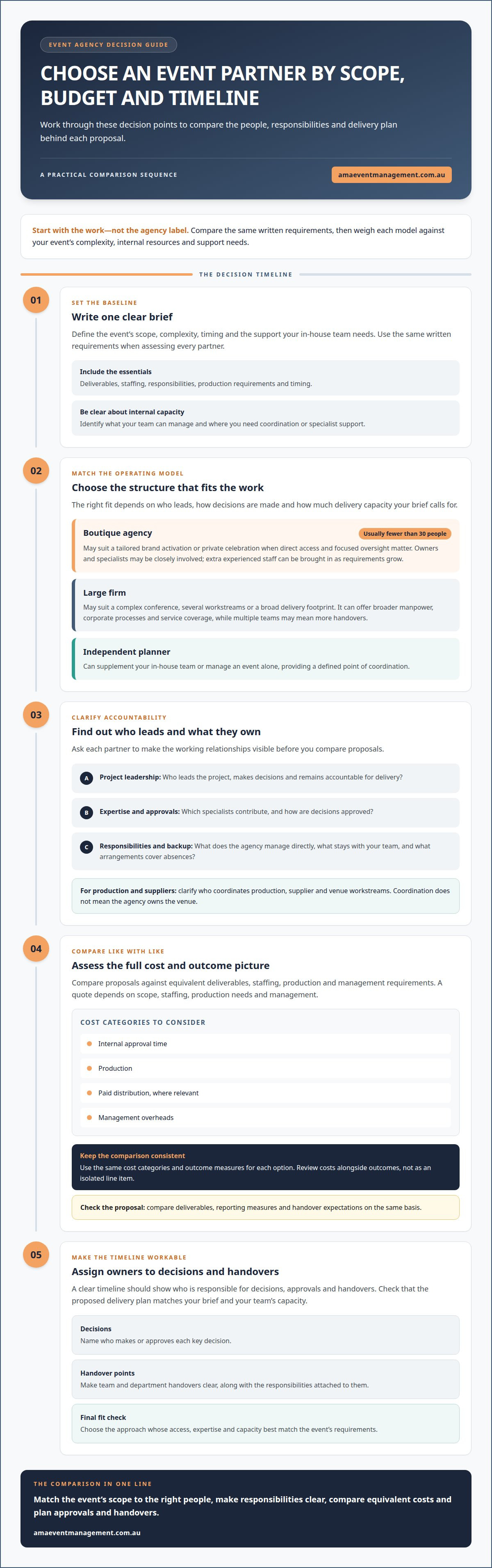
The boutique event agency vs large firm decision often comes down to who leads the work and how closely they collaborate with your team. Compare access to decision-makers, specialist expertise and delivery capacity against your event’s requirements.
Direct Access to Agency Owners
A boutique agency may give you direct contact with its owner and specialist team. In a planning meeting, you can discuss a change with the people shaping and delivering the event, rather than passing it through several departments. A large firm may offer broader services, but department handovers can add steps between your input and implementation. Consider which communication path best suits your decisions.
Leadership Access and Agency Capacity
Smaller teams can keep owners and senior staff close to project oversight, helping them keep client priorities visible as plans develop. Boutique agencies can also draw on experienced staff as event needs grow, supporting flexibility across different event sizes. A large firm may have greater overall manpower and established corporate processes, which can suit a broad, demanding scope. Its multiple teams may also create more handovers.
Specialist Expertise and Senior Talent
A boutique agency may bring specialist expertise into planning while keeping senior staff directly involved. For a tailored brand event, for example, you may value access to the people making creative and operational decisions. A large firm may offer wider service coverage, while senior staff could work across teams and stages. Compare who contributes expertise, makes decisions and remains accountable for delivery.
Choose a model by matching the access, expertise and capacity your event needs with the people responsible for delivery.
Choosing a firm based on scope, budget and timeline
Boutique teams can suit tailored brand activations and private celebrations; large firms may fit events with broad scope and multiple delivery teams. Australian businesses can compare options using the same written requirements for scope, staffing, responsibilities and timing.
Questions Before Choosing an Agency
Use one consistent brief to assess each event management partner. Ask who leads the project, which specialists contribute, how decisions are approved and what backup arrangements cover absences. Clarify what the agency manages directly, such as production or vendor coordination, and what stays with your team. Then compare proposals against the same deliverables, reporting measures and handover expectations.
Event Types and Agency Choice in Australia
A boutique agency may be a closer fit for a bespoke activation that calls for a tailored program and focused oversight. A large firm may suit a complex conference with several workstreams or a broad delivery footprint. The deciding factors are scope, your team’s capacity and the specialist expertise required, not the label alone. For an event in Australia, compare the proposed team and delivery plan with your brief.
Set your budget by comparing equivalent scopes. Include internal approval time, production, paid distribution where relevant and management overheads alongside the agency’s proposed work. Any quote will depend on scope, staffing, production needs and management. A clear timeline should assign owners to decisions, approvals and handovers.
The same structure can help assess an app development partner, but compare software deliverables and technical handovers rather than event production. For market events, event management support can be a useful next step when vendor coordination forms part of the brief.
A brand should compare agency costs using comparable costs and outcomes, including internal approval time, production, paid distribution and management. Keep the cost categories and outcome measures consistent across the options, so each proposal is considered on the same basis. Review costs together with outcomes rather than isolating one line item or treating the amount alone as the comparison. This approach keeps the budget assessment focused on the full set of cost and outcome considerations named here.
Boutique, large-agency and independent-planner models
Each model organises people, decisions and delivery differently. The right structure depends partly on how much of the event your in-house team can manage.
Boutique Studio Operating Model
A boutique studio usually has fewer than 30 people, keeping its operating structure smaller than a large agency’s. For a campaign launch, a client may work closely with the people planning the event, rather than relying on an account manager to relay every approval. This relationship can make changes more direct, while a smaller team may need to bring in additional experienced staff as the event’s requirements expand.
Production, Supplier and Venue Resources
Larger Australian event firms can bring greater capacity and corporate processes to complex delivery. They may coordinate production, supplier and venue workstreams through a structured team, without owning every resource themselves. For a conference involving several suppliers, clear responsibilities help teams manage dependencies and approvals. Distinguish coordination from venue ownership: managing a venue workstream does not mean an agency provides permanent venue hire.
An independent planner offers another structure. One planner may supplement your in-house team or manage the event alone, providing a defined point of coordination. For a community launch, your staff could retain campaign approvals while the planner handles agreed event tasks. This division works best when responsibilities are clear and your business has the capacity to oversee its own workstreams.
A hybrid model combines in-house staff with external support. Compare the full production, management and handover costs, rather than weighing an employee’s salary against an agency retainer alone. For example, your team might retain brand decisions while an agency coordinates delivery. Agree who approves changes, communicates with suppliers and owns the final handover, so overlapping roles don’t slow the project.
Boutique agencies compared with large marketing firms
The main difference is how teams organise decisions, expertise and delivery. Boutique agencies keep work more focused, while large firms bring broader capacity and processes. Boutique teams can shape events around your vision; larger firms may coordinate more departments.
Boutique and Large Firm Differences
A boutique agency can build an event around your organisation, culture and audience from the outset. Its focused structure may keep creative and operational decisions close to delivery. A large marketing agency may offer wider services and more capacity, but work can pass through several teams. The distinction isn’t simply firm size; it’s how the structure supports your event’s priorities.
Creative Flexibility and Customisation
Boutique agencies can create events for individual clients rather than relying on off-the-shelf programs. That flexibility can help adapt a launch when it needs a distinct audience experience or a brand’s vision changes. Larger firms also develop customised work, but their processes and approvals may involve more layers. Compare how each model turns a new brief into decisions and practical changes.
Risks of Small and Large Firms
A smaller agency may have capacity limits or less specialist expertise in-house. Ask which staff will lead the work and how additional expertise can be brought in if needs change. A large event firm may have greater delivery capacity, but departmental handovers can distance decisions from the people executing them. Agree on responsibilities, approval routes and backup arrangements before work begins.
For a tailored event that needs close coordination, discuss your event requirements and consider the structure that best fits your team.
A survey cited in the article found 72% of businesses reported better satisfaction when working with smaller firms. The article reports 74% of brands working with boutique agencies report higher satisfaction, compared with 58% with larger agencies.
AMA Event Management: Market Management and Vendor Coordination
AMA Event Management supports events that depend on organised vendor coordination and clear delivery responsibilities. Its Market Management and Vendor Coordination service helps businesses manage market operations and participating vendors. Community Festivals and Fairs can suit public events that need coordinated planning, including in Sydney and Melbourne.
For a brand experience, AMA Event Management’s Themed Brand Activations offer an event-focused option; Corporate Conferences and Galas suit business gatherings. The right fit depends on your event’s scope and the support needed to bring its moving parts together. Contact AMA Event Management’s expert team of professional event planners to discuss your event and next steps.
Contact AMA Event Management to discuss your event.
Give your event a clear starting point
Once you’ve selected a planning model, turn the decision into a shared working brief. Set out the event’s purpose, the experience you want guests to have and the decisions your team will retain. This gives everyone a practical reference as plans take shape.
Choosing between a boutique event agency and a large firm is only the beginning. A well-defined working relationship helps keep the event’s purpose visible during delivery. Agree how your team will record changes, resolve competing priorities and assess the outcome after the event. These foundations help protect the original vision while leaving room for sound decisions as details develop.
If you’re ready to discuss your event requirements and next steps, contact AMA Event Management. A thoughtful plan is a strong place to begin.
Frequently Asked Questions
How do boutique and large event agencies compare on cost in Australia?
Costs depend on scope, team structure and delivery requirements, so compare the work included rather than agency size alone. For a Sydney or Melbourne event budget, account for internal coordination, specialist support, supplier charges and changes to the agreed scope. A boutique proposal may focus on the people and expertise assigned to your event; a large-firm proposal may include broader team structures and overheads. Compare equivalent scopes in A$.
How do agency size and team structure affect client service and communication?
Team structure determines who handles routine updates, decisions and escalations. A named account manager can provide a consistent contact, while a larger project team may have separate leads for different workstreams. Before work begins, agree on the main contact, meeting rhythm, response channel and who can approve changes. For a Sydney event, a shared decision log can help keep internal stakeholders aligned.
What questions should you ask an event agency before signing a contract?
Ask who will lead your event, what the agreement covers and which responsibilities remain with your team. Clarify how scope changes, supplier coordination, approvals, cancellations and handovers will be handled. For an event in Melbourne, establish who communicates with suppliers and who makes time-sensitive decisions on your organisation’s behalf. Make sure the written agreement reflects those answers before signing, so everyone has a clear working plan.


Comments