

How to plan inclusive events with accessible venues and materials
A ramp at the entrance doesn’t make an event accessible on its own. According to the Federal Register of Legislation, accessible venues in Australia should meet the Disability (Access to Premises - Buildings) Standards 2010. A practical plan should apply event accessibility guidelines for disabled attendees across venue layouts, seating, catering, dietary needs, digital activities and materials.
It’s easy to focus on the physical venue, but access also depends on how people receive information and participate. Clear, accessible materials and well-planned digital activities make an event easier to follow, whether attendees join in person or online.
This guide explains how to plan an inclusive event, from reviewing routes, seating and catering arrangements to preparing accessible registration information and digital content. It also covers ways to make event materials easier to navigate, so accessibility is considered throughout planning rather than left until the final details.
Table of Contents
Inclusive venue layouts and seating assistance
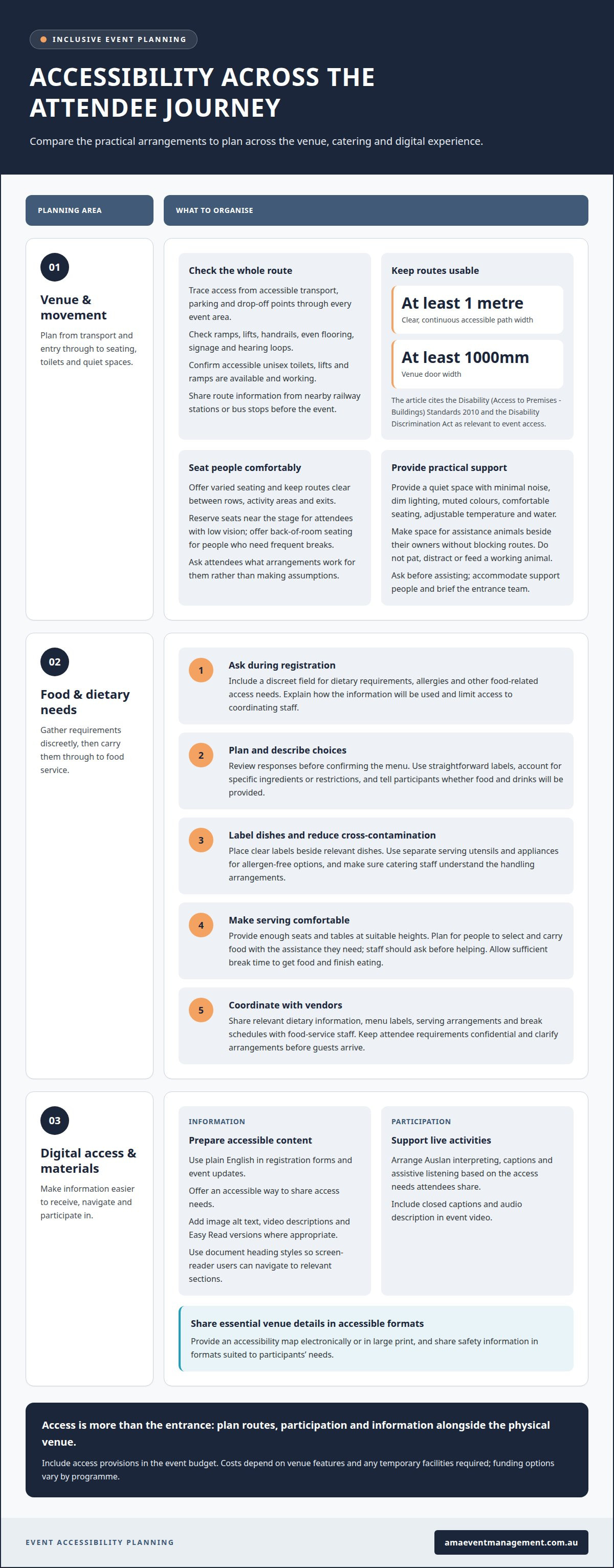
Plan access across the entire attendee journey, from transport and entry to seating, toilets and quiet spaces. These practical steps can help identify barriers before event day.
Plan and assess venue accessVisit the venue before booking and assess the complete layout, not just the entrance. Accessible venues in Australia should meet the national Disability (Access to Premises - Buildings) Standards 2010, according to the Federal Register of Legislation. The Disability Discrimination Act is also relevant to event access. An inaccessible event can exclude attendees and lead to disability discrimination concerns. Include access provisions in the event budget; costs depend on venue features and any temporary facilities required. Funding options vary by program, so plan around the event’s specific access needs.
Check routes, entrances and toiletsTrace the route from accessible transport, parking and drop-off points to the entrance, then through each event area. A clear, continuous accessible path should be at least 1 metre wide, with no steps or barriers; venue doors should be at least 1000mm wide. Check ramps, lifts, handrails, even flooring, signage and hearing loops, and ensure they’re usable. Confirm accessible unisex toilets are available and that accessible bathrooms, lifts and ramps are working. Share route information from nearby railway stations or bus stops before the event.
Arrange seating and quiet spacesOffer varied seating and keep accessible routes clear between rows, activity areas and exits. Reserve seats near the stage for attendees with low vision, and seating towards the back for people who need frequent breaks. Ask attendees what arrangements work for them instead of making assumptions. For sensory needs, provide a quiet space with minimal noise, dim lighting, muted colours, comfortable seating, adjustable temperature and water. High-contrast signs, such as black text on a white background, help attendees find these areas.
Accommodate service animals and support peopleMake space for guide dogs and other assistance animals beside their owners without obstructing accessible routes. Staff should not pat, distract or feed a working animal. Ask attendees whether they want assistance rather than assuming, and accommodate support people alongside them. If someone who is blind requests guidance, staff should introduce themselves by name, ask which side to stand on and offer an arm just above the elbow. Brief the entrance team on these arrangements before attendees arrive.
Accessible catering and dietary requirements
Collect requirements through registration. Include a discreet RSVP field for dietary requirements, allergies and other food-related access needs. Explain how the information will guide catering arrangements, and limit access to staff coordinating those arrangements. This gives attendees a way to share what they need without announcing personal details at the event. Review responses before confirming the menu and service plan.
Offer clearly described food choices. Provide different catering choices where possible, using straightforward labels that help attendees identify suitable options. Ask about requirements early enough to incorporate them into menu planning. Tell participants whether food and drinks will be provided, so they can plan accordingly. Don’t rely on broad labels alone when a participant has identified a specific ingredient or restriction.
Label dishes and manage cross-contamination. Clearly identify food that may contain common allergens or ingredients attendees have named as restrictions. Keep labels beside the relevant dishes, rather than relying on a separate menu attendees may not find. Use separate serving utensils and appliances for allergen-free options to reduce cross-contamination. Make sure catering staff understand which dishes and utensils need separate handling.
Plan a comfortable serving arrangement. Include enough seats and tables at appropriate heights for guests to eat comfortably. Arrange food service so people can select and carry food with the assistance they need. Brief catering staff to offer help with food selection and service, while asking before stepping in. Provide sufficient break time for everyone to obtain food and drinks and finish eating.
Coordinate details with event vendors. Share the relevant dietary information, menu labels, serving arrangements and break schedule with the people responsible for food service. At a community gathering, community festival planning can include vendor coordination, helping food-service logistics align with the event programme. Keep attendee requirements confidential and make agreed arrangements clear to staff before guests arrive.
Accessible digital activities and materials
Apply event accessibility guidelines for disabled attendees to digital information, live activities and follow-up materials. Plan access at every stage, from preparation through to participation.
Prepare accessible registration and event informationUse plain English in online registration forms and event updates, and provide an accessible way for attendees to share access needs. Add image alt text, video descriptions and Easy Read versions where appropriate. Structure documents with heading styles so screen-reader users can navigate directly to relevant sections. Provide an accessibility map electronically or in large print, and share safety information in formats suited to participants’ needs.
Provide interpreters, captions and listening supportArrange Auslan interpreting, captions and assistive listening based on the access needs attendees share. Include closed captions and audio description in event videos. For live or hybrid sessions, test live transcription, volume and hosting rights before participants join, and check that the hearing loop works. Tell attendees in advance which supports are available and how to access them, so they can plan their participation.
Make digital activities and materials accessibleTreat event accessibility guidelines for disabled attendees as part of activity design, not just document preparation. Offer a live broadcast or recording for people who cannot attend in person. Facilitators should read on-screen information aloud and describe activities in Easy English. For example, explain a chart’s key message rather than saying, “look at this slide”. Share presentation materials in advance where possible, then provide accessible follow-up files.
Provide an accessibility map in an accessible electronic format or large print, and make safety information available in formats suited to participants’ needs. Clear, usable guidance helps attendees orient themselves and understand essential information.
Live broadcasts or recordings can help people who cannot attend in person. For hybrid events, test accessibility features such as live transcription, hosting rights and volume before participants join.
How can event organisers provide accessible registration, ticketing and event information?
Build access questions into registration. Include a field where attendees can describe accessibility needs, such as communication support or an adjustment to their ticketing process. Keep the wording direct and explain how responses will inform event arrangements. Make the field easy to locate, and allow people to share only the details relevant to their participation.
Offer more than one way to register. Provide web, telephone and email submission options so attendees can choose a suitable channel. Keep the online process straightforward, with clear labels and plain-English instructions at each stage. Explain how to request assistance with registration, ticket details or changes, rather than making one digital form the only route.
Share useful information before the event. Send registration confirmations and updates in accessible formats. State what the ticket includes, how to follow the programme and where to find event information. If plans change, communicate the updated details promptly through the channels attendees use. During the event, keep essential announcements available in accessible formats too.
Make event information easy to understand. Use plain English for ticket instructions, schedules and attendee updates. Add alt text to informative images, describe videos and provide Easy Read versions where appropriate. For example, an image showing a room layout needs a text description that explains the relevant information, not simply “event map”. Keep terms consistent across the registration page and confirmation.
Assign responsibility for access enquiries. An accessibility coordinator can handle questions and accommodation requests, then pass relevant arrangements to the event team. Give attendees a clear way to reach this person through web, telephone or email. Brief staff on agreed arrangements, protect personal information and communicate any practical changes directly to affected attendees.
For support coordinating inclusive event logistics, plan your accessible event with a clear registration and information process.
AMA Event Management
AMA Event Management can coordinate the moving parts of an event where accessibility needs careful planning. For community festivals and fairs, themed brand activations, corporate conferences and galas, practical access considerations can inform event logistics, vendor coordination and attendee information.
Bring access requirements into planning early, alongside the event format, venue arrangements and programme. This gives the team a clear basis for coordinating vendor communication, accessible information and attendee support. AMA Event Management’s Market Management and Vendor Coordination can also support events involving multiple vendors and operational requirements.
If you’re planning an event and would like to discuss its management, contact AMA Event Management.
Make accessibility part of your next event decision
Inclusive planning works best when access is treated as a design principle, not a final check. For your next event, allow time to consider how attendees will receive information, participate in activities and share access needs. Use feedback after the event to identify practical improvements for future gatherings.
Event accessibility guidelines for disabled attendees are most useful when they inform decisions from the earliest planning conversations. A clear process keeps access considerations visible as the programme, venue arrangements and attendee communications take shape.
If you’re developing an event and want support coordinating its moving parts, contact AMA Event Management to discuss your plans. Each thoughtful decision can help create a more welcoming experience for the people attending.
Frequently Asked Questions
What venue access features should event organisers provide for attendees with mobility disabilities?
Provide a continuous, step-free route from arrival points to event areas, seating and accessible toilets. Check that lifts, ramps and entrance doors are usable, and keep routes clear of furniture, cables and temporary displays. Apply event accessibility guidelines for disabled attendees by planning seating that allows wheelchair users to participate alongside other guests. Share a venue access map before the event, and brief staff on how to guide attendees if plans change.
What accessible transport, parking and drop-off options should events provide in Australia?
Give attendees practical arrival information about accessible public transport, parking and drop-off points. Explain the route from nearby railway stations or bus stops to the entrance, including accessible paths. Identify where a vehicle can safely drop off a passenger and how that point connects to the event entrance. Event accessibility guidelines for disabled attendees should also inform updates when transport arrangements change, helping people plan a suitable route.
How can organisers make event websites, presentations and communications accessible?
Make key information available in formats attendees can navigate and understand. Use descriptive link text, structured headings and image descriptions on event pages. Ask speakers to explain important visuals aloud, and provide captions or audio description for videos. Share safety details in multiple formats, and offer an accessible electronic or large-print map. For hybrid sessions, test transcription and sound before participants join.

Comments