

Community Market Management NSW: A Guide to Composed Event Logistics
- Ever After Expo
- 10 hours ago
- 15 min read
A community market doesn't succeed on good intentions alone. Behind every thriving Saturday market, every well-curated stall row, and every satisfied council liaison is a disciplined framework of compliance, coordination, and careful planning. If you're exploring community market management in NSW and wondering how to navigate council approvals, attract quality vendors, and keep the public safe, you're already asking the right questions.
It's a genuinely complex undertaking. The regulatory landscape across NSW local government areas can feel like a moving target, vendor relationships require consistent attention, and the stakes around public safety leave little room for improvisation. Those pressures are real, and they're exactly why so many well-meaning market initiatives stall before they find their rhythm.
This guide cuts through that complexity. Drawing on the kind of methodical, end-to-end approach that has underpinned successful recurring markets across NSW, including the Aussie Night Markets, it sets out a clear roadmap covering council compliance, vendor coordination, and risk management. By the end, you'll have a structured foundation to build a vibrant, recurring market that genuinely supports your local community and economy.
Table of Contents
Navigating the Regulatory Landscape of Community Markets in NSW
Community market management NSW is, at its core, the disciplined oversight of public commerce, social engagement, and shared space. It demands an understanding of how people move, trade, and interact within a defined environment, and an equally clear understanding of the legal frameworks that govern those interactions. Without that foundation, even the most enthusiastic market initiative runs the risk of stalling at the first council hurdle.
The primary legislative framework governing public markets in NSW is the Local Government Act 1993, which establishes how councils regulate the use of public land, including the conditions under which recurring commercial events can operate. Alongside this sits a web of planning legislation, environmental health regulations, and traffic management requirements that vary meaningfully between local government areas. What's approved in one council jurisdiction may require a substantially different application process in the next. That variability is precisely why a professional, methodical approach isn't optional; it's essential.
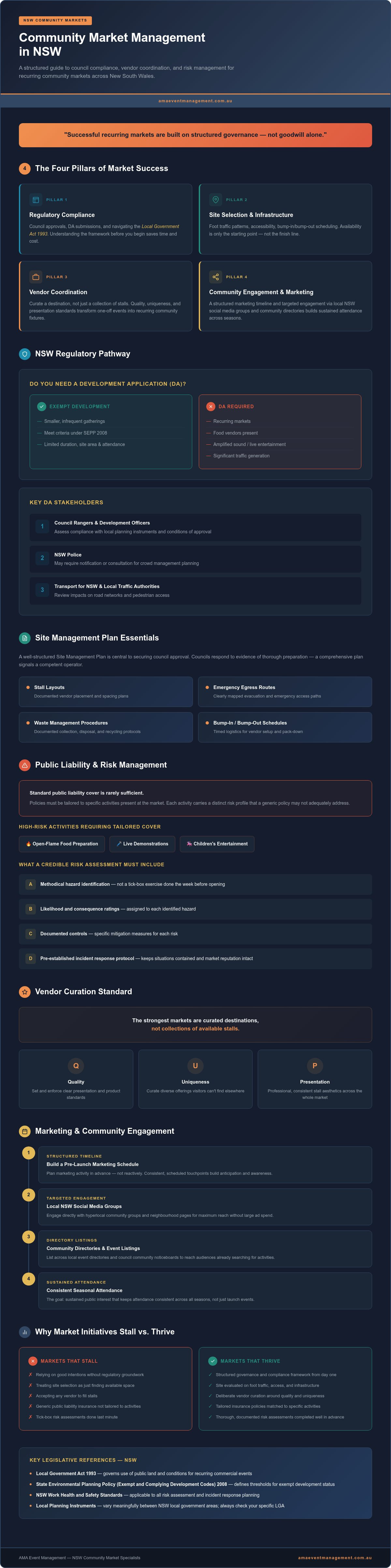
The broader context of community and farmers markets globally reflects a consistent truth: successful recurring markets are built on structured governance, not goodwill alone. Vendor coordination, crowd management, and council compliance are the architecture beneath the visible activity of a market day.
Understanding NSW Council Requirements and DA Approvals
Not every market event requires a Development Application. Smaller, infrequent gatherings may qualify as exempt development under State Environmental Planning Policy (Exempt and Complying Development Codes) 2008, provided they meet specific criteria around duration, site area, and attendance numbers. However, recurring markets, particularly those involving food vendors, amplified sound, or significant traffic generation, typically fall outside exempt thresholds and require a formal DA submission.
Key stakeholders in that process include:
Council rangers and development officers, who assess compliance with local planning instruments
NSW Police, who may need to be notified or consulted for crowd management planning
Transport for NSW and local traffic authorities, who review any impacts on road networks and pedestrian access
A well-structured Site Management Plan is central to securing approval. It should document stall layouts, emergency egress routes, waste management procedures, and bump-in and bump-out schedules. Councils respond to evidence of thorough preparation; a comprehensive plan signals a competent operator.
The Role of Public Liability and Risk Management
Standard public liability cover is rarely sufficient for a recurring market environment. Policies need to be tailored to the specific activities present, whether that's open-flame food preparation, live demonstrations, or children's entertainment. Each activity carries a distinct risk profile that a generic policy may not adequately address.
Risk assessments must also satisfy NSW workplace health and safety standards, which means they can't be a tick-box exercise completed the week before opening day. A credible assessment identifies hazards methodically, assigns likelihood and consequence ratings, and documents the controls in place for each. When something unexpected does occur, a pre-established incident response protocol keeps the situation contained and the market's reputation intact. Calm, structured responses to pressure aren't accidental; they're the product of planning done well in advance.
The Logistics of Site Selection and Infrastructure in New South Wales
Choosing the right site is one of the most consequential decisions in community market management NSW, yet it's frequently reduced to a single question: is the space available? Availability is the starting point, not the finish line. The real evaluation examines foot traffic patterns across different times of day, proximity to public transport, the site's relationship with surrounding businesses, and whether the physical environment can actually support the operational demands of a recurring market. A site that looks promising on a Saturday morning walkthrough can reveal significant constraints the moment you start mapping stall layouts and loading routes.
Local business impact also warrants careful consideration. A well-positioned market can meaningfully increase foot traffic for neighbouring retailers and hospitality venues. Positioned poorly, it can obstruct access and generate friction with the very community it's meant to serve. Early consultation with local business owners, combined with a clear understanding of NSW Fair Trading market stall regulations, establishes goodwill and surfaces potential conflicts before they become formal complaints.
Site Mapping and Traffic Management Plans
A well-designed site map does more than assign stall numbers. It anticipates how people move. Visitor flow should feel intuitive, drawing people through the full length of the market rather than concentrating activity near the entrance and leaving rear stalls underperforming. Congestion points, typically where food vendors cluster or where pathways narrow, need to be identified and resolved at the planning stage, not on the morning of the event.
Accessibility is non-negotiable. The Disability Discrimination Act 1992 sets clear requirements around path widths, surface conditions, and accessible amenities. Meeting those standards isn't simply a compliance obligation; it directly affects how many people can comfortably attend. Pathways should accommodate mobility aids without compromise, and signage should be legible at a range of heights.
Where road closures or changes to parking arrangements are required, early coordination with Transport for NSW is essential. Traffic management plans need to account for both pedestrian safety and the sequential loading zones that keep bump-in orderly. Staggered arrival windows for vendors, assigned by stall location rather than alphabetical order, prevent the bottleneck that turns early mornings into frustrating standoffs.
Essential Infrastructure: Power, Waste, and Water
Infrastructure planning separates functional markets from genuinely well-run ones. Power distribution requires a load assessment that distinguishes between food trucks, which draw substantially more current than retail stalls, and lighter-use vendors operating LED displays or point-of-sale systems. Overloaded circuits are a safety risk and a reputational one; a market that loses power mid-session loses trust.
Waste management deserves the same rigour. NSW's broader sustainability objectives around green events encourage organisers to implement clearly separated waste streams, compostables, recyclables, and general waste, with contractor-supplied collection scheduled around peak activity periods. Greywater from food preparation also requires designated disposal points; this is a detail that councils increasingly scrutinise during the approval process.
Sourcing reliable local contractors for temporary amenities, including portable facilities, hand-washing stations, and site cleaning, builds in the kind of redundancy that protects the event when individual suppliers face last-minute issues. It also supports the local economy, which aligns naturally with the community focus that defines a well-managed market. Experienced operators like AMA Event Management bring established contractor relationships that take this coordination burden off the organiser entirely.
Strategic Vendor Coordination: Beyond the Application Form
Filling every available stall is not the goal. That distinction matters more than most new market organisers realise. A market built around occupancy rates alone tends to produce an inconsistent, forgettable experience, one where visitors arrive once and don't return. Effective community market management NSW treats the vendor roster as a curated programme, not a vacancy list. The difference between a market that attracts a loyal following and one that quietly fades after a few sessions is almost always found in the deliberateness of that curation.
Curation vs. Collection: Selecting the Right Vendor Mix
A well-balanced market creates a reason to stay, not just browse. That balance requires deliberate category management across hot food, fresh produce, artisan goods, and specialty retail. When three wood-fired pizza vendors occupy the same row, they don't complement each other; they cannibalise each other's sales and reduce the overall appeal of the market. The Aussie Night Markets have built a strong reputation precisely by avoiding that trap, prioritising diverse, high-quality offerings that give visitors a genuinely varied experience across every session.
A waiting list strategy reinforces that standard without apology. When prospective vendors understand that a position becomes available only when a category opens up, rather than whenever a stall sits empty, it signals that the market has genuine value and that the organiser takes quality seriously. That perception benefits every vendor already trading, because it protects the market's reputation and sustains attendance.
Streamlining the Stallholder Application Process
The application form is where curation becomes operational. Before any vendor is confirmed, the following documentation should be collected and verified:
Current public liability insurance, with the market operator listed as an interested party
NSW Food Authority certificates for any vendor handling or preparing food
NSW Working with Children Checks where vendors operate activities involving minors
Business registration details consistent with NSW Fair Trading guidelines for markets and temporary events
Tracking these documents manually across a roster of thirty or more vendors is where things go wrong. Expiry dates lapse, renewals get missed, and a vendor who was compliant at the start of the season may not be compliant by month four. Simple systems that flag upcoming expirations and automate payment reminders take that administrative burden off the organiser and remove the ambiguity that creates friction in vendor relationships.
Clear Stallholder Guidelines, distributed at the point of application rather than the week before opening, set expectations early. They should address presentation standards, bump-in and bump-out windows, waste disposal responsibilities, and conduct on site. Vendors who understand the standards upfront are far more likely to meet them consistently, which keeps the market looking sharp and operating smoothly across every session.
Steady, professional communication underpins all of it. Vendors who receive timely updates, clear briefings before each market day, and prompt responses to their queries develop genuine loyalty to the event. That loyalty translates directly into reliability, and reliable vendors are the backbone of a market that runs without drama.
Community Engagement and Marketing for Sustainable Growth
A market that fills its stalls but fails to fill its pathways hasn't solved the right problem. Attendance is the metric that sustains everything else, and building it requires more than a social media post the week before opening day. Effective community market management NSW demands a marketing approach that's as methodical as the operational planning behind it.
The most reliable way to build anticipation is through a structured pre-launch timeline. Begin with teaser content six to eight weeks before the first session, introducing confirmed vendors and the market's character before a single stall is erected. Follow that with a steady cadence of vendor spotlights, behind-the-scenes preparation content, and community announcements in the final fortnight. By opening day, the audience should already feel invested.
Local Marketing Strategies for NSW Markets
Digital reach in NSW is highly localised. Community Facebook groups, suburb-specific pages, and regional "What's On" directories like Eventbrite's local listings and council event calendars carry genuine authority with the audiences that matter most. Collaborating with local food and lifestyle accounts, particularly those with engaged followings in Sydney's outer suburbs or regional centres, extends that reach without significant cost. These aren't influencer campaigns in the traditional sense; they're community conversations, and the tone should reflect that.
Physical presence reinforces digital visibility. Council-approved street banners and A-frame signage placed at key pedestrian intersections create awareness among residents who may never see a social media post. The combination of both channels is what builds the kind of broad, consistent recognition that sustains attendance across seasons.
A well-positioned market also generates what's known as a halo effect, where the increased foot traffic it attracts spills directly into surrounding permanent retailers and hospitality venues, lifting trade beyond the market's own footprint.
Fostering Long-term Community and Council Relations
Sustained growth depends on the market being perceived as an asset, not an imposition. That perception is actively managed, not assumed. Structured feedback channels for nearby residents, a dedicated email address for noise or parking concerns, and a clear response protocol signal that the organiser takes community impact seriously. Concerns addressed promptly and transparently rarely escalate; concerns ignored almost always do.
Councils respond equally well to evidence. Reporting back after each season with attendance figures, vendor revenue estimates, and qualitative community feedback transforms the relationship from one of compliance into genuine partnership. It positions the market as a stabilising force for the local high street and town centre, which is precisely the narrative that secures ongoing approvals and council goodwill.
When a market earns that standing, it stops feeling like an event that visits the community and starts feeling like something the community owns. That shift is the difference between a market that runs for one summer and one that becomes a fixture on the local calendar for years.
Building that kind of sustained community presence requires deliberate strategy from the outset. Speak with AMA Event Management to develop a community engagement and marketing framework tailored to your local NSW context.
Partnering with AMA Event Management for Seamless Execution
Everything covered in this guide, from DA submissions to vendor curation to traffic management, represents a significant body of work. For councils and private developers weighing whether to manage that complexity in-house, the honest question isn't whether it's possible. It's whether it's the best use of limited time and resources. AMA Event Management exists to answer that question decisively.
Led by Amanda, AMA brings over 20 years of experience to community market management NSW, with a track record that includes the well-regarded Aussie Night Markets. That's not a general events background applied loosely to markets. It's two decades of accumulated knowledge about what NSW councils expect, what vendors need to perform at their best, and what visitors return for.
The AMA Edge: 20 Years of Event Management Experience
Amanda's approach is best described as that of a meticulous architect. Every project begins with a thorough understanding of the site, the community, and the regulatory environment before a single stall is assigned. That preparation is what reduces client liability and eliminates the kind of last-minute scrambles that damage both reputations and relationships.
Critically, AMA doesn't operate from a template. Each market is designed around its specific context, its local government area, its vendor mix, and its community character. The established network of vetted NSW vendors and service providers that AMA has developed over two decades means the right contractors, suppliers, and stallholders are already known quantities, not unknowns discovered under pressure.
From Concept to Cleanup: Our End-to-End Commitment
AMA's involvement begins at the concept stage and extends through to final site cleanup. That means managing the DA submission process with the kind of structured documentation that councils respond to positively, coordinating the complex bump-in sequence with quiet efficiency, and maintaining on-site supervision throughout the event itself. Safety is never compromised, but it's also never allowed to stiffen the atmosphere that makes a market worth attending.
For councils that currently manage their own market logistics, the shift to a specialist partner doesn't mean relinquishing control. It means redirecting attention toward strategic oversight while AMA handles the operational detail. The Aussie Night Markets stand as a clear benchmark for what that partnership produces: a recurring, professionally run event that the local community genuinely values.
If you're ready to move from complex logistics to confident execution, organise a consultation for your NSW market project and take the first step toward a market that runs as well as it looks.
Your Market, Built on the Right Foundation
Community market management NSW is a discipline that rewards preparation. The regulatory groundwork, site logistics, vendor curation, and community engagement strategies covered throughout this guide aren't separate concerns; they're interconnected layers of a single, coherent operation. Get one wrong, and the others feel the pressure.
The clearest lesson across all of it is this: sustained markets are built on structure, not spontaneity. Councils respond to evidence of thorough planning. Vendors perform best when expectations are clear from the outset. Visitors return when the experience is consistently worth their time.
With over 20 years of specialist experience and a proven record through the Aussie Night Markets, AMA Event Management brings that structure to every project, from initial council compliance through to final site cleanup. You don't have to navigate NSW's complex approval landscape alone, and you shouldn't have to.
Partner with the experts in NSW community market management and give your market the professional foundation it deserves.
Frequently Asked Questions About Community Market Management in NSW
Do I need a DA (Development Application) to start a market in NSW?
Whether you need a DA depends on the scale, frequency, and nature of your market. Smaller, infrequent events may qualify as exempt development under State Environmental Planning Policy (Exempt and Complying Development Codes) 2008, but recurring markets involving food vendors, amplified sound, or significant vehicle movements typically require a formal DA submission. The threshold criteria differ between local government areas, so confirming requirements directly with your council before committing to a site is essential.
If your market falls into the DA category, expect to submit a Site Management Plan, traffic management documentation, and evidence of public liability cover alongside your application. Councils assess these materials carefully, and a thorough submission consistently produces better outcomes than a minimal one.
What insurance does a market organiser in NSW actually need?
Public liability insurance is the baseline requirement, but the appropriate policy must reflect the specific activities present at your market. A stall selling handmade ceramics carries a different risk profile to one operating an open-flame grill or a children's activity station, and a generic policy may not adequately cover those distinctions. Most councils and landowners will also require the policy to name them as an interested party before granting approval.
Beyond public liability, organisers should consider whether their vendors hold their own individual cover, and whether product liability, event cancellation, or volunteer personal accident insurance are appropriate for their specific context. Consulting a broker experienced in events and public gatherings in NSW will help you identify the right combination.
How much space is required for a standard market stall in Sydney?
A standard market stall in Sydney typically occupies a 3x3 metre footprint, though this varies depending on the vendor category and the site layout. Food trucks and larger catering operations require considerably more space, often 6 metres or more in depth, to accommodate vehicle clearance, service queues, and safe food preparation zones. Your site map needs to account for these variations rather than applying a uniform grid.
Pathways between stall rows must remain wide enough to satisfy accessibility requirements under the Disability Discrimination Act 1992, with a minimum clear width that accommodates mobility aids comfortably. Factoring in those corridor widths at the planning stage prevents the layout compromises that create congestion on market day.
How do I handle food safety regulations for market vendors in NSW?
All food vendors operating at NSW markets must hold a current Food Authority certificate and comply with the Food Act 2003 (NSW). As the market organiser, your responsibility is to verify that documentation before a vendor is confirmed, not on the morning of the event. Certificates should be collected during the application process and tracked for expiry dates throughout the season, particularly for recurring markets where a vendor compliant in February may not be compliant by July.
On-site requirements include adequate handwashing facilities, appropriate food storage arrangements, and designated greywater disposal points. Your council may conduct inspections, and vendors found operating without current certification reflect directly on the organiser. Building a clear food safety checklist into your stallholder onboarding process removes the ambiguity that leads to last-minute compliance issues.
What is the best way to manage traffic and parking for a community market?
Effective traffic management starts with early coordination with Transport for NSW and your local council, well before the event date. A formal Traffic Management Plan should address pedestrian flow, any required road closures, loading zone sequences for vendor bump-in, and the signage strategy that guides visitors to available parking without creating bottlenecks on surrounding streets. Staggered vendor arrival windows, assigned by stall location, are one of the most practical tools for keeping early morning logistics orderly.
Communicating parking options clearly to your audience before market day also reduces on-site congestion. Publishing a simple map across your digital channels and including it in vendor briefings ensures everyone arrives informed rather than improvising, which is where traffic friction most commonly originates.
Can I host a market on private land in NSW without council approval?
Hosting a market on private land doesn't automatically exempt you from council oversight. Planning approvals are determined by the nature and impact of the activity, not simply by land ownership. Depending on the zoning of the property, the frequency of the event, and the number of attendees expected, you may still require development consent or, at minimum, a complying development certificate. Some private landowners also carry their own conditions of use that restrict commercial activities.
It's also worth noting that NSW Food Authority requirements, public liability obligations, and workplace health and safety standards apply regardless of whether the land is publicly or privately owned. Confirming your obligations with both the landowner and the relevant council before committing to a private site is the prudent first step.
How do I attract high-quality vendors to a new market location?
Attracting quality vendors to a new location requires demonstrating that the market is worth their investment before it has a track record. A clearly articulated vision, a credible organiser profile, and evidence of genuine community interest carry significant weight with experienced stallholders who are selective about where they trade. Sharing your marketing plan and projected attendance strategy during outreach signals that you're approaching this professionally, not opportunistically.
A waiting list model, where vendor positions open only when a category becomes available, also reinforces the market's perceived value from the outset. Vendors who see genuine demand for a position are far more likely to maintain their standards once they're in. Connecting with established NSW vendor networks and local artisan communities through targeted outreach is typically more effective than broad, untargeted advertising.
What role does AMA Event Management play in vendor coordination?
In the context of community market management NSW, AMA Event Management handles vendor coordination as part of its end-to-end market management service. That includes managing the application and vetting process, verifying compliance documentation such as public liability certificates and NSW Food Authority credentials, and maintaining ongoing communication with the full vendor roster across each market season. The aim is to remove the administrative burden from the organiser entirely, while maintaining the curation standards that keep the market's quality consistent.
With over 20 years of experience and an established network of vetted NSW vendors developed through events including the Aussie Night Markets, AMA brings existing relationships to each new project rather than building from scratch. That depth of connection means the right stallholders are identified and confirmed efficiently, which directly benefits the visitor experience from the very first session.


Comments