

Community market vendors in Melbourne: fees, rules and venue
A crowded vendor list won’t make a community market work if the stall mix feels repetitive or the venue is hard to reach. To attract vendors to your community market in Melbourne, offer clear application and stall rules, assess each application for quality and variety, set fees that cover market expenses while remaining affordable, and choose an accessible venue with practical facilities.
It’s understandable to focus first on filling every stall. A stronger approach is to give prospective vendors a clear reason to apply and confidence that the event is organised fairly. This article explains how to structure vendor fees and accreditation, assess applications, set expectations for products, setup and trading, and select a Melbourne venue that works for stallholders and visitors.
From applications to transport, parking and site facilities, each decision shapes the market experience. Use these steps to plan a well-organised event and attract a varied group of vendors suited to your community.
Table of Contents
Market rules, setup times and product labelling
Written rules help stallholders understand what to bring, how products are assessed and when trading begins. Set expectations before accepting applications, then apply them consistently.
Trading requirements and setup times
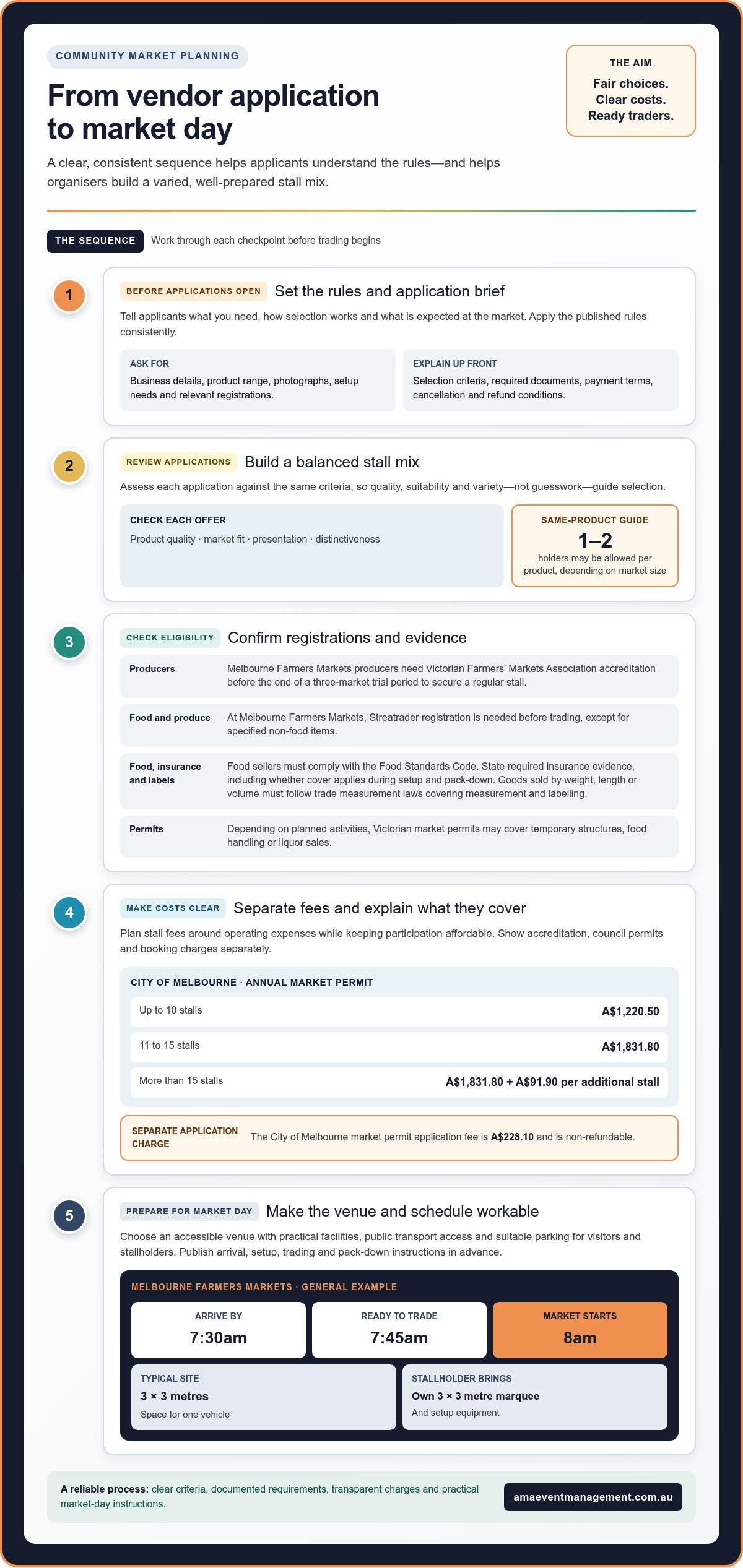
Publish arrival, setup, trading and pack-down instructions so stallholders can plan transport and staffing. At Melbourne Farmers Markets, stallholders generally arrive by 7:30am, be ready to trade by 7:45am, and the market starts at 8am. Sites are generally 3 x 3 metres, with space for one vehicle. Stallholders bring their own 3 x 3 metre marquee and setup equipment.
Product range and quality standards
Assess each application for quality and market fit, then manage the mix to encourage variety. Organisers may limit holders selling the same product to 1 or 2, depending on market size. Explain how you assess similar applications, including product quality, presentation and distinctiveness. Clear criteria help you develop a balanced stall mix without leaving selection to guesswork.
Set eligibility requirements before applications open. Melbourne Farmers Markets producers need Victorian Farmers’ Markets Association accreditation before the end of a three-market trial period to secure a regular stall. Food and produce stalls trading at Melbourne Farmers Markets need Streatrader registration before trading, except for specified non-food items.
State insurance requirements in the application pack. Set clear insurance requirements for stallholders, including the types of cover and whether it applies during setup and pack-down. Organisers commonly require stallholder insurance, and public or product liability cover may be needed. Make clear what documentation is required and whether cover should include setup and pack-down.
For food stalls, Food Standards Australia New Zealand says Australian sellers must comply with the Food Standards Code. Specify the product details and labelling information applications must include. Sellers of goods measured by weight, length or volume must follow trade measurement laws covering measurement and labelling.
Tell prospective stallholders what marketing you’ll do, such as social media updates, local promotion and event listings. Share an attendance estimate based on the venue, event schedule, past attendance where available and planned promotion. Explain how you arrived at the estimate, and don’t present it as a guaranteed customer count.
Creating an application and vetting process
A clear application helps you compare vendors consistently and plan a balanced event. Explain the selection steps, required documents and payment terms before applications open.
Application requirements and market permits
Ask applicants for their business details, product range, photographs, setup needs and relevant registrations. Explain how you assess quality, suitability and product overlap, and give applicants a clear way to submit their materials. For Victorian markets, permits may cover temporary structures, food handling or liquor sales, depending on the planned activities.
Food vendors must meet the Food Standards Code, according to Food Standards Australia New Zealand. Include relevant food safety and public liability requirements in the application, and specify what evidence is required before trading begins.
Application fees and refund policies
Keep application charges separate from market operating fees. The City of Melbourne’s market permit application carries a non-refundable fee of A$228.10. Its form asks for the first market date in dd/mm/yyyy format. Explain who pays each fee, when payment is due and whether an application is complete only after payment.
Set out cancellation and refund terms before accepting bookings. Explain what happens if a vendor withdraws, misses a payment or can’t attend, and how cancellations by the organiser are handled. State whether payments can be transferred to another market date. Clear terms help applicants understand their commitments before booking.
Vendor recruitment and advertising
Identify the mix your market needs, then approach makers, growers and local businesses whose products fit. Promote applications through community groups, social media, local directories and word of mouth. Each listing should include the event date, location, sought-after stall types, application steps and selection criteria. Direct interested vendors to one consistent application form.
Build trust through prompt decisions, consistent selection and practical updates about event conduct. After each market, invite feedback and share booking information for the next event. For structured market management and vendor coordination, use a consistent process from application through follow-up.
Accreditation and market fees
Set stall fees to cover operating expenses while keeping participation affordable. Separate accreditation, council permits and booking charges in your budget so applicants can see what each payment covers. Fees should reflect the site, facilities and services provided, with additional costs clearly identified.
Community organisations don’t need association accreditation to attend those markets. State which requirements apply to each vendor group.
Build council permit costs into the market’s operating plan. In the City of Melbourne, the annual market permit fee is A$1,220.50 for up to 10 stalls, or A$1,831.80 for 11 to 15 stalls. For markets with more than 15 stalls, the annual fee is A$1,831.80 plus A$91.90 for each additional stall. These costs help organisers match fees to the market’s scale.
A practical part of attracting vendors to your community market in Melbourne is showing applicants what the charges support. Distinguish producers from community groups and other stallholders, then explain relevant accreditation, payment timing and recurring fees. A clear breakdown helps vendors assess their commitment before booking and understand each charge.
Consider how fees relate to the market experience. Explain how stall income supports operations and helps attract public traffic through promotion, demonstrations or community activities. This context helps vendors weigh the value of attending and plan future bookings. If you’re deciding how to attract vendors to your community market in Melbourne, review the budget whenever the stall mix or event format changes, then communicate revised charges before applications open.
Choosing a suitable, accessible venue
Venue access affects whether vendors can unload, visitors can arrive comfortably and stalls can operate effectively. Assess transport, parking, site facilities and layout before committing to a Melbourne location.
Start by considering how stallholders and visitors will reach the site. Review nearby public transport connections, walking routes and available parking. Check whether vendors can unload equipment without obstructing pedestrian access. A central location may attract passing visitors, while a site near community organisations can connect the market with local groups. Match the location to your audience and vendor mix.
Walk the proposed site and map the stalls, entrances and circulation paths. Leave practical room for people to move between stalls and find facilities. Consider where queues might form near popular food or produce vendors, and keep entrances visible. A clear layout helps stallholders understand their position and visitors navigate the market.
Assess facilities against the needs of the stalls you plan to accept. Check electricity for vendors using powered equipment, water for relevant operations, toilets for visitors and stallholders, and sheltered areas for changing weather. Record which facilities are available and how vendors can access them. Use this information to ask about power, water and equipment needs in the registration form.
Choose a venue that supports a clear operating plan, not just an attractive setting. Confirm where stalls can go, how vehicles will reach unloading areas and where public access begins. Share a site map before market day showing stall locations, facilities and arrival routes. Include nearby transport and parking details in visitor information so people can plan their trip.
For markets where venue logistics and community activity need to work together, plan your community market event with an organised approach to site layout and access.
AMA Event Management: Market Management and Vendor Coordination
AMA Event Management provides Market Management and Vendor Coordination for organisers who need a structured approach to vendor applications, stall allocation and market-day logistics. It’s a natural next step when managing vendor requirements and site planning alongside the event becomes difficult.
Once the audience, venue and stall mix are clear, bring them together in a practical plan. AMA Event Management also delivers Community Festivals and Fairs, with vendor coordination as part of a broader public event. The aim is to align operational details with the event’s purpose, from managing vendor participation to coordinating the wider experience.
For support with planning and coordinating your market, contact AMA Event Management or visit amaeventmanagement.com.au.
Build your market’s next chapter
Your first market can be the starting point for a stronger local event. Treat each edition as an opportunity to learn: note what vendors and visitors value, gather practical feedback and use those insights to shape future plans. Ongoing refinement helps the market develop while keeping its purpose clear.
Attracting vendors to your community market in Melbourne isn’t just about filling stalls. It means creating an event people can understand, take part in and look forward to returning to. Decide what you want the next market to achieve, then turn that goal into a workable plan.
AMA Event Management offers Market Management and Vendor Coordination for organisers who want support bringing those moving parts together. Contact AMA Event Management to discuss your market, and take the next step towards a well-organised community event.
Frequently Asked Questions
What stall fees do community markets in Melbourne charge?
There’s no single stall fee across Melbourne markets. Organisers set charges according to the event and what participation includes. Before booking, review an itemised breakdown of stall space, booking charges, permits and accreditation expenses. Check whether promotion or site infrastructure is included, and read the cancellation terms. This helps you understand the total commitment and compare markets beyond the headline fee.
What facilities and amenities attract vendors to a Melbourne market?
Vendors value clear information about venue facilities and practical arrangements. A site map, arrival instructions and unloading details help them plan equipment and staffing. Explain which facilities are shared, where to find them and what vendors need to bring. Providing these details during registration lets applicants judge whether the location suits their products and operating needs.
How do Melbourne markets choose vendors and manage product mix or exclusivity?
Markets typically assess applications against quality, suitability and the variety of products already represented. Use consistent criteria to compare product descriptions, images and evidence of production, then decide whether an additional stall strengthens the overall mix. If several applicants offer similar goods, explain how selections will be made. Clear decisions help vendors understand the process and organisers maintain a distinct market identity.
What stall setup, power, water and accessibility requirements should vendors know?
Vendors should share their equipment footprint, power or water needs, and access requirements during registration. Organisers can then provide relevant site details, including approved stall positions, loading arrangements and available connections. For example, a vendor using powered equipment needs to know whether their assigned area has electricity access. Confirming these details before market day helps vendors prepare suitable equipment and plan their setup.


Comments