

Event management fees in Australia: compare planning options
An event budget is not the same as the planner’s fee. Event management fees and pricing models in Australia commonly include a flat fee, a percentage of the budget or hourly billing; commission-based fees are less common. The fee covers planning work, while venue and supplier costs are usually separate. For corporate events, guest numbers, production and program scope also shape the overall budget.
It’s reasonable to want a clear figure before committing, but the pricing model matters as much as the headline fee. A low planning fee may exclude important costs, while a budget-based fee needs clear boundaries around what it covers.
This guide explains how common fee structures work, what to look for in corporate event pricing and which additional charges can affect the total. It also shows how to assess a quote in context, so you can understand the work and costs involved.
Table of Contents
Hidden costs and total cost of ownership
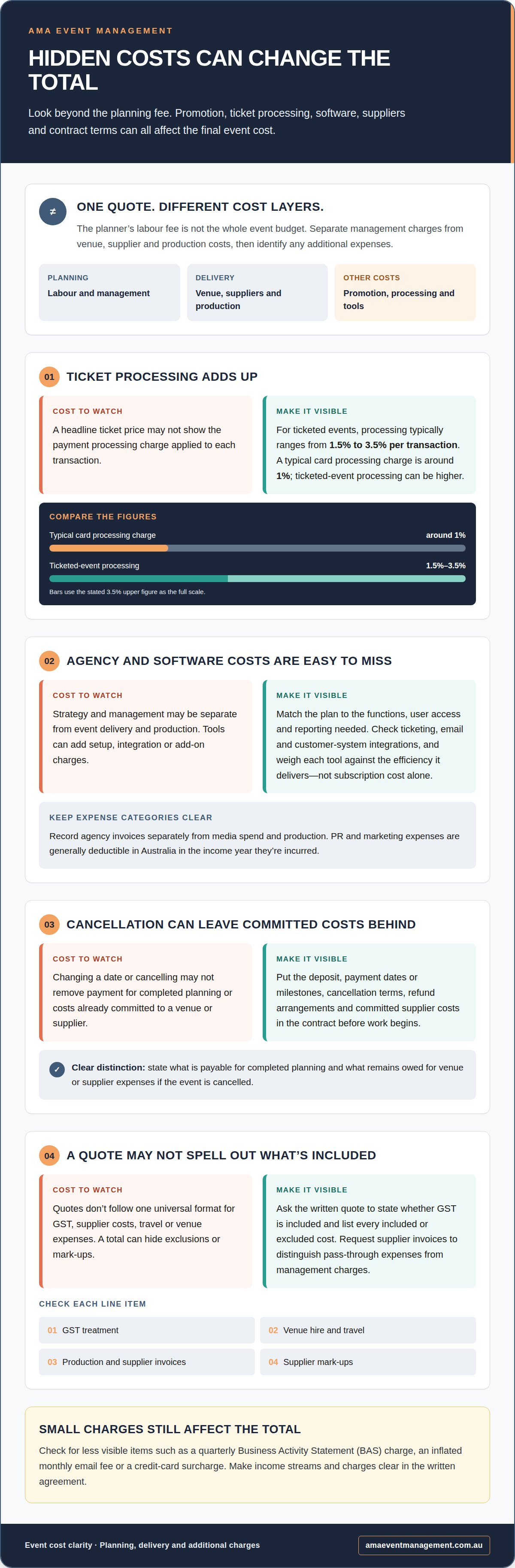
The total can extend beyond the planning fee through promotion, ticket processing, software and supplier expenses. For ticketed events, payment processing typically ranges from 1.5% to 3.5% per transaction.
Agency Strategy and Management Costs
Agency strategy and management fees cover planning and promotion, which may be separate from event delivery and production costs.
The functions required, user access and reporting needs affect which plan is appropriate. Integrations with ticketing, email or customer systems may also involve setup or add-on charges. Assess each separate tool against the efficiency it delivers, not just its subscription cost.
Marketing costs also have a tax dimension: PR and marketing expenses are generally deductible in Australia in the income year they’re incurred. Record agency invoices separately from media spend and production to keep expense categories clear.
Contract Payments and Cancellation Terms
An event management contract sets out payment dates and what happens if plans change. It should specify the deposit, payment dates or milestones, cancellation terms, refund arrangements and any supplier costs already committed.
Put the payment schedule and cancellation conditions in writing before work begins. For example, the agreement can distinguish payment for completed planning from expenses still owed to a venue or supplier if the event is cancelled. This makes the financial impact of changing the date or scope easier to understand.
GST and Supplier Expenses in Quotes
Quotes don’t follow one universal format for GST, supplier costs, travel or venue expenses. The written quote should state whether the total includes GST and identify each included or excluded cost, such as venue hire, travel, production and supplier invoices.
Request supplier invoices as supporting records. They can help distinguish pass-through expenses from management charges and show whether mark-ups apply. Also look for less visible items, such as a quarterly Business Activity Statement (BAS) charge, an inflated monthly email fee or a credit-card surcharge. A typical card processing charge is around one per cent, while ticketed-event processing can be higher.
How Much Does An Event Planner Cost?
An event planner’s fee changes with scope, location logistics, guest numbers and production complexity. A 100-guest event usually needs less RSVP and seating administration than a 10,000-guest event.
Planning Fees and Total Event Budgets
A planning fee pays for the planner’s work; the total event budget also includes suppliers, venue and production. Separating these amounts helps clarify what the fee delivers and what the event as a whole requires.
Under percentage pricing, the planning fee is typically 15-20% of the event budget. Compare the scope covered as well as the fee structure.
Budgets Across Event Types
Event budgets vary by format, particularly when transport, vehicles or national promotion shape the program.
Guidance for a new event recommends allocating 15-20% of its budget to marketing promotion. Track each commitment by category, then compare actual spend with the approved budget and engagement targets. This connects marketing costs with the return the client wants to assess.
Event Size, Location and Complexity
Size affects staffing and administration: managing RSVPs, seating and name badges for 10,000 people involves more work than for 100 guests. Location also shapes logistics, including travel, access, delivery schedules and coordination across venues or sites.
Complexity adds work when an event needs multiple suppliers, intricate production or a detailed run sheet. Event planners can estimate a fair market price by setting out the time they expect to spend. A contingency of 10-15% of total event cost can help account for unexpected expenses. Clear budget categories and regular tracking support efficient decisions; event budget planning can help bring those moving parts into view.
Flat-fee event planning
A flat fee sets one agreed charge for a defined scope of planning work. It makes the planner’s fee easier to distinguish from venue, supplier and production expenses, but the scope should spell out which tasks are included. For example, concept development and supplier coordination may be covered, while ticketing platform charges remain separate.
When comparing event management fees and pricing models in Australia, consider how each payment method fits the work. Common structures include flat fees, hourly rates, a percentage of the event budget and commission-based fees. A package may group defined services under one price, so focus on its deliverables and exclusions rather than its label.
A written scope helps both parties understand how the fee relates to the event plan. It can set out planning responsibilities, supplier communication and event-day oversight. If the brief changes, such as adding a location or engagement activity, a variation process clarifies how the additional work will be handled.
Hourly billing is often used by event-planning subcontractors and casual workers, who track their hours and invoice at a predetermined rate. It can suit a discrete task, such as updating a run sheet, when the work is separate from broader event coordination.
Percentage-based pricing links the planning fee to the event budget. Commission-based pricing is less common in Australia and may combine a minimal client base rate with supplier commissions. Clear disclosure of commissions, rebates and other supplier income helps explain how the organiser is paid.
When comparing event management fees and pricing models in Australia, compare the work covered, not just the payment label. Set out deliverables, responsibilities and exclusions side by side. This gives you a clearer basis for assessing the investment and understanding how changes in complexity could affect the agreed scope.
Corporate event pricing
Corporate event pricing combines planning with the event format, guest experience and venue model.
For a conference, separate the event manager’s work from per-person packages, venue charges and production. Australian venue service charges commonly add 15-25% to quoted hire prices. These figures describe venue costs, not the planner’s fee.
Location and format shape the comparison. A package rate and a venue minimum spend measure different things, so include both in the same budget view. A minimum spend may cover venue purchases rather than room hire alone, so check how it applies to the final calculation.
Frequency matters too. Organisations running 1-2 events per year, each with fewer than 500 attendees, may find per-event pricing more cost-effective than an annual subscription. Plot conferences and galas on the calendar, then compare the cost of each event with any recurring fee. This helps show whether a subscription reflects actual usage.
For a like-for-like comparison, break each proposal into planning, venue, production, guest packages and additional charges. Confirm in writing whether commissions, rebates or supplier mark-ups apply. This makes income streams visible and helps explain differences between quotes. A corporate conference with complex staging may require a different scope from a straightforward awards dinner, even with similar attendance.
For a coordinated corporate conference or gala, discuss your event requirements and intended scope.
AMA Event Management
AMA Event Management brings event planning, supplier coordination and delivery together in a coherent scope. For a corporate conference, gala, community festival or themed brand activation, the work is aligned with the event’s format, priorities and operational requirements.
Start by outlining the event type, intended outcomes and key responsibilities. This gives the planning discussion a practical basis: what needs managing, where coordination is required and which costs belong to suppliers rather than planning work. Pricing depends on the event’s scope, format and coordination requirements; request a quote to discuss your brief.
For market organisers, AMA Event Management’s Market Management and Vendor Coordination brings vendor requirements and event logistics together. Clear scope-setting supports planning across different event formats, rather than treating every brief as the same package.
Contact AMA Event Management to discuss your event requirements with the team.
Set your event brief in motion
Use your preferred pricing model as a starting point, then shape a brief around the event’s purpose, audience and essential decisions. A clear brief turns discussions about event management fees and pricing models in Australia into a practical scope, with responsibilities and cost categories aligned to the work required.
AMA Event Management tailors its approach to the event’s format and coordination needs. Pricing depends on the scope, format and requirements, and is provided after a quote request. That gives you a grounded next step: outline what you’re planning, what success should look like and where you need support.
Whether you’re developing a market, festival or themed activation, clear priorities help create a considered plan from the outset. Contact AMA Event Management to discuss your event and the support you’re seeking. A well-defined brief is a strong foundation for moving forward with confidence.
Frequently Asked Questions
Is it worth paying more for an experienced agency?
A higher fee may make sense when an event needs complex coordination, but the fee alone doesn’t establish value. Compare the proposed scope, planning work, supplier management and on-site responsibilities. For example, a multi-session conference with several suppliers requires different oversight from a simple gathering. Assess what each proposal delivers against your event’s needs, not just its headline price.
Okay, but what does it really cost?
The total cost combines planning work with the event itself: venue, suppliers, production, promotion and ticket processing may all contribute. A planning quote could exclude venue hire and supplier invoices, even though those expenses are part of the overall budget. In Sydney and Melbourne, list each cost category separately so the planning fee doesn’t obscure the full commitment.
What are typical event management fees in Australia?
These figures describe planning fees, not the event’s complete spend. A conference, festival or private celebration can involve different responsibilities, suppliers and delivery requirements, so compare what each fee covers before deciding whether two proposals are equivalent.
How much do Australian event planners charge for corporate events, weddings and private events?
There isn’t one fee that applies across corporate events, weddings and private celebrations. For a wedding or private event, the work depends on the brief, supplier coordination, production and event-day responsibilities.
What percentage of an event budget do Australian event managers typically charge?
What are typical hourly and day rates for event managers in Australia?
Hourly pricing is commonly used by event-planning subcontractors and casual workers, who record their time and invoice at a predetermined rate. A day rate is a separate fee structure, so its meaning depends on the agreed workday, duties and exclusions. For a supplier briefing or run-sheet update, hourly billing may suit a discrete task better than a full event-management scope.


Comments