

Event Promotion Timeline for a Local Festival: The 2026 Checklist
A memorable community gathering isn't created through eleventh-hour social media blitzes; it is built on disciplined logistical milestones. If you are coordinating council road closures and park permits across New South Wales or Victoria, establishing an organised event promotion timeline for a local festival is what separates an anxious scramble from a vibrant precinct. Balancing regulatory approval windows with public launch dates is inherently challenging, especially when you are also working hard to secure reliable stallholders, local sponsors, and regional media interest.
Leaving your marketing to chance often leads to costly, reactive promotion that stretches volunteer committees thin. Instead, you can master every stage of your festival marketing with a structured, reverse-engineered checklist tailored specifically to Australian community events. Below, we step through a proven twelve-month operational schedule that aligns municipal governance with targeted community outreach, giving your team the clarity and calm needed to drive strong attendance, stallholder buy-in, and lasting local goodwill.
Table of Contents
The Anatomy of a Local Festival Promotion Timeline
A successful public event requires operational realities and audience anticipation to move in locked step. Generic ticketing platforms often suggest simply creating a listing months in advance to let ticket sales unfold naturally. In practice, publishing early without strategic momentum leads to message exhaustion, stagnant conversions, and wasted expenditure. An effective event promotion timeline for a local festival is reverse-engineered from your operational deadlines, ensuring every promotional wave is supported by hard logistics on the ground.
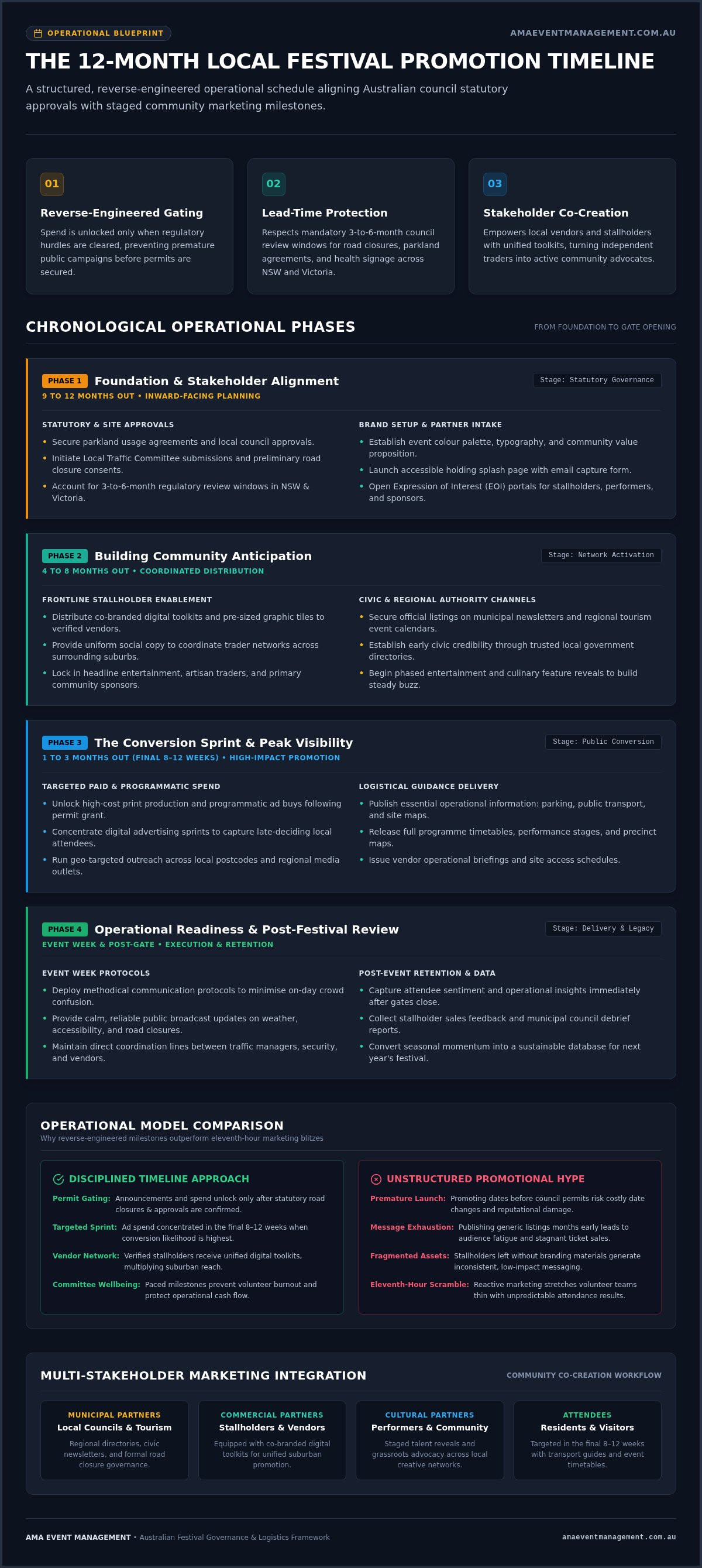
Every community festival progresses through distinct phases: foundation, advocacy, momentum, sprint, and retention. Treating these as isolated tasks invites friction. Aligning them protects your staff, assures your sponsors, and guarantees your promotional spend delivers measurable foot traffic rather than fleeting impressions.
Why Reverse-Engineered Timelines Prevent Festival Chaos
Promoting a date before your regulatory foundations are secure is an avoidable operational risk. Across New South Wales and Victoria, council approvals for major road closures, public place management, and noise variances dictate your marketing milestones. Setting promotional deadlines backwards from required council notification windows prevents the reputational damage of forced date changes or site relocations.
Reverse-engineering also controls your cash flow. By establishing gated spending phases, marketing investments only unlock once critical compliance hurdles are cleared:
Phase gates: Defer high-cost print production and programmatic ad buys until primary council permits are formally granted.
Lead time protection: Account for the three-to-six-month windows standard for community road closure reviews and environmental health signage approvals.
Resource preservation: Prevent team burnout by pacing public messaging rather than maintaining constant, high-tempo hype across an entire year.
Defining Key Stakeholders in Community Event Marketing
Community celebrations rely on co-creation. You cannot treat attendees as the sole audience of your early promotional material. A methodical campaign actively integrates local government authorities, commercial stallholders, grassroots performers, and community organisations well before broad public launches.
Stallholders and local vendors represent your most valuable frontline distribution network. Instead of expecting them to create promotional materials independently, provide verified vendors with co-branded digital toolkits, pre-sized graphic tiles, and uniform social copy. This transforms independent market traders into unified advocates who project your brand across surrounding suburbs.
Concurrently, engage municipal partners early. Australian local councils operate robust regional tourism channels, municipal newsletters, and community event listings. Securing placement on these directories provides early civic credibility, grounding your event promotion timeline for a local festival in official regional schedules that residents genuinely monitor and trust.
Phase 1: Foundation and Stakeholder Alignment (9 to 12 Months Out)
The foundation phase establishes whether your marketing will run smoothly or face constant revision. Nine to twelve months out, promotional activity is deliberately inward-facing. Before announcing dates to the general public, your priority is locking in statutory permissions and constructing the core brand assets that underpin your promotional machinery. Executing these steps early protects your committee from public retractions and sets a disciplined tone for your event promotion timeline for a local festival.
During this stage, your workflow centres on four essential actions:
Council and site approvals: Secure park land agreements, local traffic committee dates, and preliminary road closure consents.
Brand identity formulation: Establish your event palette, core typography, and distinct community value proposition.
Digital splash page launch: Publish an accessible holding site featuring a clean email capture form to begin gathering interested locals early.
Expressions of interest (EOI): Open formal application portals for commercial stallholders, artisan traders, performers, and corporate sponsors.
Brand Identity and Digital Asset Construction
A consistent visual language builds regional trust. Your web presence must prioritise rapid mobile loading, straightforward navigation, and clear privacy compliance for incoming subscriber data. Concurrently, design a suite of versatile digital asset kits. Creating standardised banners, tile templates, and partner logos now prevents visual inconsistency across subsequent campaign rollouts.
Vendor, Sponsor, and Council Engagement Milestones
Municipal engagement demands precise timing. In New South Wales and Victoria, notifying local traffic management committees and emergency services up to twelve months out provides the necessary runway to adjust routes, arrange detour signage, and finalise waste management contracts without stress. This administrative breathing room lets your team pitch sponsors with absolute certainty regarding dates, activation zones, and site footpaths.
Sponsorship prospectuses should clearly define measurable brand activations rather than passive logo placements. Partnering with seasoned community festival organisers Australia wide helps festival boards structure rigorous vendor vetting systems, ensuring quality artisan representation while meeting strict risk management standards. If your committee requires experienced governance during these critical early stages, consulting the specialists at AMA Event Management ensures your operational blueprints and marketing schedules align from day one.
Establishing these administrative foundations secures your baseline. Once permits, assets, and commercial agreements sit firmly on your event promotion timeline for a local festival, you can transition confidently toward building sustained public anticipation.
Phase 2: Building Community Anticipation (4 to 8 Months Out)
With operational permits submitted and your core brand established, attention shifts toward the public. Between four and eight months out, the objective is cultivating authentic local interest without exhausting your audience before ticket or registration gates open. Integrating structured announcement milestones into your event promotion timeline for a local festival ensures consistent momentum while establishing strong community buy-in across Sydney, Melbourne, and regional precincts.
This phase transforms operational planning into public storytelling. Pacing your announcements maintains interest across several months:
Program staggered reveals: Announce anchor attractions and cultural headliners first, followed by artisan food line-ups and craft market vendors.
Release early-bird access: Open discounted admission or priority family registrations to test checkout workflows and reward loyal local patrons.
Activate hyper-targeted social awareness: Deploy broad-radius local ad campaigns across Meta platforms, focusing on visual teasers and video reels rather than aggressive ticket sales.
Curated Programming and Themed Activation Reveals
A full festival programme should never be dropped in a single press release. Unveiling distinct zones, such as interactive craft workshops, cultural showcases, and dedicated children's activity precincts, gives your team distinct talking points every fortnight. Highlighting practical amenities, including pram parking, accessible restrooms, and shaded seating, directly addresses the considerations of local families, who often form the core demographic of regional and suburban festivals.
Grassroots Community and Media Outreach
Digital advertising requires support from trusted physical touchpoints. Regional Australian newspapers, suburban community radio stations, and municipal newsletters operate on lengthy editorial schedules. Pitching human-interest stories about local performers or historic community traditions at the six-month mark secures valuable earned media that digital algorithms cannot replicate.
Simultaneously, collaborate with local chambers of commerce, trader associations, and tourism bodies. Supplying business chambers with promotional posters and countertop flyers embeds your festival into everyday main street traffic. This dual approach bridges print and digital channels, strengthening your event promotion timeline for a local festival with genuine regional backing.
Phase 3: The Conversion Sprint and Peak Visibility (1 to 3 Months Out)
The final three months represent your primary conversion window. Up to this milestone, your promotional work focused on awareness; now, the goal is prompt action. Attendee booking cycles have compressed in recent years, meaning the majority of local visitors confirm their weekend plans only weeks or days prior. Managing a disciplined event promotion timeline for a local festival ensures your marketing budget concentrates heavily where it generates immediate foot traffic and ticket revenue.
Your team should focus on four coordinated deliverables during this sprint:
Conversion-focused retargeting: Re-engage individuals who visited your registration page or joined the initial mailing list.
Comprehensive logistics publishing: Distribute transport routes, parking hubs, accessibility facilities, and full stage timetables.
Economic and cultural PR: Distribute local media releases outlining the event's direct contribution to regional small businesses.
Physical arterial signage: Erect council-approved directional signage and street banners across high-visibility thoroughfares.
Paid Digital Strategy and Retargeting Architecture
Generic social media advertising becomes inefficient in this late window. Transition your digital spend toward narrow geo-fenced campaigns within a defined radius around the festival grounds. Direct retargeting ads toward warm audiences who previously engaged with announcements, backing these with short countdowns to build urgency.
Partnering with local food creators and family bloggers also yields dividends here. Providing creators with curated previews of stallholders or culinary features generates authentic visual material that resonates far better than generic promotional graphics.
Public Logistics Communication and Trust Building
Operational transparency converts hesitant attendees. Families and regional travellers want clear assurances before leaving home. Publishing transparent parking directions, public transit connections, and straightforward wet-weather plans directly removes friction. A detailed schedule allows visitors to plan their day around specific performances and workshops.
Central to this reassurance is an orderly directory of featured stalls. Curating these offerings through disciplined professional community market management principles guarantees visitors encounter an authentic mix of verified local operators rather than repetitive, low-tier stalls. If coordinating complex site logistics alongside multichannel digital campaigns is stretching your committee's capacity, you can partner with AMA Event Management to secure expert operational direction through every stage of your event promotion timeline for a local festival.
Phase 4: Operational Readiness, Event Week, and Post-Festival Momentum
Marketing does not conclude when the gates open. Many standard industry guides abandon their promotional frameworks 24 hours prior to launch, treating event execution as a separate operational discipline. In truth, real-time communication during festival week protects attendee sentiment, safeguards crowd safety, and captures irreplaceable visual proof. Completing your event promotion timeline for a local festival means carrying strategic messaging through the final countdown and straight into next year's planning cycle.
During the critical seven-day operating window, shift your public channels toward active logistical guidance:
Publish structured daily briefings: Share easy-to-read precinct maps, entry guidelines, public transport timetables, and prohibited item lists.
Run live customer support desks: Monitor digital direct messages and post comments actively to answer parking inquiries, lost property questions, and accessibility queries.
Document high-resolution site moments: Commission dedicated videographers to capture crowded market walkways, headline stage responses, and family engagement for subsequent promotional assets.
Final Countdown and On-Site Digital Coverage
Clarity reduces gate friction. Broadcasting measured, factual updates regarding park-and-ride shuttle availability, venue capacity thresholds, or minor weather shifts instils public confidence. When unforeseen operational adjustments occur, such as a stage time shuffle, sharing immediate notifications across primary social feeds prevents crowd frustration before it begins.
Post-Event Retrospective and Next-Year Momentum
Audience enthusiasm declines quickly after pack-down. Distribute a concise, structured survey via email within 24 to 48 hours while attendee impressions remain vivid. Inquiring about transit ease, stage visibility, and stall variety provides unfiltered empirical feedback that informs future council development applications and site layouts.
Simultaneously, transform event-day excitement into tangible commercial continuity. Publish a post-event highlight reel within 72 hours that publicly thanks local municipal bodies, emergency services, and community sponsors. While community goodwill is running high, launch a priority registration list for next year's dates and invite current stallholders to secure early expressions of interest. Closing this loop guarantees your event promotion timeline for a local festival ceases to be an annual emergency, evolving instead into a sustainable, recurring asset for your regional community.
Delivering Your Next Festival with Methodical Confidence
A thriving community celebration is never an accident of luck or last-minute advertising. By establishing an orderly event promotion timeline for a local festival, your committee protects its budget, aligns municipal approvals with public milestones, and builds genuine community anticipation from the ground up. Phasing your outreach allows your team to focus energy where it matters most, guiding attendees seamlessly from initial awareness to gate arrival.
Bringing moving parts into harmony requires seasoned oversight. With over two decades of event management experience delivering large-scale community festivals across Australia, AMA Event Management handles complex council liaisons, vendor procurement, and meticulous on-site execution. When you are ready to remove uncertainty from your operational schedule, partner with AMA Event Management to architect your next community festival with calm precision. With clear milestones in place, you can welcome your local community with total peace of mind.
Frequently Asked Questions
How far in advance should you start promoting a local festival?
You should begin internal stakeholder marketing 9 to 12 months in advance, while broad public promotion typically launches 4 to 6 months before opening day. The initial months focus on council approvals, corporate sponsors, and vendor onboarding across Sydney and Melbourne. Public campaigns roll out progressively afterwards, ensuring an event promotion timeline for a local festival aligns operational readiness with public ticket sales.
What is the most effective promotional channel for a community festival?
A balanced mix of geo-targeted digital advertising and physical community touchpoints delivers the highest attendance. Geo-fenced social campaigns capture nearby residents effectively, but grassroots channels like council event listings, street banners, and local school noticeboards drive essential civic trust. Stallholder cross-promotion also expands your regional reach organically across neighbouring suburbs without inflating advertising budgets.
How do you market a festival when working with a limited budget?
Prioritise organic community networks, co-promotional partner toolkits, and earned municipal media rather than broad paid campaigns. Supplying confirmed stallholders and performers with pre-designed digital graphics encourages them to market the event directly to their existing client bases. Additionally, leveraging free suburban council event directories, local radio notices, and community group email lists delivers high visibility across Sydney and regional Victoria at minimal expense.
When should festival programmes and performance set times be released?
Release your headline entertainment overview four to six months out, but publish specific stage timetables and set times three to four weeks before event day. Staggering these announcements prevents audience fatigue. The early announcement establishes the festival theme and justifies early ticket reservations, while the late schedule release sparks final conversion sprint momentum and aids practical family itinerary planning.
What role do stallholders play in promoting a local event?
Stallholders serve as your most authentic, direct-to-consumer promotional ambassadors. Independent artisans, food trucks, and craft vendors maintain loyal customer followings who actively seek out their market appearances. Providing vendors with uniform promotional collateral allows them to broadcast your dates to thousands of engaged local consumers, turning individual vendor followings into a unified, high-attendance festival audience.
How do local council approvals affect your event marketing timeline?
Council permits dictate when you can safely make binding public announcements and open ticket sales. In New South Wales and Victoria, approvals for road closures, crowd management, and noise variances often require three to six months of municipal review. Aligning your event promotion timeline for a local festival with these statutory milestones prevents the severe reputational fallout of having to reschedule or relocate after public marketing commences.
How do you maintain ticket sales momentum midway through a campaign?
Maintain mid-campaign momentum by staggering new programming reveals and creating clear pricing tier deadlines. Instead of exhausting your marketing message early, introduce specific artisan vendor line-ups, interactive workshops, and family zone announcements fortnightly. Pairing these reveals with early-bird tier expirations injects genuine urgency, giving hesitant attendees a compelling reason to commit well before event week.


Comments