

How to Create an Event Budget from Scratch: 2026 Guide
Updated: Sep 11
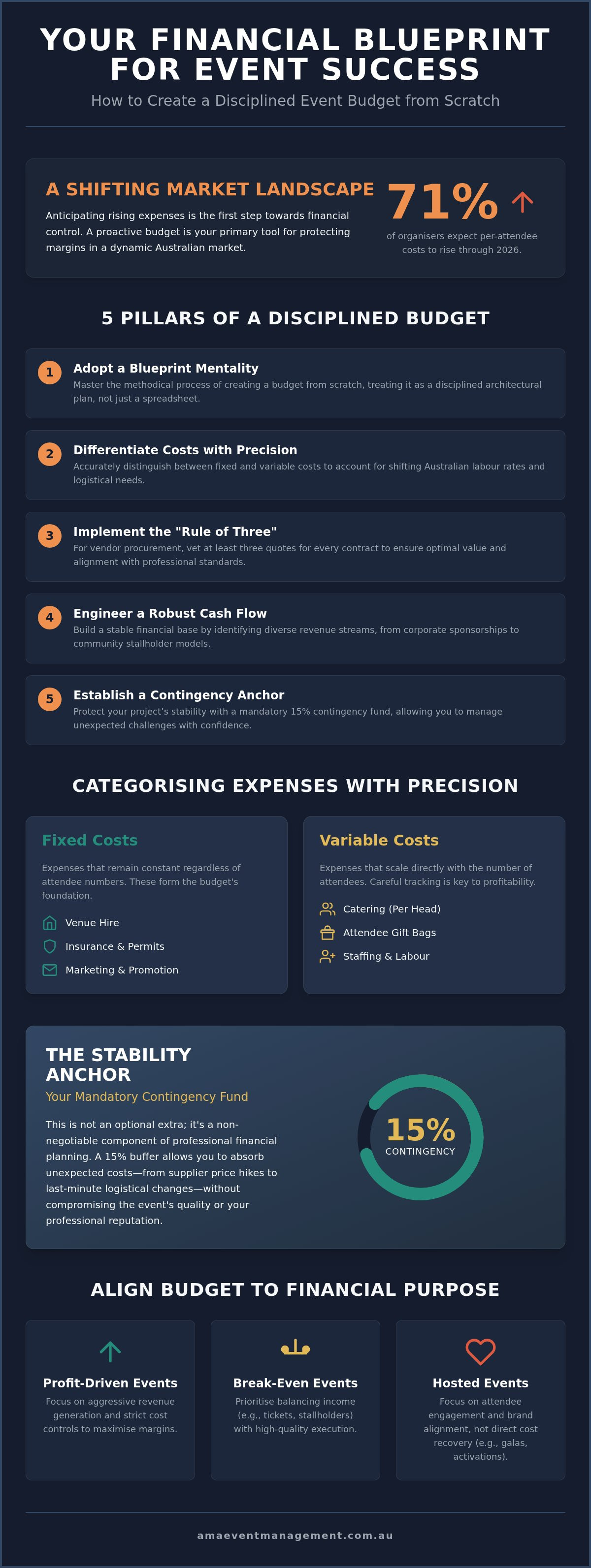
71% of event organisers expect per-attendee costs to rise throughout 2026, yet many still approach their finances with guesswork rather than a blueprint. Learning how to create an event budget from scratch is the only way to protect your margins and your professional reputation in a shifting market. It's the difference between a project that feels chaotic and one that proceeds with quiet, disciplined confidence.
We understand the pressure of staring at a blank spreadsheet while stakeholders demand certainty. It's natural to worry about fluctuating Australian market rates or the risk of a significant overspend. You need more than just a list of costs; you require a meticulous financial framework that provides the security for your creative vision to flourish. This guide offers exactly that, positioning you as the composed architect of your event's fiscal health.
You'll gain a clear, sequential roadmap for financial planning that builds confidence during vendor negotiations. We'll explore current industry benchmarks, essential budget categories, and the specific steps required to produce a professional budget that secures stakeholder approval. By the end of this guide, you'll have the tools to manage complex logistics with precision and ease.
Table of Contents
Defining the Financial Blueprint: Why Every Event Needs a Ground-Up Budget
An event budget is far more than a simple spreadsheet or a list of estimated costs. It functions as a disciplined architectural plan, providing the structural integrity required to support a high-pressure project from conception to completion. When you master how to create an event budget from scratch, you move away from reactive guesswork and toward a position of composed authority. This ground-up approach ensures that every dollar is intentional, preventing the "scope creep" and emotional spending that often derail less structured plans.
Starting from a blank slate is essential for identifying and eliminating past inefficiencies. Relying on last year's figures can lead to carrying over outdated vendor rates or unnecessary line items that no longer serve your objectives. A fresh financial roadmap provides a stabilising effect for stakeholders and event committees, offering them the security of a transparent, data-driven strategy. The field of Event management relies on this fiscal discipline to turn a conceptual vision into a tangible reality without compromising financial stability.
The Strategic Role of Financial Oversight
Identifying the Scope and Objectives
Before you can determine "how much" a project will cost, you must define the "why" behind it. Aligning your financial goals with the desired impact of the event is the first step in the construction process. Without this clarity, funds may be misallocated to areas that don't drive your primary objectives. Your approach will differ significantly based on the event's financial purpose:
Profit-driven events: Focus on aggressive revenue generation and strict cost control to maximise margins.
Break-even events: Prioritise balancing income from ticket sales or stallholders with high-quality execution.
Hosted events: Often corporate galas or brand activations where the focus is on attendee engagement and brand alignment rather than direct recovery of costs.
Understanding these distinctions ensures your resource allocation is both logical and effective. Learning how to create an event budget from scratch empowers you to defend your financial decisions with confidence when presenting to senior leadership or boards.
Categorising Expenses with Precision: Fixed and Variable Costs in Australia
Precision in categorisation separates an amateur list from a professional financial blueprint. When you determine how to create an event budget from scratch, you must first separate fixed costs from variable ones. Fixed expenses, such as venue hire, insurance, and marketing, don't change regardless of your final guest count. Conversely, variable costs like catering and gift bags scale with your attendance. In the 2026 Australian market, where 71% of organisers expect per-attendee costs to rise, this distinction is vital for maintaining your margins.
Professional corporate gala planners Sydney often manage these nuances to prevent budget blowouts. Understanding these moving parts is a key component of how to create an event budget from scratch that actually holds up under pressure. For ATO compliance, it's a best practice to calculate your budget using GST-exclusive figures. This allows you to see the true cost of services while keeping your tax obligations clear. However, you must account for the GST-inclusive total in your cash flow projections to ensure you have sufficient funds to settle invoices on time.
Core Expenditure Pillars for 2026
Your venue and site infrastructure represent your largest fixed commitment. This category goes beyond the basic hire fee to include security, cleaning, and power distribution. For those executing a themed brand activation Sydney, immersive styling and scenic construction are equally critical. These elements transform a space, but they require significant logistical oversight to execute safely and within code.
Technology and AV costs have evolved rapidly. With high-end production ranging from $10,000 to over $300,000, integrating strategic event planning ensures your tech spend aligns with your engagement goals. Whether it's multi-camera streaming for a 1,000-person conference or interactive tools for a gala, these costs must be locked in early to avoid last-minute rental premiums.
Accounting for Hidden "Budget Killers"
Small, overlooked expenses often create the most friction in a financial plan. In New South Wales, council permits and public liability insurance are non-negotiable for community-based festivals or outdoor activations. You must also account for freight and "bump-in" labour surcharges. These costs often spike during weekends or late-night shifts, which is a common reality in the 2026 Australian labour market. Finally, don't forget merchant fees and ticketing commissions. These small percentages can strip thousands from your revenue if they aren't factored into your initial calculations. Partnering with experienced event coordinators can help you identify these risks before they impact your bottom line.
Projecting Revenue and Managing Cash Flow for Stability
Sustainable events often rely on a tapestry of income sources to distribute financial risk. Sponsorship tiers shouldn't just be about logo placement; they should provide bespoke value to local partners, ensuring long-term viability. For community festival organisers Australia, stallholder fees are a vital revenue driver. By adopting models similar to the "Aussie Night Markets", where rental fees are collected upfront, you can secure early capital for essential site infrastructure. Additionally, government grants and local council funding in NSW and Queensland offer significant support for public-facing projects. When applying for these, you'll need to Create Your Event Budget with extreme precision, documenting every direct cost and personnel expense to satisfy strict acquittal requirements.
The Logic of Cash Flow Management
The Step-by-Step Construction: Assembling Your Financial Roadmap
Constructing a financial roadmap requires a methodical mindset that prioritises logic over impulse. When you begin the process of how to create an event budget from scratch, your first task is to establish a realistic baseline. This involves gathering historical data from previous years or identifying "best-guess" benchmarks from similar industry events if you are starting fresh. By grounding your initial estimates in documented reality, you provide a stable foundation for the more complex logistical decisions that follow.
The second phase of construction focuses on disciplined vendor procurement. You should strictly adhere to the "Rule of Three", which involves obtaining three comparable quotes for every significant service. This approach ensures that you compare apples to apples when evaluating contracts, allowing you to negotiate with the quiet confidence of a seasoned professional. It prevents over-reliance on a single supplier and ensures your project remains financially competitive from the outset.
Research-Based Estimation Techniques
In the current Australian market, per-head catering costs in Sydney or Melbourne typically range from $60 to $250 depending on the level of service required. For 2026 projections, it is essential to factor in a 10-15% inflation buffer to account for rising labour and supply chain costs. When reviewing these figures, you must clearly distinguish between "essential" line items, such as safety and core infrastructure, and "nice-to-have" elements like premium decor. This prioritisation allows you to make logical cuts if the initial total exceeds your stakeholders' expectations.
Organising the Master Spreadsheet
A master spreadsheet is the central nervous system of your event's financial health. It must utilise parallel structures, with dedicated columns for estimated costs, actual expenditure, and the variance between the two. This level of detail ensures you can identify potential overspends before they become critical issues. You should also implement a colour-coding system to flag urgent payment deadlines and deposit milestones. This visual organisation transforms a dense document into a living, real-time file that guides your daily decision-making.
Finally, once your roadmap is assembled, it is wise to have your figures reviewed by an expert. Consulting with a professional event management agency provides a final layer of security, ensuring no hidden logistics costs have been overlooked. This collaborative review process refines your plan, allowing you to present a polished, authoritative budget that is ready for stakeholder approval.
Professional Oversight: Ensuring the Budget Remains a Stabilising Force
Maintaining fiscal discipline throughout the project lifecycle is what distinguishes a successful organiser from an amateur. Learning how to create an event budget from scratch is only the first step; the true test lies in protecting that framework as the event date approaches. In 2026, the "Contingency Anchor" is a non-negotiable minimum of 15% of the total expenditure. This buffer isn't for poor planning. It's a strategic reserve designed to absorb market fluctuations or genuine emergencies. By treating this fund with the reverence it deserves, you ensure the budget remains a stabilising force rather than a source of stress.
When scenarios arise where costs exceed projections, you must respond with composed authority. This involves returning to your master spreadsheet to identify logical cuts. You don't slash randomly. Instead, you evaluate which "nice-to-have" items can be sacrificed to preserve the core objectives of the event. This methodical approach demonstrates to stakeholders that you are in full control of the financial narrative. When you understand how to create an event budget from scratch, you realise that the document is a promise of professional stability.
On-site supervision serves as the final line of defence. Last-minute unapproved expenses, often triggered by emotional decisions during the high-pressure "bump-in" phase, can quickly erode your margins. Strict oversight ensures that only pre-authorised costs are incurred, maintaining the integrity of the original plan. Once the event concludes, the budget transitions into the Final Financial Report. This document provides a transparent account of every dollar spent, turning your initial projections into a record of successful execution.
Managing the Contingency Fund
Tapping into the contingency fund requires a high level of transparency. You must communicate budget variances to stakeholders early, explaining the logic behind the expenditure rather than hiding it. The "Architect’s Rule" remains absolute: once the contingency is spent, it's gone. There are no additional safety nets. This reality reinforces the need for strict discipline during the procurement and execution phases, ensuring the fund is only used when strictly necessary.
The Value of Professional Budget Management
Partnering with AMA Event Management brings over 20 years of logistical precision to your bottom line. We leverage established vendor relationships across NSW and Queensland to secure commercial terms that are often inaccessible to individual planners. Our role as the meticulous architect of your event's finances doesn't end when the guests leave. We close the loop with thorough post-event reconciliation and ROI reporting. This process provides stakeholders with a professional Final Financial Report that proves the value of the investment, turning a complex expenditure into a documented success.
Achieving Fiscal Precision for Your Next Event
Mastering how to create an event budget from scratch is the foundation of any successful project. By treating your financial plan as a meticulous blueprint, you move beyond simple cost-tracking into the realm of strategic oversight. You've learned to categorise costs with precision, manage cash flow milestones, and protect your vision with a non-negotiable contingency fund. These steps ensure your event remains a stabilising force for stakeholders and attendees alike.
Professional execution requires a composed approach to complex variables. With over 20 years of industry-leading experience, we provide the expertise in high-pressure logistical execution needed to maintain absolute budget discipline. You don't have to manage these moving parts alone. Partner with the meticulous architects at AMA Event Management for your next event to benefit from our seasoned expertise and composed approach to complex budget management.
Your commitment to financial clarity today will define the success of your execution tomorrow. With a structured roadmap in hand, you're well-positioned to deliver an exceptional experience that meets both your creative and fiscal goals.
Frequently Asked Questions
How much contingency should I actually put in an event budget for 2026?
15-20% is the recommended standard for 2026. This accounts for sudden shifts in labour costs and supply chain volatility. While 10% was once common, the current economic climate in Australia requires a more robust buffer. Maintaining this higher reserve ensures you remain unfazed by unexpected logistics charges or equipment hire surcharges during the high-pressure "bump-in" phase. It provides the security needed for your creative vision to flourish without financial strain.
What are the most common hidden costs in Australian event planning?
Overlooked expenses frequently include council cleaning bonds, public holiday labour loading, and site-specific power distribution fees. Many organisers also forget to factor in credit card processing fees, which can impact revenue by 1.5% to 3%. In states like NSW and Queensland, specific security ratios, emergency management plans, and professional land surveying by firms like Hill & Blume are often required for public gatherings. These add significant line items that aren't immediately obvious when you first learn how to create an event budget from scratch.
How do I estimate costs when I have never organised this type of event before?
Start by identifying three similar events and requesting high-level quotes from reputable vendors to establish a baseline. Use industry benchmarks, such as per-attendee catering ranges of $60 to $250, to project your variable costs. If you are unsure of specific rates, it is wise to consult a seasoned expert who can provide historical data. This methodical research phase prevents the common error of underestimating complex logistical requirements when building a plan from the ground up.
Should I include GST in my event budget spreadsheet?
You should track both figures to ensure complete financial oversight. It is a professional standard to list individual line items as GST-exclusive to understand the true cost of services, but your final cash flow projection must account for the GST-inclusive total. This ensures you have sufficient funds to settle invoices while remaining compliant with Australian Taxation Office requirements. To achieve this level of fiscal precision across your entire operation, you can learn more about Cairns Quality Accounting. Clear separation of these figures prevents confusion during post-event reconciliation and ensures your reporting remains beyond reproach.
What is the difference between a fixed cost and a variable cost in event management?
Fixed costs remain constant regardless of attendance, such as venue hire, marketing, and public liability insurance. Variable costs fluctuate based on the number of guests, including catering, beverages, and delegate packs. Distinguishing between these categories is vital for understanding how your break-even point shifts if ticket sales underperform. This clarity allows you to adjust your spending logically rather than making reactive cuts that might damage the attendee experience or undermine your professional reputation.
How can I reduce my event budget without compromising the attendee experience?
Focus on optimising logistical efficiencies rather than cutting visible guest amenities. You can reduce costs by selecting a venue with existing AV infrastructure or by negotiating better commercial terms through consolidated vendor procurement. Another effective strategy is to review your "bump-in" schedule to minimise weekend labour surcharges. These disciplined adjustments protect the quality of the event while ensuring your financial roadmap remains sustainable and within the approved stakeholder limits, maintaining a polished and professional outcome.
How often should I update the event budget during the planning process?
Your budget should be treated as a living document that is updated at every major project milestone. At a minimum, you should reconcile your "estimated" vs "actual" columns weekly as vendor contracts are signed and deposits are paid. This regular oversight ensures that you identify potential variances immediately. Constant monitoring allows you to maintain a composed authority over the project's financial health, preventing small discrepancies from evolving into significant overspends as the event date approaches.
What is the best way to present an event budget to corporate stakeholders for approval?
Present your budget as a structured financial blueprint that aligns with the event's strategic objectives. Use clear, parallel columns to show projected revenue alongside anticipated expenses, and always include a dedicated section for your 15% contingency anchor. Highlighting your research-based estimation techniques builds stakeholder confidence in your figures. When you demonstrate how to create an event budget from scratch with this level of precision, you position yourself as a meticulous architect who is always several steps ahead.


Comments