

How to Manage Event Volunteers Through Better Communication and Support
A diverse volunteer team is easier to coordinate when everyone understands their role, knows who to approach and receives practical support. Knowing how to manage event volunteers effectively means planning recruitment early, matching people to suitable tasks, communicating clear expectations and providing role-specific training before event day.
It’s natural to focus on filling every shift, but a roster alone won’t keep an event team informed or supported. Volunteers also need clear communication with paid staff, a reliable point of contact and an environment where people with different skills and abilities can contribute.
This guide covers practical ways to coordinate volunteers, from recruitment and briefing to on-the-day support. You’ll learn how to improve staff communication, provide useful training, recognise volunteers’ contributions and build a diverse team that’s ready to work together.
Table of Contents
1. How Do You Successfully Manage Volunteers at an Event?
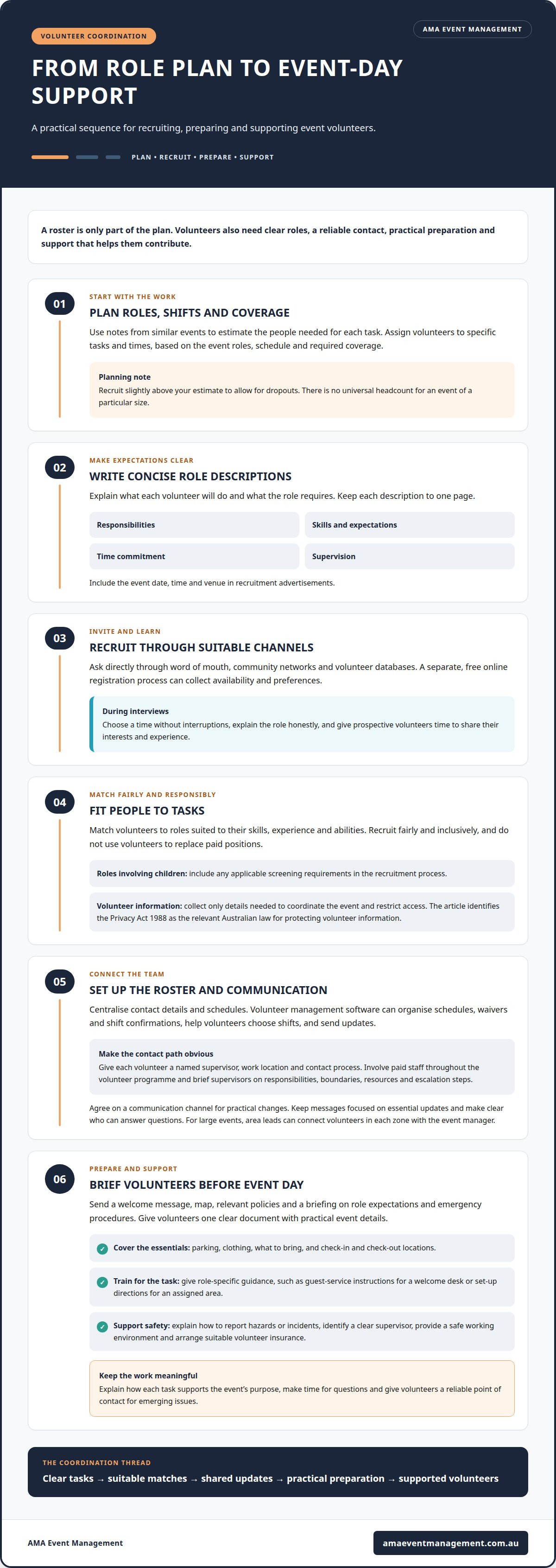
Start with a role plan, then allow enough time to recruit for every shift. Use notes from similar events to estimate the people needed for each task, and recruit slightly above that estimate to allow for dropouts. Staffing needs depend on the roles, event schedule and required coverage, so assign people to specific tasks and times rather than relying on a single headcount.
Write concise role descriptions that explain responsibilities, skills, expectations, time commitments and supervision. Keep each description to one page, and include the event date, time and venue in advertisements. Ask directly through word of mouth, community networks and volunteer databases. A separate, free online registration process can capture availability and preferences. Hold interviews without interruptions, explain the role honestly and give prospective volunteers time to describe their interests and experience.
Make recruitment fair and inclusive, match people to tasks suited to their skills and abilities, and avoid using volunteers to replace paid positions. For roles involving children, include any applicable screening requirements in the recruitment process. The Privacy Act 1988 is cited as the Australian law relevant to protecting volunteer information, according to the Federal Register of Legislation. Collect only the details needed to coordinate the event and restrict access to them.
Volunteer management software can organise contact details, schedules, waivers and shift confirmations in one secure place. It can help volunteers choose shifts and receive updates, while a central contact list makes direct communication easier. Before event day, send a welcome message, map, relevant policies and briefing covering role expectations and emergency procedures.
Support safety with role-specific instructions, a clear supervisor and a process for reporting hazards or incidents. Set out emergency procedures, provide a safe working environment and arrange suitable volunteer insurance. These steps help managers respond consistently if someone is injured, a hazard arises or an emergency disrupts normal operations.
There’s no universal headcount for an event of a particular size. Staffing depends on the roles, schedule and coverage required. Use estimates from similar events to plan for each task and shift, then recruit slightly above the estimate to allow for dropouts.
2. Communication between paid staff and volunteers
In Australia, recruit fairly and inclusively, then select volunteers against each role’s skills and expectations. Explain the commitment clearly and give each volunteer a named supervisor, work location and contact process. For example, a welcome message can identify the team lead and explain how to raise a concern before a shift begins. Knowing how to manage event volunteers effectively starts with these clear points of contact.
Involve paid staff throughout the volunteer program, not just on event day. Brief supervisors on volunteer responsibilities, boundaries, resources and escalation steps. Connect each task to the event’s purpose: explain that greeting guests helps them feel welcome, rather than simply telling someone to stand at an entrance. This context gives the role meaning and helps staff provide consistent direction.
Keep communication efficient by centralising volunteers’ email addresses and mobile numbers, then sharing updates through an agreed channel. A text thread for staff and volunteers can carry practical changes during an event, such as a new meeting point or delayed shift handover. Reserve it for essential updates and identify who can answer questions, so instructions don’t get lost. This is a practical way to manage event volunteers effectively when plans change.
For a large event, appoint area leads to link volunteers in each zone with the event manager. Leads can relay changes, report issues and confirm that each post is covered. Give volunteers one clear document with parking, clothing, what to bring, and check-in and check-out locations. Pre-event team meetings and a post-event debrief provide structured opportunities for questions and feedback.
Include appreciation in the communication plan. Acknowledge specific contributions, such as calmly redirecting guests when an entrance becomes busy. Ask for feedback during the debrief, explain how it informs future planning, and keep volunteers involved after the event. For community festivals and fairs, a clear staff-to-volunteer communication plan helps teams coordinate across event areas.
3. Training, support and development opportunities
Begin onboarding with the event’s purpose, then show how each volunteer’s duties support that goal. An orientation can cover the site layout, key contacts and how teams work together. Focus training on event-specific tasks: a welcome-desk volunteer needs guest-service guidance, while a set-up volunteer needs instructions for their assigned area. This provides practical preparation without overwhelming people with details they won’t use.
Assign a dedicated volunteer manager as the consistent contact for onboarding, training and emerging issues. Provide role-relevant guidance on safety, emergency response, dress expectations and communication with staff. Explain where to find policies and procedures, and make time for questions. Pairing a new volunteer with an experienced team member also offers practical support during their first shift.
Build the roster around volunteers’ availability and the work that needs coverage. Volunteer management software can help coordinate shift assignments, confirmations and changes, while letting volunteers choose suitable shifts. Overlap handovers so incoming volunteers can get a brief update before outgoing team members leave. If a shift changes, send the revised time and location through the established communication channel.
Support engagement with regular check-ins, useful feedback and specific recognition. Ask volunteers what went smoothly and where instructions or support fell short; use their feedback to improve the next briefing. Thank members for tangible contributions, such as helping guests find the right area or supporting a smooth handover. A personalised acknowledgement can make their contribution visible and connect it to the event’s success. Volunteering Australia’s National Standards for Volunteer Involvement include Standard 6, which focuses on a safe, supportive and inclusive environment. Put that principle into practice by listening to volunteers and responding to concerns promptly.
4. Creating diverse volunteer teams
A diverse team brings different skills, abilities and experience to event tasks. Start by mapping each responsibility, then identify what the role requires and what can be adapted. Guest welcome, information support and stock checks, for example, call for different strengths. Don’t assume that age, physical ability or previous event experience alone determines who can succeed in a role.
Recruit through a range of community channels and describe roles in plain, inclusive language. State the task, location, expectations and any physical requirements accurately, without overstating them. A role that involves standing can sometimes be divided into shorter duties or paired with a seated information role. Clear descriptions help people decide whether the work suits their skills and circumstances.
Design teams deliberately. Bring together different ages, physical abilities, skills and experience in small volunteer project teams. Pair a first-time volunteer with someone familiar with the task, and give both clear responsibilities. This supports knowledge-sharing and avoids placing every complex duty on the same experienced people. Aim for a team whose strengths complement one another.
Inclusion also depends on how the event is run. Provide accessible check-in details, explain where volunteers can take breaks and show them how to raise a concern. Invite feedback about barriers in a role or at the site, then adjust task allocation where possible. These steps make expectations clearer and help everyone contribute meaningfully.
Review the roster by task, not just total numbers. Check that each area has suitable coverage and that no volunteer is given responsibilities beyond their preparation or ability. A successful team is not measured by profit or speed alone; it depends on people understanding their contribution and being supported to carry it out. For help coordinating event teams, discuss your event planning needs.
AMA Event Management
AMA Event Management plans and coordinates events where clear roles, communication and support help teams work together. For community festivals and fairs, corporate conferences and galas, themed brand activations or bespoke private celebrations, organised event logistics can give staff and volunteers a clearer framework for event day. The team manages events across Australia, including in Sydney and Melbourne.
Bring volunteer coordination into the wider event plan early. Align responsibilities with the schedule, identify key communication points and consider how different teams will work together. This creates a more joined-up experience for volunteers, staff and attendees, rather than treating volunteer management as separate from the event.
Planning an event in Sydney or Melbourne? Contact AMA Event Management’s team of professional event planners to discuss coordinating your event.
Plan your next event with volunteer support in mind
Volunteer coordination works best when it’s part of the wider event plan, not an afterthought. Decide what a well-supported volunteer experience should look like, then build it into how teams, schedules and event operations come together. This gives volunteers a clearer role and helps organisers plan the support they need.
A practical approach to how to manage event volunteers effectively is to make communication and inclusion part of event design. Consider where volunteers will need guidance, how they can raise issues and how different skills can contribute. These decisions can improve the experience for the whole event team.
AMA Event Management can help coordinate event logistics across a range of event types. Contact AMA Event Management to discuss your event plans and the support you need. With a clear plan and thoughtful coordination, you can create the conditions for volunteers to contribute with confidence.
Frequently Asked Questions
How Do You Successfully Manage Volunteers at an Event?
Keep event-day coordination visible and respond promptly when plans change. If a queue builds near an entrance, for example, an area lead can alert the event manager, who can reassign available support and update the affected team. After the event, record what caused the issue and how the response worked. Use those notes to inform future planning.
What are the key steps for planning and organising event volunteers?
Start with the event schedule and map tasks that need volunteer coverage, including set-up, attendee support and pack-down. Use notes from comparable events to refine the plan, then assign each task a supervisor and communication route. Include practical arrival and site-access details in volunteer information. Review coverage as registrations come in and adjust assignments to address gaps or changing needs.
What volunteer training and briefing should happen before an event?
Prepare volunteers for situations they might encounter, not just their routine tasks. A check-in volunteer, for instance, can practise directing an attendee who arrives at the wrong entrance. Explain how to report an incident, request help and respond to updated instructions. Leave time for questions, then share essential updates through the agreed channel before the event begins.
What are the legal requirements for using volunteers at events in Australia?
Requirements depend on the volunteer’s role and the relevant state or territory rules, particularly for child-related activities. Organisations should provide volunteers with a safe working environment, arrange suitable volunteer insurance and avoid using volunteers to replace roles previously held by paid staff. The Privacy Act 1988 is cited as relevant to protecting volunteer information, according to the Federal Register of Legislation.
How should event organisers communicate with volunteers during an event?
Use a designated channel for operational updates and make the escalation route clear. For example, a team lead can report a blocked access point to the event manager, who can share the response with relevant staff and volunteers. Keep messages brief, state the location and action required, and confirm when the change takes effect. This helps prevent conflicting instructions during busy periods.
How can organisers measure volunteer performance and improve future events?
Review whether roles were covered, handovers completed and volunteers knew where to get help. Ask volunteers and supervisors for feedback after the event, then compare their observations with incident and attendance records. Note recurring gaps, such as unclear directions or uneven workloads, and assign someone to address each issue in the next planning cycle. This turns feedback into specific improvements.


Comments