

In-house vs outsourced event management: compare the costs
The lowest event quote can still result in a higher total cost. A useful in-house vs outsourced event management cost analysis includes internal staff time and the work delayed, as well as external fees. In-house planning may suit smaller, repeatable events; outsourcing can be more practical when logistics are complex or your team is stretched.
Keeping event planning in-house can seem more economical: your team knows the organisation and retains direct control. But planning takes employees away from core responsibilities, while external support brings its own fees and coordination needs.
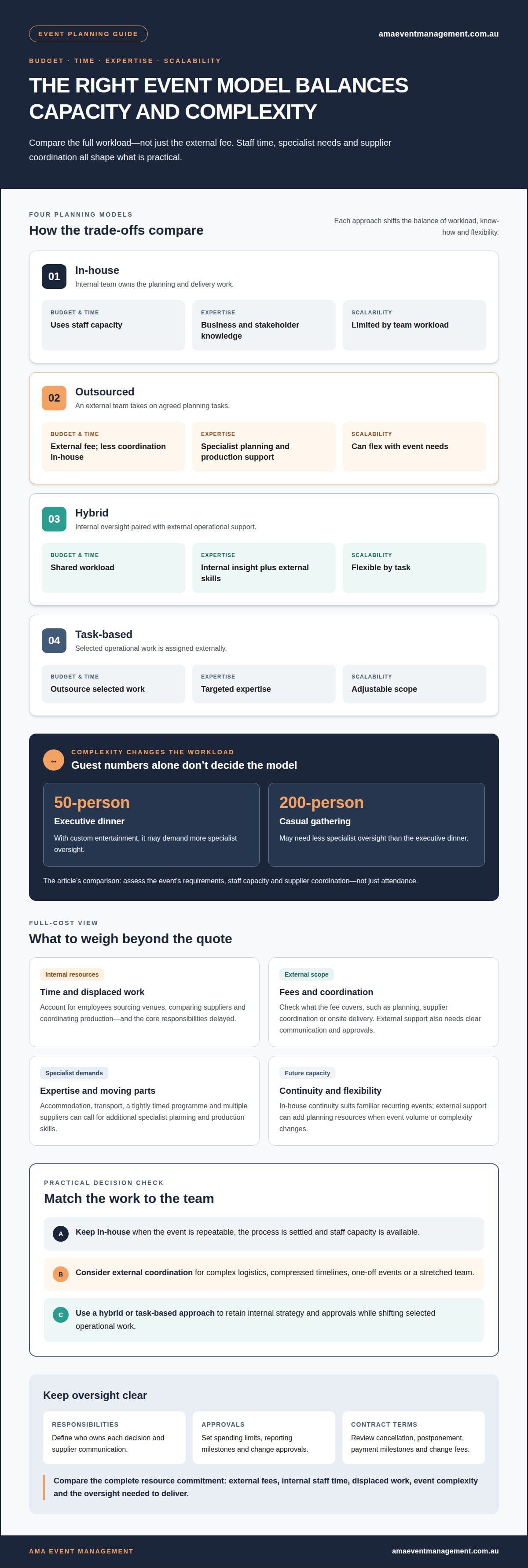
Compare the full costs, time commitment, expertise, scalability, return on investment and risks of each approach. A hybrid model can retain internal oversight while shifting operational work to an event team. The right choice depends not just on guest numbers, but on the event’s complexity, available staff capacity and the work that would otherwise be delayed.
Table of Contents
Budget, time, expertise, and scalability trade-offs
Compare the full commitment, not just the external fee. Staff capacity, event complexity and the guest experience all affect which model is practical.
Budget and time trade-offs
In-house planning avoids a separate management fee, but staff time still has a cost. Employees sourcing venues, comparing suppliers and coordinating production spend less time on core roles. That workload may be manageable for a recurring staff meeting in the same office. For a larger event, outsourced coordination may be a more practical use of internal capacity.
Scalability and contractor dependence
An in-house team offers continuity for recurring events, but its capacity depends on available staff time. Outsourcing can add planning resources when event volume or complexity changes, without building the same capability internally. The trade-off is reliance on an external team for delivery. A hybrid model can retain internal strategy while using external support during operational peaks.
Specialist planning expertise
Internal teams bring knowledge of company priorities, stakeholders and attendee expectations. They may need to develop additional expertise for complex requirements, such as accommodation, transport or a tightly timed program. An external team can contribute specialist planning and production skills. A 50-person executive dinner with custom entertainment may demand more specialist oversight than a 200-person casual gathering.
Agency expertise and supplier relationships
External event teams can bring supplier relationships and processes for coordinating multiple moving parts. This can streamline sourcing and align production details with the event brief. In-house staff may have closer relationships with internal stakeholders, while an event team can coordinate supplier communication. Clear responsibilities preserve strategic oversight and help deliver a consistent guest experience.
Match event complexity and staff capacity to the expertise and flexibility the work requires.
What is the cost difference between outsourcing and insourcing?
Outsourcing assigns agreed planning work to an external team; insourcing assigns it to employees. A useful in-house vs outsourced event management cost analysis compares staff capacity, event requirements and supplier responsibilities as well as fees. The cost difference depends on the scope and who manages delivery, not simply on whether an external quote is involved.
For a corporate conference, internal employees may understand stakeholder priorities and organisational processes particularly well. Keeping planning in-house can preserve that knowledge and limit access to sensitive business information. Outsourcing can bring dedicated coordination; a clear brief, restricted access and named internal approvers help maintain confidentiality and oversight.
Budget visibility and decision-making control
In-house teams can track commitments through their finance and procurement processes. Outsourcing changes who coordinates the work, but the business can retain approval authority through agreed spending limits, reporting milestones and change approvals. The in-house vs outsourced event management cost analysis should identify which costs need approval and who owns each decision. For example, require sign-off before a supplier change alters the approved event scope.
Agency pricing and contract terms
Australian event agencies may price work using a fixed fee, hourly rate, percentage or per-attendee charge. The price depends on the case and is provided after a quote request; event scope, complexity and assigned responsibilities shape it. Compare what the fee covers, such as planning, supplier coordination or onsite delivery.
Review contract terms for cancellation charges, postponement conditions, payment milestones and fees for changes. Check how the agreement treats supplier costs already committed if the event changes or is cancelled. Clear terms help the business understand its exposure and retain control over brand approvals and quality standards.
For events involving multiple suppliers, define internal approval points and a single contact for communications. This helps connect external execution with corporate priorities and gives employees a clear route to raise issues. Vendor coordination support can be a practical option when supplier communication needs structured oversight.
Who should outsource their event management?
Choose a planning model by matching operational demands with your team’s available capacity. An in-house vs outsourced event management cost analysis can show where internal ownership matters and where external coordination adds practical value.
Outsourced event planning
Outsourcing can suit a one-off public launch, a compressed timeline or a program involving several suppliers. An external team takes responsibility for agreed delivery tasks, allowing leadership to focus on business operations. The trade-off is less direct day-to-day involvement and the need for clear approval points. A useful in-house vs outsourced event management cost analysis weighs the coordination benefit against the external scope and internal oversight required.
Insourcing may suit a regular event with familiar suppliers and a settled process, such as a staff briefing in an established office. Employees can build continuity and retain immediate control. But this model is less practical when event tasks compete with essential operations or call for expertise the team rarely uses. Consider the time and capability needed to deliver well, not just the fee avoided.
Blended outsourcing models
A hybrid approach assigns specific tasks externally while the organisation retains strategic ownership. Internal leaders might set objectives and approve messaging, while an event team coordinates registration or transport. This focuses external support on a defined operational gap rather than transferring responsibility for the entire event. It can also preserve internal knowledge when stakeholder relationships shape the event’s purpose.
A hybrid team can adapt at each project stage. Employees might lead early planning and stakeholder decisions, then bring in execution support as supplier coordination expands. Agree on task ownership, communication channels and approval authority at the outset to prevent duplicated work between employees and external teams.
Use these checks to select a model:
Identify the event tasks and internal owners.
Map deadlines, supplier dependencies and skills required.
Decide which work can move outside without losing essential business context.
Keep leadership accountable for strategy, approvals and outcomes.
Choose the arrangement that supports delivery while protecting the capacity your core operations need.
Cost assessment, ROI projections, and risk assessment
Compare total delivery costs with the event’s intended business outcomes. Include internal resources, supplier commitments and execution risks in the same assessment.
Cost assessment and ROI projections
Set objectives before comparing models, such as attendee engagement, qualified leads or staff participation. Record relevant costs and choose measures that match each objective. For a marketing event, compare campaign spending with tracked enquiries or purchases. For an internal conference, assess attendance and feedback alongside staff time. This makes projected return more meaningful than judging savings alone.
Tax, GST and employment costs
For an Australian comparison, record GST on supplier invoices separately and account for any recoverable amount according to your organisation’s tax treatment. Include employee salaries and relevant employment on-costs, such as superannuation, workers compensation and payroll tax where applicable. Also consider recruitment, hiring time and onboarding when estimating in-house capacity. Compare like with like by distinguishing internal employment costs from an external team’s quoted scope.
Hidden outsourced costs and risks
Revisions, miscommunication and time-zone delays can increase coordination work or change delivery costs. Suppliers may also charge for work outside the agreed scope. For example, late changes to registration details or production requirements can create extra tasks. Document responsibilities, included revisions, approval points and change-control steps before work begins.
Assess event risks by mapping supplier dependencies, deadlines and decision owners. For a conference, identify who handles venue changes, production updates and attendee communications. Record each risk, its operational impact and who is responsible for escalation. This gives leadership a clearer view of coordination gaps that could affect delivery, the guest experience or the budget.
Discuss event management planning to map delivery requirements, budget controls and supplier risks.
AMA Event Management: Market Management and Vendor Coordination
AMA Event Management supports organisers who need coordinated delivery across vendors, public spaces or multiple event elements. Market Management and Vendor Coordination brings together vendor communication, stallholder logistics and event operations.
For public-facing programs, AMA Event Management’s Community Festivals and Fairs bring together event planning and community participation. Businesses developing an audience experience can consider Themed Brand Activations, while organisations planning a formal gathering can turn to Corporate Conferences and Galas. The right fit depends on the event’s purpose, scope and coordination needs.
Share your event requirements with AMA Event Management or visit AMA Event Management online.
Make your next event a clearer decision
Use your next planning cycle to turn the comparison into a practical decision framework. A disciplined in-house vs outsourced event management cost analysis helps leadership set priorities before making commitments, rather than judging the model after delivery. Record who owns each decision, which outcomes matter most and how the team will capture lessons for future events.
Choose a model that fits the event’s needs and your organisation’s capacity. Keep the approach proportionate: retain responsibilities that benefit from internal knowledge and seek external coordination where it supports execution. This gives your team a clear starting point for planning, approvals and reviewing results.
If you’re shaping an upcoming event, contact AMA Event Management to discuss your requirements. A considered conversation can help clarify the scope and coordination approach for your event. Move forward with a plan your team can assess, refine and build on.
Frequently Asked Questions
Should your business outsource or not?
Outsource when your team lacks the capacity or specialist skills to deliver an event effectively. Keep planning in-house when events are routine and employees can manage them without disrupting core work. For example, a one-off product launch across Sydney and Melbourne may need more external coordination than a recurring internal meeting. Match event demands with available capability and oversight to decide.
What is insourcing?
Insourcing means using your own employees and resources to plan and deliver an event instead of engaging an external event management team. A business might assign its marketing team to coordinate a product launch, with finance approving spend and operations managing logistics. The organisation retains direct responsibility for planning decisions, supplier communication and delivery, using its existing staff and processes.
What type of business would not be suitable for insourcing?
Insourcing may not suit a business when employees lack the time, event experience or systems needed for the requirements. For instance, a small team organising a public launch with several suppliers may struggle to manage delivery alongside its usual responsibilities. It can also be a poor fit when event work is occasional and maintaining specialist capability internally would leave staff capacity underused.
What does in-house event management cost in Australia, including salaries, superannuation and overheads?
There is no single Australian cost figure because the total depends on who does the work and how much time they commit. Include the relevant share of salaries, superannuation, workers compensation, payroll tax where applicable, recruitment, onboarding, equipment and software. Also account for core duties delayed while employees plan the event. This gives a fuller picture than salary alone.
What are typical outsourced event management fees in Australia?
External fees may be structured as a fixed fee, hourly rate, percentage or per-attendee charge. The amount depends on the agreed scope, event complexity, level of coordination and responsibilities assigned to the event team. A quote for venue coordination alone differs from one covering planning, suppliers and on-site delivery. Compare inclusions and exclusions, not just the headline fee, when assessing value.
What event costs are included in in-house versus outsourced management quotes?
In-house estimates commonly include staff time, employment on-costs and internal planning tools. An external quote may cover management work, while venue, catering, production, travel and other suppliers may be charged separately. For a fair comparison, list each event expense once, identify who pays it, and separate management fees from supplier charges and optional additions.



Comments