

Interactive Conference Ideas Sydney: How to Engage Modern Audiences in 2026
Forced icebreakers and gimmicky team games don't create genuine engagement; they simply drive senior delegates straight to their laptops. When curating sophisticated interactive conference ideas Sydney professionals will actually respect, corporate organisers often face a frustrating dilemma. You know the risk of traditional, slide-heavy presentations where audiences quietly tune out, yet the thought of forced social exercises risks alienating executive leaders and derailing tight production schedules across complex convention spaces.
Authentic audience connection doesn't stem from theatrical novelty. It is achieved through methodical logistical architecture that gives attendees purposeful reasons to contribute. In this guide, you'll discover logistically sound interactive conference formats that elevate delegate participation across premier Sydney venues without awkward gimmicks. We will examine structured collaboration models, intentional floor plans, and disciplined run sheet controls designed to keep attendance high and reinforce your core commercial messaging from the opening address to the final session.
Table of Contents
Why Traditional Sydney Conferences Fail to Engage Delegates
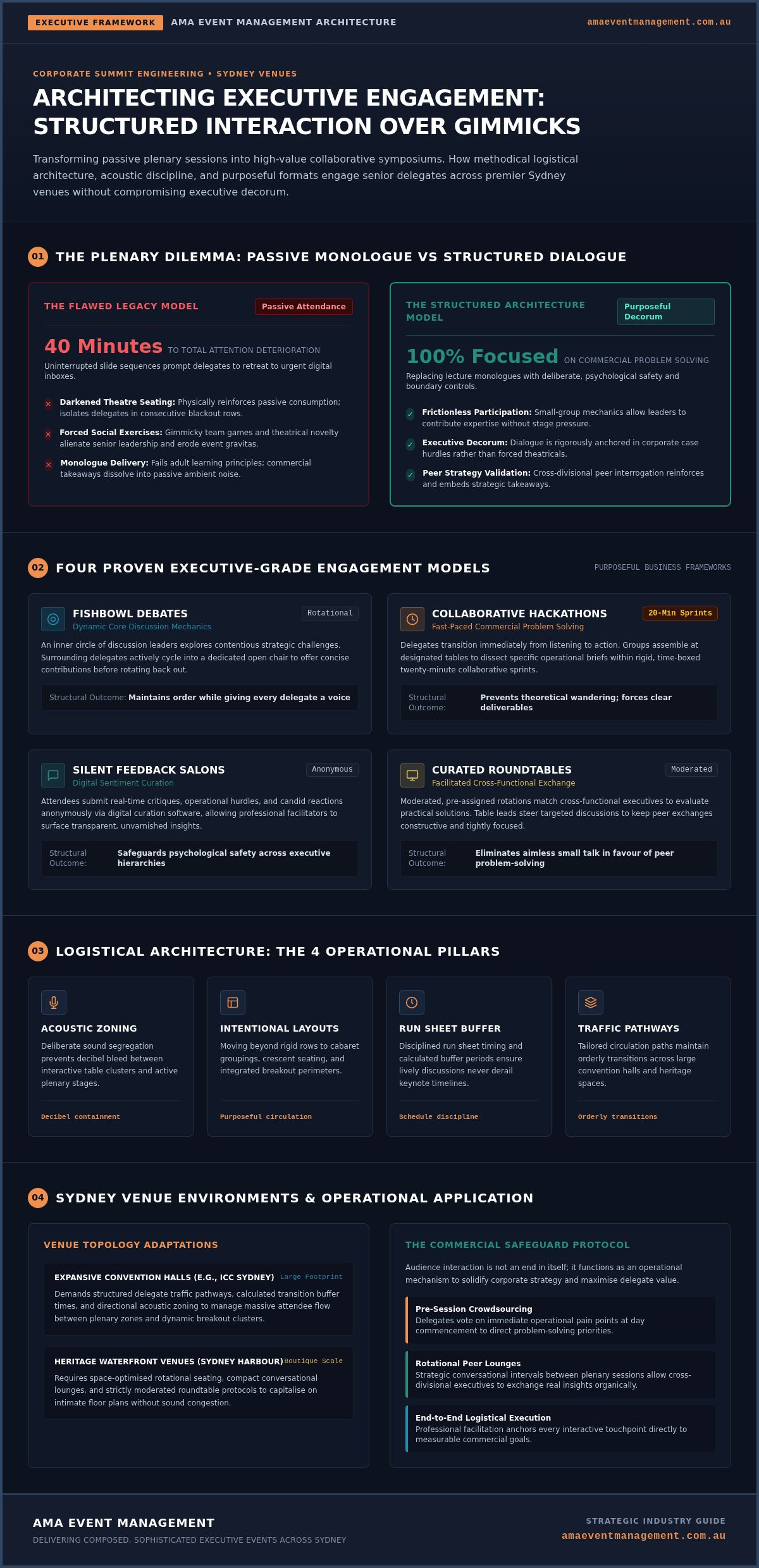
Corporate gatherings across Sydney frequently default to relentless rows of theatre seating facing a dimly lit podium. After forty minutes of uninterrupted slides, attention inevitably deteriorates. Delegates glance down at urgent inboxes, cognitive fatigue sets in, and key commercial takeaways dissolve into passive background noise. Sifting through high-calibre interactive conference ideas Sydney organisers can deploy starts with diagnosing why old delivery formats no longer work. Modern professionals don't travel to premier venues simply to consume static slide decks they could skim in an executive summary.
The Problem with Passive Plenary Formats
Monologue-driven agendas consistently ignore how adult professionals process complex information. When delegates sit isolated in the dark for consecutive hours, digital distractions rapidly overtake the room. The challenge isn't a lack of discipline among attendees; it's the design of the environment. Passive listening fosters rapid disengagement, whereas structured peer dialogue encourages attendees to interrogate strategies, validate ideas, and retain core takeaways long after the final session concludes.
Balancing Professional Decorum with Active Participation
Addressing delegate passivity doesn't mean subjecting senior personnel to cringe-worthy games or boisterous party theatrics. Forced extroversion generates immediate friction, alienating introverted executives and eroding the gravitas of a strategic summit. Real engagement relies on psychological safety, thoughtful floorplans, and clear boundaries, drawing inspiration from structured models like the participant-driven unconference where delegates guide meaningful discussions without chaotic free-for-alls.
A sophisticated engagement framework requires deliberate planning that respects professional decorum:
Frictionless participation: Designing small-group discussion mechanics that allow leaders to share expertise without mandatory stage performances.
Strategic relevance: Anchoring every collaborative touchpoint to commercial problem-solving rather than superficial icebreakers.
Facilitated boundaries: Providing professional facilitators and clear ground rules so conversations remain constructive and on schedule.
Executing high-impact interactive conference ideas Sydney delegates will genuinely embrace demands this precise balance. By removing the cognitive burden of one-way lectures and protecting professional dignity, you establish an environment where meaningful business collaboration flourishes naturally.
Sophisticated Interactive Formats for High-Impact Agendas
Elevating a corporate summit requires moving past trivia games and building blocks. High-performing interactive conference ideas Sydney businesses select must match the maturity of their executive delegates. When dialogue is anchored in purposeful business frameworks, leaders readily contribute their perspectives without fear of artificial social pressure. Replacing one-way speeches with structured, high-value formats transforms passive observers into engaged contributors.
Four proven, executive-ready engagement models include:
Fishbowl debates: An inner ring of discussion leaders explores contentious industry challenges while surrounding delegates rotate into an open chair to contribute concise viewpoints.
Fireside collaborative hackathons: Delegates transition from listening to problem-solving, breaking into tables to tackle specific commercial briefs within rigid twenty-minute sprints.
Silent peer feedback salons: Attendees anonymously submit reactions, case hurdles, or strategic critiques via digital curation tools, allowing facilitators to surface honest room sentiment.
Curated knowledge-swapping roundtables: Moderated, small-group rotations match cross-functional executives to evaluate practical solutions without descending into aimless chatter.
Peer-Driven Knowledge Sharing and Unconference Models
Structuring crowd-sourced breakout sessions allows participants to vote on immediate operational pain points at the start of the day. Dedicated table leads then steer rapid problem-solving sprints around those priorities. By scheduling rotational conversation lounges between major agenda blocks, cross-divisional peers exchange operational insights in comfortable, focused settings that feel organic rather than forced.
Digital Collaboration without Technological Dropouts
Academic research on event technology and attendee experience underscores that digital tools must reduce friction, not introduce disruptions. Moderated live polling steers plenary discussion directions without risking off-brand remarks appearing on the main screen. Digital mind mapping collates collective ideas in real time. Planners should also maintain structured physical collation cards at every table, providing a dependable analogue backup if local Wi-Fi networks encounter sudden latency issues.
Designing Immersive Physical Activations
Engagement extends beyond the formal plenary room into foyer lounges and transition spaces. Thoughtfully planned sensory breakout zones stimulate curiosity during morning tea without causing timing bottlenecks. If you want to integrate tactile installations that reinforce key business themes, exploring the creative principles behind themed brand activation Sydney offers clear blueprints for merging physical design with corporate storytelling.
If you're seeking to implement these sophisticated interactive conference ideas Sydney wide, partnering with AMA Event Management ensures every collaborative module runs with composed logistical precision.
The Logistical Architecture Behind Seamless Audience Interaction
An interactive agenda introduces dynamic variables that static slide presentations never face. When participants begin conversing, moving, and debating, schedule slippage becomes a genuine operational hazard. The successful execution of ambitious interactive conference ideas Sydney organisations plan hinges entirely on backstage governance. Without systematic floor plans and precise run sheet controls, collaborative energy quickly deteriorates into production chaos.
Rigorous Run Sheet Discipline and Buffer Planning
Unstructured discussions routinely overrun. Experienced production managers protect plenary timings by embedding five-minute operational buffers directly around every collaborative block. Digital stage monitors provide discreet visual countdown cues to facilitators, allowing them to conclude open debates gracefully without verbal interruptions. Detailed run sheets should also feature predefined compression points, enabling the team to absorb minor delays without compromising scheduled meal breaks or closing addresses.
Acoustic Zoning and Audio-Visual Infrastructure
Delegate collaboration collapses if participants can't hear one another clearly. Roving microphone runners or throwable audio cubes keep audience contributions brisk, eliminating awkward pauses while hand-held units traverse the room. In shared convention halls, sound bleed between breakout groups creates immediate cognitive friction. Integrating directional sound arrays, localized acoustic baffles, and deliberate lighting shifts allows technicians to signal transitions intuitively and isolate working clusters.
Deliberate spatial architecture prevents physical bottlenecks when delegates transition between plenary listening and peer collaboration:
Maintained thoroughfares: Ensure aisle clearances measure at least two metres wide to support fluid crowd movement toward workshop tables.
Acoustic separation: Position simultaneous breakout pods across diagonal axes of the room to minimise cross-table vocal interference.
Dedicated floor direction: Deploy professional floor managers whose sole focus is coordinating group rotations and keeping the agenda moving precisely to time.
Delivering interactive conference ideas Sydney executives appreciate requires this style of quiet, methodical operational control behind the scenes, ensuring high participation never comes at the expense of schedule integrity.
Tailoring Interactive Concepts to Premier Sydney Venues
Every commercial venue across Sydney presents distinct spatial strengths and architectural constraints. Successfully adapting interactive conference ideas Sydney delegates respect requires tailoring session formats to the host environment. A concept designed for an expansive Darling Harbour auditorium cannot be dropped unmodified into a heritage waterfront warehouse without creating operational friction.
Convention Centre Scale: Managing High-Volume Delegate Flow
Vast exhibition and plenary spaces, such as those within the International Convention Centre (ICC) Sydney, can feel impersonal if left undivided. Partitioning cavernous halls into smaller, modular conversational pods allows small working groups to focus without losing the energy of the wider summit. Coordinating synchronized digital wayfinding signage schedules guides hundreds of delegates smoothly between concurrent sessions, preventing lobby bottlenecks. Mastering these large-scale movements mirrors the complex site orchestration outlined in our guide to corporate gala planners Sydney.
Boutique and Heritage Venues: Working Around Spatial Constraints
Historic harbourside venues like Doltone House at Jones Bay Wharf offer unmatched character, yet their original structural pillars and narrow floor layouts demand creative floor plan adaptation. Traditional theatre seating in these spaces creates compromised sightlines that discourage active involvement. Adjusting room layouts to crescent cabaret configurations opens sightlines and makes small-group discussion natural.
Strategic spatial techniques for boutique settings include:
Embracing natural aspects: Transitioning delegates to outdoor harbour verandas for mid-afternoon peer reflections, using natural daylight and maritime breezes to combat afternoon cognitive fatigue.
Custom audio placements: Distributing compact low-throw speakers around heritage timber beams to ensure crystal-clear acoustic coverage without ugly cabling clusters.
Compact breakout hubs: Utilising perimeter alcoves as standing consultation nooks for rapid, fifteen-minute tactical discussions.
Executing interactive conference ideas Sydney wide also demands navigating CBD loading dock curfews, freight elevator bookings, and traffic windows. Managing these technical details ahead of time protects your schedule on event day. To seamlessly tailor your agenda to your chosen venue, contact AMA Event Management to coordinate your conference architecture and on-site logistics.
Executing Interactive Excellence with AMA Event Management
Executing sophisticated interactive conference ideas Sydney organisations demand requires more than creative intent; it necessitates rigorous operational governance. When an interactive session begins, the predictable structure of a traditional lectern disappears. Over twenty years of continuous Australian event industry management experience positions AMA Event Management as the stabilizing foundation for high-stakes corporate gatherings, ensuring audience engagement never compromises production standards.
The Architect’s Approach: Methodical from Brief to Execution
Flawless execution begins well before delegates enter the venue. Our process starts with an in-depth strategic briefing to evaluate your attendees' professional seniority, business objectives, and engagement thresholds. From there, we design structured floor layouts, acoustic zones, and granular run sheets that account for every technical cue, lighting shift, and room transition. On-site, our team delivers calm, disciplined floor management that maintains momentum while keeping agendas precisely on schedule.
Delivering Composed, High-Impact Conference Environments
Live audience participation introduces operational variables that demand constant vigilance. Our production managers maintain strict oversight across audio-visual crews, spatial staging teams, and venue operators to ensure technical infrastructure supports delegate dialogue without dropouts or delays. By managing these complex logistics, we eliminate operational anxiety, allowing your steering committee to step away from operational firefighting and participate meaningfully alongside delegates.
Our approach to conference management is anchored in disciplined project delivery:
Strategic alignment: We ensure every collaborative format directly reinforces your core commercial narrative rather than functioning as disconnected entertainment.
Production governance: We manage multi-vendor staging, audio-visual routing, and seating transitions with second-by-second precision.
Reputational protection: We deliver dignified, boardroom-appropriate environments that safeguard executive gravitas.
Bringing ambitious interactive conference ideas Sydney businesses envision into reality requires seasoned oversight. Applying the exacting attention to detail honed as a leading bespoke private event planner Sydney corporate leaders trust, AMA Event Management transforms standard agendas into polished, high-impact conferences that leave lasting commercial value.
Architecting High-Impact Conferences for 2026 and Beyond
Transitioning away from passive lectures toward structured peer exchange is essential for modern business gatherings. When you replace static monologues with disciplined collaboration, delegates stay focused, commercial strategies translate into practical outcomes, and executive gravitas remains intact. Achieving this standard requires meticulous planning. Every seating arrangement, acoustic boundary, and run sheet buffer must work in concert to protect your timeline while fostering natural dialogue.
Executing ambitious interactive conference ideas Sydney attendees value ultimately depends on composed production governance. Backed by over two decades of corporate event management and logistics across New South Wales, our team delivers calm, disciplined operational oversight from initial spatial design right through to live pack-down. We eliminate technical friction and scheduling anxiety so your steering committee can participate with complete confidence. Collaborate with AMA Event Management to design a composed, engaging Sydney conference that inspires your delegates and achieves your strategic business goals.
Frequently Asked Questions
How can we make our Sydney corporate conference interactive without feeling unprofessional?
Anchor every interactive touchpoint in structured business problem-solving rather than casual games or novelty icebreakers. Implementing formats like fishbowl discussions, moderated live polling, and curated peer roundtables keeps the focus strictly on commercial outcomes. This methodical approach respects professional decorum, protects executive gravitas, and encourages meaningful contribution without putting attendees into uncomfortable situations.
What interactive conference ideas work best for introverted executive delegates?
Formats that combine digital curation, silent brainstorming, and small-table problem-solving work best for introverted leaders. Digital platforms allow executives to submit anonymous questions, vote on strategic themes, and review peer responses without public speaking pressure. Integrating these thoughtful interactive conference ideas Sydney wide ensures analytical minds contribute valuable insights without mandatory stage performances.
How do you keep interactive breakout sessions on time during a tight conference schedule?
Maintaining schedule integrity requires dedicated floor managers, visual countdown timers, and built-in five-minute transition buffers. Facilitators should receive discreet visual prompts from stage monitors rather than vocal interruptions to wrap up group dialogue. Run sheets must also incorporate predetermined compression points, allowing production teams to absorb minor discussions without delaying scheduled meal services or plenary keynotes.
Which audio-visual equipment is essential for running interactive conference sessions?
Critical infrastructure includes low-latency throwable microphones, roving units, directional sound arrays, and synchronized digital display screens. Throwable microphones maintain conversational momentum by moving rapidly between delegates, while zoned speaker arrays prevent cross-room sound bleed during simultaneous group work. Programmable lighting consoles are also vital to signal room transitions between plenary addresses and collaborative workshops visually.
Can large plenary rooms at venues like ICC Sydney support interactive formats?
Large plenary halls can readily accommodate interactive sessions by subdividing the vast floorplate into modular collaboration zones. Arranging seating into crescent cabaret tables, deploying localized acoustic baffles, and installing repeater monitors transforms expansive spaces into functional discussion pods. When supported by clear digital wayfinding and structured aisle paths, cavernous venues maintain intimate, focused peer exchange.
What is the ideal group size for collaborative conference workshop tables?
The optimal group size for conference collaboration is five to seven participants per table. This ratio ensures every executive has ample opportunity to contribute without discussions splintering into side conversations. Groups larger than eight tend to encourage passive listening, whereas tables smaller than four occasionally lack the diversity of functional experience needed for robust strategic debate.
How far in advance should we plan interactive technology and floorplans for a Sydney conference?
Corporate organisers should finalize technical requirements, interactive conference ideas Sydney floorplans, and spatial styling four to six months prior to the event. This window accommodates thorough venue walkthroughs, acoustic zoning tests, and customized AV infrastructure design. It also leaves sufficient time to brief professional facilitators and rehearse timing sequences with production crews.


Comments