

Local Market Coordination Guide for Australian Communities
- Ever After Expo
- 4 days ago
- 11 min read
A thriving community market is not a product of luck; it is a masterpiece of logistical architecture. You likely understand the weight of responsibility that comes with managing a public precinct, from the initial stallholder application to the final pack-down. It's common to feel stretched thin when balancing vendor expectations against the rigid demands of council compliance and site safety. When the administrative burden begins to overshadow the vision for the event, professional local market coordination services provide the necessary structure to restore order and focus.
This guide explores how a disciplined approach to coordination transforms local markets into seamless, high-traffic destinations. We'll show you how to navigate complex risk assessments with confidence and curate a vendor mix that keeps the community returning week after week. You'll learn the strategic steps required to transition from reactive troubleshooting to proactive management, ensuring your market remains a vibrant, safe, and profitable asset for your local area. By implementing these rigorous standards, you can achieve complete peace of mind while fostering a truly resilient community ecosystem.
Table of Contents
What are Local Market Coordination Services in an Event Context?
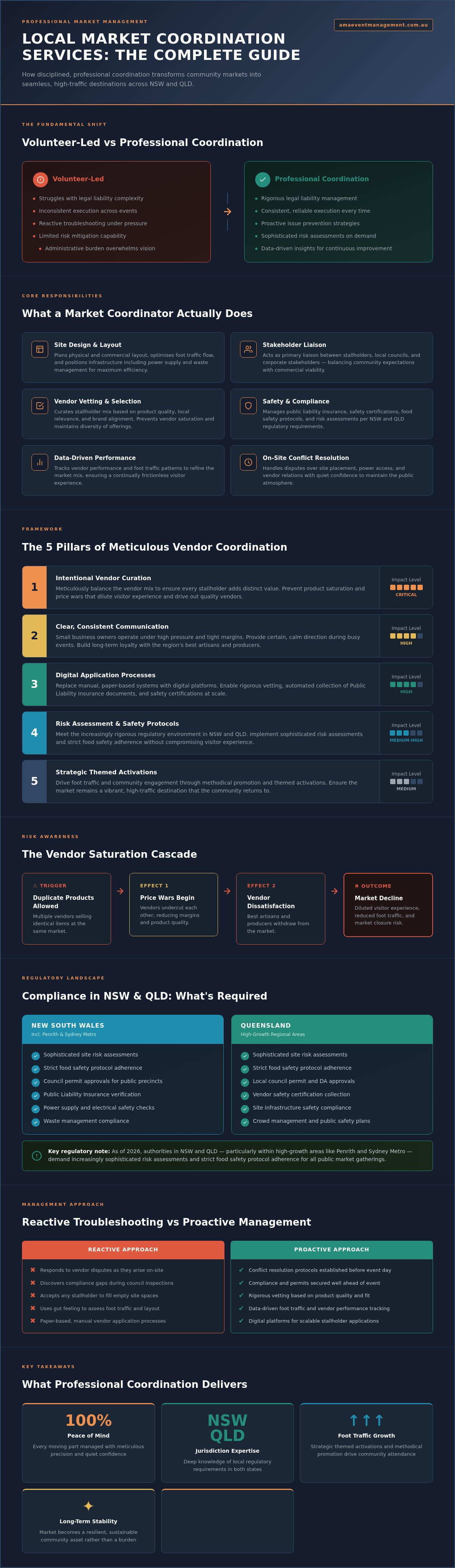
Professional local market coordination services extend far beyond the clerical task of assigning stall numbers. In an event context, this role functions as the structural backbone of a precinct, transforming a collection of individual vendors into a cohesive, high-performing ecosystem. While some may confuse this with NDIS support coordination, which focuses on individual health and disability plans, market coordination for events is a logistical discipline. It involves the strategic oversight of site infrastructure, vendor selection, and public safety. It's about being a stabilizing force in a complex environment.
Historically, many community markets relied on volunteer committees. However, modern councils and property developers are increasingly moving toward professional models. This shift is driven by the need for consistent execution and rigorous risk mitigation. A volunteer-led approach often struggles with the weight of legal liability and the complexity of modern compliance. Professional coordination provides a composed, reliable anchor; it ensures that every operational detail is handled with quiet confidence and meticulous precision.
The Role of a Market Coordinator
A coordinator acts as the primary liaison between stallholders, local councils, and corporate stakeholders. They don't just manage applications; they design the physical and commercial layout of the event. This includes selecting the optimal site, planning the flow of foot traffic, and ensuring all infrastructure, from power supply to waste management, is positioned for maximum efficiency. By balancing community expectations with commercial viability, they ensure the market remains a sustainable asset for the precinct rather than a logistical burden. Their oversight ensures that the unique character of the local area is preserved while meeting high professional standards.
Why Professional Coordination is Essential in 2026
As we move into 2026, the regulatory environment for public gatherings has become increasingly rigorous. Authorities in New South Wales and Queensland, particularly within high-growth areas like Penrith and the Sydney metropolitan region, now demand sophisticated risk assessments and strict adherence to food safety protocols. Professional coordination ensures these standards are met without compromising the visitor experience. It's a proactive approach to management that prevents issues before they arise.
Beyond safety, modern market management requires data-driven insights. Coordinators now track vendor performance and foot traffic patterns to refine the market mix. This methodical approach ensures a frictionless experience for visitors and provides stallholders with a stable environment where they can thrive. When the logistical moving parts are integrated seamlessly, the result is a vibrant, high-traffic event that feels effortless to the public.
The Pillars of Meticulous Vendor Coordination
Successful local market coordination services rely on the principle of intentional curation. A market that thrives long-term is one where every stallholder adds distinct value to the precinct ecosystem. If a coordinator allows a market to become saturated with identical products, the variety vanishes and price wars begin. This leads to vendor dissatisfaction and a diluted experience for visitors. By meticulously balancing the vendor mix, professional coordinators protect the commercial viability of each small business while ensuring the community enjoys a diverse range of high-quality offerings.
Maintaining clear communication is the foundation of professional vendor relations. Small business owners often operate under high pressure and tight margins. They require a coordinator who acts as a composed guide, providing certain direction even in the middle of a busy event. Conflict resolution on-site must be handled with quiet confidence. This ensures that disputes over site placement or power access don't disrupt the public atmosphere. This disciplined approach builds trust and encourages long-term loyalty from the region's best artisans and producers.
Streamlining the Stallholder Application Process
Modern management requires moving beyond manual, paper-based systems. Implementing digital platforms for night market stallholder applications allows for a more rigorous vetting process. Selection criteria should prioritise product quality, local relevance, and brand alignment with the specific theme of the activation. Automating the collection of Public Liability Insurance and safety certifications ensures that compliance is never an afterthought. This methodical oversight protects the event organiser and the public from unnecessary risk.
On-site Vendor Management and Logistics
The physical execution of a market requires precise timing and coordination. Methodical bump-in and bump-out procedures are essential to minimise disruption to local residents and existing retail businesses. A coordinator oversees the specific infrastructure needs of every participant, particularly for food trucks that require high-amperage power or specific waste disposal points. Professional on-site supervision remains constant throughout the event. This presence ensures that high standards of presentation and safety are maintained from the moment the first stall opens until the final vehicle leaves the site.
For those seeking a partner to manage these complex operational layers, engaging with an expert in market management and vendor coordination ensures a seamless delivery every time.
Navigating Compliance and Logistics in NSW and QLD
Operating a recurring community market across state lines requires a deep understanding of divergent regulatory frameworks. In New South Wales, the focus often centres on complex Development Applications (DA) or specific temporary event permits required by local councils. Similarly, Victoria maintains its own unique safety benchmarks for public festivals and community gatherings. Professional local market coordination services, such as those offered by AMA Event Management, act as the primary interface between your event vision and these rigid legal requirements. This oversight ensures that every permit is secured and every risk is mitigated before the first stall is ever erected on-site.
The role of a coordinator is to provide a sense of security in an environment where compliance is non-negotiable. This involves managing Public Liability Insurance (PLI) requirements for a diverse range of vendors and ensuring that the entire precinct is covered under a master safety plan. By acting as a stabilizing force, a professional coordinator allows stakeholders to focus on community engagement while the logistical and legal complexities are managed with quiet confidence.
Council Liaison and Permit Acquisition
Securing the right to operate in high-density precincts, such as Penrith or the Sydney metropolitan area, and in vibrant Melbourne locations, involves active negotiation with local government bodies. A coordinator addresses resident concerns regarding noise levels, traffic congestion, and waste management long before the event date. This process includes ensuring all food vendors strictly adhere to Australian Food Safety Standards and verifying that their specific state-based certifications are current. This proactive communication prevents the bureaucratic delays that often stall volunteer-led initiatives, providing a frictionless path to approval.
Site Safety and Risk Mitigation
Safety is the foundation of any successful public gathering. Developing a comprehensive safety plan involves mapping out emergency evacuation procedures and ensuring clear access for emergency services, including police and fire brigades. As we look toward 2026, managing crowd flow remains a priority to ensure a comfortable and secure environment for all visitors. A coordinator oversees the placement of every bollard, marquee weight, and electrical cable to eliminate potential hazards. In cases where permanent precinct upgrades require foundational civil works or erosion control, McMahons Civil and Contracting PTY LTD offers the specialized infrastructure support needed to maintain site stability. The meticulous architect approach to site safety ensures that every potential risk is identified, documented, and neutralised through disciplined planning and foresight.
By maintaining these rigorous standards, the coordination process transforms a high-pressure environment into a safe, well-ordered space. This methodical approach to logistics ensures that the market remains a resilient and trusted asset for the local community, regardless of the complexity of the precinct.
Strategic Promotion and Community Engagement
High foot traffic is the lifeblood of any precinct. While logistics provide the foundation, integrated local market coordination services ensure that the operational excellence of an event is visible to the public. Professional management involves more than just a social media post; it requires a strategic marketing plan that aligns with the specific character of the local area. By leveraging local partnerships and targeted digital campaigns, a coordinator builds a narrative of reliability and excitement that draws visitors from across the region. This proactive approach transforms a simple gathering into a landmark event on the community calendar.
Success is measured through precise engagement metrics rather than vague observations. This data-driven approach allows for the continuous refinement of future events. By tracking visitor patterns and vendor sales data, a coordinator can identify peak periods and popular categories. This methodical oversight ensures that the market remains a commercially viable destination for years to come. It provides the certainty that every marketing dollar spent is contributing to a measurable increase in precinct activity.
Creating Immersive Market Experiences
A standard market becomes a destination when it offers an immersive experience. Utilising themed brand activation Sydney strategies allows organisers to elevate the atmosphere through curated storytelling. This might include live acoustic performances, seasonal workshops, or bespoke installations that encourage visitors to linger. Designing specific moments for organic social sharing is a disciplined way to drive digital reach. This extends the influence of the market far beyond the physical site, turning every visitor into a potential advocate for the precinct.
Building Long-Term Community Bonds
Deep-rooted community engagement is built on trust and consistency. Supporting local small businesses through recurring markets NSW programmes fosters a sense of ownership among residents. When locals see their favourite artisans and growers returning each month, it creates a predictable rhythm that strengthens the community fabric. Collaborating with local schools for performances or providing space for charities further embeds the market into the local ecosystem. This collaborative partnership ensures the market is viewed as a vital community asset rather than a temporary commercial intrusion.
To ensure your next event achieves this level of community impact and commercial success, consider partnering with a specialist in market management and vendor coordination.
Partnering with AMA Event Management for Market Success
AMA Event Management brings over 20 years of industry experience to every precinct activation. This significant tenure provides a level of strategic foresight that only comes from managing hundreds of successful community events. When you engage our local market coordination services, you're partnering with a team that understands the intricate balance between community festivals and commercial logistics across New South Wales and Queensland. We act as a composed guide, navigating the high-pressure environment of market day with quiet confidence and a focus on high-level execution.
Our end-to-end service model ensures that no logistical detail is overlooked. From the initial conceptual design and site layout to on-site supervision and comprehensive post-event reporting, we manage every moving part. This disciplined oversight is what distinguishes a standard market from a premier precinct destination. Whether you require the meticulous touch of a bespoke private event planner Sydney or the strategic management of a large-scale public fair, our approach remains consistently polished. We pride ourselves on being the stabilising force that allows our clients to feel a genuine sense of relief and security throughout the planning process.
A Disciplined Approach to Event Logistics
Transparency is a core pillar of our operational philosophy. We provide professional fee structures that ensure total budget control and clear financial oversight from the outset. Our commitment to high standards is evident in the seamless execution of recurring markets and festivals across major Australian centres. These successful activations demonstrate our ability to handle complex infrastructure requirements, such as power allocation for food trucks and crowd flow management, while maintaining a frictionless experience. We value order and precision, acting as a reliable anchor for councils, developers, and local vendors alike.
Get Started with Your Local Market Project
Launching a successful market begins with a methodical consultation process. We take the time to align your vision with the logistical realities of the specific site and current council requirements in regions like Penrith or the Sydney metropolitan area. Every project is unique; therefore, we customise our services to fit the specific needs of your precinct and community. Whether it's managing complex stallholder applications or overseeing rigorous site safety protocols, our team is ready to provide the professional structure your event needs. Reach out to our team today to discuss a structured, professional approach for your next community project.
Elevating Your Community Precinct through Professional Oversight
Transforming a public space into a thriving hub of activity requires more than just a vision. It demands a disciplined architectural approach to logistics and a deep understanding of state-based regulations. By implementing professional local market coordination services, you ensure that every moving part, from stallholder compliance to precinct safety, is managed with quiet confidence. This methodical oversight not only protects your event from regulatory risk but also fosters a vibrant environment where local vendors can truly flourish and community bonds are strengthened.
With 20 years of industry-leading experience, we specialise in recurring markets across NSW and Queensland, providing composed, professional on-site supervision that guarantees a seamless experience. We manage the complexities of end-to-end planning so you can focus on the long-term growth of your precinct. It's time to partner with the meticulous architects of Australian markets at AMA Event Management. Your community deserves a market that is as safe and well-organised as it is vibrant and engaging.
Frequently Asked Questions
What exactly is included in local market coordination services?
Local market coordination services encompass the end-to-end logistical and administrative management of a precinct event. This includes site selection, curating vendor mixes, and managing council permit applications. We also oversee infrastructure requirements such as power and waste management. Our role is to act as a central anchor, ensuring every moving part integrates seamlessly to create a safe and profitable environment for the community.
How do professional coordinators select vendors for a community market?
We employ a disciplined curation process that prioritises quality, variety, and local relevance. Selection isn't random; we evaluate how each stallholder fits within the broader market ecosystem to prevent product saturation. This methodical approach ensures that vendors don't compete unnecessarily, which protects their commercial viability. We also verify that every participant aligns with the specific brand identity and aesthetic standards of the activation.
Can you help with the stallholder application process for night markets in NSW?
Yes, we manage the entire stallholder application process through streamlined digital systems. This involves collecting necessary documentation, such as Public Liability Insurance and food safety certifications, to ensure full compliance with NSW regulations. Our team reviews every applicant against your specific criteria, providing a rigorous vetting process that takes the administrative burden off your internal team while maintaining high standards.
What are the typical council requirements for starting a recurring market in Australia?
Typical requirements include securing a Development Application (DA) or a temporary event permit from the local council. You must also provide comprehensive risk assessments, traffic management plans, and waste disposal strategies. In states like NSW and Queensland, councils are particularly focused on food safety standards and noise mitigation for nearby residents. We handle these complex negotiations to ensure your recurring market meets every regulatory benchmark.
How do you ensure the safety of visitors and vendors at a large-scale market?
Safety is managed through a meticulous risk assessment and a comprehensive site safety plan. This includes defining emergency evacuation procedures and ensuring clear access for emergency services. We monitor crowd flow to prevent congestion and oversee the safe installation of all infrastructure, such as marquee weights and electrical cable protection. Our proactive oversight identifies potential hazards before they can impact the public or the vendors.
Do you provide on-site supervision for the duration of the event?
We provide constant on-site supervision from the start of bump-in until the final pack-down is complete. Our presence ensures that all vendors adhere to site rules and that any logistical issues are resolved with quiet confidence. This composed guidance is essential for maintaining order during high-pressure periods, such as vehicle movements or peak visitor times. It gives stakeholders complete peace of mind that the event is in expert hands.
What is the difference between a market coordinator and a general event planner?
While a general event planner manages a broad range of functions, a market coordinator specialises in the unique ecosystem of vendor management and precinct logistics. We focus specifically on the architectural design of the market floor, stallholder commercial viability, and the complex regulatory requirements of recurring public events. This niche expertise allows us to manage the delicate balance between community expectations and the practicalities of a busy market site.
How do you manage waste and traffic for a busy community festival?
Waste and traffic are managed through detailed, pre-approved operational plans that minimise local disruption. We coordinate with professional waste contractors to ensure consistent site cleaning and efficient removal of refuse. Traffic management involves deploying accredited controllers and implementing clear signage to guide both vendors and the public. By liaising with local residents and businesses early, we ensure the festival integrates smoothly into the existing precinct environment.


Comments