

Mastering Large Scale Public Event Logistics: The Architect’s Guide
- Ever After Expo
- Jul 29
- 12 min read
Updated: Aug 8
The success of a massive festival isn't measured by what the audience sees, but by the chaos they never notice. When you're responsible for large scale public event logistics, the margin for error is razor-thin. You likely understand the mounting pressure of ensuring public safety while navigating a complex web of local council regulations and permit requirements. It's common to feel overwhelmed by the sheer volume of moving parts, from coordinating hundreds of stallholders to managing crowd flow with absolute precision.
This article provides the methodical framework required to organise seamless, high-impact public events with composed authority. We'll move past the stress of last-minute fires and focus on a logical, architectural approach to planning. By following this guide, you'll gain the assurance that every regulatory checkbox is ticked and every vendor is aligned. We'll examine the essential steps for building a secure operational foundation, allowing you to lead your event day with quiet confidence and a clear strategic view.
Table of Contents
The Complexity of Large Scale Public Event Logistics
Managing large scale public event logistics is the disciplined integration of temporary infrastructure, rigorous safety protocols, and the fluid movement of people. It isn't merely about moving equipment from one point to another; it's the silent architecture that supports every successful gathering. In Australia, this task is uniquely demanding. A planner might start the morning accounting for a heatwave in Western Sydney and end it adjusting for a sudden coastal squall in Melbourne. This environmental volatility, combined with regional accessibility challenges, means that a "meticulous architect" mindset is the only way to prevent logistical collapse.
The shift from private event planning to high-stakes public engagement is significant. When an event moves into the public square, the responsibility expands from guest satisfaction to public safety. Every decision carries more weight because the variables are no longer contained within four walls. You're managing unpredictable weather, diverse crowds, and a complex web of local regulations that require a composed, strategic approach. Precision in the invisible details ensures success in the visible ones, and this transition requires a professional who is always several steps ahead.
The Definition of "Large Scale" in the Australian Context
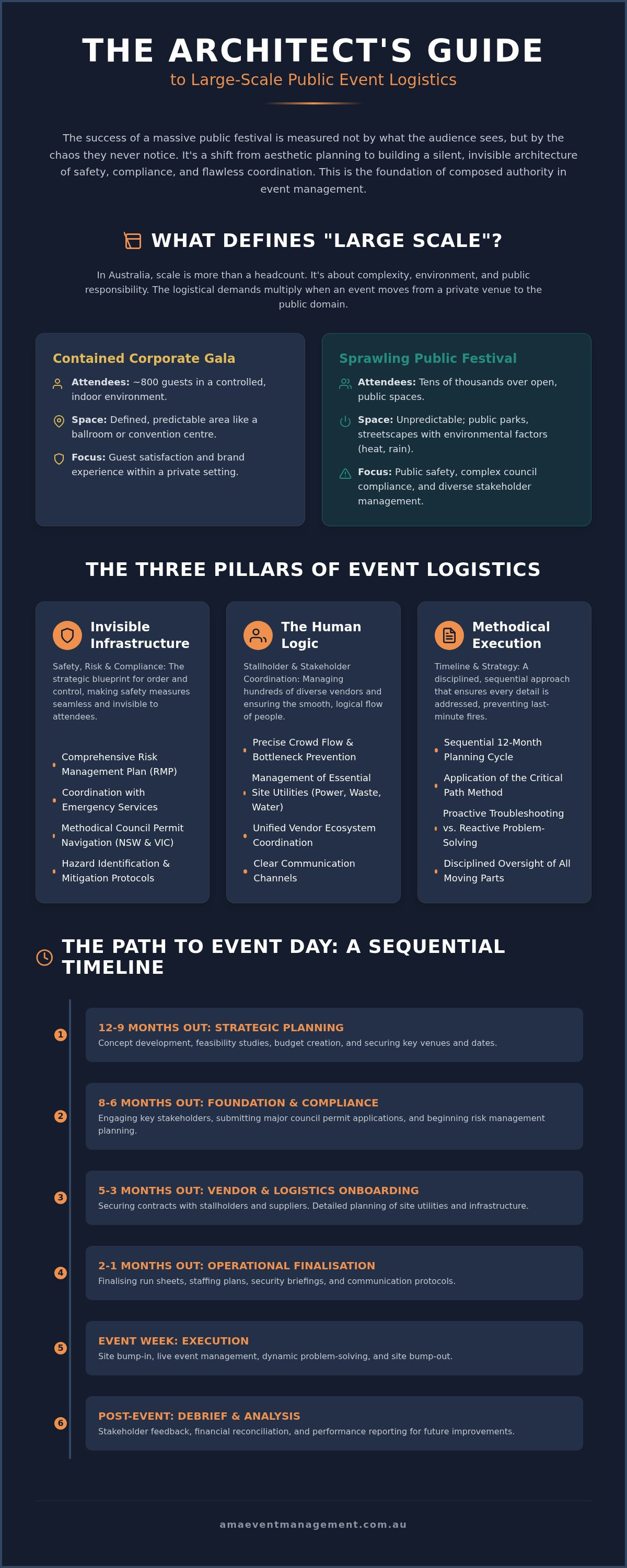
In the Australian events industry, "scale" is defined by more than just a headcount. While a corporate gala might seat 800 guests in a controlled ballroom, a sprawling community festival often occupies public parks and streetscapes, attracting tens of thousands of visitors over a weekend. These public gatherings trigger specific council requirements in cities like Sydney and Melbourne once attendee thresholds are met. To ensure these figures are accurately recorded for compliance, many organisers partner with Footfall Australia for advanced people counting solutions. The logistical requirements also change based on movement. A static trade expo in a convention centre follows a predictable flow, whereas a moving street parade requires a rolling perimeter and constant coordination with local authorities to manage human flow safely.
Why Logistics is the Stabilising Force of Any Event
It's easy to focus on the "aesthetic planning" of a themed brand activation, but the logistical architecture is what actually delivers the experience. Poorly managed logistics can quickly overshadow even the most creative vision. If vendors can't access power or if crowd bottlenecks form at entry points, the brand's reputation suffers. Professional event management acts as a stabilising force, providing a sense of certainty in a high-pressure environment. By maintaining composed authority over a complex vendor ecosystem, you ensure that every moving part—from waste management to site power—functions as one cohesive unit. This disciplined oversight allows the event's creative elements to shine without the distraction of operational fires.
The Invisible Infrastructure: Safety, Risk, and Compliance
The most successful events are those where the safety measures are so seamlessly integrated they become invisible to the public. In the context of large scale public event logistics, this invisible infrastructure is built on a foundation of rigorous compliance and risk mitigation. A comprehensive Risk Management Plan (RMP) isn't merely a box-ticking exercise for council approval; it's a strategic blueprint for maintaining order. It identifies potential hazards, from extreme weather to equipment failure, and establishes clear protocols for every scenario. This level of preparation allows for a sense of quiet confidence on the day. When the unexpected occurs, the management team remains a stabilising force, acting with the authority required to resolve issues before they escalate.
Effective safety planning often involves close coordination with Emergency Services Management of Large Events to ensure rapid response times and clear evacuation routes. Maintaining this level of oversight requires constant communication between security personnel, medical teams, and event directors. By prioritising these invisible systems, you create an environment where attendees feel secure without feeling restricted. For those managing recurring events, our Professional Community Market Management in Australia: A Strategic Guide offers deeper insights into vendor-specific safety standards and long-term compliance strategies.
Navigating Australian Regulatory Frameworks
Securing council permits in Sydney and Melbourne requires a methodical approach to documentation. Each jurisdiction has its own set of requirements, often involving detailed site plans, noise management strategies, and waste disposal programmes. You must also adhere to WorkSafe Australia standards, particularly regarding the installation of temporary structures like marquees and stages. Ensuring every vendor provides a current Certificate of Currency for Public Liability Insurance is a non-negotiable step in this process. This disciplined attention to detail protects the organiser, the vendors, and the public from unforeseen liabilities.
Crowd Dynamics and Traffic Management Plans (TMP)
Designing a site map that naturally guides human flow is essential for preventing bottlenecks and ensuring a positive attendee experience. A well-conceived Traffic Management Plan (TMP) addresses the logistics of "bump-in" and "bump-out" for hundreds of vehicles within busy urban centres. This requires precise scheduling to avoid congestion on local roads and coordination with transport authorities to manage increased public attendance. If you're currently planning a complex gathering, our team provides the disciplined oversight required for bespoke private celebrations and community festivals that meet all regulatory benchmarks.
Stakeholder and Stallholder Coordination: The Human Logic
While infrastructure provides the physical frame, the vendors and stallholders provide the lifeblood of a public gathering. Managing hundreds of independent operators simultaneously requires a system rooted in logic rather than emotion. In large scale public event logistics, the coordinator acts as a stabilising anchor, ensuring that diverse stalls align with the overall event architecture. This coordination extends far beyond stall placement; it involves the precise allocation of site power, waste management, and water access, particularly for food vendors who have strict operational requirements. When these utilities are managed with disciplined oversight, the risk of site-wide failure is mitigated, allowing the event to function as a cohesive whole.
To ensure all temporary electrical installations meet safety standards, check out A Plus Compliance Services for expert compliance support throughout Victoria.
Effective communication is the cornerstone of this process. Establishing clear channels before and during the event ensures that every stakeholder understands their role within the broader plan. It's about providing a sense of certainty to small business owners who are often operating in high-pressure environments. By acting as a proactive manager of these complex human interactions, you ensure that the creative energy of the stalls doesn't compromise the safety or flow of the public space. This methodical approach transforms a collection of individual vendors into a unified, high-impact brand activation.
The Lifecycle of a Stallholder Application
The journey from an initial enquiry to on-site placement follows a sequential logic. Successful vendor procurement starts with a rigorous vetting process, ensuring each applicant meets the necessary professional standards. At AMA, our expertise in high-volume stallholder applications allows us to streamline this lifecycle, managing specific requirements for regional night markets and community fairs with ease. We implement a clear "code of conduct" that every vendor must sign. This document sets the standard for presentation, safety, and professional behaviour, ensuring that every independent stall contributes positively to the event's reputation.
Balancing Council Expectations with Community Spirit
A seasoned event manager acts as a vital liaison between government bodies and local small businesses. Councils in Sydney and Melbourne have high expectations for compliance and community engagement, while stallholders often focus on the immediate needs of their trade. Bridging this gap requires a composed guide who can translate complex regulations into actionable steps for vendors. Ensuring community engagement events meet social objectives while remaining logistically sound is a delicate balance. For more on this strategic role, read The Architect’s Guide to Community Festival Organisers in Australia. This approach ensures that the "community spirit" of an event is supported by a robust, professional framework that satisfies all regulatory stakeholders.
Methodical Execution: A Sequential Timeline for Success
The successful execution of large scale public event logistics is never the result of a last-minute rush. It is the outcome of a disciplined, chronological roadmap that begins at least twelve months before the first attendee arrives. To maintain oversight of such a complex operation, we utilise the Critical Path Method (CPM). This architectural approach identifies every task that must be completed in a specific sequence to ensure the project stays on track. By understanding which tasks are dependent on others, such as securing a traffic management permit before finalising stallholder placements, you create a project timeline that is both predictable and resilient.
During the event itself, the focus shifts to centralised control through an on-site command centre. This is where the "Show Caller" oversees the minute-by-minute programme, acting as the single point of truth for all staff and contractors. This level of structure ensures that even in a high-pressure environment, every movement is intentional and coordinated. Once the event concludes, the methodical approach continues into the post-event phase. This involves site restoration to meet council standards, vendor acquittal processes, and detailed impact reporting. This final stage is crucial for maintaining long-term partnerships with local authorities and stakeholders.
Phase 1-3: Strategy, Procurement, and Permitting
The first six months are dedicated to defining the event architecture and securing the primary venue or site. Strategy involves more than just a vision; it requires a logical assessment of how the space will function. During this phase, vendor procurement is treated as a strategic exercise. We select a mix of stallholders that specifically appeals to the local demographic, ensuring the event feels relevant and engaging. Simultaneously, we initiate long-lead council applications and traffic management negotiations. In cities like Sydney and Melbourne, these regulatory processes can take several months to finalise, making early action a non-negotiable requirement for success.
Phase 4-5: The Final Countdown and On-site Execution
As the event date approaches, the timeline narrows to the "48-hour bump-in." This is a choreographed arrival of infrastructure, where every truck and marquee must be placed with centimetre-perfect precision. During this window, the event manager acts as a composed guide, overseeing the site with quiet discipline. Real-time problem solving becomes the priority, but because the foundation was built on a rigorous 12-month plan, these challenges are managed without panic. If you require this level of disciplined oversight for your next project, our team specialises in market management and vendor coordination for high-impact public gatherings.
The AMA Approach: 20 Years of Composed Event Excellence
AMA Event Management serves as the stabilising anchor for organisations facing the immense pressure of public gatherings. With 20 years of industry experience, we've developed a reputation for quiet confidence in environments where others might feel overwhelmed. Our approach to large scale public event logistics is built on the belief that no two event architectures are identical. We don't apply a one-size-fits-all template. Instead, we design bespoke logistical frameworks that respect the unique constraints of your site, your demographic, and your regulatory obligations. This methodical focus ensures that every moving part is integrated into a single, cohesive operation.
Navigating Australian event legislation requires a seasoned expert who is always several steps ahead. We've spent two decades building relationships with local councils and safety authorities across New South Wales and Victoria. This tenure allows us to project an aura of calm under pressure, providing our clients with the relief that comes from knowing every detail is under professional oversight. For those specifically looking for Corporate Gala Planners in Sydney, our guide offers further insights into selecting an agency that prioritises these rigorous standards.
Bespoke Logistics for Corporate and Community Clients
The AMA methodology scales with precision, whether we're managing an intimate executive retreat or a sprawling national expo. We understand that the "invisible" logistics must support the visible brand experience. We seamlessly integrate themed styling with rigorous safety and operational standards, ensuring the aesthetic never compromises the infrastructure. On any event site, composed authority is our most valuable asset. It allows us to manage complex vendor ecosystems and human flow with a level of discipline that ensures a frictionless experience for every attendee. By maintaining this strategic view, we prevent the logistical collapses that often plague less structured events.
Partnering with AMA for Your Next Large Scale Event
Choosing a logistics partner is about more than just outsourcing tasks; it's about finding a collaborative partner who becomes an extension of your own organisation. We work closely with our clients to ensure their brand activation or community festival leaves a lasting, positive legacy within the community. By taking over the heavy lifting of permit applications, vendor coordination, and risk management, we allow you to focus on engagement rather than putting out fires. Experience the security of a project managed with architectural precision and high-level execution. Organise your next high-impact event with AMA Event Management to ensure your vision is supported by twenty years of composed excellence.
Leading Your Next Event with Composed Authority
Success in the public square is built on the invisible details you've meticulously planned months in advance. We've explored how a disciplined Risk Management Plan and a sequential 12-month timeline transform overwhelming complexity into a manageable, logical process. By prioritising the human logic of stallholder coordination and the rigorous standards of Australian regulatory frameworks, you ensure that your event remains a stabilising force for the community. Mastering large scale public event logistics isn't about avoiding challenges; it's about possessing the strategic view to navigate them with quiet confidence.
With 20+ years of industry-leading experience, AMA Event Management provides the composed, professional on-site supervision required to keep high-pressure environments running smoothly. As specialists in NSW and QLD community markets, we act as the proactive guide you need to deliver high-impact results without the stress of operational fires. It's time to shift your focus from managing crises to engaging your audience with absolute precision. Partner with the meticulous architects of Australian events at AMA and experience the relief of truly professional management. Your vision deserves a foundation of excellence.
Frequently Asked Questions
What is included in large scale public event logistics?
Large scale public event logistics includes the integration of physical infrastructure, safety protocols, and human flow management. It involves everything from securing council permits and managing traffic flow to coordinating site power, water access, and waste disposal. By overseeing these moving parts through a single, disciplined framework, we ensure that the event's operational foundation is secure. This allows the creative and engagement elements to function without disruption or operational fires.
How far in advance should we start planning a community festival in Australia?
Planning for a major community festival should ideally begin 12 to 18 months before the event date. This long-lead timeline is necessary to secure preferred venues, navigate complex local council permit processes, and manage vendor procurement. Starting early allows for a methodical approach to risk management and traffic planning. It ensures that all regulatory requirements are met with precision and that the event remains on its critical path to success.
Do I need a specific licence to hold a public market in NSW or Victoria?
You typically require a special event or street activity permit from the local council to host a public market in NSW or Victoria. These applications often require detailed site maps, waste management plans, and evidence of public liability insurance. While specific requirements vary by municipality, we manage this administrative burden by acting as the primary liaison between your organisation and government bodies. We ensure every regulatory checkbox is ticked well before the bump-in date.
How does AMA Event Management handle crowd safety and risk assessments?
We develop a comprehensive Risk Management Plan (RMP) that identifies potential hazards and establishes clear mitigation protocols. This process includes calculating crowd control ratios and designing site layouts that prevent bottlenecks. On the day, our team provides composed on-site supervision, acting as a stabilising force that monitors human flow in real-time. This disciplined oversight ensures that safety measures remain invisible yet highly effective, maintaining a secure environment for all attendees.
Can you help with stallholder applications for recurring night markets?
We specialise in managing the end-to-end stallholder application process for recurring events like night markets. This includes vetting vendors, managing site requirements, and ensuring all participants adhere to a professional code of conduct. Our experience with large-scale stallholder applications allows us to streamline vendor coordination. We ensure a diverse and high-quality mix that aligns with your event's demographic and commercial objectives, providing a seamless experience for organisers and vendors alike.
What happens if it rains during a large-scale outdoor event?
Contingency planning is a core component of our logistical architecture. We establish clear weather triggers and communication protocols to manage rain or extreme weather events with quiet discipline. This might involve adjusting site layouts, securing additional floor protection, or implementing pre-arranged evacuation procedures if safety is compromised. By possessing a broad strategic view and focusing on the smallest details, we ensure that weather challenges are managed without panic or operational collapse.
How do you coordinate traffic and parking for thousands of attendees?
Traffic and parking are managed through a detailed Traffic Management Plan (TMP) developed in coordination with local transport authorities. We design specific routes for vendor bump-in, emergency access, and public arrival to minimise congestion in urban centres. By integrating these plans with public transport schedules and local parking availability, we ensure that large scale public event logistics support a frictionless arrival and departure experience for thousands of guests.
Why should we hire an event management agency instead of doing it in-house?
Hiring a specialist agency provides the relief of professional, methodical management in a high-pressure environment. We bring 20 years of industry experience and deep knowledge of Australian event legislation, which helps mitigate the risks of public safety incidents or regulatory non-compliance. Our role is to act as a composed guide, allowing your internal team to focus on strategic engagement while we manage the complex, invisible infrastructure that defines large scale public event logistics.


Comments