

Post-event survey questions for better future events
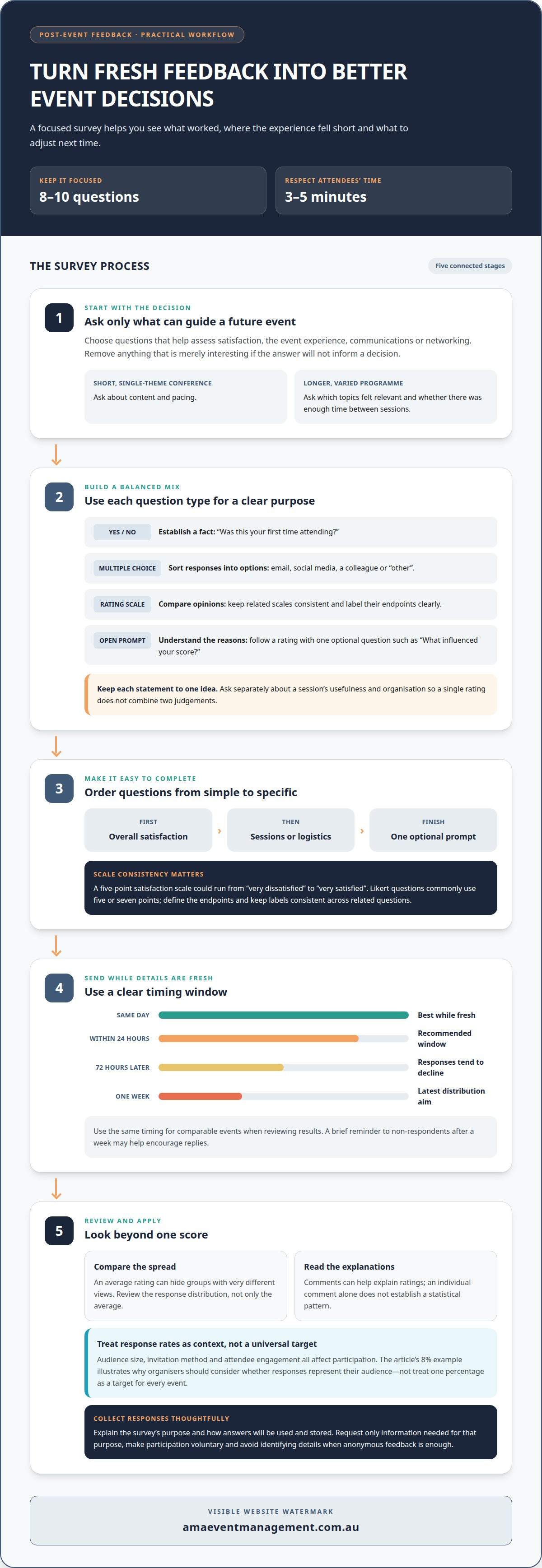
The most useful feedback arrives while an event is still fresh. Send a post-event survey the same day or within 24 hours, and keep it focused: around 8 to 10 questions should take no more than 3-5 minutes to complete. Well-chosen post-event survey questions for attendees can show what worked, where the experience fell short and what deserves attention next time.
Even a carefully planned event can leave attendees with different impressions. A clear post-event survey gives them a practical way to share those views. This guide explains how to combine rating scales, multiple-choice questions and open-ended prompts, and what to ask at public events, conferences and training courses. Adapt the examples to your audience so the responses point to useful changes, not just more inbox clutter.
Table of Contents
1. Why send post-event surveys?
A post-event survey turns attendee impressions into decisions for your next event. Ask about satisfaction, the event experience, communications and networking to identify what worked and what needs adjustment. For example, if conference attendees value a session but struggle to connect with others, keep the content and review the networking arrangements.
Conference length and topic variety affect what attendees can recall and report. A short conference built around one theme may need questions about content and pacing. A longer programme with varied sessions can ask which topics felt relevant and whether attendees had enough time to move between sessions. Tie each question to a decision you can act on.
Keep the survey focused: a useful guide is 8 to 10 questions, taking about 3-5 minutes. Put easy, relevant questions first, such as overall satisfaction, then ask about specific sessions or logistics. Finish with one optional open-ended prompt. Remove questions that are merely interesting if their answers won’t inform a future event decision.
Send the survey on the same day or within 24 hours, while details are fresh. Response rates tend to fall as organisers wait; feedback sent 72 hours later is associated with declining responses. Aim to distribute the survey within one week at the latest, and use the same timing for comparable events when reviewing results.
For an Australian attendee survey, explain its purpose before collecting responses and request only information needed for that purpose. Tell attendees how their answers will be used and stored, make participation voluntary, and avoid asking for identifying details when anonymous feedback will meet your needs.
There’s no single response-rate figure that makes every event survey successful; audience size, invitation method and attendee engagement all affect participation. An example response rate of 8% illustrates why organisers should assess whether responses represent their audience, rather than treating one percentage as a universal target.
To encourage replies, send a concise survey soon after the event and explain how feedback will inform future planning. State how long it should take, make it easy to access, and consider an appropriate incentive, such as raffle entry. Send a brief reminder to non-respondents after a week.
2. Likert scale, multiple-choice and open-ended question types
Choose each question format based on the decision you need to make. Closed-ended questions are easier to compare, while open-ended prompts reveal details fixed options can miss. A balanced survey combines both, helping you spot patterns and understand the reasons behind them.
Use yes-or-no questions to establish a clear fact: “Was this your first time attending?” Multiple-choice questions work well for options such as how people heard about the event: email, social media, a colleague or “other”. These categories identify groups without ranking one answer above another.
Rating scales measure an opinion, such as satisfaction with a session. A 1-10 scale can show differences in overall experience, but label the endpoints clearly. Likert scales commonly use five or seven points. For example, attendees can select “strongly agree”, “agree”, “neutral”, “disagree” or “strongly disagree” to respond to “The session met my expectations.”
A matrix presents several related statements against the same response scale. It can help compare sessions or event features in one format, but too many rows make a survey harder to complete. Keep each statement distinct and let respondents skip items that don’t apply.
For a useful rating scale, keep the range consistent across related questions and define what its endpoints mean. A 1-5 satisfaction scale could run from “very dissatisfied” to “very satisfied”. For an overall experience rating, a 1-10 scale offers more gradation; use one approach consistently so results remain easier to compare.
Open-ended questions capture personal feedback, such as “What could we improve?” They take more effort to answer and analyse, and individual comments alone don’t establish statistical patterns. Follow a closed-ended rating with one optional prompt, such as “What influenced your score?” At virtual events, this can reveal a technical issue that a general rating doesn’t explain.
For conference organisers shaping the attendee journey, conference event management can bring programme and event planning into one coordinated process.
3. Likert scale questions
A Likert question asks attendees to rate their agreement or satisfaction using ordered choices. For example: “The speakers explained the key ideas clearly.” Offer five responses, from “strongly agree” to “strongly disagree”, with “neutral” in the middle. This makes it easier to compare views on specific parts of the event.
Include one clear idea per statement. “The session was useful” asks about value, while “The session was useful and well organised” combines two judgements. If a respondent liked the content but found the structure confusing, one combined rating won’t show what needs attention. Separate the ideas into distinct questions.
Likert scales typically use five or seven points. A satisfaction question could use five, with 1 meaning “very dissatisfied” and 5 meaning “very satisfied”. Keep the labels consistent across related questions, and state what the endpoints mean. That makes the response task clearer and supports comparisons between speakers, sessions or event features.
Scale results need careful interpretation. An average session rating of 3.8 may look precise, but it can hide different audience views. One group may have selected high ratings while another chose low ones. Review the distribution of responses, not only the average, and compare comments to understand what influenced each score.
Neutral answers need context too. They can reflect a genuinely mixed view, a question that doesn’t apply or uncertainty about the statement. Where relevant, add a “not applicable” option instead of forcing a rating. Attendees who missed a workshop, for example, shouldn’t have to rate its usefulness.
Use a follow-up prompt to add context to numerical feedback. After a low speaker rating, ask what would have improved the presentation. Keep the prompt optional and focused, because written responses take more time to review. A consistent scale shows where attention may be needed; a short comment can explain why.
4. Post-event questions for public events, conferences and training courses
Match each question to the event and the decision it should inform. A public event may need feedback on registration, location and activities; a conference needs detail on sessions, speakers and networking. For training, ask whether participants can apply the skills they learned.
Use the same satisfaction scale for different parts of the experience, then invite a short explanation. Ask attendees to rate the venue, catering and logistics separately, for example. Follow a low venue score with “What would have improved the location?” This helps distinguish concerns about access, comfort and travel.
Questions about intent can guide planning for future events. Ask, “How likely are you to attend our next event?” using a 1-5 scale from very unlikely to very likely. To measure recommendation intent, ask how likely attendees are to recommend the event on a 0-10 scale.
Public events: “Was registration straightforward?” and “Which activity or stall did you enjoy most?”
Conferences: “Did the conference content meet your expectations?” and “Were there enough networking opportunities?”
Training courses: “How satisfied were you with the course content?” and “How have you applied your new skills?”
Speakers and logistics: “How clearly did the speaker explain the topic?” and “Was the event length right?”
For training, a follow-up can ask which session or activation changed behaviour within 30 days. Keep sponsor feedback separate from attendee feedback, since sponsors may assess exposure or business outcomes rather than the participant experience.
For immediate feedback during a debrief, the NSW Ministry of Health recommends offering a QR code at the introduction and close. Participants can scan it while the experience is still fresh.
Planning a conference with clear attendee touchpoints? Plan your corporate conference with a coordinated event approach.
AMA Event Management: Market Management and Vendor Coordination
AMA Event Management helps organisers turn attendee feedback into practical priorities for future events. For public markets and community gatherings, its Market Management and Vendor Coordination service brings together elements that shape the visitor experience, from vendor arrangements to event operations.
This support is useful when survey responses point to issues across the event, rather than one isolated session. Feedback about vendor variety, wayfinding or the flow between activities can inform the planning of Community Festivals and Fairs. For business audiences, Corporate Conferences and Galas or Themed Brand Activations can suit events that need coordinated programmes and attendee experiences.
Use survey findings to identify what deserves attention, then bring those priorities into your next event plan. To discuss an upcoming event, contact AMA Event Management or visit amaeventmanagement.com.au.
Make attendee feedback part of your next plan
Treat feedback as a planning input, not a final report. Choose a few changes for the next event, assign each an owner, then review whether they improved the attendee experience. This creates a practical learning loop: listen, decide, apply and assess. Keeping the process visible also helps teams distinguish useful adjustments from reactions to a single comment.
Shape future post-event survey questions for attendees around the changes you make. If you adjust registration, for example, ask whether the revised process was clear. This connects attendee feedback with planning decisions and keeps the next survey focused on what the event needs to learn.
If you’re planning an event and want to discuss the next steps, contact AMA Event Management. A considered approach can help turn attendee insights into a stronger plan for the next gathering.
Frequently Asked Questions
Why send post-event surveys?
Post-event surveys help organisers identify which parts of an event need attention before they plan the next one. Ask attendees to name one moment that worked well and one point of friction, such as unclear directions between sessions. Group similar comments by issue, then assign each actionable theme to the person responsible for that part of event delivery.
Should I send the same survey to attendees, sponsors, and VIPs?
Use separate surveys because each group experiences the event differently. Attendees can comment on registration and activities, sponsors can assess how their involvement was presented, and VIPs can give feedback on hosting and access. Keep a shared question, such as overall event satisfaction, if comparing groups will inform a specific planning decision.
What's the difference between a good survey question and a bad one?
A good question is neutral, clear and focused on one experience. “How easy was it to find the main stage?” asks about a specific task. “Did you enjoy the excellent event and helpful staff?” leads respondents towards a positive answer and combines separate topics. Replace vague wording such as “Was everything good?” with a question about an observable part of the event.
Why is this feedback so important?
Feedback gives the planning team evidence to consider alongside operational observations. If attendees mention long queues while staff report smooth entry, the difference can prompt a closer review of arrival times or registration points. Record the issue, the decision and the outcome at the next event to give colleagues a useful reference, including those who weren’t there.
What questions should a post-event survey ask attendees?
Choose questions that match the event’s purpose and the decisions you need to make. Post-event survey questions for attendees might ask what prompted registration, which activity they would recommend to a friend, and what would make them return. At a public event, ask whether visitors found the information they needed before arriving, then invite one practical suggestion.
What are the best event satisfaction survey questions?
The most useful satisfaction questions cover distinct parts of the experience rather than relying on one overall score. Ask attendees to rate pre-event communication, arrival, programme relevance and the value of networking separately. Add a follow-up such as “Which part most influenced your rating?” This helps identify what shaped satisfaction and where a change could make a difference.


Comments