

Strategic NSW Community Market Management Guide 2026
- Ever After Expo
- 11 minutes ago
- 11 min read
A successful community market is not a weekend hobby; it is a complex piece of social and logistical architecture that requires absolute precision to survive the 2026 regulatory landscape. For many community market organisers NSW councils present a formidable barrier, with intricate Development Applications and minimum A$20 million public liability requirements creating a high-pressure environment. It's often exhausting to balance difficult stallholder dynamics against the need for strict safety audits and site compliance. This guide provides the strategic blueprint you need to move from reactive troubleshooting to composed, professional oversight.
We will examine the essential components of modern market management, including council liaison, curated vendor selection, and the rigorous risk frameworks necessary for a seamless, high-quality operation. By adopting a methodical approach, you can transform a chaotic local gathering into a disciplined, reputable brand that serves the community and satisfies every regulatory demand. You'll learn how to navigate the specific 2026 requirements for food stall licences and local vendor quotas with quiet confidence.
Table of Contents
The Evolution of Community Market Management in NSW
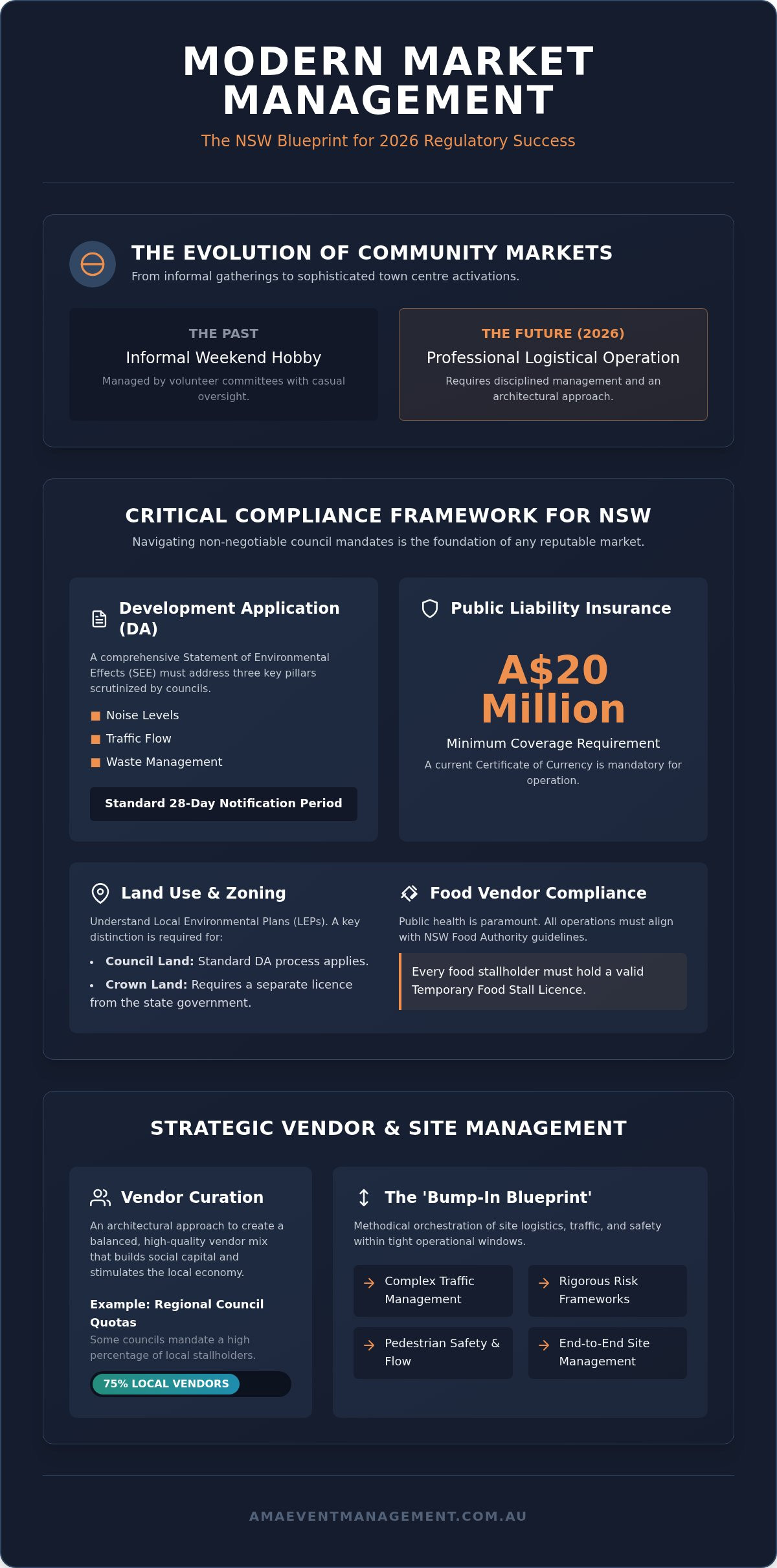
Markets have outgrown their origins as casual car-boot sales or informal weekend gatherings. Today, they function as vital town centre activation strategies, designed to stimulate local economies and foster social cohesion. While the historical evolution of marketplaces demonstrates their enduring role in commerce, the 2026 landscape in NSW demands a level of sophistication previously reserved for major festivals. Professional community market organisers NSW now act as the primary anchor between diverse stakeholders, ensuring that the vision of a local council aligns perfectly with the operational reality of dozens of independent vendors.
This shift toward highly regulated, curated events is driven by a need for consistency and safety. A modern market is a complex logistical puzzle where the manager must oversee everything from electrical safety tags to precise stall placement. Without a methodical approach, the delicate balance between community charm and commercial viability can quickly collapse. For an event to survive in 2026, it must move beyond the "informal" and embrace a structured management framework that satisfies both public expectations and strict council mandates.
Understanding the NSW Market Landscape
The requirements for a successful event vary significantly based on its core purpose and geographic location. A weekly farmers' market in regional NSW faces different pressures than a high-density night market in Western Sydney. For instance, certain regional councils mandate that over 75% of stallholders must be local residents to support the immediate economy. This geographic context dictates everything from vendor curation to traffic management. Whether it's an artisan fair or a themed food event, these recurring markets build immense social capital. They create a predictable rhythm for community life, turning underutilised public spaces into vibrant hubs of engagement.
The Professionalisation of Market Logistics
Relying on volunteer committees or casual oversight is no longer a viable strategy for long-term success. Inconsistent management often leads to poor vendor quality, lacklustre crowds, and significant safety risks. The 2026 standard for market site management requires a disciplined, architectural approach to every detail. This includes managing complex insurance requirements, such as the minimum A$20 million public liability coverage now standard across most councils. The transition toward professional event management agencies ensures that risk mitigation, vendor coordination, and site logistics are handled with precision. A methodical manager doesn't just fill spaces; they curate an ecosystem that protects the brand reputation of both the organiser and the host council.
Navigating NSW Council Compliance and Land Use
Securing a physical site is only the first step in a long journey of regulatory hurdles. For community market organisers NSW legislation requires a deep understanding of Local Environmental Plans (LEPs) and State Environmental Planning Policies (SEPPs). These frameworks dictate how land is used and whether a market is a permitted activity in a specific zone. Operating without the correct approvals can lead to immediate shutdowns or heavy fines, making a methodical approach to compliance non-negotiable for any serious organiser.
The DA Process: A Methodical Approach
Most markets operating on public or private land require a Development Application (DA). This process involves preparing a comprehensive Statement of Environmental Effects (SEE) that details how the event will impact the local area. Councils scrutinise three main pillars: noise levels, traffic flow, and waste management. You should expect approval timelines to vary between Local Government Areas (LGAs), though a 28-day notification period is standard for most temporary event permits. It's also vital to distinguish between Council Land and Crown Land. Crown Land often requires a separate licence from the Department of Planning, Housing and Infrastructure, adding another layer to your project timeline.
Health, Safety, and Food Compliance
Public safety is the anchor of a reputable market. Most NSW councils mandate a minimum of A$20 million in public liability insurance, evidenced by a current Certificate of Currency. For events involving food, you must strictly adhere to the NSW Food Authority guidelines. This includes ensuring every food stallholder has a valid temporary food stall licence. In Sydney, registration for this licence typically starts from A$180 and requires submission at least 28 days before trading begins.
Operational safety extends beyond food. Your risk management plan must include verified gas and electrical safety tags for all equipment. Conducting on-site risk assessments before every "bump-in" ensures that potential hazards are identified and mitigated before the public arrives. If the complexity of these requirements feels overwhelming, partnering with a specialist in market management and vendor coordination can provide the professional oversight needed to ensure a frictionless, compliant launch.
Strategic Vendor Coordination and Stallholder Curation
Successful markets aren't built on "all-comers" policies or casual social media call-outs. Professional community market organisers NSW view the vendor list as a carefully balanced ecosystem where each participant adds specific value to the collective. This architectural approach to curation ensures that stallholders complement one another rather than competing for the same limited pool of customers. By curating a mix that includes both established commercial entities and grassroots artisans, you create an immersive guest experience that keeps visitors on-site longer and encourages repeat attendance.
Curation Strategies for High-Impact Markets
Category saturation is the quickest way to diminish vendor morale and market quality. If a site features five identical candle makers, no one thrives. Instead, you should limit specific categories to ensure diversity and healthy competition. Anchor vendors, such as high-profile food operators or renowned local designers, serve as essential draws that drive initial foot traffic to new locations. Sourcing local talent is also a strategic necessity; some NSW councils mandate that over 75% of stallholders originate from the local or neighbouring areas. This authentic local flavour builds the social capital required to make a market a true community hub.
Stallholder Management and Logistics
Managing dozens of independent business owners requires a disciplined communication protocol and a meticulous administrative framework. Implementing a rigorous night market stallholder application process is the first step in maintaining high standards across the site. This workflow should automate the collection of essential documentation, such as public liability certificates with a minimum A$20 million coverage. For food vendors, aligning with the NSW Food Authority market guidelines is a mandatory requirement that organisers must verify before any trade commences.
Precision in the bump-in schedule is vital to prevent site congestion and ensure public safety. Clear terms and conditions must outline everything from stall fees to waste removal expectations. In the current market, casual stall fees typically range from A$40 to A$145 per day, while established urban markets can command between A$145 and A$370 per trading day. Handling these financial and logistical details with quiet confidence allows you to manage vendor expectations effectively, ensuring the operational side of the market remains invisible to the public while the brand's reputation for excellence grows.
Operational Excellence: Site Management and Risk Mitigation
Managing a physical site is where the meticulous architect persona becomes most visible. For community market organisers NSW, the "Bump-In Blueprint" is a critical document that orchestrates 50 or more vendors within a restrictive two-hour window. It's not just about parking; it's about sequence, safety, and silence. Effective site management also requires meeting 2026 sustainability standards. Councils now frequently mandate waste diversion targets and the elimination of single-use plastics as part of the approval process. A professional manager acts as a composed guide, ensuring these environmental benchmarks are met without disrupting the flow of trade.
Logistics and Infrastructure Planning
Power distribution is a frequent failure point in food-heavy markets. A single overloaded circuit can halt operations for an entire row of vendors, causing significant revenue loss and frustration. Professional organisers calculate total amperage requirements well before the first van arrives. Similarly, acoustic management is essential for maintaining positive relationships with local businesses and residents. This involves the strategic placement of generators or live music stages to ensure sound levels remain within the decibel limits set by the council DA. An intuitive site map is the final piece of this puzzle, designed to guide crowds through a logical path that maximises visibility for every stallholder while preventing dangerous bottlenecks.
Risk Management and Emergency Protocols
A live market is a dynamic environment that demands constant vigilance. Real-time risk assessments must occur throughout the event, identifying trip hazards or structural issues as they arise. Weather monitoring is equally important, particularly in the unpredictable NSW climate. Organisers must have a clear go/no-go decision framework based on wind speeds or lightning proximity to protect public safety. Professional event marshals play a key role here, managing pedestrian safety and incident reporting with quiet authority. This level of oversight ensures that even in high-pressure situations, the operation remains stable and secure.
If you're looking for a partner to manage these complex operational layers with precision, consider the expertise of a specialist in market management and vendor coordination. Having a seasoned professional at the helm allows you to focus on community engagement while the logistical heavy lifting is handled with disciplined excellence.
Partnering for Professional Market Execution
Councils and property developers increasingly seek the security of established event management agencies to mitigate the inherent risks of public gatherings. While a community vision often starts with a group of passionate volunteers, the transition to a sustainable, professional operation requires a level of oversight that only experienced community market organisers NSW can provide. An end-to-end management approach ensures that every phase, from the initial concept design and council liaison to the final site clean-up, is executed with disciplined precision. This professionalisation protects the organisers and provides a reliable, high-quality experience for the public.
The AMA Advantage: Composed Authority in Management
AMA Event Management applies over 20 years of industry experience to help clients navigate these complexities with quiet confidence. Our meticulous architect approach ensures that site layouts and vendor coordination are handled with surgical detail, leaving nothing to chance. We leverage an extensive, existing network of high-quality NSW stallholders, ensuring your event features a curated mix of vendors who are already vetted for compliance and quality. By managing the heavy lifting of council liaison and regulatory adherence, we allow our partners to focus on the broader community impact of their recurring markets in NSW. Our presence acts as a stabilizing force, providing the reliability needed to manage high-pressure environments without friction.
Next Steps for Your Market Vision
Transforming a local space into a thriving community hub begins with a clear, strategic assessment. Requesting a site-specific feasibility study or a professional management proposal provides a grounded understanding of what is possible within your specific LGA. Beyond basic operations, integrating themed brand activations can significantly boost engagement and attract a broader demographic to your site. These activations turn a standard market into a destination event, increasing dwell time and local economic impact. Whether you are launching a new artisan fair or seeking to professionalise an existing event, our teams in Sydney and Melbourne are available for a professional consultation. We provide the stabilizing force needed to turn ambitious community visions into seamless, compliant, and highly successful realities.
Establishing Your Legacy in the NSW Market Landscape
Transitioning from a passion project to a sustainable community asset requires more than just a collection of stalls. It demands a sophisticated understanding of council land use, a balanced vendor ecosystem, and the logistical discipline to manage complex site operations. For many community market organisers NSW presents a rewarding but high-pressure environment where compliance and public safety are the absolute priorities. By adopting a methodical approach to curation and risk management, you ensure your market becomes a reliable anchor for the local community rather than a logistical burden.
At AMA Event Management, we apply over 20 years of industry experience across Sydney and Melbourne to bring your vision to life. Our extensive background means we specialise in council liaison and end-to-end logistics, providing the stabilising force needed to navigate every regulatory hurdle with quiet confidence. Discuss your NSW community market vision with our expert team to begin building a professional, seamless, and enduring event. Your journey toward a frictionless market operation starts with a single strategic partnership.
Frequently Asked Questions
Do I need a Development Application (DA) to start a market in NSW?
Yes, most markets operating on public or private land in NSW require a formal Development Application (DA) unless they fall under specific exempt or complying development categories. Professional community market organisers NSW typically begin by consulting the local council's Local Environmental Plan (LEP) to determine if a market is a permitted land use in the chosen zone. A comprehensive DA will address environmental impacts, traffic flow, and noise management to ensure the event is sustainable.
How much public liability insurance is required for a community market?
Most NSW councils mandate a minimum of A$20 million in public liability insurance coverage for any market operating on public land. This requirement protects the organiser, the council, and the public against claims for injury or property damage. You must ensure that your Certificate of Currency is up to date and specifically covers the activities planned for the market. Individual stallholders are also typically required to carry their own public and product liability insurance.
What are the NSW Food Authority requirements for stallholders?
Stallholders selling food must comply with the NSW Food Authority guidelines for temporary events, which include holding a valid temporary food stall licence. Organisers are responsible for verifying that vendors have notified the local council of their intent to trade and that they adhere to strict hygiene and temperature control standards. In Sydney, registration for these licences typically starts from A$180 and requires submission at least 28 days before the event commences.
How do I manage traffic and parking for a large-scale community market?
Managing high-density crowds requires a formal Traffic Management Plan (TMP) that has been reviewed by the local council or NSW Police. This plan should detail pedestrian crossing points, vendor loading zones, and overflow parking areas to prevent local congestion. Professional event marshals are essential for directing vehicle flow during the critical bump-in and bump-out periods. Effective traffic management ensures that the market remains a welcome addition to the neighbourhood rather than a logistical disruption.
What is the best way to curate a diverse and high-quality vendor mix?
The most effective curation strategy involves an architectural approach that limits the number of vendors in specific categories to prevent market saturation. You should prioritise a mix of anchor vendors, such as popular food operators, alongside local artisans and makers who provide a unique community feel. Implementing a rigorous application process allows you to vet vendor quality, insurance compliance, and brand alignment. This disciplined selection process ensures a high-quality guest experience and healthy trading for vendors.
Can I run a market on Crown Land in New South Wales?
Yes, running a market on Crown Land is possible, but it requires a specific licence or lease from the NSW Department of Planning, Housing and Infrastructure. This process is distinct from standard council approvals and often involves longer lead times for assessment. Organisers must demonstrate that the market provides a clear community benefit and aligns with the dedicated use of the land. It's vital to begin this application process well in advance of your planned launch.
How do professional managers handle bump-in and bump-out logistics?
Professional managers use a sequenced "Bump-In Blueprint" to orchestrate the arrival of dozens of vendors within a narrow operational window. This involves assigning specific arrival times and loading zones to prevent site bottlenecks and ensure safety. By maintaining a disciplined schedule, community market organisers NSW can ensure that all infrastructure is secure and vendors are ready for trade before the public arrives. This methodical approach minimises stress for stallholders and ensures a seamless transition into live operations.
What should be included in a market management plan for council approval?
A comprehensive market management plan should include a detailed site map, a Statement of Environmental Effects (SEE), and specific plans for risk management and emergency protocols. You must also outline strategies for waste minimisation, noise control, and traffic management to satisfy council requirements. Including proof of insurance and a list of proposed vendor categories demonstrates professional oversight. A well-structured plan acts as a blueprint for the event, reassuring the council that all logistical moving parts are integrated.


Comments