

The Hidden Costs of Corporate Event Planning: An Architect’s Guide to Budget Integrity
Updated: Sep 10
A budget that appears flawless on paper often contains the very oversights that will eventually dismantle it. For many professionals, the hidden costs of corporate event planning only become visible when the final invoice arrives, long after the last guest has left the centre. You likely understand the frustration of seeing your carefully managed margins vanish into unexpected venue service charges or AV equipment add-ons that weren't in the original quote. It's a common challenge that can make even the most prestigious brand activation feel like a financial compromise.
We believe that budget integrity is not a matter of luck, but a result of meticulous architectural oversight. This guide identifies the overlooked expenses that frequently erode event budgets and provides a clear framework to mitigate them. By the end of this article, you'll have the tools to ensure a transparent, predictable financial outcome. We'll explore how to manage complex labour overtime during bump-in and provide a structured approach to vendor coordination that protects your bottom line while maintaining a high-impact experience for every attendee.
Table of Contents
Beyond the Spreadsheet: Why 65% of Corporate Event Budgets Overrun
A spreadsheet is a theoretical model, not a logistical reality. While most project leads start with a clear vision, industry data suggests that 65 per cent of corporate event budgets eventually overrun. These overages aren't always the result of catastrophic failures. Instead, they stem from the hidden costs of corporate event planning that are predictable yet frequently overlooked during the initial feasibility phase. To a meticulous planner, a hidden cost is simply a logistical line item that hasn't been accounted for yet.
There is a fundamental difference between a contingency fund and a poorly planned budget. A contingency is designed to absorb "unknown unknowns," such as a sudden change in weather or a speaker cancellation. However, using that fund to cover basic necessities like rigging, power distribution, or council permits indicates a lack of structural integrity in the original plan. Margin leakage often begins during the vendor procurement phase, where the focus remains on top-line figures rather than the granular details of service delivery.
The Psychology of Underestimation in Event Planning
Stakeholders often push for "lean" budgets to secure internal approval. This creates an optimism bias where the project is funded for the best-case scenario rather than the most likely one. It's a risky strategy. When the event date nears, last-minute pivots and scope creep become inevitable. Without an architect's perspective, these changes aren't just logistical hurdles; they're financial drains. A professional guide anticipates these shifts early. They ensure the budget reflects the actual complexity of the task, protecting the brand's prestige from the friction of late-stage cuts.
Margin Leakage vs. Budget Surprises
Margin leakage occurs when small, uncaptured expenses compound into a significant deficit. It's a slow erosion of funds rather than a sudden shock. For instance, failing to account for Wi-Fi bandwidth upgrades or loading dock access fees can quietly diminish your available capital. For a broader context on these requirements, this Event Management Overview details the logistical moving parts that demand constant oversight. Common points of leakage include:
Unquoted venue service charges for after-hours access.
Credit card surcharges on large vendor deposits.
Mandatory security ratios based on final guest numbers.
Venue and Technical Logistics: The Most Common Financial Blind Spots
The physical environment of a venue often conceals the most significant hidden costs of corporate event planning. While a hire fee provides access to the space, it rarely covers the logistical machinery required to execute a high-level activation. The bump-in and bump-out trap is a primary example. Most venues quote for the event's duration, yet technical crews often require hours of access before and after the scheduled times. If these periods fall outside standard business hours, labour costs escalate rapidly due to penalty rates and overtime. Failing to secure these windows in the initial contract leads to expensive last-minute negotiations.
Invisible infrastructure, such as rigging and power distribution, represents another frequent blind spot. A corporate gala featuring custom lighting plots or heavy LED screens requires specialised rigging points and dedicated power drops that are seldom part of a standard package. To better understand the logistical needs of these setups, you can check out ETA Visual for expert guidance on professional LED display integration. In major precincts across Sydney and Melbourne, loading dock management fees can also apply. These charges cover the coordination of delivery vehicles in high-traffic city centres, a detail that is often buried in the venue's fine print.
Digital requirements also demand a meticulous approach. Standard venue Wi-Fi is typically designed for casual browsing, not the high-bandwidth needs of a corporate conference with hundreds of delegates. Securing a dedicated, high-speed connection is a non-negotiable expense for seamless presentations and live-streaming. By engaging a professional vendor coordinator, you can ensure these technical requirements are identified during the site inspection rather than on the event day.
The Logistics of AV and Technical Add-ons
AV contracts often present a choice between package pricing and line-item transparency. While packages seem convenient, they frequently exclude essential services like technical rehearsals and dedicated on-site support staff. A high-stakes presentation requires a technician who understands the specific lighting plots and audio cues of your programme. Bespoke styling also introduces technical dependencies; a custom stage set may require specific floor-weight clearances or additional fire-retardant certifications that carry their own administrative costs.
To ensure your audio-visual requirements are handled with precision, you can check out Zanzibar Productions LLC for professional live sound and entertainment solutions that help eliminate technical uncertainty.
Venue Service Charges and Hidden Surcharges
Analysing the fine print of venue contracts in Sydney and Melbourne reveals several mandatory service charges. These include cleaning fees for large-scale builds, security mandates based on guest ratios, and compulsory cloakroom staff. Public holiday and weekend surcharges are particularly impactful for events held in the CBD, where award rates for hospitality and technical staff can double the anticipated labour spend. A methodical budget accounts for these variables from day one, ensuring the final invoice reflects the initial quote.
Compliance, Insurance, and Australian Regulatory Requirements
Regulatory compliance is often the most significant source of financial friction in the lead-up to a major activation. While venue hire and technical production are visible line items, the administrative and legal frameworks governing Australian events create substantial hidden costs of corporate event planning. These aren't optional extras; they're non-negotiable protections for your brand's reputation and financial health. A meticulous architectural approach ensures these obligations are met without depleting your contingency fund.
The Australian regulatory landscape has become increasingly complex. For example, as of June 2025, individuals have a personal right to sue for serious invasions of privacy. By late 2026, most businesses will need to comply with updated Australian Privacy Principles, including transparent disclosures regarding automated decision-making. Managing attendee data now requires technical and organisational measures that carry their own implementation costs. Ignoring these shifts can lead to significant penalties, with the Office of the Australian Information Commissioner (OAIC) increasing proactive enforcement sweeps in 2026.
Navigating Fair Work and Event Labour Costs
Australian labour laws, overseen by Fair Work Australia, significantly influence the cost of late-night event execution. Event staff are often entitled to penalty rates that can double or triple base hourly costs after midnight or on weekends. It's essential to budget for mandatory breaks, staff meals, and travel allowances if work finishes after public transport has ceased. Choosing a professional event supervisor over a casual staffing agency often provides better value. A seasoned expert understands these award complexities and manages staff rotations to minimise unnecessary overtime spend while staying compliant with national standards.
Risk Mitigation and Insurance Essentials
Standard corporate insurance policies rarely cover the specific risks of bespoke private celebrations or community festivals. Public Liability Insurance (PLI) is a baseline requirement for any professional gathering. Most Australian venues and local councils, such as the City of Sydney or North Sydney Council, require a minimum of $10 million in coverage. For a one-day event, single-event PLI typically costs between $70 and $200 for coverage up to $20 million. Beyond liability, meticulous planners account for several other regulatory factors:
Council Permit Fees: As of June 2026, high-impact events in premium North Sydney parks can reach fees of $2,000 for a three-hour booking.
Sanctions Compliance: The Australian Sanctions Office requires screening of international speakers and vendors against the Consolidated List. Failure to comply can result in fines of up to $910,000 for bodies corporate.
WHS Compliance: Mandatory Work Health and Safety site audits and safety management plans for large-scale builds.
Waste Management: Sustainability reporting and waste diversion mandates required by premium precincts and local government authorities.
Accounting for these regulatory requirements ensures your budget remains resilient. It transforms potential legal and financial liabilities into managed, predictable expenses that reflect the professional standards of your brand.
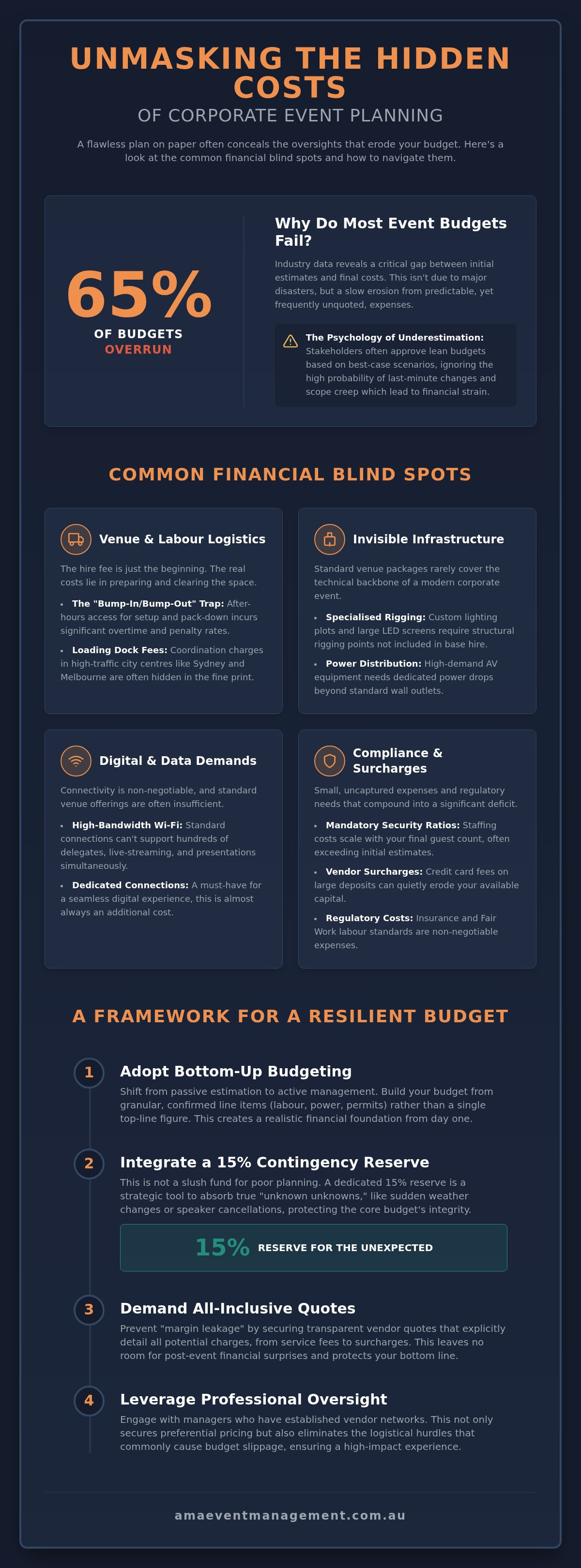
A Methodical Framework for a Resilient Event Budget
Budgeting for a high-stakes activation requires a transition from estimation to architecture. Most overruns occur because project leads use a top-down approach, setting an arbitrary figure and attempting to fit complex logistics into it. A resilient budget is built from the bottom up. This involves identifying every granular requirement, from council permits to specific technical rigging, before a single vendor is engaged. This methodical sequence ensures that the hidden costs of corporate event planning are captured as line items rather than being treated as surprises later in the timeline.
A hallmark of a meticulous planner is the 15 per cent contingency rule. This is not a slush fund for poor planning; it's a disciplined reserve designed to protect the project's integrity against external variables. A well-structured budget also includes a rigorous scrutiny of vendor contracts. Before signing, it's essential to identify excluded items such as freight, credit card surcharges, or travel allowances for technical crews. This level of detail prevents the slow erosion of capital and ensures that the quoted price remains the final price.
The Architect’s Approach to Vendor Procurement
Comparing vendor quotes is rarely a straightforward task. One supplier might include on-site technicians in their base rate, while another lists them as an additional daily charge. To compare apples with apples, you must standardise these quotes into a uniform format. Negotiating for all-inclusive rates is a strategic way to lock in budget certainty. For those seeking a partner to manage these complexities, our guide on Corporate Gala Planners Sydney: The Architect’s Guide to Selecting an Event Management Agency provides deeper insights into selecting a disciplined partner.
Implementing a Phased Financial Oversight
Financial control shouldn't be a post-event exercise. Implementing monthly budget audits during the planning cycle allows you to track spend in real time and adjust for any scope changes. The final 10 per cent of the timeline is often where panic-buying occurs. Strong on-site supervision prevents unauthorised vendor spend and ensures that last-minute additions are vetted against the established contingency. This phased oversight leads to a smooth post-event reconciliation, where the final financial report matches the initial projections. If you require a partner to provide this level of oversight, you can request a consultation with our logistics experts to secure your next activation.
How Professional Event Management Eliminates Financial Surprises
The true value of professional event management lies in the ability to foresee what others overlook. With over 20 years of industry experience, AMA Event Management acts as a stabilising force, transforming high-pressure logistics into a seamless, predictable operation. This seasoned perspective is essential for identifying the hidden costs of corporate event planning before they manifest as budget overruns. By anticipating logistical hurdles, such as freight bottlenecks or complex site access requirements, we ensure that every moving part integrates perfectly into the project timeline.
End-to-end coordination removes the friction that typically occurs during vendor handovers. When multiple suppliers operate in isolation, data points often fall through the cracks, leading to uncaptured expenses and late-stage budget erosion. A composed guide manages these vendor networks with precision, ensuring that every quote is vetted for completeness and every service level agreement is strictly enforced. This methodical oversight protects your margins and allows your team to focus on the event's strategic objectives rather than administrative fires.
Strategic Vendor Relationships in Sydney and Melbourne
Our deep roots in the Sydney and Melbourne event scenes provide a distinct financial advantage for our clients. Over two decades, we've cultivated a network of trusted suppliers who understand our high standards for transparency and precision. These long-term relationships often result in better contract terms and the elimination of the "hidden" fees that less experienced planners might miss. While we specialise in the NSW and VIC markets, our methodical approach remains consistent across all regions. You can learn more about our broader strategy in our guide on Corporate Event Planners Brisbane: A Methodical Guide to Composed Excellence in 2026.
The ROI of Composed Authority
The professional management fee shouldn't be viewed as an additional expense; it's a strategic investment in budget protection. The savings found through meticulous planning, vendor negotiation, and the avoidance of penalty rates often offset the cost of engagement. Beyond the balance sheet, there's the invaluable ROI of brand prestige. A flawlessly executed gala or conference reflects your organisation's commitment to excellence, unmarred by the stress of logistical failures or financial surprises.
We provide the quiet confidence and disciplined oversight required to navigate the most complex activations. By prioritising budget integrity from the initial feasibility study to the final post-event reconciliation, we ensure your event is remembered for its impact rather than its overruns. Partner with AMA Event Management for your next corporate gala to experience the security of professional architectural oversight.
Securing Budget Integrity for Your Next Activation
Maintaining the financial integrity of a high-stakes corporate gala requires more than a simple spreadsheet. It demands a disciplined architectural approach that anticipates the technical, regulatory, and logistical complexities of the Australian landscape. By identifying the hidden costs of corporate event planning early in the feasibility phase, you transform potential financial shocks into managed, predictable line items. Whether it's navigating Fair Work penalty rates or securing complex technical rigging, meticulous oversight ensures that your budget remains resilient and your brand's prestige is protected.
With over 20 years of experience specialising in the Sydney and Melbourne markets, we act as a stabilising force in a high-pressure environment. We provide the end-to-end logistics and vendor coordination necessary to deliver a seamless experience without post-event surprises. You can rely on our seasoned expertise to manage every detail with composed authority. Secure your event budget with AMA Event Management and ensure your next activation is defined by its impact rather than its overruns. We look forward to helping you deliver a frictionless and professional event.
Frequently Asked Questions
What percentage of an event budget should be set aside for contingency?
A 15 per cent contingency is the industry standard for a resilient budget. This reserve isn't intended for poor planning but for mitigating external variables like vendor price shifts or late-stage scope changes. By maintaining this buffer, you ensure that the hidden costs of corporate event planning don't compromise the guest experience or your brand's prestige. It allows for a composed response to unexpected logistical hurdles without requiring a total budget restructure.
Are venue service charges usually included in the initial quote?
Venue service charges are frequently omitted from the initial hire quote. Base rates typically cover the space and standard furniture, but cleaning fees, mandatory security ratios, and cloakroom staff are often separate line items. You should also check for loading dock management fees, especially in high-traffic Sydney and Melbourne CBD precincts. Identifying these expenses during the site inspection prevents the final invoice from exceeding your original financial projections.
How much does event cancellation insurance typically cost in Australia?
While cancellation insurance costs vary based on the event's scale and risk profile, public liability insurance for a single event typically ranges between $70 and $200 for coverage up to $20 million. Most local councils and premium venues now require a minimum of $10 million in public liability coverage to secure a permit or booking. Cancellation insurance is a separate, critical protection that safeguards your capital against external disruptions and unforeseen venue closures.
What are the most commonly overlooked technical costs in corporate events?
Rigging points, power distribution, and high-bandwidth Wi-Fi are the technical elements most likely to be overlooked. A standard venue package rarely accounts for the specific power drops required for LED screens or the specialised labour needed to execute a complex lighting plot. Technical rehearsals are another common omission. These items are primary sources of hidden costs of corporate event planning and should be vetted thoroughly during the initial procurement phase.
How do Fair Work regulations affect my event budget?
Fair Work regulations dictate penalty rates and mandatory breaks that can significantly increase your labour spend. Staff working late-night shifts or weekends are often entitled to rates that double the standard hourly cost. You must also account for meal allowances and travel expenses if work concludes after public transport has stopped. A methodical planner calculates these award requirements early to avoid the financial strain of unplanned overtime and ensure full regulatory compliance.
Can I avoid hidden costs by using an all-inclusive venue package?
All-inclusive packages rarely cover the full scope of a bespoke activation. While they offer convenience, they often exclude specialised technical support, freight handling, and precinct-specific fees like loading dock access. Packages are designed for standard requirements, so any deviation for immersive branding or technical complexity will result in additional charges. Scrutinising the fine print ensures that a package doesn't simply become a baseline for expensive future add-ons.
Why is AV rigging often charged as a separate line item?
AV rigging requires specialised engineers and venue-specific safety certifications that go beyond standard equipment hire. Every lighting plot or hanging installation must be vetted for weight clearances and fire safety, which involves dedicated labour and administrative oversight. Charging rigging as a separate line item ensures that the specific structural requirements of your event are managed by qualified professionals, maintaining the safety and integrity of the entire build.
What is the benefit of a professional post-event budget reconciliation?
Professional post-event budget reconciliation closes the loop on financial reporting and identifies exactly where margin leakage occurred. It allows you to compare final invoices against initial quotes to ensure vendor compliance and captures data that informs future feasibility studies. This methodical process provides stakeholders with a transparent view of the event's ROI and builds a foundation for even greater financial precision in your next high-stakes corporate activation.


Comments