

Corporate Conference Attendee Engagement Ideas for Every Stage
Corporate conference attendee engagement ideas work best when participation is built into the programme, not left to chance. Alternate presentations with small-group workshops, live polls, audience Q&A and relaxed networking breaks so attendees can contribute, connect and absorb what they learn. A moderated keynote that welcomes audience questions can also make a formal session more conversational.
A full schedule can seem like the safest choice: every session has a purpose, and every minute is accounted for. But engagement depends on more than filling the agenda. Attendees need clear opportunities to participate, share perspectives and make useful connections.
This guide covers practical ways to encourage participation at every stage of a conference, from event apps and interactive sessions to break-time activities and live feedback. It also explains how to match ideas to your audience and event goals, so the experience feels considered rather than crowded.
Table of Contents
1. How do I incorporate corporate event ideas into a conference?
Build participation into the programme instead of treating it as an add-on. For example, use an opening visual to introduce the theme, an interactive session to explore it, and a short audience response to gather ideas. A conference on workplace innovation could present a challenge, invite teams to develop solutions, then collect a live rating of each proposal.
Use engaging visuals to make information easier to follow and act on. An opening screen might show the agenda, session locations and a prompt for attendees to share a priority. During a presentation, a screen can display a process map or product demonstration, with the speaker inviting discussion at key points. Keep text readable, use strong colour contrast, and make screen content support rather than compete with the speaker. A final slide can show the next session and a clear action, such as submitting a question.
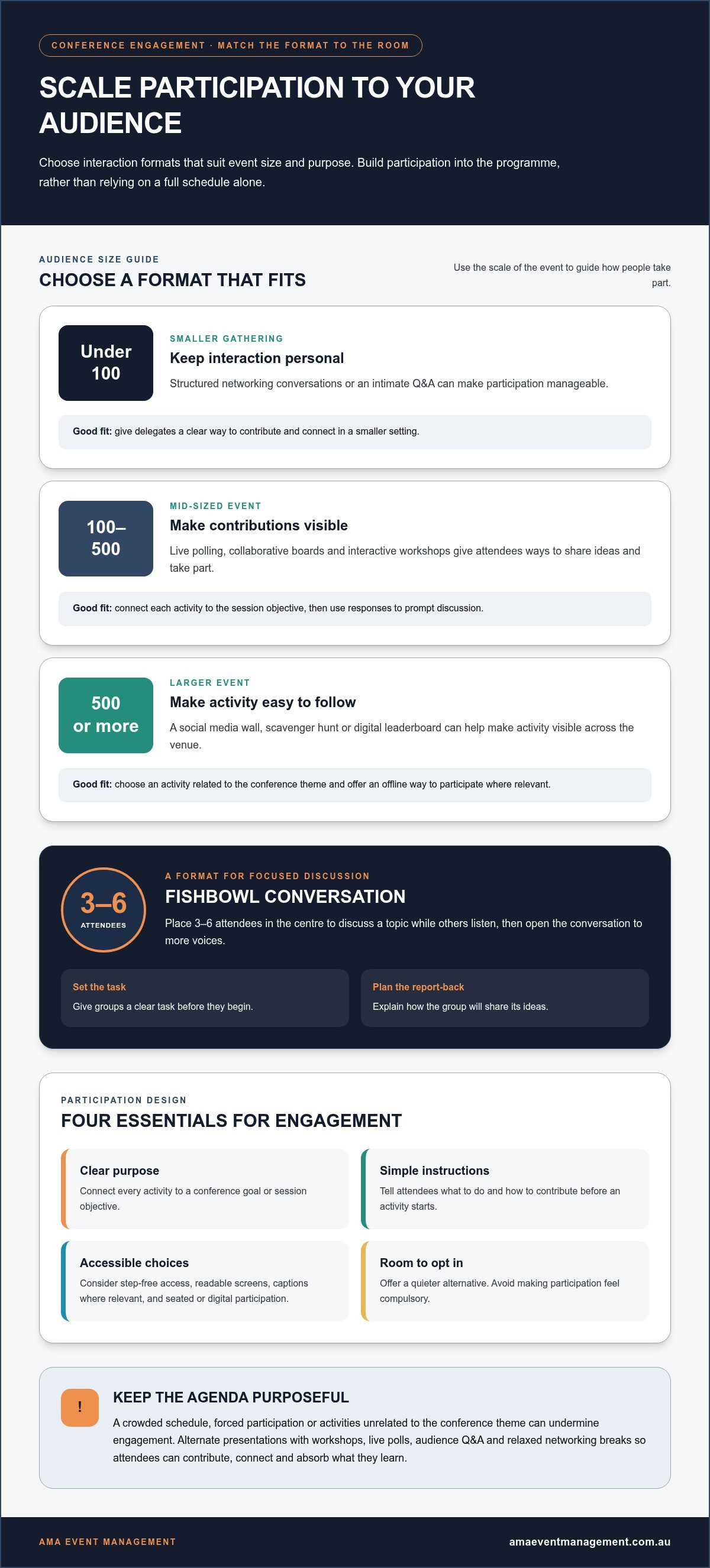
For deeper participation, design a workshop around a task attendees can complete together. A session on customer experience could ask small groups to map a client journey, identify a friction point and share one improvement. Breakout sessions give people room to discuss specialist issues, while round tables help quieter participants contribute without addressing a large room. A Fishbowl format places 3-6 attendees in the centre to discuss a topic as others listen, then opens the conversation to more voices. Set a clear task and report-back format before groups begin.
Branded photo booths and interactive art can make arrival or a break more social. A photo booth could use the conference colours and a backdrop related to the event theme, with an optional prompt to share a professional takeaway. An interactive mural gives delegates a visible way to contribute, such as adding a word or sketch in response to an industry question. Place activities near natural gathering areas without blocking movement or making participation feel compulsory.
For inclusive activities in Sydney and Melbourne, consider step-free access, readable screens, captions where relevant, and ways to participate while seated or digitally. Give clear instructions and a quieter alternative so attendees can choose how they contribute.
Live polling makes audience interaction immediate. Ask one focused question after a presentation, such as which challenge deserves more discussion. Show the responses, then invite the speaker to address the leading themes. Polls can also check understanding or gather opinions, but each question should relate to the session objective.
Forced participation, crowded schedules and activities unrelated to the conference theme can undermine engagement. Avoid relying on one format, such as standing networking, which may exclude attendees or leave some without a comfortable way to join. A successful activity has a clear purpose, simple instructions and an accessible way to participate.
2. Event apps, notifications and engagement analytics
A conference app can bring practical details and participation tools together. Use it for the schedule, speaker biographies, session recommendations, attendee connections, polls and quizzes. Before the event, ask delegates which topics they want to explore and what kinds of contacts they hope to make. Use their responses to shape session suggestions and networking prompts instead of sending everyone the same agenda. These corporate conference attendee engagement ideas help tailor the experience to delegates’ interests.
Make notifications useful, not constant. Send a reminder when a chosen session is approaching, when a room changes, or when a networking activity begins. A message such as “Your product strategy workshop starts soon in Room 2” gives a clear next step; repeated generic alerts can distract from sessions and conversation. Let attendees manage notification preferences and keep essential event updates easy to find in the app.
Engagement data can help organisers adjust the programme as it runs. Review session bookings, poll responses, app interactions and submitted questions, then compare them with the event’s goals. Strong interest in a session may signal a need to add capacity or extend it. If a discussion draws little participation, a moderator can invite questions or run a short poll to find out what attendees want addressed.
Use pre-event surveys to understand delegates’ priorities, accessibility needs and preferred ways to connect. Ask focused questions, such as which industry challenge they want discussed or whether they’re looking to meet new contacts. Send personalised communications based on the answers, such as recommending a relevant breakout or suggesting a structured networking conversation. Relevant messages give attendees a reason to keep engaging throughout the event.
Social media contests can encourage participation when the task relates to the conference. Invite attendees to share one practical insight using the event hashtag or post a photo from a themed activation. Explain how entries will be recognised and offer an offline option for people who prefer not to post. For remote participants, virtual gifts could include a downloadable resource or personalised thank-you message rather than a physical item.
Match the format to event size and purpose. For under 100 attendees, structured networking conversations or an intimate Q&A can make participation manageable. Events with 100–500 attendees can use live polling, collaborative boards and interactive workshops. For 500 or more, a social media wall, scavenger hunt or digital leaderboard can help make activity visible across the venue.
Interactive entertainment should suit the event’s theme and audience. A themed brand activation might invite delegates to complete a product challenge, while a conference app can record participation and display a leaderboard. Keep the activity optional, clearly explained and connected to a business objective. These corporate conference attendee engagement ideas work best when they feel like part of the experience, not a distraction from it.
Low-cost options include a moderated Q&A, a simple app poll, conversation prompts on tables or a collaborative digital board. Choose based on your audience, event goals and existing tools, rather than adding technology for its own sake.
For a conference programme that connects digital participation with in-room activities, explore corporate conference planning.
3. Entertainment during arrival, networking and breaks
Arrival sets the tone before the first presentation. Live music, a relaxed welcome space or a simple conversation prompt can give early arrivals an easy way to start talking. During breaks, a short comedy act or interactive music experience can refresh the room without competing with conference content. Place entertainment where people can join or leave comfortably, instead of turning every break into a scheduled performance.
Interactive activities can support networking by giving attendees something specific to discuss. Try a question-led table, collaborative challenge or cocktail workshop where participants work together. For example, ask each group to name an emerging industry issue and suggest a practical response. Structured mixers and icebreakers can make introductions less awkward, while informal coffee breaks and dinners leave room for conversations to develop naturally.
Speed networking suits business conferences, trade exhibitions and leadership summits. Give each conversation a clear prompt, such as “What are you hoping to learn today?”, then rotate attendees after 3-5 minutes. A 45-60 minute session can help people meet 10-15 new contacts. Keep the format straightforward: explain the rotation, display a timer and provide a comfortable way to pass on a conversation.
For activity-based networking, try a World Café discussion. Small groups explore one question for 15-20 minutes, then share their insights with the room. A team challenge or shared task can also start conversation between attendees who might not otherwise meet. Balance these organised opportunities with informal networking, so delegates can choose between guided introductions and open conversation.
An event app can help attendees find relevant people before they arrive. Let participants share their interests or professional goals, then use those details to suggest connections and arrange one-on-one meetings. A delegate interested in supply-chain innovation, for example, could receive a prompt to meet others attending that session. Keep suggestions optional and make meeting times and locations easy to find.
Entertainment can also create a shared point of conversation. Live bands, comedy acts and virtual reality experiences can fit between sessions or during an evening social. A trivia competition offers a compact alternative: it takes 10-15 minutes and uses five quick, random questions. Choose an option that suits the conference audience and schedule, and allow enough time for people to participate without rushing to the next session.
Vary the formats across the day with a welcome activity, a timed networking session and relaxed break-time entertainment. This creates different opportunities to connect without asking attendees to network in the same way throughout the event.
4. Live polls for gathering attendee feedback
Live polls give audiences a direct way to respond during a session. Use them to gauge sentiment, identify priorities or check understanding, then let the presenter respond to the results. After a discussion about workplace technology, for example, ask which implementation challenge needs more attention. Displaying responses can turn a presentation into a focused conversation and give speakers an immediate prompt.
Build each poll around one decision or discussion point. A question such as “Which topic should the panel explore next?” lets participants shape the session. Keep answer options distinct, relevant and easy to scan on a phone or screen. Avoid combining several issues in one question, as the results will be harder to interpret and less useful to the audience.
Icebreaker polls can help participants join in before a detailed presentation begins. Use a few distinct questions, such as which industry issue attendees follow, what skill they want to develop or which session interests them most. Add a light question about how they prefer to learn, such as through a demonstration or group discussion. Share the results to give people an easy opening for conversation.
For panels, combine polls with moderated Q&A. Let attendees submit questions during the discussion, then have a moderator group similar themes and display selected questions. This gives participants a way to contribute without speaking from the floor. A poll can help identify the most relevant topic, while the panel’s answers add context that a vote alone cannot provide.
Use surveys to gather broader feedback than a live poll can provide. A short session survey might ask whether the content met expectations, which example was most useful and what delegates want covered next. Keep questions tied to a clear purpose, and explain how responses will inform future planning. Live polls invite immediate participation; surveys capture more considered feedback after a session.
To engage in-person and virtual attendees equally, use the same digital polling and Q&A channel for both groups. The moderator should read remote questions aloud, display responses in the room and ensure online participants can follow the session.
Live streaming can extend a session to people who cannot attend in person, while virtual networking spaces give them a place to connect. An immersive product demonstration or virtual tour can make the streamed programme more memorable, provided the presenter also explains what is happening for people watching on a standard screen.
Close each poll with a visible response: acknowledge the result, explain what it suggests or invite a panellist to address it. This shows the audience that their participation has a purpose and makes the feedback a useful part of the session.
5. Benefits of attendee engagement
Active participation can turn a conference from a series of presentations into a shared learning experience. When delegates answer a poll, contribute to a workshop or ask a speaker a question, they work with the material rather than simply receive it. A session on workplace change, for example, could invite attendees to identify an obstacle and compare possible responses.
Taking part can help attendees absorb information, connect it to their own work and remember the experience. A practical exercise gives people a chance to apply an idea straight away. After a session on customer service, delegates could map a client interaction and identify where communication could improve. The discussion turns a broad principle into a useful action.
Engagement can also create more meaningful connections between attendees. A structured discussion about a shared industry challenge gives people a natural reason to exchange perspectives. Someone who meets a potential collaborator during a workshop may leave with a clearer next step than someone who only exchanged business cards. Design activities around the relationships delegates want to build.
Attendee responses help organisers understand what matters to their audience. Poll results can show which challenge deserves more attention, while questions submitted during a panel reveal what delegates want explained. Use these insights to guide a speaker’s follow-up or shape later sessions. Audience input then informs programme decisions rather than serving only as a record of participation.
Engagement can help attendees feel involved in the conference’s direction. A facilitator might ask groups to propose solutions, then share common themes with the room. Delegates can see how their contributions connect to the wider conversation. This shared ownership can make the programme feel more relevant than a schedule built entirely around one-way delivery.
Content created during the event can remain useful afterwards. With appropriate permissions, organisers can adapt attendee insights, speaker highlights or workshop outcomes for internal communications, future promotions or event recaps. A concise summary of delegates’ proposed actions, for example, can help participants revisit the discussion when they return to work.
Measure each activity against its purpose, not just the number of people who joined. A networking session may be valuable if it helps attendees make relevant connections; a poll may help a presenter choose a clear direction. Set the objective first, then review participation, feedback and outcomes together.
For a conference programme that connects attendee participation with coordinated delivery, plan your corporate conference.
AMA Event Management: Market Management and Vendor Coordination
AMA Event Management can help turn an engagement plan into a coordinated corporate conference or gala. Its event management service brings the programme, audience activities and event logistics together around your goals.
Involve AMA Event Management while shaping the event concept or coordinating the details behind attendee participation. Market Management and Vendor Coordination supports the coordination of vendors, while Themed Brand Activations can create a distinctive, interactive setting for delegates. For a broader public-facing event, Community Festivals and Fairs are another option.
Share your conference objectives, audience and preferred activities to begin a practical planning conversation. Contact AMA Event Management to discuss your event.
Make engagement part of your next event plan
Start by deciding what attendees should take back to work after the event. Choose an intended outcome, such as a useful new connection or practical idea, then shape the programme around it. This gives your corporate conference attendee engagement ideas a clear direction and keeps each activity relevant to delegates.
AMA Event Management supports event planning through Corporate Conferences and Galas, Themed Brand Activations, Community Festivals and Fairs, and Market Management and Vendor Coordination. A productive planning conversation starts with your event goals, audience and the experience you want to create. Then consider how each element contributes to an organised, coherent event.
Contact AMA Event Management to discuss your event plans. A considered next step can help you build a conference that gives people a reason to participate and something meaningful to take away.
Frequently Asked Questions
What are some effective conference planning ideas to increase engagement?
Start with the outcome delegates should take back to work, then design the attendee journey around it. For a leadership conference in Sydney, connect the opening message, session choices and closing reflection to a strategic priority. Map where people might lose momentum, such as moving between rooms or waiting for a session, and give each transition a clear purpose. This helps the programme feel coherent rather than like a collection of unrelated activities.
How can event management technology improve conference engagement?
Event technology can reduce practical friction and leave delegates more attention for the conference itself. A digital registration confirmation can bring key details together, while accessible online materials let attendees revisit information after a session. In Melbourne, a conference with several rooms could make directions and programme updates easy to find on attendees’ devices. Choose technology for a defined task, and provide a non-digital way to access essential information.
How do I incorporate corporate event ideas into a conference?
Choose an idea that supports the conference objective and connect it to the programme’s central message. For a conference focused on collaboration, organisers could invite teams to develop shared working principles and display the agreed themes at the close. This gives the activity a useful outcome instead of making it entertainment without a clear link to the event. Brief facilitators on its purpose and desired result before the session.
How do you make an event more interactive?
Give attendees a meaningful role in shaping what happens, not just a chance to watch. A facilitator could present a realistic business scenario, invite the room to identify the key decision, then ask a speaker to respond to different approaches. Make the task clear and let people contribute verbally, in writing or through a digital channel. These options let participants take part in a way that suits the room and session.
What are the best networking activities for professional events?
Peer consultation can make networking useful from the outset. Invite a delegate to briefly describe a current work challenge, then ask a small group to offer perspectives from their own experience. A facilitator can keep the exchange focused and ensure everyone has an opportunity to contribute. This works well when attendees share a professional interest, while hosted introductions can connect people with relevant roles or expertise.
What tools help make conferences more interactive?
Simple room tools can support interaction without a complex platform. A shared digital document lets groups record recommendations, while a visible agenda helps attendees follow how each activity fits the session. A roving microphone can help people hear spoken contributions in a large room. For a hybrid session, give remote attendees an equivalent way to contribute and ensure the facilitator brings their input into the conversation.
Why is attendee engagement important?
Engagement helps organisers see whether the programme is meeting its purpose. If delegates repeatedly ask for clarification, the presenter can explain the topic differently or make space for follow-up. If they identify an unexpected priority, organisers can use that insight when planning future events. Participation also gives attendees a more active role, helping them connect conference themes with decisions in their own work.
What are effective attendee engagement ideas for corporate conferences?
Effective ideas give delegates a clear reason to contribute and a useful outcome to take away. Ask attendees to bring a current work question, then invite them to record one action they will test after the conference. A colleague or team can help them reflect on that commitment later. This keeps the focus on applying ideas beyond the event, rather than measuring success only by activity in the room.
Comments