

Melbourne Festival Logistics Checklist: 2026 Guide
A missed handover between suppliers, site teams and event-day staff can create problems across an entire festival. A practical festival logistics checklist Melbourne organisers can adapt keeps those moving parts connected, from early site planning through to pack-down.
Coordinating vendors, infrastructure, access, transport and safety can feel fragmented, especially when requirements depend on the site and event setup. Give each task an owner, a deadline and a plan for changing conditions. This makes it easier to see what is ready, what depends on other work and where gaps remain.
This guide covers festival sites, supplier coordination, permits and approvals, accessibility, safety, transport, event-day operations and contingencies in Melbourne. It also explains how to assign responsibilities across planning and delivery. Whether you’re organising in Melbourne or Sydney, use the checklist as a working plan and adapt it to your festival and location. AMA Event Management provides end-to-end event management, including vendor procurement, site management and on-site supervision.
Table of Contents
Start your Melbourne festival logistics checklist with the site and local context
Coordinate Melbourne festival suppliers, vendors and event infrastructure
Make Melbourne festival access, safety and contingencies part of operations
Use an event-day checklist to manage Melbourne festival operations
Bring your Melbourne festival logistics plan together with professional event management
Start your Melbourne festival logistics checklist with the site and local context
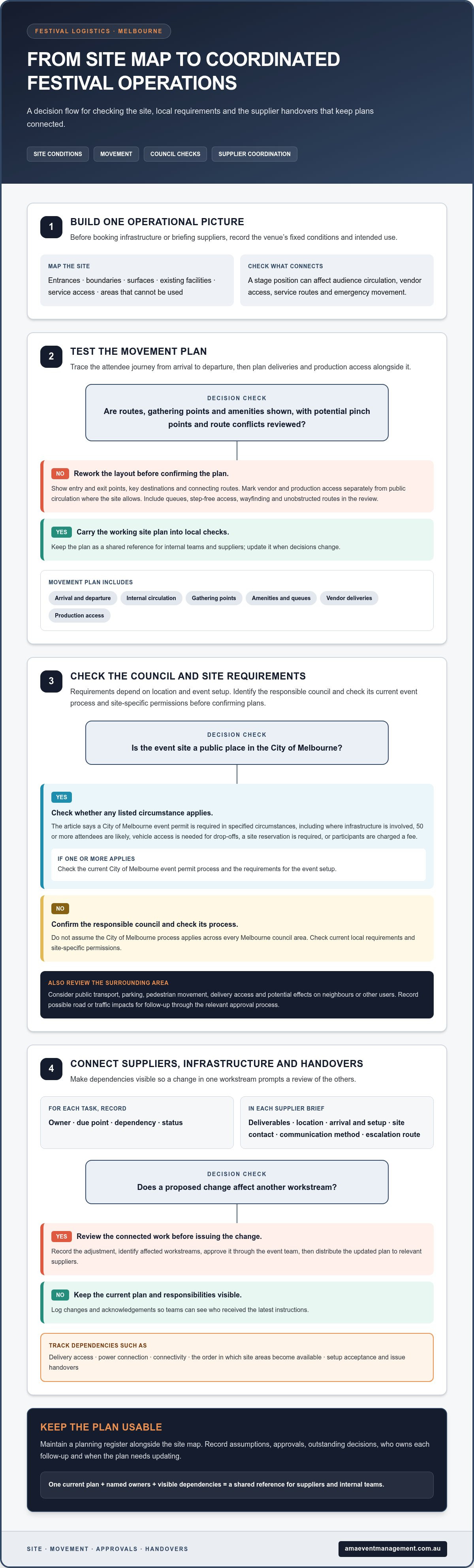
Before booking infrastructure or briefing suppliers, create one operational picture of the site. A change to a stage position can affect audience circulation, vendor access, service routes and emergency movement. Treat the layout as a connected system, not a collection of separate zones. A festival logistics checklist is an owned plan linking site needs, people and operations, so decisions in one area account for their effects elsewhere.
Start with the venue’s fixed conditions and intended use. Record entrances, boundaries, surfaces, existing facilities, service access and any areas that cannot be used. Then check how the festival footprint fits those conditions. A layout that looks workable on paper may create pinch points once queues, stalls and gathering areas are added.
Map the festival site around real attendee movement
Trace the attendee journey from arrival to departure, including entry, internal circulation, gathering points and amenities. Plan these routes alongside vendor deliveries and production access, rather than adding them afterwards. For broader context on crowd movement and operational pressures, see Music festival logistics and challenges.
Use a working site plan to mark public areas, vendor zones, production spaces and staff-only areas. Check where routes cross or compete for space. Include step-free access, clear wayfinding and unobstructed routes in the same review, so these needs shape the layout from the outset.
Show entry and exit points, key destinations and the routes connecting them.
Mark vendor and production access separately from public circulation where the site allows.
Note gathering points, amenities and areas where queues could affect movement.
Build Melbourne requirements into the site plan
Identify which council is responsible for the site, then check its current event process and any site-specific permissions before confirming plans. Requirements depend on the location and event setup. For example, the City of Melbourne requires an event permit for events in a public place in specified circumstances, including where infrastructure is involved, 50 or more attendees are likely, vehicle access is needed for drop-offs, a site reservation is required or participants are charged a fee. Do not assume the same process applies across every Melbourne council area.
Review how the site connects with surrounding streets and public spaces. Consider nearby public transport, parking, pedestrian movement, delivery access and potential effects on neighbours or other users of the area. If the plan may affect roads or traffic, record the issue for follow-up through the relevant approval process rather than treating it as a site-map detail alone.
Keep a planning register alongside the map. Record assumptions, approvals, outstanding decisions, who owns each follow-up and when the plan needs updating. This gives suppliers and internal teams a shared reference, and helps prevent an unresolved site question from becoming a late change to access, layout or operations.
Coordinate Melbourne festival suppliers, vendors and event infrastructure
A site plan becomes an operating plan when the people and services behind it are coordinated. Infrastructure, vendors, staffing and attendee services depend on one another. A vendor’s setup, for example, may rely on access being available, power being in place and the allocated area remaining clear. Treat these as connected workstreams so a change in one area prompts a review of the others.
Named owners and tracked dependencies reduce ambiguity by showing who must act, what their work relies on and where to escalate a problem. For each task, record an owner, due point, dependency and status. This turns a festival logistics checklist Melbourne organisers use into a working coordination tool, rather than a list of disconnected bookings.
Brief vendors and suppliers with consistent site information
Give each supplier a shared brief with the information relevant to their role. Include deliverables, allocated location, arrival and setup arrangements, site contact, event-day communication method and escalation route. Vendors may need different details from production or staffing teams, so tailor each brief while keeping the underlying site information consistent.
Maintain one current site plan as the reference point. Set a straightforward change process: record the proposed adjustment, identify affected workstreams, approve it through the event team, then distribute the updated plan to relevant suppliers. This helps prevent a vendor working from an outdated location or a production team preparing for an earlier layout.
Record responsibilities and handover points, including who accepts a completed setup or passes an issue to the next owner.
Track dependencies such as delivery access, power connection, connectivity and the order in which site areas become available.
Log changes and acknowledgements so the team can see who has received the latest instructions.
Plan infrastructure, staffing and attendee services together
Map infrastructure to the function of each area. Check that power requirements match the locations and operating needs of equipment, and that connectivity supports the event functions relying on it. Consider how these arrangements affect public movement and staff access. If the site plan changes, revisit the infrastructure and staffing tasks linked to the affected area.
Assign practical roles for entry, information, vendor support and issue escalation. Each person should know their area of responsibility, who they report to and how to raise an issue. Make handovers explicit, especially where one team’s work must be completed before another can begin. This reduces the chance that an assumption about access, setup or readiness goes unowned.
List each operating area’s infrastructure needs and the supplier or team responsible.
Identify the staff contact for vendors and the route for escalating operational issues.
Note which attendee services rely on power, connectivity, equipment or a specific setup being ready.
When several workstreams need coordinated oversight, AMA Event Management’s event management services bring vendor procurement, site management and on-site supervision into the planning and delivery process.
Make Melbourne festival access, safety and contingencies part of operations
Access, safety, traffic and contingency planning work best when they shape the operating plan from the outset. A change to an entry point can affect accessible routes, queues, staffing positions and vehicle movements at the same time. Connect these considerations to the site layout, supplier responsibilities and event-day decisions rather than leaving them in separate documents without a clear owner.
Use the table as a planning prompt, then tailor it to the festival’s location, programme and current risk assessment. Assign an owner for each issue and record how the team will prevent, identify and respond to it. These prompts support operational planning. They are not legal advice or a substitute for checking current local requirements. Verify relevant requirements with the responsible council and appropriate authorities.
Turn accessibility planning into practical site arrangements
Review the site from an attendee’s perspective, from arrival and entry through to movement between areas, facilities and departure. Consider step-free routes, clear wayfinding and the information people need before they arrive. The City of Melbourne accessibility guide can be a useful local reference where relevant. Check its current guidance and whether it applies to your site and event.
Include access arrangements in the working site plan, supplier briefs and attendee communications. If a route or facility changes, update every affected document and team so the information stays consistent. A route shown on a map must also be considered in the operational setup, including how teams will keep it clear.
Prepare responses for operational changes and incidents
Identify plausible disruptions for your event, such as changing weather, congestion, supplier delays or equipment issues. For each, decide who can make an operational decision, who communicates updates and how the issue is escalated. Keep responses proportionate to the site and programme, and align them with the event’s current risk assessment and relevant authority requirements.
Record decisions and changes in the event team’s operational register. This gives staff a clear reference for ownership and escalation while keeping safety and access arrangements connected to the live plan. For a festival logistics checklist Melbourne organisers can act on, every identified risk needs a responsible person, a practical prevention measure and a response the team can communicate clearly.
Use an event-day checklist to manage Melbourne festival operations
On event day, the plan needs to work as a shared control point, not just a document prepared in advance. Organise checks around four stages: opening readiness, live operations, issue response and close-down. Give each task an owner and status, and make the reporting route clear so an emerging issue reaches someone with authority to act. A concise checklist lets the team see what is ready, what needs attention and what decision comes next.
Keep one current version available to the people responsible for delivery. Use the same status terms throughout, such as “not started”, “in progress”, “ready” and “needs action”. Consistent labels help staff communicate during handovers and reduce confusion when plans change. The checklist should reflect the approved site plan and relevant event procedures.
Opening readiness: confirm the site and operating areas are ready before attendees arrive.
Live operations: monitor site conditions, attendee movement and vendor needs.
Issue response: record the issue, notify the right decision-maker and communicate approved actions.
Close-down: coordinate pack-down, site handovers and outstanding tasks.
For quick scanning, use a shared table with a task, owner, status and escalation contact. Add a brief note where a task depends on another team or handover.
Run a coordinated pre-opening readiness check
Before opening, compare the site with the approved plan and confirm that key areas are ready for their intended use. Check that staff understand their roles, communication channels and process for reporting emerging issues. Confirm supplier handovers and access arrangements, including whether outstanding work could affect public areas or another team’s setup. Record unresolved items, assign an owner and escalate them through the agreed route before they affect opening decisions.
Keep live operations and close-down controlled
During the festival, monitor attendee movement, vendor needs, site conditions and access arrangements through the people assigned to each area. Record decisions and share approved changes through the agreed event channels, so teams are not acting on inconsistent instructions. At close-down, assign responsibility for pack-down, site handovers and outstanding operational actions. Record what is complete and what still needs follow-up, rather than leaving tasks implicit at the end of a busy shift.
A festival logistics checklist Melbourne organisers can use on the day depends on clear ownership and timely updates. AMA Event Management provides event management support for the operational plan and on-site delivery, including festival coordination.
Bring your Melbourne festival logistics plan together with professional event management
A reliable festival plan connects the work from concept through to close-down. The site, budget, supplier commitments and event-day responsibilities should support the same delivery approach, with clear ownership for decisions and handovers. A checklist helps reveal gaps, but it needs someone to keep the moving parts aligned as details develop.
Internal coordination can become difficult when several workstreams depend on one another, site requirements are evolving or operational decisions need consistent oversight. If teams are managing separate plans and updates, changes can be missed between planning and delivery. A festival logistics checklist Melbourne organisers can use is most effective within a coordinated plan, rather than as another document to maintain.
Connect the event concept and budget to site needs and delivery priorities.
Coordinate supplier procurement, responsibilities and site information.
Maintain oversight of operational decisions through event-day delivery and close-down.
Know when the logistics need an experienced coordinating team
Consider how many vendors, site requirements and operational decisions need to come together, and how much one task depends on another. If a site change affects supplier access, staffing or attendee arrangements, identify who is responsible for tracking those links and communicating updates. Dedicated event management can maintain oversight from planning through execution while keeping workstreams connected.
For wider context on organising a community festival, the community festival management guide explores broader planning considerations. Use it alongside your site-specific checklist to keep overall event objectives connected to practical delivery decisions.
Plan the next step with AMA Event Management
AMA Event Management plans, coordinates and manages public events and festivals across Australia. Its event management service covers planning through execution, including budget management, vendor procurement, site management and on-site supervision. These capabilities address the core coordination needs in this checklist by bringing suppliers, site operations and event-day oversight into a connected plan.
Professional coordination gives organisers a clearer view of who owns each task, how workstreams depend on one another and where decisions need to be made. The approach can be tailored to the event, helping replace fragmented updates with a more coherent structure from concept to delivery.
If you’re planning a Melbourne festival and want dedicated oversight across its connected workstreams, contact AMA Event Management’s professional event planners to discuss your next event.
Set your next festival up for confident delivery
Use your festival logistics checklist Melbourne as a live decision-making tool, not a document to file away once planning begins. As the event takes shape, revisit assumptions, ownership and dependencies whenever the programme or site requirements change. This keeps planning responsive and gives your team a clear basis for the next decision. Record decisions so each update has a rationale and a responsible owner.
Some organisers have the capacity to coordinate these workstreams internally. Others benefit from dedicated oversight, particularly when supplier, site and event-day responsibilities need to stay aligned. AMA Event Management manages public and private events across Australia, supporting planning through execution with budget management, vendor procurement, site management and on-site supervision.
For practical support with your next festival, contact AMA Event Management’s expert team of professional event planners about your next event today. Discuss your priorities and shape a considered path from early planning to delivery, keeping suppliers, site operations and event-day responsibilities connected.
Frequently Asked Questions
What should a festival logistics checklist include?
A festival logistics checklist Melbourne organisers can use should show each task’s owner, due point, dependencies and completion status. Include evidence of readiness, such as a supplier handover recorded as complete or an approved site-plan update shared with affected teams. This makes it easier to distinguish between a task that has been discussed and one that is ready for delivery, and to see what needs attention before the next planning decision.
Do I need council approval to run a festival in Melbourne?
It depends on the site and event setup, so identify the responsible council and check its current requirements. In the City of Melbourne, an event permit is required for an event in a public place if it involves infrastructure, is likely to attract 50 or more attendees, needs vehicle access for drop-offs or a site reservation, or charges participants a fee. Other council areas may have different processes. Check applicable requirements before finalising the plan.
How do I plan accessibility for a Melbourne festival?
Assess the experience from arrival onwards, including how attendees find the entrance, move between programme areas and locate facilities. Make sure event information explains accessible routes and relevant arrangements clearly before people arrive. Ask someone unfamiliar with the site to follow the proposed journey using your map and attendee communications. Their review can reveal unclear directions or gaps between what the plan describes and what the site setup will provide.
What should a festival site map show?
A useful site map should let someone quickly understand where they can go and how key areas relate. Alongside marked entrances, exits, public areas and facilities, include a clear legend, north direction and version date. Label restricted zones and distinguish public routes from operational access. A dated version helps staff recognise whether they are viewing the current plan, while a legend makes symbols easier to interpret during briefings.
How should festival organisers prepare for bad weather?
Build weather-related decisions into the event’s risk assessment and define who reviews conditions, who can authorise a change and how updates reach staff, suppliers and attendees. Consider how weather could affect the programme, site conditions, equipment and access, then document suitable responses for the event. Set review points that fit the event’s operating schedule, and make sure teams know where to find the latest decision rather than relying on informal messages.
Who coordinates festival vendors and suppliers on event day?
Assign an event-day coordinator or operations lead as the central contact for supplier handovers and operational issues. That person should know each supplier’s site contact, responsibilities and escalation route, and direct issues to the relevant decision-maker. For a large or complex festival, divide oversight by area or function while keeping one clear reporting structure. This helps avoid conflicting instructions and gives vendors a reliable route for raising problems.

Comments