

Corporate Event Ideas in Melbourne to Impress Executives
Book early if the date matters: peak periods in Melbourne, including November through mid-December and the EOFY run in June and July, tend to fill six to twelve months ahead. For a regional residential venue hosting a group of 20 to 80, a reasonable booking window is three to six months. The best corporate event ideas to impress executives in Melbourne also depend on the purpose, audience and time available.
A polished event doesn’t need to be elaborate for its own sake. It should feel considered, run smoothly and give attendees a clear reason to take part. Choose the format early to align the experience with your objectives and plan the practical details.
This guide explains when to book and how to compare team activities, facilitated planning days, retreats, conferences and group cooking classes. You’ll find ways to match each format to your audience and purpose, so you can shape an event that feels purposeful rather than simply filling a space in the calendar.
Table of Contents
1. How far in advance should a corporate event be booked?
For a regional residential venue hosting 20 to 80 people, allow three to six months for booking. Melbourne’s peak periods, November through mid-December and the EOFY run in June and July, tend to fill six to twelve months ahead. Start earlier for those dates, especially when the event needs a particular venue, private room or programme. For a flexible weekday event, choosing the date before settling on one exact location can leave more options.
Build the booking timeline around the event’s moving parts. First, set the purpose, preferred date and expected attendance. Next, shortlist Melbourne venues suited to the format, from a private room for an executive dinner to a larger conference space. Before committing, confirm the layout, access and activity requirements. An escape room, for example, needs a different setting and schedule from a formal gala or collaborative workshop.
Location shapes both the guest experience and the practical plan. A CBD venue may suit executives travelling from nearby offices, while Fitzroy or Southbank can offer a distinctive setting for team activities. Consider how guests will arrive by tram, train, taxi or on foot, and make arrival instructions clear. Choose a location that supports the agenda, not just one with atmosphere.
If the event serves alcohol in Melbourne, establish with the venue who is responsible for liquor licensing and which permissions apply. Requirements depend on the venue and service arrangement, so resolve this before confirming the booking.
Collect dietary requirements during RSVPs and give the caterer a clear summary of attendance and needs. Confirm menu options, allergen handling and how suitable meals will be identified on the day. This helps catering fit the group without disrupting the programme.
Common booking risks include date changes, attendance shifts, access constraints and supplier changes. Before paying a deposit, read the cancellation and rescheduling terms, including deadlines, payment conditions and any minimum-attendance clauses. Put key decisions and changes in writing so the event team works from the same plan.
Finally, test the guest journey from arrival to departure. Check nearby public transport, drop-off arrangements, parking information and accessible routes through the venue. A private room can provide focus, but its location still needs to work for the audience. Practical checks make it easier to take part and help the schedule run smoothly.
2. Activity planning and professional facilitation
Start by defining what the event must achieve, then select activities that support that outcome. A leadership group seeking agreement needs structured discussion, while a cross-functional team may benefit from collaborative problem-solving. In Australia, an activity should also suit the organisation’s culture, the attendees’ roles and the time available. Entertainment can create energy, but it shouldn’t crowd out the purpose of the gathering.
Separate essential costs from optional elements when setting the budget. Consider the venue, facilitation, equipment, food, transport and entertainment before choosing packages or activities. Then decide where extra investment matters most, such as expert guidance, a distinctive setting or an interactive format. This makes options easier to compare without treating every extra as essential.
Facilitated planning days are recommended for teams of 6 to 20 people. A single day can give a small group time to define priorities, examine challenges and agree on next steps. To make the session productive, circulate the purpose in advance, identify the decisions that need attention and reserve time to document actions. For example, a team reviewing a launch plan could finish with owners and deadlines for its key tasks.
A facilitator can keep the agenda on track, draw out different perspectives and guide discussion towards decisions. This is useful when executives need to resolve competing priorities or quieter participants might otherwise have fewer chances to contribute. Choose exercises that produce useful outputs, such as a prioritised list, a decision record or agreed actions. Avoid activities that feel disconnected from the group’s work.
Event planning also means coordinating the details around the activity. Map the schedule from arrival through breaks to the close, and ensure the room layout, equipment and transitions suit each session. For a workshop followed by networking, allow time to reset the space and make the change clear to attendees. Keep one running plan for timings, responsibilities and requirements so everyone works from the same information.
Forget the idea that an unforgettable programme must be packed with activities. One well-chosen exercise, with a clear purpose and thoughtful facilitation, can serve a group better than a crowded agenda. Use a brief review after the event to capture what participants found useful and what should change next time. For complex programmes, event planning support can help coordinate corporate conferences and galas around the intended experience.
3. Corporate retreats and conferences
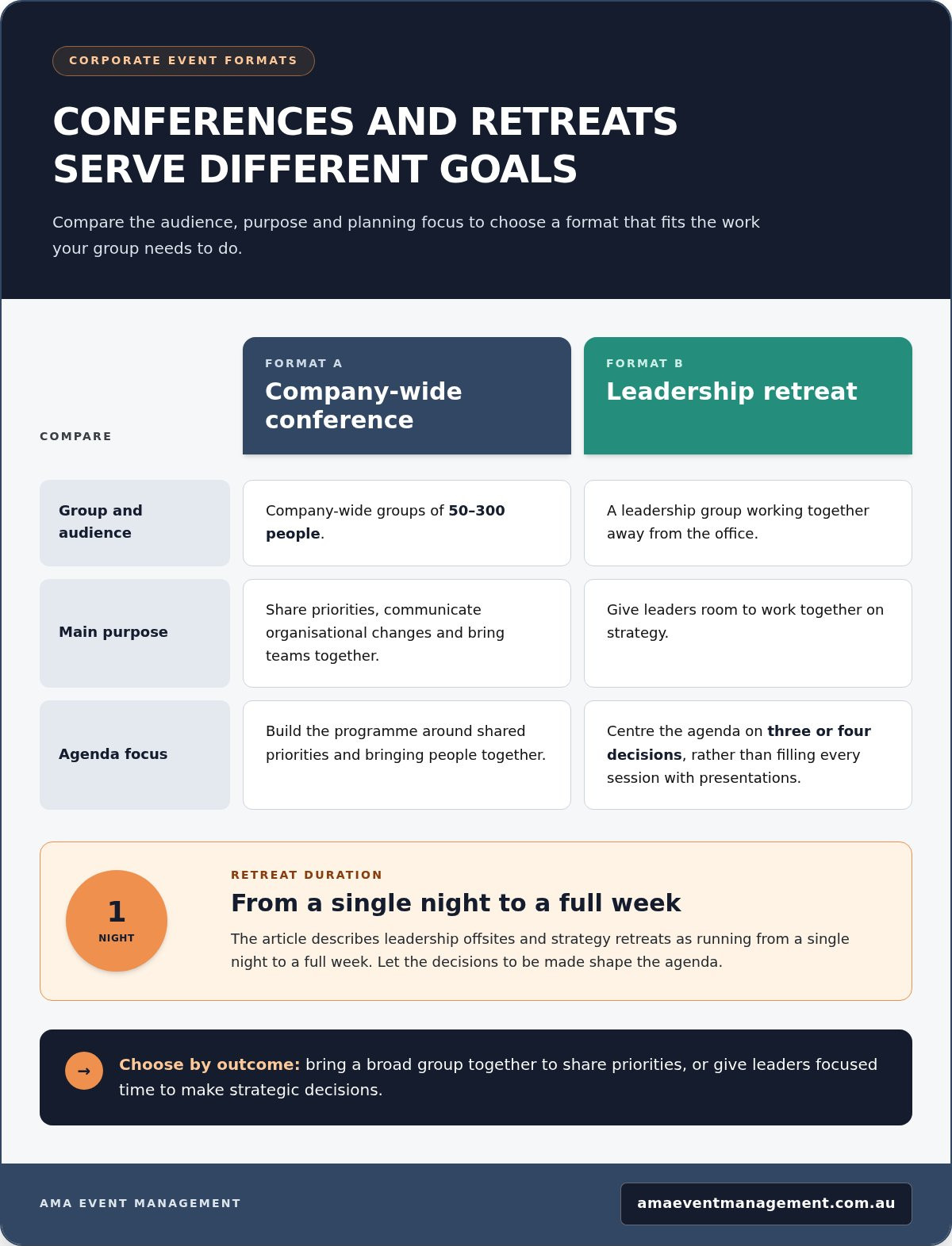
A company-wide conference suits a different purpose from a leadership retreat. Groups of 50 to 300 people can use a conference to share priorities, communicate organisational changes and bring teams together. A retreat gives leaders room to work together on strategy away from the office. Choose the format according to the decisions or shared understanding the event needs to produce.
Leadership offsites and strategy retreats can run from a single night to a full week. Centre the agenda on three or four decisions rather than filling every session with presentations. Leaders might set priorities, resolve a cross-team issue and agree how progress will be reviewed. A shorter programme can suit focused decision-making, while a longer retreat allows more time for discussion and reflection.
Room layout should support the way attendees will work. For events with fewer than 50 people, adjacent rooms can accommodate plenary sessions and breakouts. Participants can hear shared context together, then split into smaller groups before returning to compare recommendations. Confirm that the transition between rooms fits the timetable, particularly when sessions rely on presentations or equipment.
For events with more than about 120 people, plan for a dedicated plenary space, separate breakout rooms with their own AV, and sufficient on-site accommodation. These elements matter when attendees need to move between shared announcements, smaller discussions and overnight stays. Map the programme against each space before finalising the schedule. That makes it easier to identify clashes, unnecessary room changes and gaps in the attendee experience.
In Melbourne, Palladium at Crown Melbourne can host up to 1,300 seated guests. That capacity may suit a large formal gathering, but the event’s format still determines the right setup. A seated presentation, networking session and breakout programme each place different demands on the venue. Match the guest count and agenda to the room configuration, rather than using capacity as the only measure.
Treat a corporate conference package as a coordinated plan, not simply a room booking. Record venue spaces, session sequence, audiovisual requirements, catering arrangements and arrival information in one schedule. Identify who owns each decision and when it must be finalised. For a multi-session conference, this helps speakers, organisers and attendees follow the same plan.
Communication continues beyond the main stage. Give attendees a clear programme, explain where each session takes place and share changes promptly. A conference can combine company-wide updates with focused team discussions, while a retreat can protect time for strategic work. The right format makes the event’s purpose clear through its agenda, venue and participant experience.
4. Group cooking classes
A group cooking class gives participants a shared task, a clear sequence and a meal to enjoy together. In Melbourne, group classes are often suitable for groups of up to 20 people. Hands-on cooking sessions are recommended for groups of 10 to 40 people. The right format depends on the kitchen setup, the level of participation and how much interaction the group wants.
For a smaller executive team, choose a practical menu that lets everyone contribute without crowding the workstations. Participants can prepare separate components and combine them into a shared meal. For larger groups, divide people into teams, with each responsible for a dish or stage. This keeps the activity structured and gives everyone a shared outcome.
Interactive cooking works best when it has a purpose beyond completing a recipe. Teams can practise communication by coordinating preparation, timing and plating. A light challenge, such as presenting a dish to the group, adds focus without making the session a high-pressure contest. Keep the emphasis on collaboration, not culinary experience.
Plan the session for the people attending. Consider differences in cooking experience, mobility needs and dietary requirements. Gather dietary information during registration, then organise the menu and ingredient handling around those needs. Share the format in advance, including what participants will do, so attendees arrive ready to take part.
Timing matters. Allow space for an introduction, preparation, cooking, serving and a relaxed meal. If the session moves too quickly, participants may watch rather than take part; an overly long programme can lose energy. Map each activity stage against the event schedule, including transitions and time for conversation. This helps balance cooking with speeches or business discussion.
Cooking classes can offer low-stakes opportunities to solve challenges together. Teams share tasks, adapt when a step takes longer and coordinate the final presentation. These moments can prompt natural conversation across departments and seniority levels. Choose a menu and challenge that invite participation rather than relying on specialist skills or competition to hold attention.
Before committing, clarify the group size the kitchen can accommodate, what the session includes and how dietary needs will be managed. Match these details to the event’s purpose: a social team gathering may suit a relaxed shared meal, while a leadership session may use cooking as a break from formal discussion. A well-planned class gives participants a distinct experience and a reason to work together outside the office.
5. Choosing an event format by purpose and audience
Start with what executives should take away: a decision, stronger relationships, shared knowledge or recognition. Then choose a format that supports that outcome. A strategy session needs space for focused discussion; a gala creates an opportunity to recognise achievements; a social activity encourages informal conversation. For corporate event ideas that impress executives in Melbourne, match the format to the purpose, not just the calendar.
Networking, entertainment and team building serve different purposes. A conference reception gives guests space to meet, a gameshow adds shared entertainment, and an escape room asks participants to solve challenges together. Combine formats only when each has a clear place in the schedule. A short welcome followed by a collaborative activity, for example, can give attendees both introductions and a shared experience.
Audience matters as much as purpose. Consider seniority, how familiar teams are with one another, accessibility needs and appetite for participation. A competitive trivia format may suit colleagues who enjoy quick questions, while a quieter group may prefer guided conversation. Adapt activities to let everyone contribute without putting individuals under unnecessary pressure.
Scale the activity to the group and the setting. Cellar door experiences are recommended for groups of 8 to 30 people, while team mini-golf offers a lighter option for a social programme. A scenic helicopter experience creates a distinctive outing, but requires careful planning around travel and timing. Compare the practical demands as well as the memorable element before deciding.
Use a simple decision sequence. First, state the event objective in one sentence. Next, identify what participants should do or discuss. Then select a format, venue and programme that support those actions. For cross-team connection, choose an activity that mixes departments. For executive alignment, protect time for structured conversation and clear decisions.
Success also depends on how the programme fits together. Set start and finish times, include transitions and make the next step clear to attendees. For a conference followed by a gala, explain when formal sessions end and how guests move into the evening. For an activity-led event, describe participation expectations in advance. Clear communication helps people arrive prepared and keeps the experience coherent.
Finally, review the event against its original purpose. Ask whether the format supported networking, entertainment or team building, and capture practical improvements for next time. This gives organisers a useful basis for refining future corporate events. To shape a programme around your audience and objectives, plan a corporate event experience with considered logistics and a clear purpose.
AMA Event Management: Market Management and Vendor Coordination
AMA Event Management helps organisations turn an event concept into a coordinated experience shaped around its format and purpose. Its Corporate Conferences and Galas support executive gatherings that need clear event logistics. For public-facing events, Market Management and Vendor Coordination, Community Festivals and Fairs, and Themed Brand Activations serve different objectives.
Consider this support when the programme involves multiple event elements that need to work together, or when you need an experienced team to manage coordination. A conference, gala or brand activation each calls for a different plan, shaped by its audience, setting and desired experience.
To discuss an event that fits your organisation’s purpose, contact AMA Event Management.
Turn your event concept into a clear plan
Move from an appealing idea to a brief stakeholders can act on. Set out the experience you want attendees to remember, the message executives should take away and the practical decisions that need an owner. This gives the planning process direction and keeps each element connected to the organisation’s aims.
Before planning begins, align key stakeholders on the event’s purpose, audience and desired tone. Consider the attendee journey from invitation to departure, and decide how you’ll assess whether the event met its objectives. These choices give the programme a clear foundation and make later decisions easier to evaluate.
For corporate event ideas that impress executives in Melbourne, thoughtful coordination can shape the experience from first contact to the final moment. AMA Event Management offers Market Management and Vendor Coordination, Community Festivals and Fairs, and Themed Brand Activations. These services support different objectives, from coordinating participating vendors to creating an engaging brand experience.
Bring your objectives and initial concept together, then contact AMA Event Management today to discuss your event. A considered brief is a practical starting point for creating an experience that reflects your organisation with confidence.
Frequently Asked Questions
How far in advance should a corporate event be booked?
Book as soon as the date and event format are clear, especially for Melbourne’s busy periods. November through mid-December and the EOFY run in June and July tend to fill six to twelve months ahead. For a regional residential venue hosting a group of 20 to 80, allow three to six months. Once you have a preferred date, reserve the venue before finalising optional programme details.
What are the main types of corporate events?
Common formats include conferences, strategy retreats, galas, team-building activities, brand activations and private corporate celebrations. Each serves a different purpose: a conference shares information, a retreat creates space for decisions, and a gala recognises people or milestones. A brand activation can bring a product or message to life for an audience. Choose by asking what attendees should understand, do or remember afterwards.
What corporate event venues in Melbourne are suitable for impressing executives?
Choose a Melbourne venue that suits the programme, guest experience and privacy required. A heritage setting such as United Co’s Fitzroy building may appeal when character and city access matter; it is close to several tram stops. For presentations, prioritise a layout with clear sightlines and focused listening. For networking, consider how guests can move between the main event space and conversation areas.
What unique corporate event ideas are available in Melbourne?
Options include an interactive cooking session, a scenic helicopter experience, an escape room or a hosted gameshow-style activity. A winery visit can suit a group seeking a relaxed, conversation-led outing, while a cooking class gives participants a shared task. Match the idea to the group’s preferences and the event objective. Choose a collaborative challenge for team connection, for example, or a distinctive outing to mark a company milestone.
How much do executive corporate events in Melbourne typically cost per person?
There isn’t one typical per-person cost: the total depends on the format, venue, catering, equipment, entertainment and transport. A conference with technical requirements has different cost drivers from a small activity or formal gala. List essential elements first, then allow for optional enhancements and attendance changes. Event-management fees depend on the project and are provided after a quote request.
Which Melbourne venues offer private dining, rooftop views, or exclusive-use spaces?
Shortlist venues by the experience you want, then compare private dining rooms, rooftop settings and exclusive-use areas. These features suit different occasions: private dining supports confidential conversation, while a rooftop can create a social atmosphere. Ask for details on the room layout, access arrangements and which areas are reserved for your event. Match the space to your guest numbers and programme before deciding.
What transport and accessibility considerations matter for executive events in Melbourne?
Make the arrival plan clear before invitations go out. Share the venue address, nearby tram or train options, drop-off points and parking guidance, then explain the route from the entrance to the event space. Consider step-free access, lifts, accessible facilities and seating needs as you plan the guest journey. For events across multiple locations, allow time for transfers and give attendees clear directions between each part.

Comments