

Event Supplier Contract Checklist for Australian Organisers
A robust event contract is not merely a defensive shield; it's the architectural blueprint for a frictionless partnership. When you're managing a complex community festival or a high-stakes corporate gala, utilising a professional event supplier contract checklist ensures the stability of your entire project. It's common to feel a sense of apprehension regarding the fine print, especially when hidden fees or vague service standards threaten to compromise your vision. You want to ensure that every partner is as committed to excellence as you are, yet the reality of post-pandemic logistics often leaves organisers feeling exposed.
This guide provides a comprehensive framework tailored for the Australian market to help you standardise vendor onboarding and mitigate logistical risks. By establishing these professional boundaries, you can secure clear legal protection under Australian Consumer Law and eliminate the ambiguity that leads to disputes. We'll walk through the essential clauses every agreement needs, from precise cancellation terms to detailed performance benchmarks. This methodical approach ensures your next activation or brand experience runs with the quiet confidence and precision that defines a truly successful event.
Table of Contents
Why the Contract is the Foundation of Your Event Strategy
A robust contract is far more than a legal formality; it's the operational blueprint for your entire event. In the Australian event industry, the shift from informal "handshake deals" to rigorous professional accountability is essential for protecting your investment. By approaching your agreements as a meticulous architect, you're not just outlining services. You're mitigating risks, you're stabilising quality, and you're protecting your reputation. This structured approach serves as a grounding force, allowing you to maintain composed authority even when the pressure of event day intensifies.
Utilising a comprehensive event supplier contract checklist allows you to delegate tasks with total confidence. When expectations are documented with precision, the mental load on the organiser is significantly reduced. You don't have to guess if a vendor understands their role. The contract provides the certainty needed to lead a complex team toward a successful outcome, ensuring that the 1% of variables that could go wrong are already accounted for in writing.
The Cost of Informal Agreements
Relying on vague or verbal agreements introduces unnecessary risk into your project timeline. Equipment failures, last-minute cancellations, or unauthorised sub-contracting can quickly derail a corporate gala or brand activation. Without the framework of Australian contract law to anchor your partnerships, you're vulnerable to "scope creep" and unexpected budget blowouts. In the competitive Sydney and Melbourne corporate markets, these oversights don't just cost money; they damage your brand's standing. A professional agreement ensures that every dollar spent is accounted for and every service standard is met without exception.
Building Partnerships Through Clarity
High-calibre suppliers actually prefer detailed contracts. Clarity isn't a sign of distrust; it's a sign of professional respect. By establishing a collaborative tone during the initial negotiation, you create a partnership based on mutual transparency. Documenting every item within your event supplier contract checklist sets the stage for a seamless event day. When a vendor knows exactly what's expected regarding quality, timing, and conduct, they can perform their role with the same level of discipline you bring to the overall management. This clarity transforms a simple transaction into a reliable, long-term professional alliance.
Essential Clauses for Australian Event Supplier Agreements
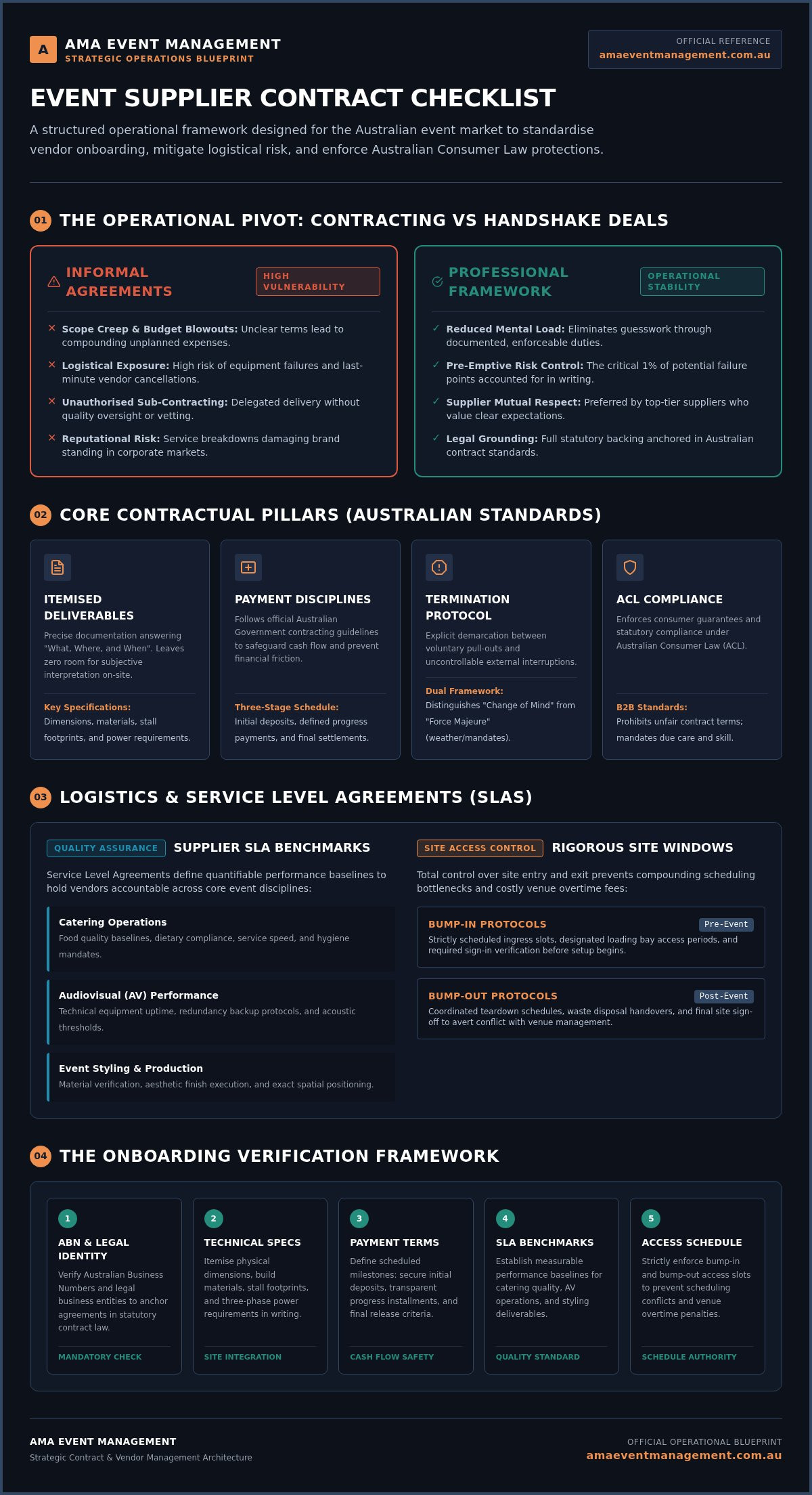
Precise documentation is the cornerstone of a secure partnership. When drafting your agreements, every entry on your event supplier contract checklist must be anchored in specific, measurable deliverables. This includes the "What, Where, and When" of the service, ensuring there's no room for interpretation on event day. For instance, if you're coordinating a themed brand activation, the exact dimensions, materials, and power requirements of a vendor's stall must be itemised to avoid logistical friction. This level of detail acts as a stabilizing force, allowing you to manage the project with quiet confidence.
Payment terms require equal discipline. You should clearly define the schedule for deposits, progress payments, and final settlements. Following the Australian Government guide to preparing contracts ensures your financial arrangements remain transparent and legally sound. This structure protects your cash flow while providing suppliers with the security they need to commit resources to your project. Clear financial boundaries prevent the "scope creep" that often leads to budget blowouts in high-pressure environments.
Termination and cancellation clauses have become increasingly complex. It's vital to distinguish between "Change of Mind" cancellations and "Force Majeure" events, such as extreme weather or government-mandated restrictions. A well-drafted clause specifies exactly what happens to the deposit in each scenario, preventing the emotional and financial strain of a legal dispute. This clarity ensures that both parties understand the risks involved and the agreed-upon path forward if the unthinkable occurs.
Navigating Australian Consumer Law (ACL)
The ACL provides a safety net by prohibiting "unfair contract terms" in B2B agreements, particularly those that create a significant imbalance in rights. Suppliers must also meet consumer guarantees, ensuring services are provided with due care and skill. As we look toward the future, the ACL dictates that by 2026, event cancellations must be handled with transparent refund policies that reflect actual costs incurred rather than arbitrary penalties. Keeping your event supplier contract checklist aligned with these regulations protects your organisation from future litigation.
Insurance and Compliance Requirements
Compliance is non-negotiable. For major community festivals or corporate galas, most NSW and Victorian councils require a minimum of $20 million in Public Liability Insurance (PLI). You must also verify your vendor’s Workers Compensation and Professional Indemnity certificates to ensure total coverage. Managing these intricate details is where AMA Event Management excels, acting as a meticulous architect to ensure every supplier meets local regulatory standards before they set foot on site.
Logistics and Performance: Beyond the Legal Jargon
While legal clauses provide the framework, the actual success of your activation depends on the logistical fine print. A comprehensive event supplier contract checklist must translate abstract rights into concrete site actions. This starts with a rigorous bump-in and bump-out schedule. You need to document specific loading dock access times, freight elevator dimensions, and vehicle clearance heights to prevent a bottleneck before the event even begins. Precise timing ensures your styling and AV teams aren't tripping over each other, maintaining the orderly environment required for high-level execution.
Service Level Agreements (SLAs) define what quality looks like in practice. For catering, this might involve specifying food temperature at the point of service or the exact ratio of floor staff to guests. In AV, it includes redundancy plans for critical equipment. These benchmarks allow you to hold vendors accountable to the high standards your brand demands. When negotiating these terms, referring to the ACCC guidelines on commercial contracts and unfair terms can help ensure your performance requirements are both enforceable and fair. Technical specifications should never be left to "on-the-day" workarounds; power draw requirements and cable run lengths must be verified well in advance.
The Importance of On-Site Supervision
Contractual terms are only as effective as their enforcement. Having a dedicated lead on-site to verify that every deliverable matches the agreed-upon scope is essential. This proactive oversight, often managed through on-site event supervision Sydney, ensures that any deviations are corrected immediately. If a vendor dispute arises, it's handled quietly and professionally behind the scenes. This allows the event to continue without interruption, preserving the guest experience and your reputation.
Sustainability and Inclusivity Benchmarks
Modern event management requires a commitment to social and environmental responsibility. Your event supplier contract checklist should now include specific waste management protocols for stallholders and caterers. This might involve banning single-use plastics or requiring a detailed plan for organic waste disposal. Similarly, accessibility standards must be documented to ensure that all attendees can engage with vendor activations. By codifying these environmental and inclusive commitments in the agreement, you ensure your suppliers are aligned with your organisation's broader values from the outset.
The 10-Point Event Supplier Contract Checklist
To ensure your next corporate gala or community festival remains on track, your event supplier contract checklist must be exhaustive. It serves as the final layer of protection before the first truck arrives on site. By standardising these ten points, you create a reliable framework that prevents common logistical oversights and financial disputes. This methodical approach allows you to lead your team with the quiet confidence that every detail is secured in writing.
Verified Supplier Details: Always confirm the ABN via the Australian Business Register and ensure the registered business name matches the entity you're paying.
Detailed Deliverables: Every service must be itemised. Don't just list "furniture"; specify "50 white bentwood chairs with cushions" to avoid standard-of-service issues.
The Event Timeline: Clearly define the windows for setup, the active performance or service period, and the final pack-down.
Financial Schedule: Document the total fee, the GST component, and specific deadlines for deposits and final settlements.
Cancellation Policy: Implement tiered refund schedules based on the notice period provided, ensuring fairness for both parties.
Reviewing the Fine Print
Dispute resolution shouldn't begin with a lawyer. Your contract should outline a clear, staged mediation process to resolve disagreements quickly and professionally. Confidentiality and Intellectual Property (IP) clauses are equally vital; they protect your event’s unique branding, strategy, and attendee data from unauthorised use. Finally, ensure your Force Majeure clause reflects the Australian context, specifically covering local risks like extreme weather events or sudden public health restrictions. This precision ensures you're never left guessing when "unforeseeable events" occur.
Final Execution and Storage
Efficiency is key during the final stages of vendor procurement. You should use legally binding digital signature tools to expedite approvals without sacrificing security. Once executed, store all agreements in a centralised management system so your on-site team can access them instantly if a vendor's delivery doesn't match the brief. For recurring events, such as night market stallholder applications, you must perform periodic reviews of your templates to reflect updated council regulations or insurance minimums. This continuous refinement keeps your operations disciplined and your brand protected.
If you're looking to standardise your vendor procurement process with professional oversight, partner with AMA Event Management to secure your next project's success.
Navigating Complex Vendor Partnerships with AMA
Managing a complex vendor ecosystem requires more than just a list of names; it requires a partner who understands the deep nuances of Australian logistics. AMA Event Management acts as your composed guide throughout the entire procurement process. We've spent over two decades refining our methods, providing a stabilising force for organisers who face the high-pressure demands of the industry. This extensive experience includes managing intricate corporate event logistics in Sydney and overseeing large-scale community festivals across NSW and Queensland.
We approach every project as a meticulous architect. This means we maintain a broad strategic view while remaining intensely focused on the smallest details. We don't simply provide an event supplier contract checklist; we integrate those requirements into a seamless operational plan. Whether you're planning a themed brand activation or a bespoke private celebration, our role is to act as a reliable anchor. We ensure that every moving part, from the smallest styling detail to the largest AV installation, is synchronised and performing to the highest standard.
The AMA Difference: Meticulous Oversight
Our oversight begins long before the first vendor arrives on site. We vet every supplier against a rigorous set of professional standards to ensure they align with our commitment to reliability and quality. Our history with recurring community markets, such as the Aussie Night Markets, demonstrates our ability to coordinate hundreds of individual stallholders with total precision. We take a disciplined approach to budget management and cost-efficiency. By identifying potential "scope creep" early, we protect your financial interests and ensure that every dollar spent contributes to a successful outcome without unexpected post-event fees.
Your Next Steps to a Frictionless Event
Outsourcing your vendor management to a seasoned expert isn't just about saving time. It's about significant risk mitigation. When you partner with us, you gain the peace of mind that comes from professional, project-based coordination. We handle the complex negotiations and the fine-print details so you don't have to. We invite you to connect with our team for a bespoke planning consultation where we can apply our event supplier contract checklist to your specific needs. Enquire about our end-to-end event management services to start building your next extraordinary celebration with absolute confidence.
Securing Your Event's Success Through Precision
A professional agreement is the stabilising force that allows your vision to transition from a concept to a flawless reality. By consistently using an event supplier contract checklist, you move beyond the uncertainty of informal deals and establish a foundation of mutual accountability. This process ensures every vendor is aligned with your standards for quality, safety, and logistical precision. It transforms a complex network of suppliers into a cohesive team, providing the legal protection and operational clarity required to lead with confidence. We know that successful execution doesn't happen by chance; it's the result of disciplined planning.
With 20 years of industry experience, we specialise in large-scale community festivals and corporate galas, providing expert on-site supervision for total peace of mind. We handle the intricate coordination so you can focus on your project's broader impact. Partner with the meticulous architects at AMA for your next event and ensure your project is anchored by professional discipline. We look forward to helping you deliver an extraordinary experience that exceeds every expectation.
Frequently Asked Questions
What is the most important clause in an event supplier contract?
The Scope of Work is arguably the most critical component because it defines the precise deliverables and performance standards required. It eliminates ambiguity by detailing exactly what the vendor must provide, from the number of staff to technical specifications. Without this clarity, organisers often face budget blowouts and "scope creep." Ensuring this clause is part of your event supplier contract checklist allows you to maintain total control over the project's quality and execution.
How much Public Liability insurance should an event vendor have in Australia?
Most major Australian councils, particularly in Sydney and Melbourne, require a minimum of $20 million in Public Liability insurance for any vendor operating on public land. This standard protects the organiser, the venue, and the public from significant financial risk in the event of an accident. You should always verify a vendor's Certificate of Currency before they bump in. This verification step is a non-negotiable part of a professional event supplier contract checklist.
Can I cancel an event supplier contract due to bad weather?
You can only cancel due to weather if your agreement includes a specific inclement weather clause or if the conditions trigger a Force Majeure event. Most contracts for community festivals and corporate galas include tiered refund schedules based on the notice period. If the event is outdoors, it's essential to define "unworkable conditions" clearly. This prevents disputes and ensures both parties understand their financial obligations when the Australian climate becomes unpredictable.
What happens if a vendor fails to show up on the day of the event?
A vendor's failure to appear constitutes a material breach of contract, which usually entitles the organiser to a full refund and potential damages. To mitigate this risk, professional planners use on-site supervision to manage arrivals in real-time. Having a "failure to perform" clause provides the legal leverage needed to recover costs. It's often helpful to have a contingency plan or a secondary supplier list ready for critical services like AV or security; for those requiring a reliable partner, you can learn more about Stone Security Services and their professional event protection solutions.
Digital signatures are fully legally binding in Australia under the Electronic Transactions Act 1999 and its state-based counterparts. They are a highly efficient way to manage vendor onboarding for large-scale events like recurring local markets. Using professional e-signature platforms provides an audit trail and ensures all parties have an identical, timestamped copy of the agreement. This modern approach reduces administrative delays and keeps your project timeline moving forward without friction.
How do I handle a dispute with a supplier after the event has finished?
You should first refer to the dispute resolution clause in your agreement, which typically mandates a structured mediation process. It's best to address issues through formal correspondence that references the specific performance benchmarks outlined in the contract. Handling these disagreements professionally and away from the public eye is vital for maintaining your brand's reputation. If mediation fails, the matter can escalate to the relevant state tribunal or court under Australian contract law.
Do I need a separate contract for every small stallholder at a community market?
Yes, every stallholder requires an individual agreement to ensure they are covered by the necessary insurance and compliance standards. For community festivals like the Aussie Night Markets, we use a standardised stallholder application that acts as a legally binding contract. This ensures every small business on site adheres to waste management, power safety, and public liability requirements. It creates a safe, orderly environment for both the vendors and the attendees.
What is a Force Majeure clause and why is it essential for Australian events?
A Force Majeure clause covers "unforeseeable events" beyond the control of either party, such as floods, bushfires, or government-mandated restrictions. It's essential for Australian organisers because it defines who bears the financial loss if the event cannot proceed. A well-drafted clause specifies whether deposits are refunded or held for a future date. This provides a sense of security and a clear roadmap for navigating complex, high-pressure situations without immediate litigation.


Comments