

The Meticulous Event Contingency Plan for Bad Weather: An Architect’s Checklist
Imagine standing on a festival site in Sydney as an unpredicted East Coast Low begins to brew on the horizon. The wind gusts are picking up, and you must decide if your temporary structures can safely withstand a sudden 60 km/h surge. It's a high-pressure moment that every organiser dreads, making a comprehensive event contingency plan for bad weather an absolute necessity rather than a luxury. You likely agree that managing outdoor events in Australia often feels like a gamble against the Bureau of Meteorology, where the stakes for public safety and financial reputation are incredibly high.
Mastering this process isn't about hoping for clear skies; it's about architecting a response that leaves nothing to chance. We promise to provide you with a methodical framework that transforms weather-induced anxiety into a disciplined, professional strategy. This guide breaks down the essential technical thresholds, from AS 1768:2021 lightning protocols to the Australian Warning System levels. You'll gain a clear, step-by-step checklist that ensures you remain the composed, stabilising force your vendors and guests rely on when the clouds turn grey.
Table of Contents
Understanding the Australian Weather Risk Profile for Events
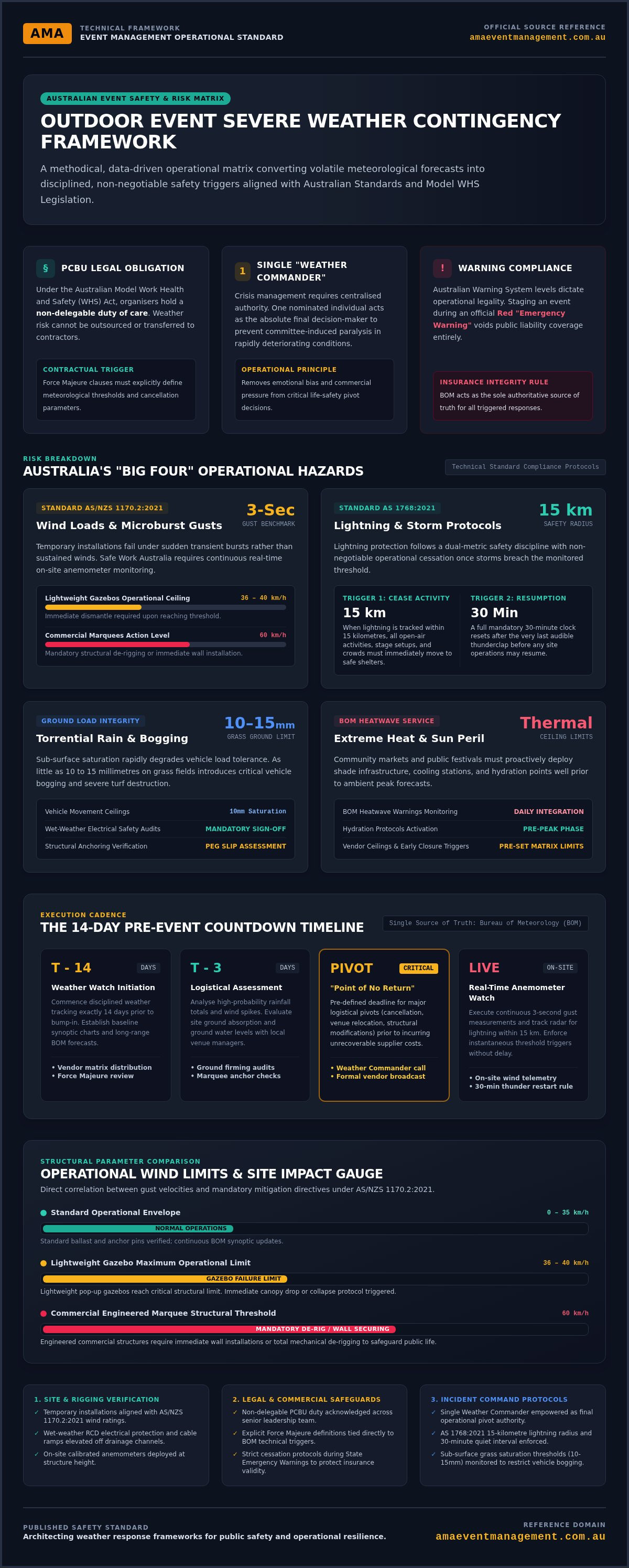
An event contingency plan for bad weather is far more than a simple backup site. It's a technical protocol that transforms unpredictable environmental variables into a series of manageable, data-driven actions. While many organisers focus solely on the threat of rain, a professional approach integrates broader contingency planning frameworks to address the "Big Four" Australian hazards: torrential rain, high winds, extreme heat, and lightning. We treat the Bureau of Meteorology (BOM) as the single source of truth for all operational decisions. A disciplined weather watch begins exactly 14 days before the first day of bump-in, allowing for a steady, methodical transition from monitoring to active response as the event date approaches.
Beyond Rain: The Hidden Danger of Wind and Heat
Australian conditions are notoriously volatile, and wind loads represent a significant structural risk that often goes overlooked. Adopting a "she'll be right" attitude toward marquee safety isn't just negligent; it's dangerous. We monitor 3-second wind gusts against engineering benchmarks, such as the AS/NZS 1170.2:2021 standard, because temporary structures often fail during sudden transients rather than sustained winds. For community markets and outdoor festivals, extreme heat is an equally critical peril. We utilise the BOM Heatwave Warning Service to trigger hydration protocols and shade requirements well before temperatures peak. Lightning safety follows a strict 15-kilometre rule under AS 1768:2021. If storm activity is tracked within this radius, outdoor activities must cease, and a full 30-minute wait is mandated after the final audible thunder before any resumption is permitted.
The Legal and Insurance Landscape in Australia
Organisers operate as Persons Conducting a Business or Undertaking (PCBUs) under the Australian Model Work Health and Safety (WHS) Act. This means your duty of care is non-delegable. You cannot simply transfer weather-related liability to your contractors or equipment suppliers. Proceeding with a public festival during a Red "Emergency Warning" from state authorities can void your public liability insurance and lead to catastrophic reputational damage. It's essential to scrutinise "Force Majeure" clauses in all vendor and venue contracts during the planning phase. These clauses must clearly define what constitutes an "Act of God" and establish the financial triggers for cancellation or postponement. By aligning your contracts with your weather matrix, you ensure that high-pressure decisions are guided by legal clarity rather than financial panic.
The Architecture of a Weather Decision Matrix
A professional event contingency plan for bad weather relies on a structured decision matrix rather than gut instinct. This matrix is a pre-determined blueprint that removes emotional bias from high-pressure situations by establishing clear, non-negotiable triggers. To ensure seamless execution, we recommend appointing a single "Weather Commander." This individual serves as the final authority, preventing the decision-making paralysis that often occurs when committees attempt to manage a developing crisis. By centralising oversight, you maintain the composed authority necessary to guide your team through shifting conditions without hesitation.
Setting Your Thresholds
Precision is the cornerstone of effective risk management. You must define specific weather parameters that mandate immediate action. For instance, standard lightweight gazebos often reach their operational limit at 36-40 km/h, while larger commercial marquees may require structural de-rigging or wall installation at 60 km/h. According to the Safe Work Australia hazardous weather guidelines, duty of care requires these thresholds to be monitored in real time using on-site anemometers. Rainfall limits are equally vital, particularly for grass sites where as little as 10-15mm can lead to bogged vehicles and site damage. For community markets, temperature ceilings are established using the BOM Heatwave Warning Service to trigger cooling stations or early closure. When these technical details feel overwhelming, engaging an expert in market management and vendor coordination ensures these thresholds are monitored with professional rigour.
The Communication Chain of Command
A meticulous architect remains several steps ahead of the crowd through a disciplined communication rhythm. This process follows a strict countdown protocol to ensure every stakeholder is informed but never panicked. At the 72-hour mark, we initiate an internal team briefing to review the "Advice" level forecast and prepare for potential pivots. By the 24-hour window, the "Point of No Return" (PONR) is reached. This is the latest possible moment to postpone or relocate before significant financial and logistical costs are locked in. Finally, the 4-hour protocol involves a site-wide safety check and final vendor notifications. We use a three-tiered communication strategy to maintain order:
Internal Team: Briefings focus on logistics and safety protocols to ensure a unified response.
Vendors and Stallholders: Direct updates keep the market ecosystem informed of load-in changes or cancellations.
Guests and Stakeholders: Composed, authoritative updates are delivered via social media and EDM to manage public expectations.
This steady, deliberate sequence mirrors a well-organised project timeline. It transforms a potential disruption into a managed event, ensuring that even if the weather turns, your reputation for reliability remains intact.
Infrastructure and Site Safety: The Hard Logistics
Ensuring structural adequacy is the physical manifestation of your event contingency plan for bad weather. It's the point where theoretical risk management transforms into tangible site safety. Every temporary structure, from the smallest vendor gazebo to the main festival stage, must align with Australian Standard AS/NZS 1170.2:2021 for wind actions. We don't rely on guesswork; we demand engineering certificates of structural adequacy before any patron sets foot on site. This meticulous approach extends to ground protection, where we use track mats and heavy-duty flooring to preserve the venue's integrity and prevent vehicle bogging during the critical bump-in and bump-out phases.
Marquee and Stage Stability
A structure's wind rating is only as reliable as its anchoring system. While pegging is effective in dense soil, many urban sites require concrete or water ballast weights to meet engineering benchmarks. We pay close attention to the "sail effect" created by side-walls. During gusty conditions, an enclosed marquee can trap air and exert massive upward lift, potentially exceeding its ballast capacity. Professional on-site supervision is essential to monitor these dynamics in real time. We follow the guidance provided in the Safe and Healthy Crowded Places Handbook to manage crowd movements and structural de-rigging if 3-second gusts approach the 60 km/h engineering benchmark. This ensures that the site remains a controlled environment even when the wind picks up.
Electrical and AV Protection
Water and electricity represent a volatile combination that requires strict oversight. All outdoor lighting, sound equipment, and LED screens must possess appropriate Ingress Protection (IP) ratings to withstand moisture. We implement a disciplined cable management strategy, using elevated cable bridges or heavy-duty ramps to prevent trip hazards and water ingress. Generators are positioned on high ground to avoid pooling water and are earthed according to Australian Standards to ensure safety in damp conditions. Our logistics team always carries a dedicated "Wet Weather Kit," which includes:
Heavy-duty waterproof tape and industrial-grade cable ties.
Calibrated anemometers for real-time wind speed monitoring.
Sandbags and additional ballast for rapid structure reinforcement.
Submersible pumps for clearing low-lying areas.
This level of preparation ensures that the infrastructure remains stable and the technical production continues without interruption. It projects a sense of quiet confidence to your vendors and guests, reinforcing the image of a well-ordered and professional operation.
The Master Event Contingency Checklist
A master event contingency plan for bad weather isn't a static document; it's a living project timeline that guides you from the initial risk assessment through to the final post-event debrief. This methodical approach ensures every stakeholder understands their role when conditions shift. During the pre-event phase, we focus on rigorous insurance reviews and vendor contracts that clearly define weather-related liabilities. As the event approaches, the monitoring phase takes over, involving constant BOM tracking and site inspections to verify that all triggers remain relevant to the current forecast. The execution phase is where your preparation pays off, allowing for a composed deployment of wet weather infrastructure and a structured communication blast to your entire network. Finally, a post-event damage assessment and stakeholder debrief ensure that lessons are documented for future resilience.
Pre-Event: Finalise risk assessments and audit vendor insurance certificates.
Monitoring: Review hourly BOM updates and check site anemometer readings.
Execution: Deploy ground protection and initiate the communication chain.
Post-Event: Conduct a site restoration check and document structural performance.
The 48-Hour Critical Window
The two days leading up to bump-in are the most significant for a disciplined organiser. We recommend a final site walk-through with your professional event coordinator to identify any new environmental risks, such as soft ground or blocked drainage channels. This is the moment to confirm "Plan B" logistics with your hire companies, ensuring that additional weights or flooring are on standby. We also draft the "Composed Response" emails and social media updates at this stage. Having these templates ready allows you to communicate with guests and vendors with quiet confidence, even if you're making a high-pressure call on the morning of the event.
On-Site Execution Checklist
Once you're on the ground, the focus shifts to the minutiae of site safety and infrastructure. A meticulous architect leaves nothing to chance, checking every marquee tie-down and ballast weight against the engineering requirements discussed earlier. We pay particular attention to clearing drains and identifying potential pooling areas that could disrupt the visitor experience. It's also vital to brief the community festival organisers on the emergency PA script. This ensures that any necessary announcements are delivered clearly and calmly, preventing panic and maintaining order. If you're managing a complex site with multiple moving parts, our team provides the expert market management and vendor coordination needed to execute these protocols seamlessly. This level of oversight ensures that your event remains a stabilising force, regardless of what's happening on the horizon.
Composed Execution: Why Professional Oversight is Non-Negotiable
The transition from a theoretical event contingency plan for bad weather to its live execution is the moment where true expertise becomes visible. While a plan provides the map, professional on-site supervision provides the steady hand at the wheel. With over 20 years of industry experience across Sydney and Melbourne, AMA Event Management understands that a weather event is as much a psychological challenge as it is a logistical one. Anxiety can spread quickly through a site, but a composed leader acts as a stabilising force, preventing panic and ensuring that every safety protocol is followed with disciplined precision.
The Architect vs. The Amateur
The primary difference between a seasoned professional and an amateur organiser is the ability to maintain quiet confidence when conditions deteriorate. An architect of events anticipates the ripple effects of a storm, such as how increased humidity might affect technical equipment or how a sudden shift in wind direction impacts pedestrian flow. For example, managing a night market stallholder application process during a volatile wet season requires more than just administrative skill. It demands an understanding of which vendors have the appropriate weighted infrastructure and which may need additional support to remain operational. This level of foresight protects your reputation and ensures that the human element of the event remains calm and informed.
Partnering for Peace of Mind
Building resilience into a large-scale festival or brand activation is a collaborative process that starts long before the clouds roll in. A robust event contingency plan for bad weather is the foundation of this security, but its success relies on the disciplined oversight of a seasoned expert. By integrating methodical market management into your planning phase, you ensure that every stallholder and contractor is aligned with your safety culture. We don't just react to the weather; we manage it through a series of logical, sequential steps that prioritise the wellbeing of everyone on site. This disciplined approach transforms a high-pressure environment into a showcase of professional competence.
If you're ready to master the art of composed event delivery, we invite you to consult the architects of methodical logistics. Let AMA Event Management handle the unforeseen so you can focus on the success of your project. Reach out to our team today to begin architecting your next resilient event.
Architecting Resilience for Your Next Event
Navigating Australia's volatile weather patterns requires more than just a backup venue. It demands a technical and psychological framework that prioritises site safety and structural integrity. By establishing clear operational triggers and maintaining a disciplined communication chain, you transform potential chaos into a managed logistical process. You've seen how a robust event contingency plan for bad weather acts as a stabilising force, ensuring that vendors, stakeholders, and guests remain safe and informed when conditions shift.
Success in these high-pressure moments is rarely accidental. It's the result of meticulous preparation and the quiet confidence that comes from deep industry knowledge. With 20 years of expertise as specialists in NSW and QLD logistics, our team provides the professional oversight necessary to handle the unforeseen. We invite you to secure your event’s success with AMA’s composed management services. When you partner with experienced architects of event delivery, you can proceed with the certainty that your project is in capable hands. We look forward to helping you deliver a flawless experience, regardless of what the elements bring.
Frequently Asked Questions
What is the most important part of an event contingency plan?
The most critical component is the establishment of non-negotiable operational triggers paired with a clear chain of command. An event contingency plan for bad weather fails if there's ambiguity during a crisis. You must define the specific weather parameters that mandate action and appoint a single "Weather Commander" to make the final call. This structure removes emotional bias and ensures the safety of all attendees through decisive, data-driven leadership.
How much rain is too much for an outdoor event in NSW?
The threshold for rainfall depends heavily on your venue's surface and drainage capacity. For grass sites common in Sydney regional parks, as little as 10 to 15 millimetres of rain can lead to significant soil saturation and vehicle bogging. We monitor Bureau of Meteorology (BOM) forecasts closely to assess the risk of site damage. If heavy falls are predicted during the bump-in phase, it often necessitates an early pivot to protect the ground.
At what wind speed should I evacuate an event marquee?
Evacuation protocols typically trigger when 3-second wind gusts approach the 60 kilometres per hour benchmark for standard commercial marquees. While some structures are engineered for higher loads, this threshold accounts for the "sail effect" of side-walls and the stability of ballast weights. It's vital to use calibrated on-site anemometers rather than relying on distant airport data. This ensures you're making decisions based on the specific micro-climate of your Sydney or Melbourne event site.
Do I need special insurance for bad weather at my event?
Standard public liability insurance does not cover the financial losses associated with cancellation or postponement. You should consider specific "Adverse Weather" or parametric insurance policies that pay out based on pre-agreed BOM data. These policies are essential for protecting your investment against extreme heat, torrential rain, or cyclonic winds. Always review the "Force Majeure" clauses in your vendor contracts to ensure your insurance coverage aligns with your legal obligations and financial risks.
How do I communicate an event postponement to guests without causing panic?
Effective communication relies on a composed, authoritative tone that provides clear instructions without unnecessary alarm. Use a structured "Composed Response" template across social media and EDM channels to explain the decision based on public safety. Focus on the solution, such as the new date or venue, rather than the severity of the weather. This methodical approach maintains your reputation as a reliable organiser and ensures guests feel secure and well-guided throughout the transition.
Who is responsible for the final decision to cancel an event due to weather?
The final decision rests with the designated "Weather Commander," who typically operates as the lead Person Conducting a Business or Undertaking (PCBU). Under Australian Work Health and Safety laws, this duty of care is non-delegable. While you may consult with stakeholders and structural engineers, one individual must hold the authority to trigger the event contingency plan for bad weather. This prevents decision-making paralysis and ensures that safety remains the absolute priority during high-pressure scenarios.
What should be included in a wet weather kit for event staff?
A professional wet weather kit includes essential items for rapid site reinforcement and technical protection. Your kit should feature industrial-grade waterproof tape, heavy-duty cable ties, and calibrated handheld anemometers for real-time wind monitoring. Additionally, ensure you have a supply of sandbags for extra ballast and submersible pumps for clearing pooling water in low-lying areas. These tools allow your logistics team to act proactively, maintaining site stability and technical production even as conditions change.
Can an event still proceed during a BOM severe weather warning?
Proceeding during a BOM severe weather warning is a high-risk decision that requires a thorough site-specific risk assessment. While an event might technically continue during an "Advice" level warning, a "Watch and Act" or "Emergency Warning" usually mandates the activation of your contingency protocols. Ignoring these official alerts can void your insurance and lead to severe legal repercussions. We prioritise public safety by aligning our site actions with the Australian Warning System's directives.


Comments