

Family-friendly festival ideas for Sydney organisers
The most memorable family moment at a Sydney festival may not come from its biggest stage. A shortlist of family-friendly festival entertainment ideas Sydney organisers can deliver should do more than fill the programme: it needs to engage different age groups while fitting the site, schedule and event operations.
That balance can be difficult to get right. Children want activities they can take part in, carers need room to pause and regroup, and the wider community should feel welcome. A varied programme can support these needs when each activity suits its audience and setting.
This guide compares practical formats, from hands-on workshops and interactive play to live performances and visual experiences. It also covers how to plan timings, manage space, coordinate suppliers and consider different access needs. Use it to build a shortlist and plan how to bring the programme together.
Table of Contents
What makes family-friendly festival entertainment work in Sydney?
Family-friendly festival entertainment welcomes children and carers while giving people of different ages and interests a reason to enjoy the same event. The aim isn’t to make every activity suit everyone. It’s to create a thoughtful mix, so families can choose how they take part and other festival-goers still feel included.
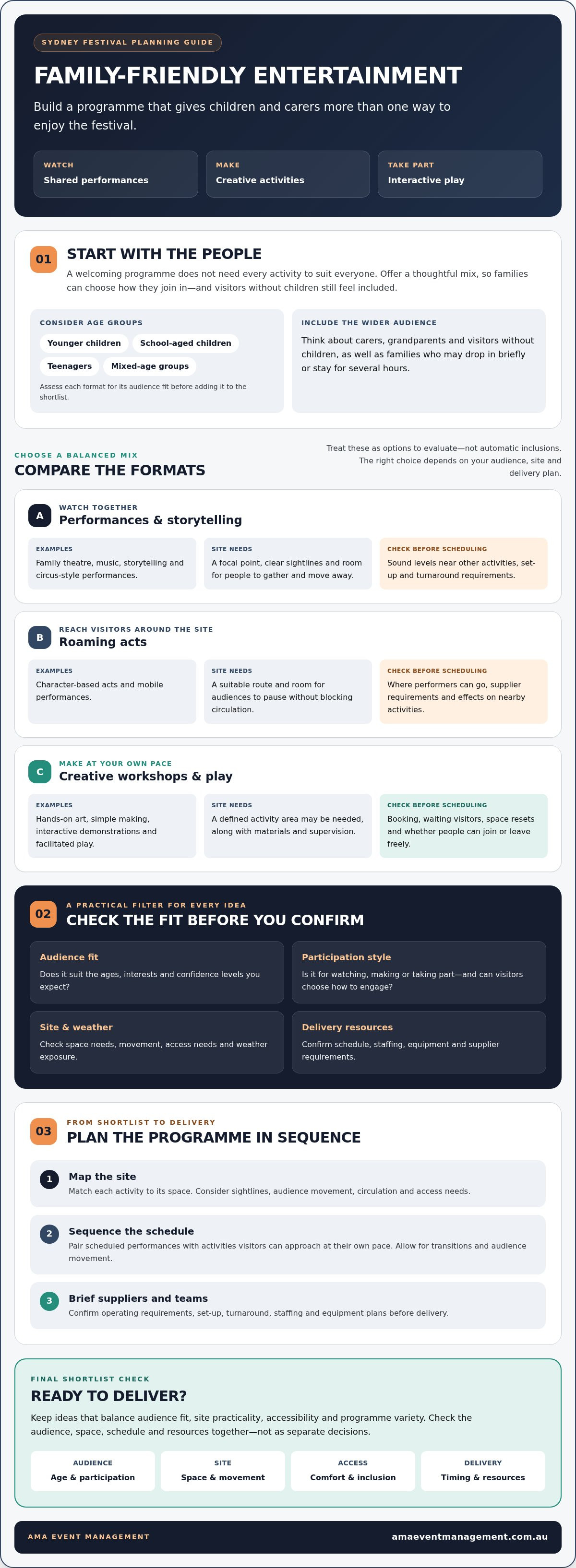
A performance gives visitors a shared moment to watch; a creative activity lets them make something at their own pace; interactive play invites them to join in. Together, these formats make for a more balanced programme than one built around a single type of experience. The best family-friendly festival entertainment ideas Sydney organisers consider should also suit the audience, site, schedule and resources available.
Start with the families and community you want to welcome
Begin with your expected audience. Consider whether you’re planning for toddlers, school-aged children, teenagers or a mix, and whether people may drop in briefly or stay for several hours. Think about carers, grandparents and visitors without children, too. Their comfort and enjoyment contribute to the wider festival atmosphere.
Ask community partners what local families would find engaging and comfortable. Their input can help test assumptions before you choose formats. For broader context, explore the range of festivals in Australia, then focus your planning on the needs and character of your community.
Build a programme that offers more than one way to join in
Pair scheduled performances with activities visitors can approach at their own pace. A lively show might appeal to people ready to gather and watch, while a hands-on creative station gives others a quieter way to participate. Consider different energy levels, interests and confidence levels, and make sure visitors don’t have to join in to feel welcome.
The mix also needs to work as a programme, not just as a collection of appealing ideas. Check that formats fit the available spaces, running order and staffing and equipment plans. AMA’s guide to community festival organisers in Australia offers further context on shaping an event around its community and practical requirements.
Use these principles to filter ideas before comparing individual formats. Next, weigh up what each option asks of your audience, site and delivery team.
Festival entertainment ideas for children and families in Sydney
To compare family-friendly festival entertainment ideas Sydney organisers can programme, assess each format by audience fit, participation style, space and scheduling needs. A stage show may suit families who want a shared performance, while an activity station gives visitors more freedom to join in at their own pace. Treat these as formats to evaluate, not automatic inclusions: the right choice depends on your audience, site and delivery plan.
Performances, storytelling and roaming acts
Family theatre, music, storytelling and circus-style performances can create a focal point for children, carers and other visitors. A fixed audience area needs clear sightlines and enough space for people to gather and move away. Check sound levels near other activities, and confirm performers’ set-up and turnaround requirements before adding acts to the running order.
Roaming entertainment, such as a character-based act or mobile performance, can reach visitors across a larger site without asking everyone to gather in one place. It still needs a suitable route, room for audiences to pause without blocking circulation, and clear limits on where performers can go. Confirm operating requirements with the supplier and consider how the timing affects nearby activities.
Creative workshops, play and interactive activities
Hands-on art, simple making activities, interactive demonstrations and facilitated play offer an active alternative to watching. They can suit visitors who prefer a quieter, self-paced experience as well as children who enjoy making or experimenting. Check whether the format needs a defined activity area, materials, supervision or booking, and how the team will manage waiting visitors and reset the space between sessions.
Interactive play may attract visitors for different lengths of time. Decide whether people can join and leave freely or need to stay for a set activity. A workshop with a clear start and finish may be easier to schedule; an open activity offers more flexibility but may need ongoing oversight. Eventbrite’s advice on planning family-friendly events can help organisers consider practical details such as timing and pram access.
Themed activations can also offer an interactive format, particularly where the festival has a clear theme or community focus. They need to suit the event and work within its footprint. AMA’s Sydney brand activation guide explores how activations can be shaped around an audience and setting.
Once you have a shortlist, compare the space, staffing, equipment and timing each option requires. AMA Event Management plans and coordinates community festivals and fairs, which can help organisers bring entertainment choices into a broader delivery plan. Explore AMA’s festival management support when assessing how programme coordination could fit your event.
How to compare family festival entertainment by age, access and site
A promising activity still needs to work for the people attending and the place hosting it. Use a comparison table to assess each option consistently, then confirm details against the actual venue layout, weather contingency and access conditions. This helps organisers weigh family-friendly festival entertainment ideas Sydney audiences may enjoy against what the event can deliver.
Format
Audience fit and participation
Space and weather
Live performance
Shared, scheduled viewing; check age appeal and sightlines.
Needs a defined audience area; assess sound, shelter and weather exposure.
Creative workshop
Hands-on, often guided; check instructions and participation options.
Needs room for materials and activity; consider cover and accessible approaches.
Interactive play
Active or self-paced; assess suitability across ages and confidence levels.
Needs a clear footprint and movement space; check surface and weather conditions.
Roaming entertainment
Visitors can watch or engage as the act moves around.
Needs a suitable route that won’t obstruct access or audience flow.
Match activities to age ranges and different participation needs
Consider younger children, school-aged children, teenagers and mixed-age family groups separately. Age guidance doesn’t tell you what someone can or wants to do, so avoid labelling an activity as suitable for everyone. Check whether visitors can participate quietly, sit down, follow clear instructions or stay close to carers. Consult relevant community groups when shaping access provisions, and use their feedback to identify practical adjustments.
Check the Sydney site, weather exposure and audience flow
Compare indoor, covered and outdoor options against the confirmed venue plan. A workshop may need shelter, while a performance needs space for gathering without blocking entry and exit paths. Map queues, nearby activities and routes between programme areas; sound or crowd overlap can affect how well formats work together.
Whether you’re planning in Sydney or Melbourne, check the specific site’s weather contingency, permissions and applicable requirements with the venue or relevant authority. Conditions differ between locations, so don’t assume an arrangement that suits one site will transfer to another. This review helps turn an appealing shortlist into a coordinated programme.
Plan the entertainment schedule, site layout and delivery
A workable programme takes more than selecting appealing family-friendly festival entertainment ideas Sydney audiences might enjoy. Plan in sequence: confirm event objectives, map the site, select formats, build the schedule, then brief suppliers. This connects audience needs to practical decisions about space, timing and delivery.
Map activity footprints, access routes, gathering areas and nearby uses. Check which shortlisted formats fit each location and what they require, such as power, equipment, staff or weather protection. Staffing, permissions and safety requirements depend on the activity and venue, so confirm them with suppliers and the relevant land manager or authority.
Create a running order that supports a relaxed festival visit
Build the schedule around the time each activity needs, not just its advertised performance or session length. Allow for set-up, pack-down, changeovers and possible delays. Give families time to move between locations without rushing, and avoid overlapping attractions likely to draw the same audience from opposite ends of the site.
Plan a wet-weather alternative where the site and format allow one. If an activity can only proceed in suitable conditions, make that clear in the running order and visitor information. A schedule that accounts for transitions and contingencies is easier for suppliers and on-site teams to follow.
Coordinate suppliers, site operations and visitor information
Give each supplier a clear brief covering arrival and departure arrangements, equipment, access routes, activity timing and the on-site contact. Confirm how their requirements fit with site operations and other activities. Prepare visitor information that makes locations, age guidance and participation details easy to find, so families can decide what suits them before setting off across the site.
Check event-specific permits, insurance and safety obligations with the venue or relevant authority rather than relying on general assumptions. For example, the City of Sydney advises submitting applications at least 16 weeks before major events and six weeks before minor events on its land. It also requires public liability insurance with minimum cover of A$10 million for any individual claim when organisers use City public spaces. Confirm current requirements directly with the relevant authority.
For broader planning guidance, read AMA’s community festival planning and management guide. If you’d like support coordinating a festival programme, explore AMA’s community festival and fair management, which includes planning, logistics and on-site coordination.
Turn your Sydney festival entertainment shortlist into a deliverable plan
A strong shortlist becomes a workable programme when every option has a clear purpose and a confirmed path to delivery. Before committing, test each activity against your audience, site, schedule and available resources. This helps distinguish appealing family-friendly festival entertainment ideas Sydney organisers can realistically deliver from options that still need more information.
Use a final decision checklist before confirming entertainment
Work through the same checks for each proposed activity. Record the answers and flag anything that still needs approval or verification before you publish the programme.
Audience and objectives: Does the activity serve a defined audience need and support the festival’s aims?
Site and access: Does the confirmed location suit the activity, including its space, access and weather requirements?
Schedule: Is there enough time for the activity, set-up, changeovers and visitor movement?
Supplier requirements: Are equipment, staffing, access arrangements and on-site contacts clear?
Contingencies and approvals: Are weather alternatives understood, and are outstanding permissions or requirements recorded?
Keep unresolved items visible rather than treating them as minor details. If a site arrangement, supplier requirement or approval could change the activity, confirm it before making a public commitment. This also makes it easier to compare options fairly and maintain balance across the programme.
When event management support can simplify delivery
Coordinated planning can be useful when entertainment involves several suppliers, activity areas or operational dependencies. An event management partner can help connect programme decisions with logistics, vendor procurement, budget management and on-site supervision. These elements are part of delivering a community festival or fair, rather than decisions made in isolation.
AMA Event Management plans and manages community festivals and fairs, with planning, logistics, vendor procurement and on-site supervision among its capabilities. Founder Amanda brings more than 20 years of industry experience. The appropriate level of support depends on your event’s requirements, site and delivery structure.
If you’re shaping a Sydney festival programme and would like to discuss how planning and coordination could fit your event, discuss your Sydney festival plans with AMA.
Shape a festival programme families can enjoy
The strongest family-friendly festival entertainment ideas Sydney organisers choose balance participation with practical delivery. A mix of performances, creative activities and interactive options can welcome different ages and interests, while checks for access, site suitability and audience flow help turn a shortlist into a workable programme.
Before confirming entertainment, connect each activity to an audience need, allow for transitions in the schedule and record supplier details or approvals still to verify. These steps help the programme feel considered for families and manageable for the event team.
AMA Event Management plans and manages community festivals and fairs, with services including planning, logistics, vendor procurement and on-site supervision. Founder Amanda brings more than 20 years of industry experience. If you’re developing a festival in Sydney or Melbourne, discuss your festival plans with AMA Event Management to explore how coordinated event planning could support your requirements.
With clear priorities and a well-coordinated plan, you can create a welcoming festival experience for families and the wider community.
Frequently Asked Questions
What entertainment is suitable for a family-friendly festival in Sydney?
A suitable programme combines performances, creative activities and interactive experiences selected for the audience and venue. For family-friendly festival entertainment ideas Sydney organisers are assessing, compare age guidance, participation style, access needs, space and weather exposure. A performance may need a defined viewing area, while a drop-in activity may require materials and ongoing supervision. Pair a varied shortlist with a clear schedule and site plan, then confirm delivery requirements with each supplier.
How do you make festival entertainment enjoyable for different age groups?
Offer activities with different energy levels, durations and ways to participate. A scheduled performance could sit alongside a hands-on activity and a quieter option, giving families room to choose what suits them. Check age guidance with each supplier rather than assuming one format will work for everyone. Consider how carers and mixed-age groups can enjoy activities together, and publish clear details so visitors can make informed choices before they arrive.
What are some low-pressure entertainment ideas for a community festival?
Storytelling, drop-in creative activities, demonstrations and performances visitors can watch without registering can offer lower-pressure ways to take part. Their suitability depends on the audience, site and delivery plan. Check space, sound, materials, staffing and participation arrangements before confirming an activity. Don’t describe an option as universally accessible. Ask suppliers and relevant community groups what practical adjustments may help more visitors participate comfortably, then include accurate guidance in the programme.
How can a Sydney festival plan for wet weather?
Check the venue’s indoor or covered options first, then identify which activities could move or adapt. Confirm each supplier’s weather requirements, decision timelines and equipment needs, and build contingency time into the running order. Prepare visitor updates explaining any programme changes and where to find current information. Conditions and permissions differ between Sydney venues, so confirm the specific wet-weather arrangements with the site manager before publishing a contingency plan.
How do you choose entertainment for a festival site?
Compare each option with the site layout, audience flow, access, equipment or power needs, sound levels and schedule. Mark possible queues and check whether nearby activities might compete for space or attention. Ask suppliers to document their operational requirements, then review the proposed arrangement with the venue or land manager. A site plan helps identify conflicts before you confirm activity locations or publish the programme.
Should a festival hire an event manager to coordinate entertainment?
Event management support may help if your team needs assistance connecting entertainment choices with planning, logistics, vendor coordination, budget management or on-site supervision. The right scope depends on the festival’s objectives, complexity and your internal capacity. AMA Event Management manages community festivals and fairs, and founder Amanda has more than 20 years of industry experience. Ask any prospective event manager to clarify responsibilities, including what they coordinate and what remains with your team or venue.


Comments