

Local Market Coordination Services: The Architect’s Guide to Professional Management
A successful community market is far more than a collection of gazebos on a Saturday morning; it's a precisely engineered ecosystem where safety, commerce, and culture intersect. When you're at the helm, the weight of responsibility can feel immense. You aren't just managing stalls; you're navigating complex council requirements and public safety standards that demand absolute precision. Engaging professional local market coordination services ensures that every moving part, from the initial vendor application to the final pack-down, is handled with the steady hand of a seasoned architect.
We understand that the pressure to deliver a safe, commercially viable, and vibrant event can be overwhelming. You want a frictionless experience for your vendors and a memorable day for your visitors, yet the logistics often feel like a barrier. This guide will show you how meticulous management transforms these challenges into a seamless community landmark. We'll examine the essential pillars of expert coordination, including balanced vendor curation, rigorous compliance protocols, and the strategic site layouts that drive sustained foot traffic and long-term success.
Table of Contents
Defining Professional Local Market Coordination Services in Australia
In the context of Australian event management, professional local market coordination services represent the strategic oversight of vendor logistics, site safety, and community engagement. It's a role that goes far beyond the simple allocation of stall spaces. It functions as a market coordination mechanism that aligns the commercial interests of small businesses with the safety requirements of local government and the expectations of the public. This service acts as a stabilising force, ensuring that every participant, from the artisan baker to the council inspector, operates within a structured and secure environment.
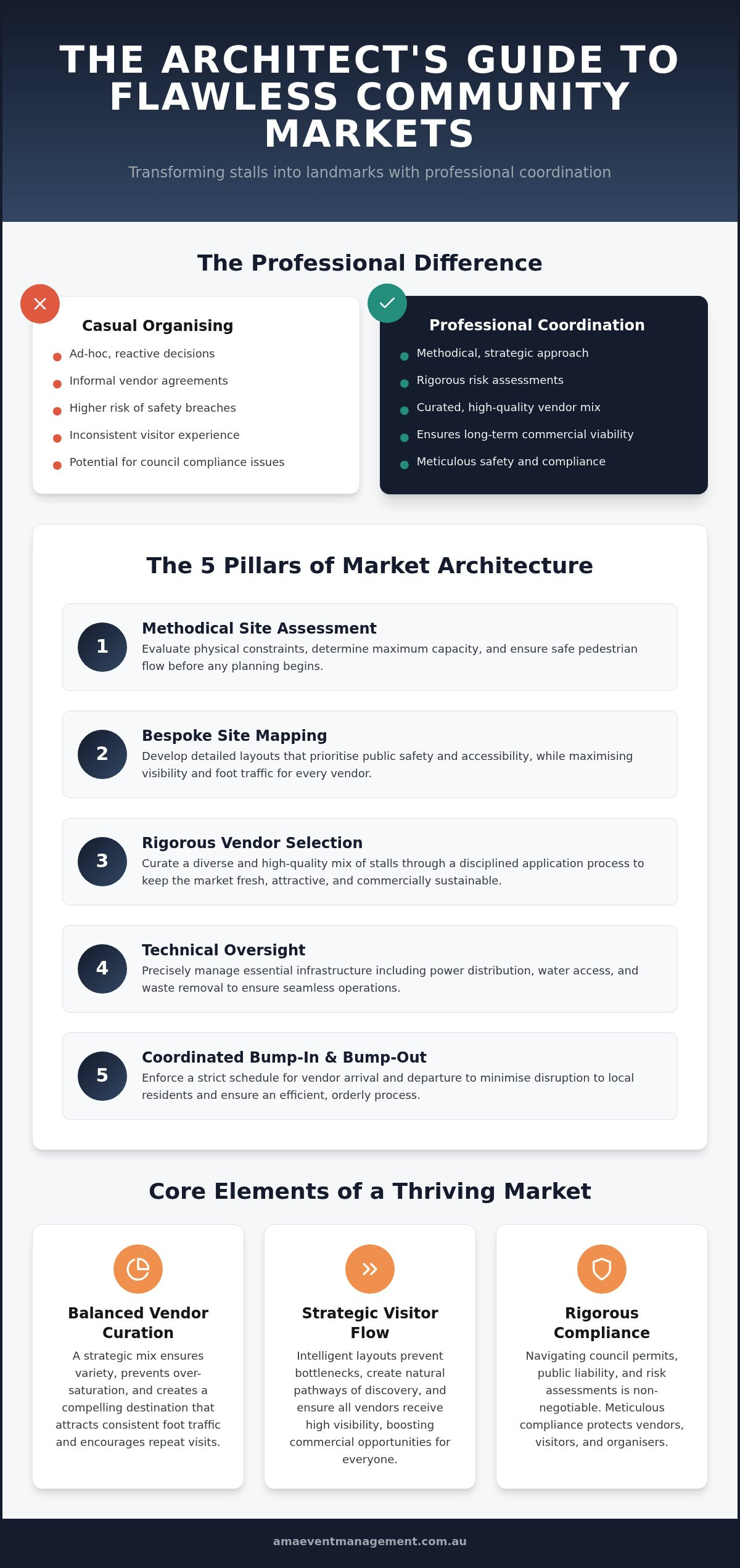
Distinguishing between casual market organising and professional coordination is vital for any stakeholder. Casual organising often relies on ad-hoc decisions and informal vendor agreements. In contrast, professional services are defined by a disciplined, methodical approach. This includes rigorous risk assessments, curated vendor mixes, and sophisticated site layouts that prioritise foot traffic flow. Councils and developers in Sydney and Melbourne increasingly outsource this role because the regulatory environment in 2026 demands a level of precision that internal teams often lack the capacity to maintain.
Beyond the Stall: The Scope of Modern Coordination
The role has evolved from simple stall booking into comprehensive site management. We view this as market stewardship. It's about fostering long-term community growth rather than just filling a park for a day. When a market is professionally coordinated, it becomes a driver for local economic development. It provides a low-barrier entry point for micro-businesses while creating a vibrant destination that benefits surrounding brick-and-mortar retailers. This includes niche service providers; for example, you can learn more about Atoz Watch And Jewellery Repairs to see the type of precision craftsmanship that thrives in both physical shops and curated artisan spaces. This holistic view ensures the event remains sustainable and continues to receive positive community feedback year after year.
Why Intent Matters: Event Logistics vs. NDIS Coordination
It's helpful to clarify the terminology used within Australia. While the term "coordination" is frequently used within the NDIS framework to describe personal support connections, in our industry, it refers strictly to the physical and logistical management of a trading site. We don't manage individual care plans; we manage the complex intersection of power requirements, waste management, and public access. Local market coordination is the methodical architecture of public trading spaces. This distinction ensures that developers and councils are engaging the right expertise for high-pressure public environments.
The Logistics of Coordination: From Site Maps to Vendor Curation
The physical manifestation of a successful event relies on a disciplined logistical framework. Professional local market coordination services bridge the gap between a conceptual plan and a functional, high-traffic site. This architectural approach ensures that every stall is positioned with purpose and every technical requirement is met before the first patron arrives. The coordination process follows a structured timeline of five essential steps to ensure the event remains safe and sustainable.
Methodical Site Assessment: We evaluate the physical constraints of the location to determine maximum capacity and safe pedestrian flow.
Bespoke Site Mapping: A detailed layout is developed to prioritise public safety while maximising visibility for every vendor.
Rigorous Vendor Selection: We curate a diverse mix of stalls to ensure the market remains commercially sustainable and attractive to visitors.
Technical Oversight: This involves the precise management of power distribution, water access, and waste removal.
Coordinated Bump-in and Bump-out: A strict schedule is enforced to ensure vendors enter and exit the site efficiently, minimising disruption to local residents and businesses.
Strategic Site Mapping and Pedestrian Flow
A well-designed layout uses data to predict foot traffic and prevent bottlenecks at popular intersections. We ensure accessibility for all community members, including those using mobility aids, by maintaining wide, clear thoroughfares across the entire site. Balancing 'anchor' food stalls with smaller, local boutique vendors creates a natural movement through the space. This strategic placement encourages visitors to explore the entire market, which increases the commercial opportunity for every participant and ensures no section of the event feels isolated.
Technical Infrastructure: Power, Water, and Waste
Managing multi-vendor power requirements is a quiet discipline that requires constant oversight to prevent site-wide failures. We coordinate with local Sydney and Melbourne service providers to ensure the site's infrastructure can handle the peak load during high-impact community events. Sustainable waste management is also a priority; we implement strategies that manage the high volume of a community festival while respecting the local environment. For vendors, adhering to professional standards is mandatory for site safety. The Victorian Government supplier guide offers a useful benchmark for the conduct and compliance expected on a professionally managed site. By managing these invisible details, we create a stable environment where commerce can thrive. If you require a partner to oversee these complexities, our team offers professional vendor coordination tailored to your specific site needs.
Vendor Coordination: Building a High-Quality Market Mix
The commercial success of a recurring market hinges on the quality and diversity of its participants. While site logistics provide the necessary skeleton, the vendors act as the lifeblood of the event. Effective local market coordination services focus heavily on curation to ensure long-term sustainability for every stallholder involved. A balanced mix prevents the common pitfall of category saturation, where too many similar vendors compete for the same limited pool of customers. Instead, we aim for a complementary variety that encourages visitors to spend more time and money across the entire site.
Precision begins at the very start of the engagement. Managing the night market stallholder application process requires a methodical eye for detail. We vet each applicant not just for their product quality, but for their reliability and compliance with Australian standards. This rigorous screening ensures that every artisan or producer on-site contributes to the event's overall reputation. High standards for stall presentation are non-negotiable; a polished, professional appearance attracts higher foot traffic and fosters positive community feedback.
The Art of Vendor Curation
Curation is a strategic exercise in demographic alignment. We often use themed activations, such as seasonal festivals or cultural celebrations, to attract specific visitor groups. By carefully selecting vendors that fit a particular theme, we create a bespoke experience that feels fresh and engaging. Reliability is the cornerstone of this process. We prioritise long-term relationships with local producers who have a proven track record. This consistency builds trust with the public, who return to the market knowing they will find the high-quality goods they've come to expect.
Communication and Conflict Resolution
On the day of an event, the coordinator serves as the central anchor for all stallholders. High-pressure environments can occasionally lead to friction, whether over stall placement or power access. Maintaining a sense of composed authority is essential during these moments. We implement clear stallholder agreements and codes of conduct from the outset to manage expectations. This structured approach to communication ensures that issues are resolved quickly and professionally, allowing the event to proceed without disruption. By acting as a stabilising force, we allow vendors to focus on engaging with the community and growing their business.
Safety and Compliance: Navigating Australian Regulatory Requirements
Managing a public space requires more than just goodwill; it demands a rigorous adherence to Australian regulatory frameworks. Professional local market coordination services act as the primary gatekeeper for compliance, ensuring that every vendor and activity meets strict safety benchmarks. This oversight protects the event organiser from liability while providing a secure environment for thousands of visitors. A disciplined approach to documentation is the foundation of this security, involving the systematic collection and verification of risk assessments, Safe Work Method Statements (SWMS), and insurance certificates.
Every event must be supported by a comprehensive suite of safety documentation. In 2026, most Australian councils mandate a minimum of $10 million in public liability insurance, though many Sydney and Melbourne-run markets now require $20 million as a standard condition. We verify these certificates for every stallholder before they are permitted on-site. Compliance also extends to the rigorous food safety standards mandated by the Food Standards Code. Since December 2023, businesses handling unpackaged, potentially hazardous food must comply with Standard 3.2.2A, which requires a certified food safety supervisor and trained food handlers to be present. Our on-site supervision includes checking these credentials and ensuring that temporary stalls maintain the required hand washing facilities and temperature controls.
Council Liaison and Permit Management
Navigating the specific permit requirements for the City of Sydney or the City of Melbourne is a complex undertaking. Each jurisdiction has its own set of expectations regarding noise levels, footpath usage, and waste management. Early engagement with local authorities is critical to secure the necessary approvals without last-minute delays. We manage this dialogue on behalf of our clients, ensuring that every vendor understands their individual compliance obligations within the broader permit framework. This proactive communication prevents regulatory friction and ensures the event remains in good standing with local government bodies.
Risk Mitigation and Emergency Planning
Meticulous pre-event site safety audits are the first line of defence against potential hazards. We identify risks such as uneven terrain, tripping hazards, or crowded entry points and implement mitigation strategies before the public arrives. This preparation includes developing clear evacuation protocols and emergency response plans that are communicated to all staff and vendors. The coordinator's responsibility for public safety serves as the stabilising anchor that prevents a minor incident from escalating into a crisis. For developers and councils seeking to mitigate risk, our expert market management services provide the oversight needed for a compliant and successful event.
Partnering with a Meticulous Market Architect
Engaging local market coordination services is an investment in the stability and reputation of your community event. AMA Event Management brings over 20 years of industry experience to every partnership, acting as a meticulous architect for councils and developers across NSW and Queensland. We specialise in end-to-end management. This means we oversee the complex intersection of vendor logistics, regulatory compliance, and site safety so you don't have to. By adopting a process-oriented approach, we reduce the inherent risks associated with public events while ensuring a frictionless experience for all stakeholders.
Our track record is best exemplified by the success of the Aussie Night Markets. This recurring event demonstrates how professional oversight transforms a simple collection of stalls into a high-impact, commercially sustainable landmark. We apply the same level of precision and strategic curation to new local projects, whether they're recurring monthly markets or one-off community festivals. Partnering with a seasoned expert ensures the smallest details are managed with the same intensity as the broad strategic vision.
The AMA Approach: Composed Authority
We pride ourselves on maintaining a sense of composed authority throughout the event lifecycle. Markets are dynamic environments with many moving parts; our role is to remain several steps ahead of potential challenges. Whether it's managing power fluctuations or resolving vendor queries, we provide a stabilising force that allows you to focus on broader community outcomes. Our commitment to high standards and bespoke quality ensures every event we coordinate reflects positively on the sponsoring council or developer.
Getting Started with Professional Coordination
The journey toward a successful market begins with a methodical initial consultation. During this phase, we work closely with you to define your market's vision, target demographics, and specific logistical requirements. We then customise a coordination package that aligns with your objectives, whether you're launching a new recurring series or enhancing an existing community fair. If you're ready to elevate your event through professional management, Contact AMA Event Management to discuss your local market coordination needs today. Our team is prepared to guide you through every step of the process with the quiet confidence that only two decades of experience can provide.
Building a Sustainable Legacy for Your Community Event
A thriving market is the result of deliberate planning rather than chance. By moving beyond casual organising and embracing professional local market coordination services, you ensure that your event remains a safe, commercially vibrant, and legally compliant landmark. We've explored how meticulous site mapping, rigorous vendor curation, and a disciplined approach to Australian safety standards create the necessary foundation for long-term success. These elements work in unison to transform a collection of stalls into a high-impact destination that resonates with the public.
With over 20 years of industry experience and a proven track record managing the Aussie Night Markets across NSW and Queensland, our team provides the composed, professional management required for complex logistics. We act as your stabilising guide, handling every moving part with precision so you can focus on the positive community outcomes your project deserves. It's time to elevate your next festival or fair with the oversight of a seasoned expert. Partner with the meticulous architects of local markets and watch your vision come to life with absolute certainty. We look forward to helping you create a seamless and memorable community experience.
Frequently Asked Questions
What do local market coordination services actually include?
Local market coordination services encompass the end-to-end strategic oversight of a trading site. This includes methodical site mapping to ensure pedestrian flow, rigorous vendor curation to maintain commercial balance, and the management of technical infrastructure like power and waste. We also handle the administrative burden of vendor applications and compliance verification. Our role is to act as a stabilising force, ensuring the event remains safe, organised, and profitable for all stakeholders involved.
How much does it cost to hire a professional market coordinator in Sydney?
Professional fees for coordination are typically project-based and reflect the complexity and scale of the event. Rather than a flat rate, costs are determined by the scope of site management, the number of vendors, and the level of regulatory liaison required. Factors such as the duration of the market and specific council requirements in Sydney or Melbourne also influence the final local market coordination services package. We focus on delivering a high-impact event that justifies the investment.
Do we need a coordinator for a small community market fair?
Engaging a professional for a small community fair is a strategic choice to mitigate risk and ensure a polished outcome. Even smaller events must comply with the same rigorous public safety and food standards as large-scale festivals. A coordinator provides the necessary oversight to prevent logistical failures, such as power overloads or accessibility bottlenecks. This professional touch ensures that even a boutique market fair receives positive community feedback and remains a viable recurring project for the long term.
What insurance is required for market stallholders in NSW?
Most markets in NSW mandate a minimum of $10 million in public liability insurance, though $20 million is increasingly the standard for council-run sites in 2026. This coverage protects both the vendor and the event organiser from claims arising from third-party injury or property damage. We verify these certificates during the application process to ensure every participant meets their compliance obligations. It's a critical component of our risk management strategy for maintaining a secure and professional public environment.
How do you ensure a diverse and profitable vendor mix?
We maintain a diverse and profitable mix through a disciplined curation process that prioritises demographic alignment. By carefully vetting vendors for product quality and reliability, we avoid the category saturation that often undermines stallholder revenue. We balance established food vendors with local artisans to create a complementary variety. This strategic approach ensures the market remains a destination that encourages visitors to explore the entire site, driving sustained commercial success and positive feedback from the local community.
Can you help with council permits and DA applications for new markets?
Professional coordination includes navigating the complexities of local council permits and development applications. We act as a composed guide through the regulatory landscape of Sydney and Melbourne, managing the dialogue with local authorities to secure necessary approvals. Our team handles the specific documentation required for noise levels, traffic management, and waste removal. This proactive liaison prevents last-minute delays and ensures your market project adheres to all local government requirements from the very first day of planning.
What is the difference between a market organiser and a market coordinator?
While a market organiser may focus on basic administration and stall bookings, a market coordinator acts as a logistical architect. Coordination involves a higher level of technical oversight, including site safety audits, infrastructure management, and strategic curation. The difference lies in the depth of professional management provided. A coordinator is always several steps ahead of potential challenges, providing a stabilising anchor that ensures a frictionless experience for vendors, patrons, and regulatory bodies alike.
How do we handle power and waste management for a night market?
Managing power and waste for a night market requires precise technical planning and constant on-site supervision. We calculate the peak load requirements for all food vendors to prevent site-wide power failures and coordinate with local service providers for reliable infrastructure. Our waste management strategies focus on high-volume removal that respects the local environment. By overseeing these invisible but essential details, we create a stable and clean environment where the community can focus on enjoying the immersive event experience.


Comments