

Multi-Stakeholder Event Management: A Guide to Composed Excellence in 2026
The most successful events in Australia aren't defined by a lack of conflict, but by how elegantly those tensions are organised before the first guest arrives. When you are balancing the commercial interests of a major sponsor against the grassroots expectations of a community group, the pressure to please everyone can feel like a recipe for reputational damage. Effective multi stakeholder event management is not about saying "yes" to every request. Instead, it is the art of building a disciplined framework where logistics remain absolute and every party feels valued.
You likely already know that a single communication breakdown can ripple through a project, turning a minor oversight into a public failure. It's a stressful position to be in, but it doesn't have to be your reality. This guide provides a clear path to mastering complex interests with quiet confidence and meticulous precision. We will outline a structured engagement framework, navigate the latest 2026 regulatory shifts in privacy and crowd safety, and show you how to deliver a seamless experience that generates positive feedback from every stakeholder involved.
Table of Contents
Understanding Multi-Stakeholder Event Management in the Australian Context
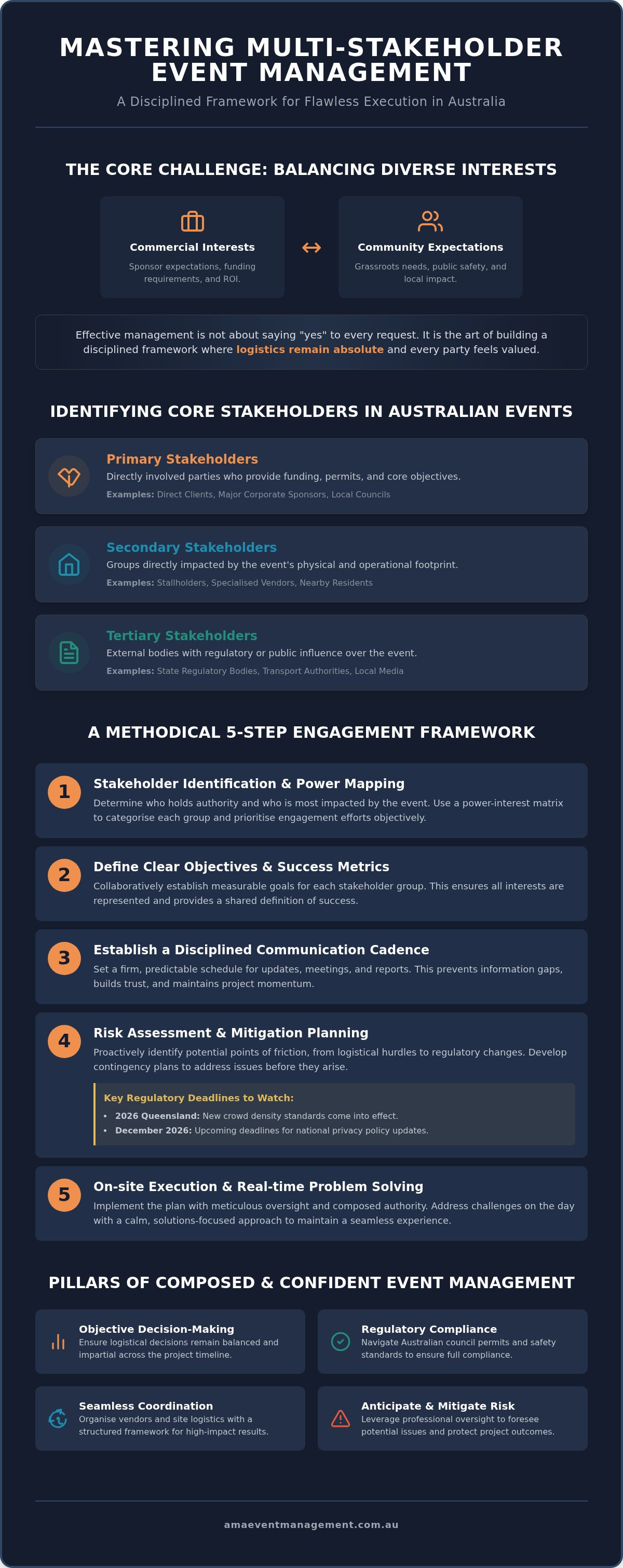
Multi stakeholder event management is the disciplined coordination of diverse groups, each holding a distinct vested interest in a project's outcome. While traditional management often focuses on a linear path to execution, this specialised field draws from the principles of multistakeholder governance to ensure that every voice is heard within a structured logistical framework. In the Australian context, particularly across NSW and Queensland, the complexity of these interactions requires a meticulous approach. You aren't just managing a schedule. You're balancing the strict requirements of local councils, the commercial expectations of sponsors, and the safety of the general public.
Adopting the role of a meticulous architect is essential for large-scale community festivals and themed activations. Without this level of oversight, projects often succumb to budget blowouts and communication breakdowns. Poor stakeholder management doesn't just impact the bottom line; it creates significant reputational damage that can take years to repair. When conflicting priorities aren't reconciled early, the resulting friction often manifests as logistical delays or public dissatisfaction. A proactive manager identifies these points of friction months in advance, building a plan that accommodates diverse needs without compromising the event’s core objectives.
The Core Stakeholders in Modern Australian Events
Identifying the layers of influence is the first step toward composed excellence. Every group requires a different communication style and level of engagement to feel secure in the process.
Primary stakeholders: These include the direct clients, major corporate sponsors, and local councils who provide the necessary permits and funding.
Secondary stakeholders: Stallholders, specialised vendors, and residents living near the event site who are directly impacted by the physical footprint.
Tertiary stakeholders: State regulatory bodies, such as liquor licensing or transport authorities, and local media outlets.
Why Composed Authority is Your Best Asset
High-pressure environments demand a stabilising force. A seasoned expert with 20 years of industry experience doesn't just react to problems. They anticipate them before they materialise. This quiet confidence allows for professional oversight across multi-layered logistics, ensuring that no detail is overlooked. By maintaining a grounded tone and a disciplined process, an event manager acts as a strategic anchor for the entire project. This approach transforms a chaotic web of demands into a methodical project timeline, providing a sense of relief and security for everyone involved. When the manager remains unfazed by shifting priorities, the stakeholders remain confident in the final delivery. This standard of excellence is reflected in major international gatherings like the Los Angeles Real Estate Grand Expo, where the coordination of diverse investors and vendors serves as a benchmark for successful multi stakeholder management.
A Methodical Framework for Stakeholder Engagement
Success in multi stakeholder event management depends on a structured, five-step process that eliminates ambiguity. When you treat engagement as a logistical exercise rather than a social one, you create a predictable environment for all parties. Designing multi-stakeholder events requires more than just an invitation list; it demands a rigorous assessment of how each group influences the project’s trajectory. This methodical approach ensures that even as deadlines approach, the project remains a stabilising force for everyone involved.
Step 1: Stakeholder Identification and Power Mapping. Determine who holds the authority and who is most impacted by the event footprint.
Step 2: Defining Clear Objectives and Success Metrics. Establish measurable goals for every group to ensure their interests are represented.
Step 3: Establishing a Disciplined Communication Cadence. Set a firm schedule for updates to prevent information gaps and maintain trust.
Step 4: Risk Assessment and Mitigation Planning. Anticipate regulatory hurdles, such as the 2026 Queensland crowd density standards or the December 2026 privacy policy deadlines.
Step 5: On-site Execution and Real-time Problem Solving. Implement the plan with meticulous oversight and composed authority on the day.
Mapping Stakeholder Influence and Interest
A power-interest matrix is an essential tool for categorising your audience. In an Australian council setting, "Key Players" are those with high power and high interest, such as the lead event permit officer or a naming rights sponsor. These individuals require frequent, high-touch consultation to remain aligned. "Context Setters," like local transport authorities or emergency services, have the power to halt an event but may have lower interest in the specific creative content. Tailoring your engagement strategy to these quadrants ensures you aren't over-communicating with those who only need high-level updates, while providing deep technical oversight for those who require it. It's about precision in communication, not just volume.
Setting Objectives That Align Diverse Interests
Balancing commercial sponsor goals with community engagement outcomes requires a shared vision. You must identify where these interests intersect to foster a collaborative partnership rather than a transactional one. Aligning a corporate sponsor with a local market vendor requires positioning the sponsor's brand as a supportive pillar of the vendor's community-driven craft, ensuring both parties benefit from shared foot traffic and positive brand association. This alignment must be documented in your success metrics to ensure every party feels the event has met its purpose. If you're managing a complex community festival or brand activation, using a professional framework ensures these diverse priorities remain in balance from start to finish.
Navigating Conflicting Interests with Quiet Confidence
Conflict isn't a failure of planning; it's a natural byproduct of diverse interests. In multi stakeholder event management, the goal is to act as a composed guide who mediates these tensions without losing momentum. Drawing on the OECD framework for multi-stakeholder engagement, we understand that meaningful collaboration requires a balance of power and a shared commitment to the final outcome. Active listening serves as your primary tool for de-escalation. By acknowledging a stakeholder’s concern before offering a technical solution, you transform a potential roadblock into a constructive dialogue. This approach keeps the project timeline intact while ensuring that valid perspectives are integrated into the final execution plan.
Conflict Resolution Strategies for Event Managers
Conflict often arises when individual priorities clash with the broader event vision. An interest-based negotiation model is particularly effective for vendor disputes, focusing on underlying needs rather than fixed positions. For example, a stallholder’s frustration over site placement usually stems from a need for foot traffic, which can be addressed through better signage or marketing support. When managing "Not In My Backyard" (NIMBY) concerns for public festivals, transparency is vital. Engaging with residents early and providing clear maps of noise zones or traffic diversions builds goodwill and reduces friction. Establishing a clear hierarchy of decision-making ensures that when a consensus cannot be reached, a pre-determined authority makes the final call to avoid project bottlenecks.
Communication Tools for Transparency
Trust is built on the steady, predictable flow of information. Using centralised project management software provides a single source of truth, allowing stakeholders to see progress in real-time without needing constant meetings. Regular reporting is equally important, yet it must be handled with care. Sponsors and councils require high-level updates that highlight milestones and risk mitigation rather than granular logistical data. This level of professional oversight is a hallmark of Professional Community Market Management in Australia. By providing structured reports, you reassure your partners that the project is under control, allowing them to feel secure in their investment. A disciplined reporting rhythm prevents the overwhelm that often leads to micromanagement or last-minute interventions.
Technical Logistics and Compliance for Complex Events
Technical logistics represent the physical manifestation of your stakeholder agreements. In multi stakeholder event management, the site plan must reflect every negotiated priority while adhering to strict safety protocols. This requires a meticulous approach to coordinating stallholders, infrastructure, and crowd flow. When you manage a complex site, you aren't just placing vendors; you're building a temporary ecosystem that must function with zero margin for error. Composed oversight ensures that infrastructure is positioned for maximum efficiency, preventing the bottlenecks that lead to guest frustration or safety risks.
Australian Safety and Compliance Standards
Navigating the regulatory landscape requires a disciplined focus on both state and local requirements. A robust Risk Management Plan (RMP) is mandatory for any project, particularly with the new Queensland capacity calculation standards taking effect in July 2026. These regulations move away from simple floor-space formulas to dynamic crowd density zones. You must also ensure all participants meet their Work Health and Safety (WHS) obligations. Managing insurance is equally critical. Public liability premiums for small events with up to 300 attendees typically start at $300, but these costs rise as the scale increases. For a deeper look at these requirements, see The Architect’s Guide to Community Festival Organisers. Precise documentation provides a sense of security for councils and sponsors alike.
Coordinating Vendor and Stallholder Logistics
Precision timing is the backbone of site management. The bump-in and bump-out process must be choreographed with the accuracy of a project timeline. When coordinating fifty diverse vendors, a staggered arrival schedule prevents the congestion that often leads to safety incidents or delayed openings. You must also account for the specific utility requirements of each participant. Food vendors may require high-amperage power and greywater disposal, while artisan stalls need specific footprint dimensions. Maintaining site integrity during high-traffic community festivals requires proactive waste management and constant monitoring of temporary infrastructure. This methodical oversight ensures the venue remains polished and professional from the first guest to the final pack-down.
Budget management for these events demands absolute transparency, especially when funds are sourced from multiple sponsors or government grants. Every dollar must be accounted for to maintain the trust of your financial partners. On-site supervision is the final piece of the puzzle, providing a stabilising force that can solve technical issues in real-time. For a seamless execution that balances every commercial and community interest, explore our bespoke event management services. Our 20 years of experience ensures that every logistical detail is handled with quiet confidence.
Why a Seasoned Event Management Agency is Your Strategic Anchor
Engaging a seasoned agency provides more than just logistical support; it offers a strategic anchor in a high-pressure environment. With over 20 years of industry experience, we've developed a refined intuition for identifying potential pitfalls before they impact your timeline. Multi stakeholder event management is a delicate balancing act that requires a stabilising force to navigate conflicting interests with quiet confidence. While "cookie-cutter" planning might suffice for simple gatherings, complex activations across NSW and Queensland demand bespoke solutions tailored to the specific nuances of your site and stakeholders. This level of professional oversight ensures that the project remains disciplined, polished, and secure from inception to completion.
The AMA Edge: Meticulous Architecture
Our approach is built on the foundation of meticulous architecture. We understand how the intimacy and precision of high-end celebrations translate into the disciplined execution of large-scale corporate galas or community festivals. For instance, our work as a Bespoke Private Event Planner Sydney informs our ability to manage the smallest details without losing sight of the strategic vision. By providing a dedicated project manager as your single point of contact, we eliminate the communication breakdowns that often plague diverse teams. This structure ensures that every moving part is integrated into a seamless whole, providing you with a profound sense of relief and security as the event date approaches.
Post-Event Debriefing and Relationship Longevity
The value of a professional partnership extends far beyond the event day. We believe in building long-term stakeholder value through rigorous post-event evaluation and transparent reporting. This process involves conducting formal debriefs to measure success against the pre-defined KPIs established during the initial planning phase. Reporting these results to sponsors and councils with professional polish reinforces your reliability and helps secure future funding or permits. By converting one-off attendees into long-term community supporters, we ensure your event leaves a lasting legacy. This commitment to relationship longevity is what distinguishes a strategic manager from a simple coordinator. We turn a single activation into a recurring success, ensuring that every stakeholder feels their investment has yielded a high-impact result.
Delivering Composed Excellence for Your Next Activation
Mastering multi stakeholder event management requires a shift from reactive problem solving to proactive, meticulous architecture. By implementing a disciplined engagement framework and maintaining a steady communication cadence, you transform potential conflict into a collaborative partnership. Whether you're navigating the latest 2026 safety standards or balancing the commercial goals of a major sponsor, success is found in the details. A structured approach ensures that every vendor, council official, and attendee feels the security of a well-organised project.
With over 20 years of experience in the Australian event industry, AMA Event Management provides the composed authority needed to anchor high-pressure logistical environments. We specialise in multi-stakeholder community and corporate events, ensuring every moving part is integrated with precision and quiet confidence. Discuss your complex event needs with the experts at AMA Event Management to secure a seamless, high-impact result for your next festival or gala. You can move forward with the certainty that your reputation is in seasoned hands.
Frequently Asked Questions
What is multi-stakeholder event management?
Multi stakeholder event management is the disciplined coordination of diverse groups that hold a vested interest in an event's success. This includes managing the expectations of local councils in Sydney or Melbourne, corporate sponsors, and community vendors. Unlike general project management, it focuses on building a framework where logistical requirements remain absolute while every party feels heard. It requires a composed expert to balance these competing priorities without compromising the event’s core objectives or timeline.
How do you handle conflicting priorities between event sponsors?
Handling conflicting sponsor priorities requires a transparent, interest-based negotiation model that focuses on shared outcomes. You must establish clear success metrics during the initial planning phase to ensure every commercial partner understands how their specific goals fit into the broader vision. By acting as a stabilising force, a manager can mediate disputes with quiet confidence. This prevents bottlenecks and ensures that sponsors feel their investment is secure, even when compromises are necessary for the event's overall flow.
What are the main stakeholders in a community festival?
The main stakeholders in a community festival are typically categorised into three layers of influence. Primary stakeholders include the direct clients, naming rights sponsors, and local councils who provide essential permits. Secondary stakeholders consist of the stallholders, local residents, and vendors who operate on-site. Tertiary stakeholders include regulatory bodies and local media. Each group requires a tailored engagement strategy to ensure their specific needs are met while maintaining the meticulous architecture of the larger project.
How can I ensure my event complies with Australian safety regulations?
Ensuring compliance involves developing a comprehensive Risk Management Plan (RMP) that adheres to current Work Health and Safety (WHS) obligations. In 2026, this includes meeting new Queensland capacity standards that focus on dynamic crowd density zones. You must also verify that all vendors hold appropriate insurance cover. Professional oversight from a seasoned manager ensures that every regulatory hurdle is cleared well before the event date, providing a sense of security for all involved parties.
Why is stakeholder mapping important for event planning?
Stakeholder mapping is vital because it categorises individuals by their impact and influence on the project. Using a matrix to identify "Key Players" versus "Context Setters" allows you to allocate your communication resources with precision. This methodical approach ensures that high-power stakeholders receive the technical oversight they require, while others are kept informed without being overwhelmed. It's a foundational step in multi stakeholder event management that prevents communication breakdowns and keeps the timeline on track.
How do you manage communication with 50+ different stallholders?
Managing communication for fifty or more stallholders requires a disciplined cadence and centralised project management tools. You should use a single source of truth to distribute bump-in schedules, utility requirements, and site maps. This structured approach eliminates ambiguity and ensures every vendor knows exactly what is expected of them. By providing clear, professional updates, you build trust with your vendors and ensure the site remains organised during high-traffic community festivals or brand activations.
What role does a local council play in event management?
Local councils act as both a regulatory body and a primary stakeholder by providing the necessary permits, site approvals, and sometimes funding. They ensure that public events in areas like Sydney or Melbourne meet strict safety and noise requirements. A professional manager coordinates closely with council officers to navigate these bureaucratic processes with composed authority. This relationship is critical for securing the venue and ensuring the event integrates seamlessly with the surrounding community and its infrastructure.
How do you measure the success of a multi-stakeholder event?
Measuring success involves conducting formal stakeholder evaluations against the KPIs established at the project's start. You should gather feedback from sponsors, councils, and attendees to determine if their specific objectives were met. Reporting these metrics with professional polish demonstrates accountability and helps build long-term relationship longevity. Success isn't just about the event day; it's about whether the project delivered lasting value and fostered a positive reputational impact for every party who held a vested interest.


Comments