

Multi-Stakeholder Event Management: A Strategic Guide to Composed Coordination
- Ever After Expo
- 4 days ago
- 12 min read
Updated: 2 days ago
Imagine it's forty-eight hours before your festival launch, and you're caught between a local council's strict safety regulation and a major sponsor's demand for a non-compliant brand activation. If you've managed large-scale Australian events, you've likely felt the weight of these competing priorities. It's a high-pressure environment where communication breakdowns often lead to last-minute chaos, leaving even the most seasoned organisers feeling overwhelmed by the moving parts. This guide provides a methodical approach to multi stakeholder event management, ensuring you remain the stabilising force amidst the noise.
We'll explore a clear framework for stakeholder mapping, practical strategies for conflict resolution, and the logistics required to deliver a frictionless experience that meets every partner's objective. You'll learn how to move from reactive firefighting to a state of composed coordination. By the end of this article, you'll have the tools to align diverse interests toward a single, immovable event vision, ensuring your next corporate conference or community gala is defined by its precision rather than its pressure. Mastering these complex relationships is the key to delivering a successful project that satisfies every stakeholder involved.
Table of Contents
What is Multi-Stakeholder Event Management?
Multi stakeholder event management is the disciplined coordination of diverse groups who hold a vested interest in a project's outcome. In the Australian event industry, this landscape has become increasingly intricate. It involves far more than just hiring vendors; it requires an architectural approach to align the objectives of local councils, corporate sponsors, community groups, and government bodies. Successful execution depends on your ability to synthesise these varied perspectives into a single, cohesive plan.
A common mistake in the industry is failing to distinguish between operational vendors and strategic project stakeholders. An operational vendor provides a specific service, such as a security firm or a florist, and usually operates within a defined scope. A strategic stakeholder, however, has the power to influence the event's direction, reputation, or financial viability. Effective Stakeholder management involves identifying these influential players early to ensure their expectations don't conflict with the project's core objectives or budget constraints.
The Complexity of Modern Event Ecosystems
Large-scale events in Sydney and Melbourne function as complex ecosystems where corporate, community, and government interests intersect. For example, a community festival might require strict safety approvals from a local council while simultaneously needing to meet the high-visibility branding requirements of a major corporate partner. This shift from simple logistics to complex relationship management is why a methodical strategy is essential. Identifying the core pillars of your project allows you to manage these intersections with precision rather than reacting to friction as it arises.
The Role of the Composed Event Manager
In high-pressure environments, the event manager must act as a stabilising force. It's easy to become overwhelmed by the sheer number of moving parts, but a seasoned expert remains several steps ahead. By maintaining a broad strategic view, you ensure the event vision remains the primary anchor for every decision. This composed authority instils a sense of security in your partners, proving that the project is under disciplined oversight. It's about being the reliable anchor that keeps the project grounded when competing priorities pull in different directions.
The cost of fragmented coordination is often high. When communication breaks down, it leads to last-minute chaos that can damage your reputation and inflate the budget. In an industry where trust is the primary currency, having a manager with over 20 years of experience ensures that every detail is meticulously planned. This level of oversight prevents the "silo effect," where different groups work at cross-purposes, and instead creates a frictionless experience for everyone involved.
The Strategic Foundation: Mapping Your Event Stakeholders
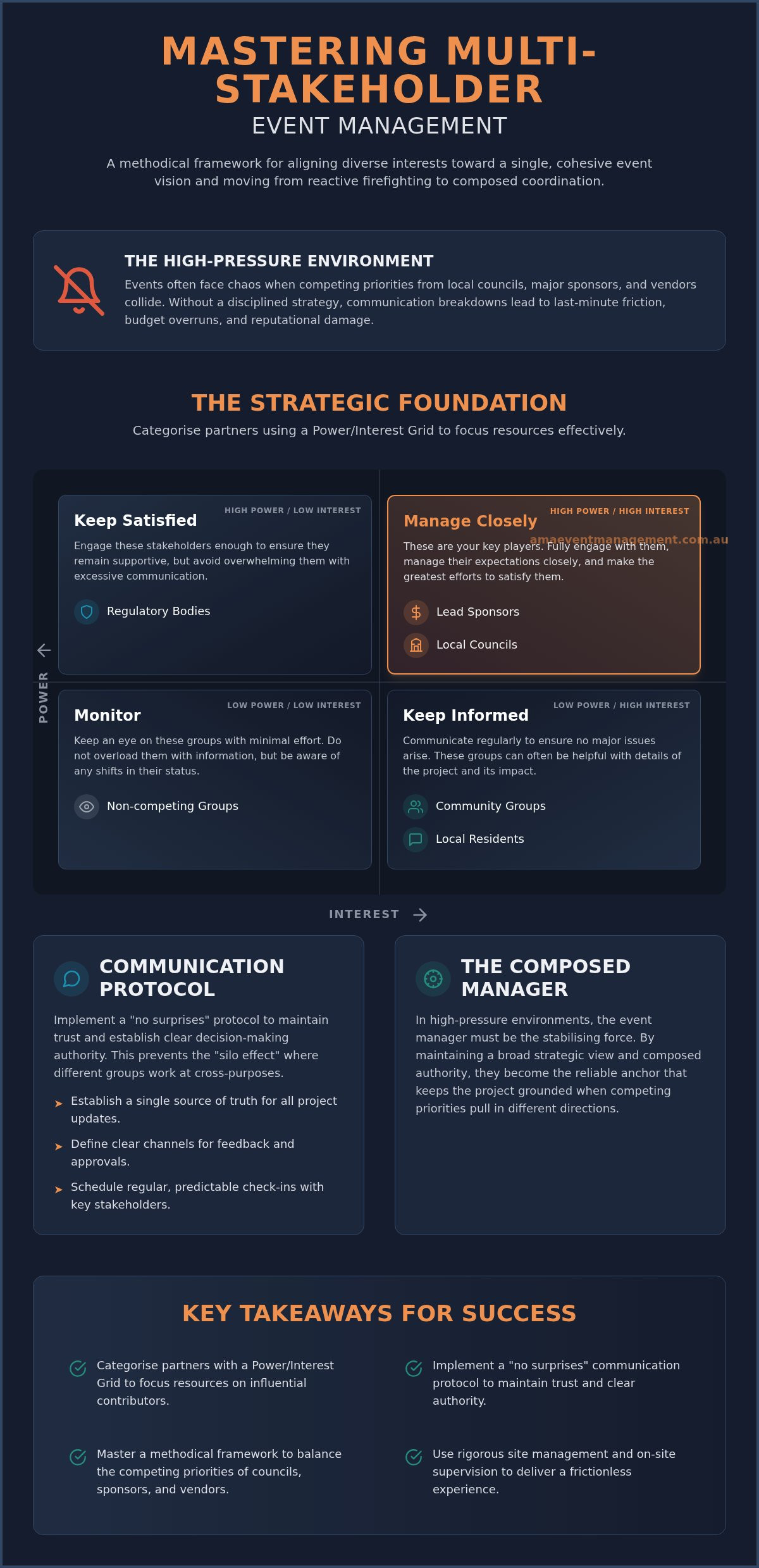
Effective multi stakeholder event management begins with a deliberate mapping process. It involves identifying every individual and group that can influence your project's success. To achieve this, we utilise the Power/Interest Grid, a methodical tool that categorises stakeholders based on their level of authority and their concern for the event's outcome. By plotting partners into four distinct quadrants, you can determine who requires close management and who simply needs to be kept informed. This level of clarity prevents the common pitfall of treating all partners as a single, homogenous group.
In the Australian context, distinguishing between primary and secondary stakeholders is vital. Primary stakeholders, such as local councils or lead sponsors, possess the power to halt or significantly alter your project. Secondary stakeholders might include local residents or non-competing community groups who have a high interest but limited direct authority. Analysing their specific motivations is the next step in this disciplined approach. You must ask what each group actually wants. A corporate sponsor seeks brand alignment and return on investment, while a local council prioritises public safety and adherence to noise ordinances. Documenting these needs in a stakeholder register ensures nothing is overlooked during the high-pressure execution phase.
Sponsors, Councils, and Community Groups
Managing high-value corporate sponsors requires a sophisticated touch. These partners expect their brand values to be reflected in every facet of the event. Simultaneously, navigating the requirements of community festival organisers Australia involves a deep understanding of local nuances. In NSW and Victoria, engaging with local residents and community interest groups early is essential for securing social licence. A proactive manager addresses potential concerns regarding traffic or noise before they escalate into formal complaints, maintaining the project's momentum. For those seeking disciplined event coordination, this early engagement is a hallmark of professional oversight.
Internal vs. External Stakeholders
A composed event manager must also balance internal board requirements with external public perception. Internal stakeholders often focus on financial viability and long-term strategic goals, while the public judges the event based on their immediate experience. Government bodies and regulatory authorities act as critical external stakeholders, enforcing standards that can't be compromised. Ensuring alignment between diverse vendor groups is equally important. When every vendor understands how their role supports the broader stakeholder objectives, the result is a frictionless operation that feels seamless to the end user. This methodical alignment is what transforms a complex project into a successful, high-standard reality.
Communication Protocols for Composed Authority
Effective communication in a complex project isn't just about the frequency of contact; it's about the hierarchy and protocol of information flow. While digital tools provide the infrastructure, they don't replace the need for clear lines of reporting and decision-making authority. In the context of multi stakeholder event management, every partner needs to know exactly who holds the final say on specific deliverables. This structured approach prevents the "too many cooks" scenario that often leads to conflicting instructions and wasted resources. By establishing these boundaries early, you create a professional environment where everyone understands their role and respects the expertise of others.
The "No Surprises" rule is a cornerstone of trust-building in high-pressure environments. It dictates that stakeholders should never discover a problem through a third party or, worse, at the event itself. Proactive updates act as a stabilising force, ensuring that even when challenges arise, they're presented alongside a considered solution. If a council permit is delayed or a sponsor's delivery is behind schedule, the manager's role is to communicate this immediately and calmly. This transparency reinforces your position as a composed guide who is always several steps ahead of potential issues.
Maintaining a "Methodical Sequence" during project meetings is equally vital for disciplined oversight. Meetings shouldn't be open-ended discussions; they must follow a strict agenda that moves from high-level strategic updates to granular operational tasks. This rhythm ensures that time is used efficiently and that every stakeholder feels their priorities are being addressed. It prevents the conversation from stalling on minor details before the broader strategic alignment is confirmed, keeping the project on a steady, predictable timeline.
Structured Reporting and Documentation
The project timeline serves as the single source of truth for all involved parties. Using regular status reports provides stakeholders with a sense of security, showing exactly how the project is progressing against its original objectives. These documents are essential for preventing "scope creep," where stakeholders attempt to add requirements late in the process. By documenting every agreement and change in writing, you maintain a polished record that protects both the budget and the event's integrity. This meticulous documentation ensures that all partners remain aligned with the primary event vision.
Conflict Resolution and Negotiation
Clashes in stakeholder interests are inevitable, but they don't have to lead to chaos. Identifying potential friction points before they escalate allows you to negotiate from a position of quiet confidence. We utilise a "Win-Win-Event" framework, where disputes are settled by refocusing all parties on what is best for the event's overall success. Maintaining a professional register during these high-pressure negotiations ensures that emotions remain secondary to logic. This disciplined approach to conflict resolution allows for a frictionless experience, even when balancing the competing demands of government bodies and corporate sponsors.
Methodical Execution: From Logistics to On-site Supervision
Transitioning from the strategic planning phase to the physical execution of an event requires a shift in focus toward granular logistical precision. A comprehensive site management plan acts as the blueprint for this transition, detailing every movement within the venue. In the context of multi stakeholder event management, this plan must account for the physical requirements of every partner, from sponsor activation footprints to council-mandated emergency access lanes. Synchronising these diverse activities into a seamless sequence ensures that the build-up is orderly and that potential conflicts between vendor deliveries are neutralised before they cause delays.
When public roads or high-traffic areas are involved, the expertise of Acquired Awareness Traffic Management can be vital in securing the necessary approvals and maintaining safety standards. This specialised oversight allows the event manager to focus on broader strategic alignment while ensuring that the physical perimeter remains secure and accessible.
Navigating the specific regulatory landscapes of Sydney and Melbourne is a critical component of this phase. Each local council maintains distinct permit requirements and safety standards that must be met to avoid costly fines or event stoppages. A composed manager understands these nuances, ensuring that all documentation is submitted well in advance of deadlines. This level of oversight extends to on-site event supervision Sydney, where real-time coordination is required to manage the intersection of public space usage and private brand objectives.
Regulatory Compliance and Risk Mitigation
Managing Occupational Health and Safety (OH&S) requirements is complex when multiple stakeholder groups are operating simultaneously. Each vendor must be vetted to ensure they meet the high standards expected by corporate gala planners Sydney. This includes verifying insurance, conducting site inductions, and developing robust contingency plans for high-impact community festivals. By maintaining a disciplined approach to risk mitigation, you protect the reputation of all partners and ensure the safety of every attendee. If you require professional oversight for your next project, explore our Market Management and Vendor Coordination services.
On-site Stakeholder Concierge
During the event, the manager serves as a designated point of contact for high-value sponsors and VIPs. This on-site concierge role involves managing real-time feedback and addressing stakeholder needs without disrupting the event's flow. It requires a composed, unfazed presence on the ground, regardless of the pressure. By acting as the central hub for communication, the manager ensures that stakeholders feel heard and valued while the operational team continues to execute the plan with precision. This balance of high-level hospitality and strict logistical control is what defines a truly successful multi-stakeholder project.
The AMA Edge: 20 Years of Disciplined Event Management
AMA Event Management serves as the reliable anchor for projects where the stakes are high and the partners are many. With over 20 years of industry experience, we understand that multi stakeholder event management is about more than just checking boxes; it's about the sophisticated alignment of human and logistical interests. This depth of expertise allows us to anticipate challenges before they manifest as disruptions. We provide our clients with a sense of security that only comes from seasoned oversight, acting as a stabilising force in high-pressure environments across Sydney and Melbourne.
Engaging a professional event management agency is a strategic investment in your brand's long-term reputation. While some view coordination as a line-item cost, the reality is that disciplined management prevents the expensive errors associated with communication breakdowns and regulatory non-compliance. We provide bespoke solutions for corporate conferences, themed activations, and private celebrations. Every project is delivered to a high standard of polished competence, ensuring your event vision remains the primary anchor from the initial concept to the final pack-down.
A Legacy of Successful Australian Events
Our portfolio spans a diverse range of complex projects, from large-scale national expos to recurring community market management Australia. The AMA philosophy is built on the intersection of a broad strategic view and an intense focus on the smallest details. Our clients often speak of the relief they feel when they realise every moving part is being managed with methodical precision. This frictionless experience isn't an accident; it's the result of two decades of refined processes and a commitment to a collaborative partnership that prioritises your objectives.
Partnering for Future Success
We don't just work for you; we integrate with your team to deliver composed excellence. Whether you're planning a community festival in Melbourne or a corporate gala in Sydney, our approach remains strictly disciplined and highly structured. As you look toward your 2026 event calendar, consider the value of a partner who remains unfazed by the complexities of modern event ecosystems. We invite you to enquire about our multi-stakeholder management services today to begin the process of turning your complex vision into a seamlessly executed reality. Our team is ready to provide the meticulous oversight your next project deserves.
Achieving Composed Excellence for Your Next Project
Mastering multi stakeholder event management is the difference between a project defined by chaos and one defined by architectural precision. By implementing a methodical framework for stakeholder mapping and establishing clear communication protocols, you transform competing interests into a unified vision. You've learned that a "no surprises" approach and rigorous on-site supervision are essential for maintaining trust with councils, sponsors, and community groups alike.
With over 20 years of industry experience, AMA Event Management acts as the stabilising force your complex project requires. We're specialists in community markets across Sydney and Melbourne, bringing meticulous attention to logistical detail to every gala, festival, and brand activation. It's our disciplined oversight that ensures a frictionless experience for all involved partners. Contact the experts at AMA Event Management to discuss your complex event requirements. Your next successful event is within reach when you have a reliable anchor to lead the way.
Frequently Asked Questions
What is the definition of multi-stakeholder event management?
Multi-stakeholder event management is the strategic coordination of various parties with a vested interest in a project's success. This includes corporate sponsors, local councils, community groups, and operational vendors. Unlike simple vendor management, this discipline focuses on aligning diverse and often-competing strategic priorities toward a single, cohesive event vision. It's about being the stabilising force that ensures all partner objectives are met with logistical precision and professional oversight.
How do you identify all stakeholders for a large-scale Australian event?
Identification begins with a thorough audit of every group capable of impacting or being impacted by the project. This includes primary partners like corporate sponsors and local councils in cities like Sydney or Melbourne. We also look at secondary groups such as local residents, emergency services, and community interest groups. Using a methodical Power/Interest Grid ensures no influential group is overlooked during the initial planning phase.
What are the most common challenges in managing multiple event partners?
Conflicting demands and communication breakdowns are the most frequent obstacles in this high-pressure environment. For instance, a sponsor's branding requirements might clash with a council's safety regulations or public space restrictions. These competing priorities can lead to last-minute chaos if not managed with a disciplined approach. Maintaining a composed presence amidst these pressures is essential for delivering a frictionless event experience for every partner involved.
How do you handle conflicting priorities between a sponsor and a local council?
We act as a professional mediator by refocusing both parties on the event's core objectives and safety standards. If a sponsor's activation footprint interferes with a council-mandated emergency access lane, we negotiate a solution that maintains safety while preserving brand visibility. This requires a composed authority and a deep understanding of Australian regulatory standards to find a win-win outcome that satisfies all stakeholder requirements.
Why is stakeholder mapping important in the initial planning phase?
Mapping provides a strategic foundation by categorising partners based on their influence and interest. It allows the manager to allocate resources efficiently and establish clear lines of reporting from the outset. By identifying potential friction points early, you prevent scope creep and ensure that every decision aligns with the primary event vision. This level of disciplined oversight is what creates a sense of security for all partners.
What role does communication play in preventing event day chaos?
Structured communication protocols ensure that every partner is informed and aligned before the gates open. By implementing a "no surprises" rule and providing proactive updates, you build trust and eliminate ambiguity. During multi stakeholder event management, clear reporting lines mean that if an issue arises on the ground, the resolution process is already established. This prevents reactive firefighting and maintains a professional, orderly environment throughout the day.
Can a small business benefit from professional multi-stakeholder coordination?
Professional coordination is a strategic investment that protects a business's reputation and budget regardless of its size. For a small business managing a themed activation or community fair, the complexity of council permits and vendor logistics can be overwhelming. Professional oversight ensures that these moving parts are integrated seamlessly, allowing the business owner to focus on their primary commercial objectives while we handle the meticulous logistical details.
How does AMA Event Management ensure all stakeholder objectives are met?
We utilise a methodical sequence that prioritises transparency and thoroughness across every project phase. With over 20 years of experience, we've refined a process that includes detailed stakeholder registers and rigorous site management plans. By acting as the reliable anchor for the project, we ensure that the specific goals of sponsors, government bodies, and private clients are balanced and achieved without compromising the event's high standards.


Comments