

National Expo Logistics Australia: The Architect's Guide to Seamless Execution
Updated: Sep 11
A flawless exhibition isn't built on the day of the event; it's won months earlier in the quiet corridors of strategic planning. In a country where the distance between a Sydney loading dock and a Perth exhibition centre spans nearly 4,000 kilometres, the margin for error in national expo logistics Australia is effectively zero. You're not just moving crates. You're orchestrating a high-stakes synchronisation of vendor standards, complex venue regulations, and unforgiving timelines that leave no room for a single missed delivery.
It's understandable if the sheer scale of coordinating across state lines feels like a constant battle against chaos. Most organisers recognise that inconsistent standards and rigid loading dock schedules can turn a professional showcase into a logistical nightmare. This guide provides a methodical framework to master these complexities, ensuring your next event is defined by composed, high-stakes execution rather than last-minute fires. We'll examine how to harmonise vendor procurement, navigate specific Australian venue requirements, and maintain a broad strategic view while managing every minute detail of your national rollout.
Table of Contents
Defining National Expo Logistics in the Australian Context
Logistics is the heartbeat of a successful event. It isn't just about moving crates from point A to point B. It's the strategic synchronisation of people, assets, and timing to ensure a brand's vision is realised exactly as intended. In the broader field of logistics, the physical movement of goods is merely the foundation. For a national campaign, that foundation must support layers of vendor coordination, venue compliance, and strict project timelines.
Australia presents unique geographic hurdles. Moving a multi-state exhibition from Sydney to Perth involves crossing nearly 4,000 kilometres of varied terrain. This isn't a standard delivery; it's a mission that requires a bespoke logistical approach. National expo logistics Australia demands an architect's eye to account for transit times, climate variations, and the specific quirks of each capital city's loading docks.
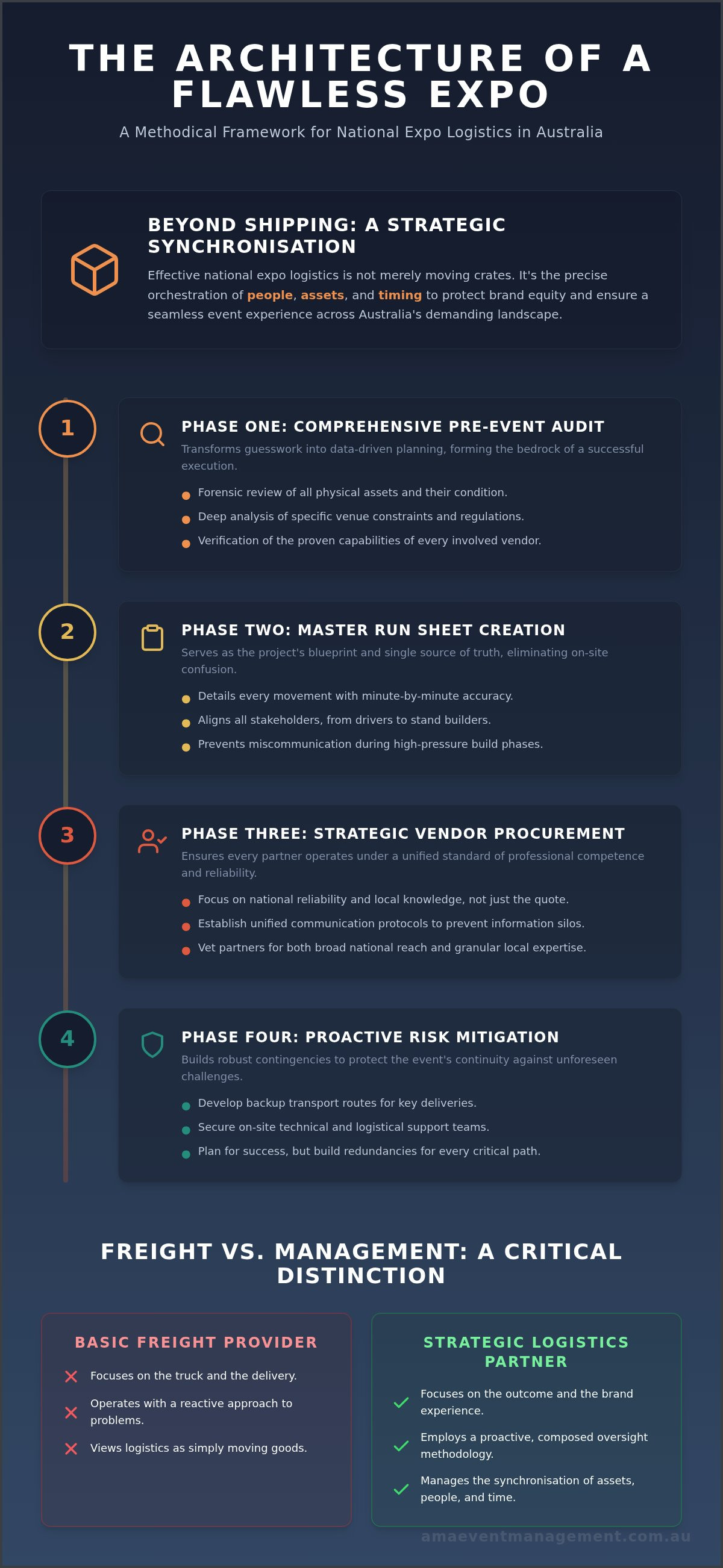
When you're managing a high-stakes corporate activation, logistics becomes a tool for protecting brand equity. A damaged display or a late delivery isn't just a minor delay. It's a direct blow to your professional reputation. Distinguishing between a basic freight provider and a comprehensive event management partner is vital. While a freight company focuses on the truck, a partner focuses on the outcome.
The Complexity of Multi-State Expo Circuits
The 'East Coast Triangle' of Sydney, Melbourne, and Brisbane serves as the engine room for many Australian event circuits. Efficiently navigating these hubs requires more than a map. You must understand state-specific variations in work health and safety (WHS) requirements, which can change significantly as you cross borders. For instance, managing specialised waste for health-focused trade shows in Victoria requires adherence to strict protocols, where BioSafe Waste Management provides the necessary clinical disposal expertise. National expo logistics Australia is a multi-layered management discipline that integrates physical transport with strategic site supervision and vendor orchestration.
Why Composed Oversight is Non-Negotiable
Reactive logistics is expensive. Missed loading slots, damaged assets, and the resulting stress on your internal team can derail even the best-funded campaigns. A methodical approach reduces on-site friction, allowing exhibitors to focus on their audience rather than their crates. For the internal event lead, the presence of a composed guide provides immense psychological relief. It's the difference between managing a crisis and overseeing a success. This level of precision is especially critical for complex themed brand activation Sydney projects where every element must be perfect.
The Architecture of a Methodical Logistics Plan
A successful event is a structured assembly of precise movements. Unlike simple freight shipping, national expo logistics Australia requires a four-phase architecture that begins long before the first truck arrives at the venue. This process transforms a complex set of requirements into a predictable, manageable sequence of events.
Phase 1 focuses on a comprehensive pre-event audit. This involves a forensic review of physical assets, specific venue constraints, and the proven capabilities of every involved vendor. Without this data, planning is merely guesswork. Phase 2 involves the creation of the master run sheet. This document serves as the project's blueprint, detailing every movement with minute-by-minute accuracy to ensure no stakeholder is left guessing during the high-pressure build phase.
Phase 3 shifts to vendor procurement, where professional standards are treated as a baseline requirement. For organisations manufacturing bespoke stands or promotional inventory in Asia, you can learn more about how professional sourcing ensures these assets meet quality standards before they enter the logistics chain. Finally, Phase 4 addresses risk mitigation. A seasoned architect doesn't just plan for success; they build robust contingencies for the 'unforeseen'. This might include backup transport routes or on-site technical support ready to step in at a moment's notice to protect the continuity of the event.
Vetting logistics partners for national reliability requires looking beyond the initial quote. You need partners who possess both broad national reach and granular local knowledge of the Australian landscape. It's essential that all contractors align with the AMA Event Management standard of polished competence. This ensures that every stakeholder, from the heavy vehicle driver to the specialised stand builder, operates under a unified set of communication protocols. This disciplined oversight prevents the information silos that often lead to expensive on-site confusion and delays.
Site Management and Loading Dock Discipline
The loading dock is where the most meticulous plans meet the reality of high-pressure timelines. Managing the 'bump-in' and 'bump-out' requires quiet authority and a deep understanding of venue-specific cultures and safety protocols. Major centres like the ICC Sydney or MCEC Melbourne have rigid regulations that demand strict adherence to time slots and vehicle specifications.
Staying informed about industry standards through platforms like the CeMAT Australia Trade Show helps maintain a competitive edge in supply chain efficiency and material handling. When the site infrastructure is prepared with this level of detail, themed activations can be executed without the distraction of logistical friction. If you're seeking a partner to oversee these moving parts with composed excellence, adopting a methodical architectural approach is the only path to a seamless result.
Freight vs. Management: Why Strategy Beats Shipping
Choosing the cheapest quote for transport is often a false economy. While a freight company might promise to move your items, they rarely take responsibility for the outcome of the event itself. Poor coordination leads to hidden expenses, such as waiting time surcharges, missed loading windows, or the need for emergency on-site repairs. In the context of national expo logistics Australia, the focus must shift from simple shipping to strategic management. This ensures that every component is not just delivered, but integrated into a functional whole.
Strategic management bridges the gap between logistical reality and creative intent. For projects like a themed brand activation Sydney, the requirements go far beyond standard pallet dimensions. You're often dealing with delicate custom-built structures, precise lighting rigs, and specific layout requirements that must be executed perfectly the first time. A management partner acts as a stabilising force on the ground, overseeing the transition from delivery to installation. This distinction is vital; a delivery driver leaves the crate at the dock, but a logistics manager ensures the asset is positioned, unpacked, and ready for the show.
Integrating Logistics with Creative Vision
A meticulous architect ensures that bespoke styling elements arrive and are installed exactly as the designer intended. This level of oversight maintains the aesthetic integrity of the expo stand, preventing the 'rough around the edges' look that often plagues poorly managed builds. Drawing on the same discipline required of a bespoke private event planner Sydney, this approach treats every asset as a critical part of a larger narrative. It's about ensuring the brand's story isn't lost in the shuffle of crates and forklifts. When the logistics plan respects the creative vision, the result is a polished, professional presence that commands attention.
The Value of 20 Years of Industry Experience
Success in the Australian event landscape is often built on the strength of long-term relationships. Two decades of experience allows a manager to navigate venue politics and supplier limitations with quiet authority. This tenure makes it easier to recognise 'red flags' in the logistics chain, such as unrealistic lead times or inadequate packing, before they escalate into critical failures. Professional bodies like the Australasian Supply Chain & Logistics Association emphasise the importance of this expertise in maintaining high industry standards. When you have a seasoned expert at the helm, you're not just buying a service; you're securing a stabilizing force that remains unfazed by the inevitable pressures of a national rollout.
A Framework for National Expo Logistics in Australia
A successful nationwide rollout requires more than a series of individual events; it demands a unified framework that connects every state-based activity. Establishing a centralised command structure ensures there is a single point of truth for all stakeholders. This oversight is supported by a rigorous asset tracking system that monitors every component from the warehouse to the final stand position. Without this level of visibility, the risk of lost inventory or delayed builds increases exponentially as you move between capital cities.
Every phase of the project must be underpinned by clear, venue-specific briefings for transport and installation teams. These sessions clarify expectations and ensure that local regulations are respected from the moment the first truck arrives. Maintaining a 'live' contingency budget and a dedicated resource pool allows for a rapid response to any issues that arise. This proactive stance ensures that the integrity of the event is never compromised by a single point of failure.
Managing the Australian Geographic Challenge
Australia's vastness is a primary logistical hurdle. Crossing the Nullarbor or navigating regional NSW requires precise transit planning that accounts for fatigue management and vehicle capabilities. When organising public-facing events, standardising your community market management Australia approach ensures a consistent brand experience regardless of the location. You must also factor in weather-related contingencies, such as tropical storms in the north or winter frost in the southern states, which can disrupt even the most polished schedules. National expo logistics Australia is as much about managing the environment as it is about managing the equipment.
On-site Supervision: The Stabilising Anchor
The presence of a senior coordinator for the full duration of the build is a non-negotiable requirement for high-stakes projects. This individual manages the delicate balance between rigid venue rules and the immediate, often evolving needs of exhibitors. On-site supervision transforms a chaotic build into a methodical operation by providing a single point of authority to resolve conflicts and manage vendor performance. This composed presence ensures that the 'bump-in' remains professional and disciplined, even under tight time constraints.
Once the event concludes, the final step in the framework is the post-event debrief. This process is essential for refining your national circuit strategy and identifying opportunities for greater efficiency in the next city. For organisations that require this level of disciplined oversight and architectural precision, partnering with AMA Event Management ensures your next national rollout is executed with quiet confidence and professional excellence.
Partnering for Composed Excellence: The AMA Approach
AMA Event Management represents a departure from the high-energy hype often found in the event industry. Instead, we offer a sense of composed authority built on over 20 years of industry experience. For organisations managing high-stakes corporate expos, we act as a stabilising force in an environment that is frequently defined by high pressure and zero margins for error. Our approach to national expo logistics Australia is grounded in a meticulous architectural model that prioritises precision over volume.
The 'Quiet Confidence' methodology is designed to provide immediate relief to your internal team. We understand that the mental load of coordinating multiple state-based vendors is significant. By assuming full responsibility for the logistical execution, we remove this burden, allowing your staff to focus on high-level strategy and audience engagement. This isn't just about managing a checklist; it's about providing a polished, professional presence that reflects the high standards of your brand. We believe that a successful event should feel frictionless from start to finish, regardless of the geographic complexity involved.
Bespoke Solutions for National Brands
National brands require more than a one-size-fits-all logistical framework. Every activation has specific requirements that must be tailored to match the brand's unique narrative. We provide a single point of contact for nationwide programmes, ensuring that the creative vision established in Sydney is executed with identical precision in Melbourne or Perth. This consistency is vital for maintaining brand equity across diverse markets. When selecting a partner, it's essential to look for an agency that understands the strategic weight of your event. For more insights on this process, our guide for corporate gala planners Sydney provides a framework for selecting an agency that aligns with your professional values.
Next Steps for Your 2026 Expo Calendar
Transitioning from a reactive planning style to a structured, architectural model begins with a thorough audit. We start by reviewing your current logistical requirements and identifying potential points of friction in your national circuit. This initial consultation allows us to develop a bespoke proposal that prioritises reliability and precision. As you look toward your 2026 expo calendar, engaging a 'composed guide' is the most effective way to secure your event's success. We invite you to experience a partnership where every moving part is integrated into a seamless, methodical operation. Our focus remains on delivering a professional, grounded execution that removes the stress of national logistics and replaces it with the certainty of a job well done.
Orchestrating Your Next National Rollout with Precision
Mastering the complexities of national expo logistics Australia requires moving beyond simple freight to a disciplined architectural model. By prioritising strategic management over basic shipping, you ensure that every asset is not just delivered but perfectly integrated into your brand's vision. A methodical framework, supported by rigorous tracking and expert on-site supervision, transforms high-stakes pressure into a sequence of predictable, successful outcomes across every state border.
With over 20 years of national event experience, AMA Event Management serves as the stabilising force your organisation needs. We specialise in high-pressure corporate logistics and provide bespoke planning specifically tailored for the competitive Sydney and Melbourne markets. Our approach removes the heavy logistical burden from your internal team, replacing potential chaos with quiet confidence and a high level of professional excellence.
Secure your expo's success with the composed expertise of AMA Event Management. We look forward to helping you execute a seamless, polished event that commands the attention your brand deserves.
Frequently Asked Questions
What is included in national expo logistics services?
National expo logistics services involve the comprehensive planning and physical execution of every moving part within a trade show or corporate activation. This includes site management, vendor procurement, and detailed site supervision to ensure all infrastructure is installed correctly. Unlike basic transport, these services encompass the strategic synchronisation of assets, people, and timing. We focus on delivering a polished experience that covers everything from budget management to the final bump-out.
How do I manage logistics for an expo in multiple Australian cities?
Managing a multi-city tour requires a centralised command structure to maintain a single point of truth across different states. You must implement a rigorous asset tracking system that monitors equipment as it moves between venues in Sydney, Melbourne, and other capital cities. Standardising your approach ensures consistency in brand delivery. It's essential to account for state-specific variations in safety regulations and transit times, especially when crossing vast distances like the Nullarbor.
Why should I use an event management agency instead of a freight company?
An event management agency provides strategic oversight and on-site supervision that a standard freight company cannot offer. While a carrier focuses solely on moving crates, an agency doesn't just move boxes; it manages the entire outcome, including vendor coordination and venue compliance. This architectural approach ensures that assets are correctly installed and integrated into the event. It provides a stabilising force that remains responsible for the project's success from start to finish.
What are the common logistical challenges for expos in Australia?
The primary hurdles for national expo logistics Australia include the vast geographic distances between capital cities and inconsistent vendor standards across different states. High-pressure timelines often leave zero room for error, making complex loading dock regulations at major venues particularly challenging. Weather-related disruptions, such as tropical storms or winter frost, also require robust contingency planning. Successfully navigating these factors requires a composed guide who understands the unique nuances of the Australian landscape.
How early should I start planning the logistics for a national expo?
Strategic planning should ideally begin at least six months before the first event date. This timeframe allows for a thorough pre-event audit of assets, detailed vendor procurement, and the development of a master run sheet. Early engagement is critical for securing preferred loading slots at major centres and ensuring that custom-built elements are ready for transit. Starting early provides the necessary buffer to manage risks and refine the national circuit strategy for maximum efficiency.
Can you coordinate with venues like the ICC Sydney or Melbourne Convention Centre?
Yes, we specialise in navigating the rigid regulations and loading dock cultures of major Australian venues. Our team possesses deep experience with the ICC Sydney and the Melbourne Convention and Exhibition Centre (MCEC), ensuring that all bump-in and bump-out procedures follow local protocols. We manage the delicate balance between venue requirements and exhibitor needs with quiet authority. This local knowledge is vital for maintaining high standards and avoiding expensive on-site delays during a national rollout.
What role does on-site supervision play in expo logistics?
On-site supervision acts as the stabilising anchor during the high-pressure build phase of an event. A senior coordinator remains present to oversee vendor performance, resolve immediate conflicts, and ensure that all safety requirements are met. This role transforms a potentially chaotic environment into a methodical operation by providing a single point of authority. It ensures that the final execution matches the creative intent while protecting the aesthetic integrity of the brand activation throughout the event.
How do you handle damaged or missing freight during a national tour?
We handle logistical failures through a structured risk mitigation framework and a live contingency budget. If assets are damaged or missing, we activate a rapid response plan that may include local sourcing of replacements or immediate technical support. Our asset tracking system helps identify exactly where a breakdown occurred, allowing for swift resolution. This proactive stance ensures that the continuity of the national tour is maintained despite any unforeseen challenges that arise during transit.


Comments