

Building a community after your event: a practical follow-up plan
What if the most important part of your event happens after the last guest has left? The energy of a gathering can carry into the weeks ahead, but it won’t last on its own. Building a community after your event means giving people a clear reason to reconnect, not simply adding them to a mailing list or social group and hoping conversation follows.
It’s understandable to wonder what to say, when to say it and how often to stay in touch. Attendees have limited time, so each follow-up should be useful and make participation straightforward. A considered plan can turn event-day conversations into ongoing connections without overwhelming your team or your audience.
This guide sets out a practical sequence: follow up while the event is fresh, choose a channel and rhythm that suit your community, and invite participants to help shape future activity. For local markets and community festivals in Sydney and Melbourne, each gathering can build on the last. AMA Event Management plans and coordinates events, helping organisers connect event-day delivery with what comes next.
Table of Contents
Building a community after your event starts with more than a successful event day
Create a clear follow-up path from event day to the next contribution
Choose the right community channels and connection points between events
Build a sustainable engagement rhythm that gives participants a role
Make community-building part of your next Australian event plan
Building a community after your event starts with more than a successful event day
A busy event can attract a large audience, but attendance alone doesn’t show whether people feel connected. Some people come to browse, listen or enjoy the day without wanting further involvement. A community grows when people share a purpose, build relationships and have opportunities to participate over time. That distinction helps organisers decide what to nurture after the event.
At a local market, connection might grow between regular visitors, stallholders and local groups who value the place and its character. At a community festival, it could be people who return to support a recurring celebration or help shape its next programme. At a professional gathering, it may be attendees who continue exchanging ideas after the formal sessions. Each setting has its own purpose, so participation should suit the people involved.
For building a community after your event, treat the event as a starting point, not a complete strategy. A well-run day can create trust and shared memories, but ongoing connection needs room to develop. The broad overview of Community building highlights the role of collective activity in strengthening connections. For event organisers, the practical question is how to offer relevant ways for people to take part beyond attending.
What makes an event community different from an audience?
An audience receives an experience; a community has some scope to shape what happens next. Members may share an interest, place, profession or goal, and have chances to connect with one another as well as with the organiser. That doesn’t mean every attendee needs to join a group, volunteer or attend every future event. Offer different levels of involvement and let people choose what suits them.
An event community is a group of people who stay connected through a shared purpose, relationships and ongoing opportunities to participate. This definition keeps the focus on connection, not headcount. Repeat attendance can be a useful sign of interest, but it doesn’t prove belonging on its own. Notice whether people also contribute ideas, make connections or take part in ways that support the event’s purpose.
Why the event-day experience still matters
The event itself sets the conditions for future involvement. Clear information, thoughtful logistics and a welcoming atmosphere help attendees feel comfortable enough to engage. A conversation with a stallholder, a question after a conference session or feedback shared at a festival can reveal what mattered to someone. These moments offer a relevant starting point for follow-up, rather than a generic message sent to everyone.
One successful event can’t guarantee a lasting community. Treat positive interactions as openings, then build on them with considered planning and opportunities that reflect the event’s shared purpose. For recurring markets and community festivals in Sydney or Melbourne, each gathering can connect to the next. For a one-off professional event, the next contribution might be a useful exchange or a future point of contact. The aim isn’t to keep everyone constantly engaged, but to make meaningful participation possible.
Create a clear follow-up path from event day to the next contribution
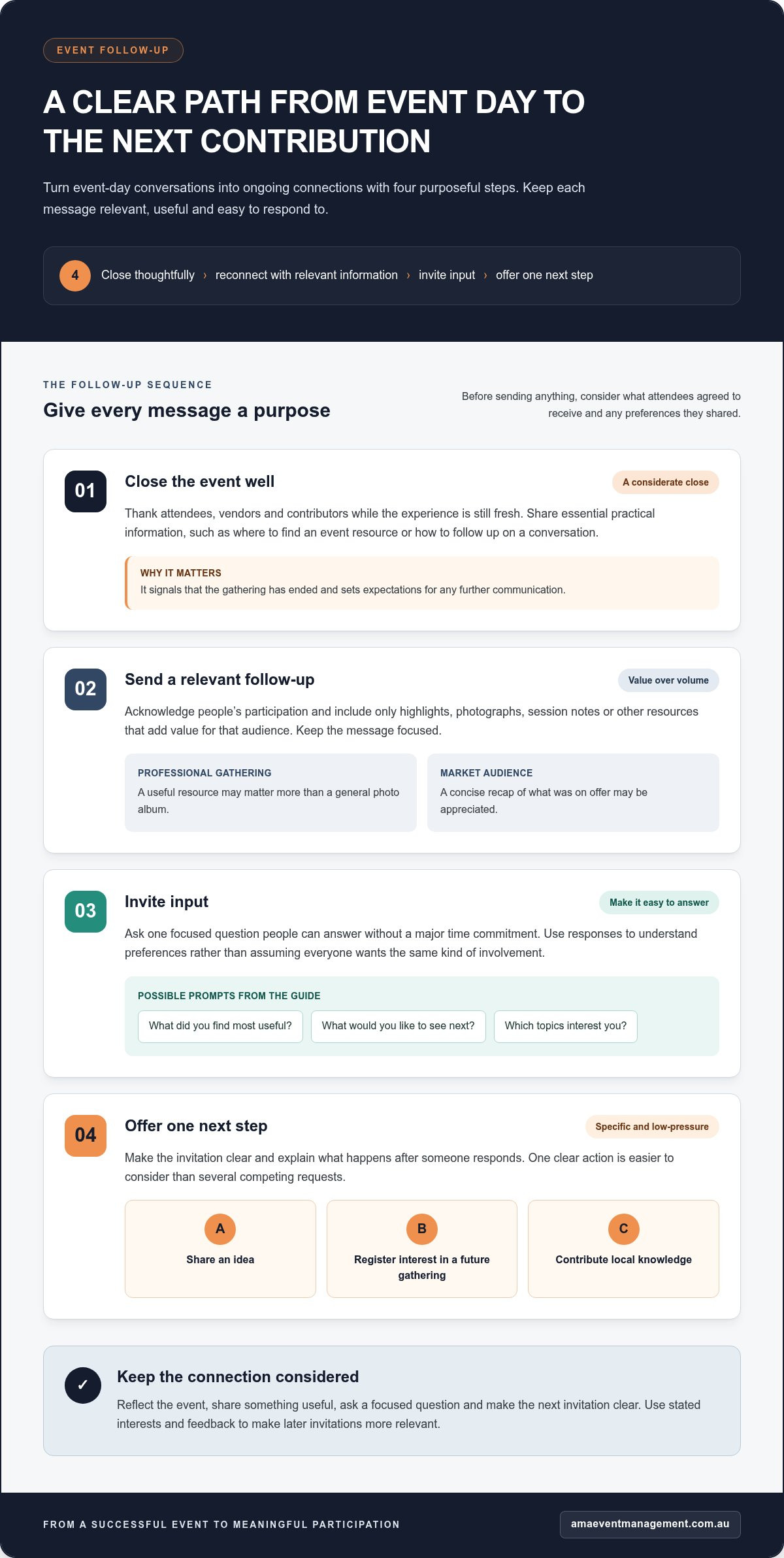
A useful follow-up plan moves attendees through a simple progression: close the event thoughtfully, reconnect with relevant information, ask for feedback, then offer a suitable next step. Giving each message a purpose makes building a community after your event easier to manage. Before sending anything, consider what attendees agreed to receive and any preferences they shared. Keep communication relevant and make the invitation clear.
Close the event well. Thank attendees, vendors and contributors while the experience is still fresh. Share essential practical information, such as where to find an event resource or how to follow up on a conversation. A clear, considerate close signals that the gathering has ended and sets expectations for any further communication.
Send a relevant follow-up. Acknowledge people’s participation and include only highlights, photographs, session notes or other resources that add value for that audience. Keep the message focused. For a professional gathering, a useful resource may matter more than a general photo album. A market audience may appreciate a concise recap of what was on offer.
Invite input. Ask a focused question that people can answer without a major time commitment. You might ask what they found most useful, what they’d like to see next or which topics interest them. Use responses to understand preferences, rather than assuming everyone wants the same kind of involvement.
Offer one next step. Make the invitation specific and low-pressure: share an idea, register interest in a future gathering or contribute local knowledge. Explain what happens after someone responds. One clear action is easier to consider than several competing requests.
What to do in the first follow-up
Send a timely, considered message that reflects the event rather than relying on a generic template. Thank recipients, mention a detail they’ll recognise and include a relevant highlight or resource if it helps them continue a conversation or use what they learnt. Then state one next action clearly. For example, invite feedback with a focused question or ask whether they’d like to hear about a related future activity.
How to turn follow-up into ongoing participation
Use stated interests and feedback to make later invitations more relevant. Offer several ways to contribute, such as suggesting a topic, sharing a skill or adding local insight, without implying that attendance or volunteering is expected. For market organisers, practical operations matter too. Professional community market management connects visitor engagement with vendor coordination and event delivery.
Keep communication conversational. If every message is an announcement, recipients have little reason to respond. Share a useful update, invite a considered contribution, then show how input informs the next activity. For recurring markets, festivals and professional events, build this sequence into event logistics from the outset. AMA Event Management’s event planning and management brings planning, logistics and on-site execution together, so organisers can consider how one gathering connects to the next.
Choose the right community channels and connection points between events
The best channel is one your participants will use and your team can maintain. It should make useful connection easier, not become another task that exists for its own sake. First, consider what people need between events: timely updates, public conversation, peer-to-peer exchange or a place to contribute ideas. Then compare how each option supports access and interaction with the moderation and administration it requires.
When email, social media or an online group fits
Email suits direct updates and invitations that recipients may want to find later. Social media works well for visible event news and open conversation. A dedicated group is more appropriate when participants have a shared reason to talk between events, not simply because a group can be created. Start with one primary channel, then add another only when it serves a distinct purpose.
For example, a recurring market in Sydney might use email for practical updates and social posts for public information, while a small professional network in Melbourne may value a group for continuing a focused discussion. These are starting points, not fixed rules. Ask attendees which channels they prefer and notice where they already respond. Building a community after your event shouldn’t require participants to join a platform they rarely use.
How to keep connection accessible and respectful
Explain what each channel is for, what people can expect to receive and how they can take part. Don’t assume every attendee wants frequent messages or public visibility. Offer a straightforward way to receive relevant updates without joining a discussion space, and make participation optional.
Use attendee information in line with the purpose and expectations communicated during sign-up. Ask clearly about preferences, and don’t treat details shared for event logistics as automatic permission for unrelated messages. Assign responsibility for updates, replies and moderation so each space remains useful and the team can sustain it.
Build a sustainable engagement rhythm that gives participants a role
A community doesn’t need constant messages to stay connected. It needs a dependable rhythm of useful communication and genuine opportunities to take part. Set a cadence your team can maintain, then check that each touchpoint has a purpose: sharing relevant information, inviting a response or helping participants connect. A lighter, consistent plan is more sustainable than frequent updates that are difficult to deliver or offer little value.
Turn engagement into a repeatable rhythm
Map the natural points between gatherings rather than filling the calendar for its own sake. A recurring market might share a practical update, ask for feedback after a trading day, then invite suggestions as the next market takes shape. A festival programme may need a different pattern. Adjust the frequency to audience interest and your team’s capacity to read and respond to feedback.
Share a useful update: Give participants information that helps them stay informed or prepare for what’s ahead.
Make space for feedback: Ask a focused question about an experience, idea or area for improvement.
Invite a contribution: Offer a specific way to suggest a topic, share local knowledge or take part in a future activity.
Close the loop: Let people know what you heard and, where appropriate, how their input shaped a decision.
Before sending a message or hosting a conversation, ask whether it gives people something useful, strengthens a relevant connection or offers a clear way to participate. If it does none of these, leave it out. This check helps protect people’s attention and gives organisers a practical way to review the communication rhythm over time.
Invite co-creation without overburdening participants
Participation should feel manageable. Instead of asking people to help plan everything, offer small, clear invitations: recommend a discussion topic, identify a local need, suggest a stallholder category or share a skill. Attendees, vendors and community partners can contribute in different ways, so make room for ideas without turning involvement into an obligation.
Acknowledge what people contribute. A brief response, a summary of recurring suggestions or an update on a decision shows that input has been considered, even when not every idea can be acted on. For a festival programme in Sydney or Melbourne, community feedback can help organisers connect activities with local participation and practical delivery.
Assess progress through meaningful signals, not reach alone. Track whether people respond, return, share ideas or contribute knowledge, and consider which invitations lead to useful involvement. Building a community after your event is a process of listening and adjusting, not simply sending more updates. Plan your next event with AMA Event Management to bring participant engagement into the wider event plan.
Make community-building part of your next Australian event plan
Follow-up is easier to deliver when it’s designed into the event plan, not left as a task for someone to remember after pack-down. Decide who will manage attendee communications, who will review feedback and how the next opportunity to participate connects with event planning. Assigning these responsibilities in advance helps carry useful information from the event close into the next planning cycle.
Coordinate the people and details behind continuity
Assign responsibility for the transition from event delivery to follow-up. That person or team can coordinate the thank-you message, route attendee questions, capture suggestions and share relevant feedback with those planning the next gathering. Agreeing on this handover beforehand reduces the risk that useful conversations are lost once the site is cleared and the event team moves on.
Bring communications and operational planning together. If attendees at a Sydney market ask for more local makers, for example, that feedback may inform vendor coordination as well as future updates. If a Melbourne community festival draws interest in a particular activity, organisers can consider whether it fits the programme and explain the next chance to get involved. Feedback doesn’t need to dictate every decision; review it alongside the event’s purpose, logistics and resources.
Recurring local markets offer a practical way to build continuity between gatherings, because organisers can learn from one event and carry relevant insights into the next. They’re an example, not a universal model. A one-off professional conference or a community festival with a different programme may need a different follow-up plan. The principle is the same: connect attendee communication, vendor or partner coordination and the next planning milestone.
Set a practical next step for your organisation
Start with two decisions: define the shared purpose you want the event to support, then choose one useful post-event action. It could be inviting participants to suggest a future topic, sharing an update shaped by attendee feedback or offering a clear way to express interest in the next gathering. Keep the action relevant to the event and assign someone to respond.
Coordinated event management can align the moving parts, from planning and logistics to on-site supervision and the handover into future activity. Founded by Amanda, AMA Event Management brings more than 20 years of industry experience to corporate and community events. The team plans and manages events with follow-up and event delivery treated as connected parts of the plan.
For a community festival, recurring market or other event programme in Sydney or Melbourne, discuss your next event with AMA Event Management and bring planning, coordination and participant involvement together.
Give your next gathering a stronger starting point
The next event can begin before planning gets underway. Decide what you want people to carry forward from the experience, then make a practical space for that connection to grow. It could be a conversation, a shared idea or a reason to take part in what comes next. A clear purpose helps your team make deliberate choices about how the event is organised and how participants can stay involved.
That’s the foundation of building a community after your event: creating continuity people can recognise and choose to join. Shape the approach around the event, whether you’re planning a community gathering, local market or corporate occasion in Sydney or Melbourne. With coordinated planning, follow-up becomes part of the event plan rather than an afterthought.
Discuss your next event with AMA Event Management and explore how purposeful planning can support the connections you want to carry forward. Each gathering offers a fresh opportunity to bring people together and give their involvement a meaningful next step.
Frequently Asked Questions
Is a mailing list enough to build an event community?
No, a mailing list is a delivery tool, not a community by itself. For a Sydney festival, it might keep subscribers informed about programme announcements, while a post-event discussion gives interested attendees a way to exchange ideas. Keep the list useful by tailoring updates to expressed interests and making the purpose clear. Look at whether subscribers respond or act on invitations, not just whether messages are sent.
Can a one-off event create a lasting community?
Yes, a one-off event can give people a shared experience to build on, but it can’t ensure they’ll stay connected. Building a community after your event could start with a follow-up that refers to a particular session or shared interest, then offers a relevant next step. For example, invite attendees to suggest a topic for a future professional discussion. Make the invitation optional and manageable for the organising team to deliver.
How can organisers recognise returning attendees without excluding newcomers?
Welcome familiar faces while making it easy for first-time attendees to understand how to join in. At a Melbourne gathering, organisers could offer a short welcome, clear programme information and introductions that don’t rely on shared history. Explain useful customs in plain language, and design activities for different levels of familiarity. Returning attendees can help newcomers feel at ease, but shouldn’t be expected to speak for the wider group.
What should a post-event feedback survey ask?
Ask focused questions that can inform a decision, such as which part of the event people valued, whether they made a useful connection and what they’d like included next time. Add an optional open-response question for suggestions that don’t fit the set choices. Keep the survey proportionate to the event and avoid collecting personal details you don’t need. Tell respondents how their feedback may guide future planning.
What happens if engagement drops between events?
A quieter spell doesn’t necessarily mean the community has failed. People may have little to respond to, or the communication format may not be convenient. Review which messages prompted replies or participation, then ask a small, relevant group what would be useful. Try one well-timed invitation or discussion prompt before changing the whole approach. Avoid increasing message volume unless you have something worthwhile to share.
Can vendors and community partners be part of an event community?
Yes, vendors and partners can contribute when their involvement supports the event’s shared purpose. At a local market, a vendor might share knowledge about a product or local interest, while a community partner could suggest a relevant activity. Agree on clear boundaries so contributions inform the experience rather than turn every conversation into promotion. Leave space for attendees to share their own perspectives and influence future activity.

Comments