

Event Risk Assessment Template: 2026 Australian Guide
A risk rating doesn’t make an event safer unless it leads to a clear, workable control. An event risk assessment template Australia organisers can rely on should connect each hazard with practical action, a responsible person and a review point, rather than become paperwork that sits unused.
It can be hard to know what belongs in an assessment. A generic form may prompt you to consider common hazards, but it cannot account for your venue, audience, activities or event schedule. Australian WHS guidance and local council requirements can vary by jurisdiction and location, so adapt the template to the event you’re planning.
This guide covers what to include, how to work through risk ratings and how to select controls for bump-in, event delivery and bump-out. It also explains how to assign owners, review actions, involve relevant people and check the state, territory and council context. The aim is a structured assessment you can tailor and use to support coordinated planning and delivery.
Table of Contents
Purpose of an Australian Event Risk Assessment Template
A useful event assessment turns a broad safety concern into a decision the organising team can act on. An event risk assessment records hazards, the harm they could cause, the controls selected to address them, and the actions needed to put those controls in place and review them. That is the purpose of an event risk assessment template Australia organisers can adapt: connecting risks to practical planning, clear responsibilities and follow-up.
The record should help organisers make informed choices about how an event will operate. If an activity, layout or delivery arrangement creates a hazard, the assessment gives the team a structured way to consider what could happen and decide how to respond. This process follows the general principles of Risk Assessment, but the useful detail comes from applying them to the event itself, not simply completing a form.
A generic workplace checklist or venue inspection may cover useful baseline issues, such as access routes or equipment condition. It may not account for event-specific activities, temporary structures, vendor movements, crowd flows or changes between setup and public opening. Treat those documents as possible inputs, not substitutes for an assessment shaped around the event’s work and conditions.
Which events and organisers can use a template?
The same core structure can support a community festival, market, conference, expo or private function. Organisers can use it for indoor, outdoor or multi-space events. The format can stay consistent, but the assessment should not. Activities, site conditions, audience needs, contractors and operating arrangements determine which hazards need attention and which controls are workable.
For example, a market assessment may need to cover how vendors and vehicles move through the site, while a conference assessment may focus on room layouts, equipment setup and attendee circulation. These are prompts, not a fixed hazard list. Work through the event plan to identify what applies, including unusual activities and site constraints.
What a template can and cannot do
A template provides a repeatable way to ask questions, record decisions and track follow-up. It can help the team spot gaps before delivery and share responsibilities. It cannot identify every hazard automatically, judge every situation for you or guarantee a safe event. A completed document is useful only when its findings inform decisions and the planned controls are put in place.
Keep the assessment active as planning develops. If the site, schedule, activities or operating arrangements change, reconsider the entries affected. The template should support discussion with people who understand the work, not replace their knowledge with assumptions or a tick-box exercise.
Australian organisers should check the current WHS guidance relevant to the state or territory where the event takes place, alongside local council requirements for the site and event. These sources can affect what planning information is needed. A template is a starting framework. Tailoring it to the local context and reviewing it as plans evolve makes it a practical planning tool rather than paperwork alone.
What to include in an event risk assessment template
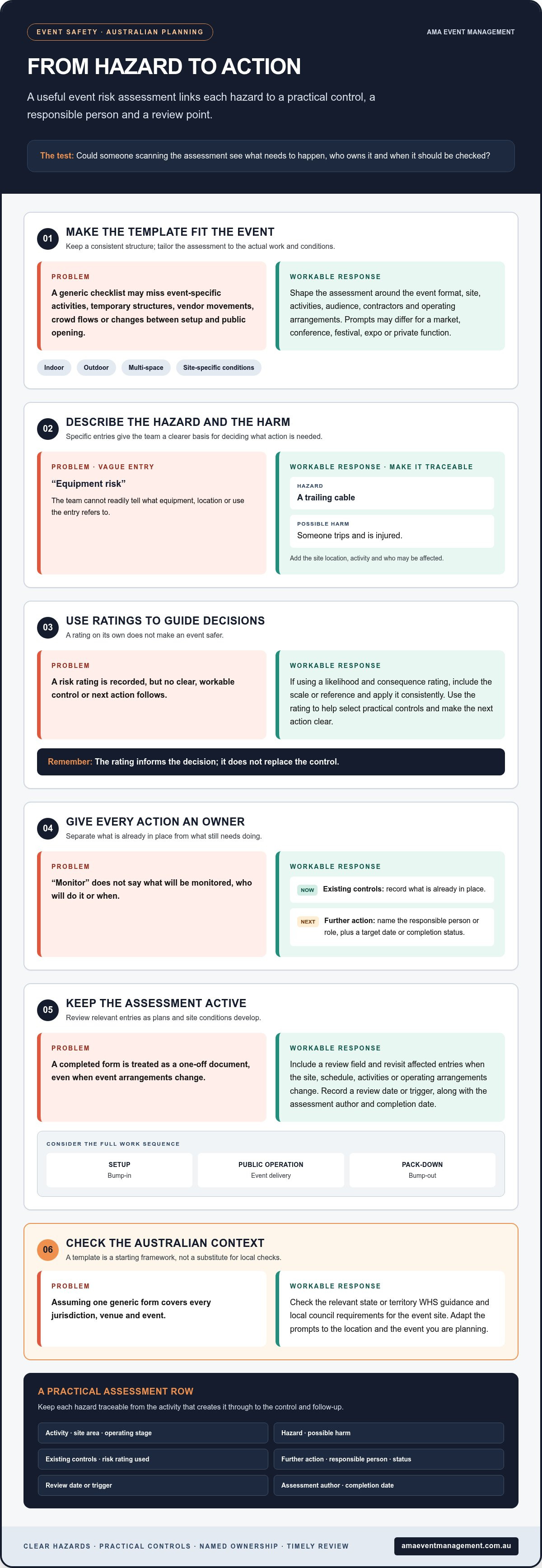
A well-structured assessment makes it easy to trace each hazard from the activity that creates it through to the control, action owner and review. For an event risk assessment template Australia organisers can adapt, record the event and assessment details first, then use a consistent row for each hazard. Keep the layout readable so the team can quickly see what is already in place and what still needs attention.
Recording event details and identifying hazards
Start with the event format, site areas, activities and operating conditions. Include who completed the assessment and when, then note when it should be reviewed. Consider the full work sequence, including setup, public operation and pack-down, as well as conditions that may change. Describe hazards in plain language and record possible harm separately: a trailing cable is a hazard; someone tripping and being injured is the potential harm.
Useful context can include the location within the site, the activity taking place and who may be affected. A broad entry such as “equipment risk” is difficult to assess or assign. Naming the equipment, its location and how it is being used gives the team a clearer basis for deciding what action is needed.
Adding controls, owners and review fields
Connect each control directly to the hazard it addresses. Separate existing controls, which are already in place, from further actions that remain outstanding. For each action, name a responsible person or role and record a target date or completion status. Add a review field so changes to the event, site or operating conditions prompt the team to revisit the relevant entry.
If you use a likelihood and consequence rating, include the scale or its reference and apply it consistently. The rating should inform decisions, not stand alone. Make the next action clear, even to someone scanning the assessment quickly. Avoid vague entries such as “monitor” unless the record explains what will be monitored, by whom and when.
A practical table can use one row per hazard, with columns for:
Activity, site area and operating stage
Hazard and possible harm
Existing controls and any risk rating used
Further action, responsible person and completion status
Review date or trigger, plus the assessment author and completion date in the document details
For example, an assessment might identify a cable crossing a pedestrian route during equipment setup. Describe the trip hazard and possible injury, note any control already in place, then record a specific further action, such as changing the cable route or securing the crossing. Assign the action to a named role and include a completion check before the area is used. This makes the gap between identifying a hazard and managing it visible.
Use the same structure across different event formats, but tailor every entry to the actual site and operating plan. For complex logistics, professional event planning and management can help keep assessment actions connected to coordination and delivery.
How to assess event risks and choose practical controls
Move from observation to action in a clear sequence. Walk through the planned activities and consider what could cause harm, who might be affected and how the work will happen. Include people who understand the tasks, such as workers, contractors, volunteers and suppliers. Their knowledge can reveal hazards a desk-based review may miss. An event risk assessment template Australia organisers use is most useful when it records this reasoning and the decisions that follow.
Using risk ratings without false precision
Likelihood means how plausible it is that harm could occur in the circumstances; consequence describes how serious that harm could be. Before applying a matrix, check that its definitions and categories come from guidance relevant to the event and are used consistently. There is no universal event score to insert by default. If a rating involves judgement, briefly record why the team selected it, including relevant conditions or assumptions.
A rating helps prioritise attention, but it does not explain how a hazard will be managed. A low-looking score is not a control, and a high score does not identify the next step. Use the rating to inform decisions, then describe the action in plain language. If people could interpret the control in different ways, make it more specific.
Turning assessment findings into controlled actions
Choose controls that address the source of the hazard where practicable. Consider whether the hazard can be eliminated, then whether substitution or an engineering change could reduce exposure. Administrative measures and personal protective equipment may also have a role, but a written instruction should not replace a more effective practical change where one is available.
A useful control addresses a specific hazard, describes the action clearly and has an owner responsible for carrying it through.
Identify the hazard and possible harm. Describe the relevant activity or condition and how it could affect people.
Select a control. State what will change, such as altering a process, adjusting a layout or setting out a clear work procedure.
Assign the action. Name a responsible person or role, record when the action is due and explain how completion will be checked.
Review the result. Reconsider the assessment if the control is not in place, does not work as intended or circumstances change.
Keep proposed actions visible until they are completed and checked. Do not mark a hazard as resolved simply because a control has been written down. For example, a planned change to an event layout remains an open action until the change has been made and the relevant area reviewed.
Revisit the assessment when event arrangements, site conditions or activities change. A revised schedule, different setup or unexpected site constraint may affect whether existing controls remain suitable. Record what changed and update the relevant action or rating so the team works from the current plan, not an earlier assumption.
Adapting Templates to Australian Sites and Conditions
A template becomes useful when it reflects both the place and the way the event will run. Australian organisers should check the current WHS guidance for the state or territory where the event is held, along with relevant local council requirements. A form developed for one council or jurisdiction may offer a useful starting structure, but it should not be treated as a universal rulebook. Confirm the guidance’s current name, scope and applicability before relying on it.
Checking Australian state, territory and council context
Start with the relevant state or territory WHS regulator. SafeWork NSW, WorkSafe Victoria and SafeWork SA are examples of jurisdiction-specific sources; other jurisdictions have their own regulators and guidance. Then review the local council’s event information for the proposed site. Consider whether council conditions, site arrangements or event approvals raise assessment questions that the general template does not cover.
Keep a record of the sources consulted and the date you checked them. This helps the organising team understand which guidance informed the assessment, particularly if planning continues over time or the event location changes. An event risk assessment template Australia organisers use should support local tailoring, not suggest one checklist applies identically across every state, territory and council.
Adapting hazard prompts to event type and location
Use prompts to direct attention, not to declare an assessment complete. For festivals and markets, consider site access, vendor activity, weather exposure and crowd movement. For conferences and expos, look at venue flows, contractor activity, equipment installation and temporary event arrangements. The relevant questions depend on the site plan, activities and how people will move through the event.
These examples can help organise an initial review:
For further context, see this guide to community festival organisers in Australia and this overview of community market management in Australia. Treat every prompt as a starting point. Walk the site, review the event plan and account for access arrangements, weather exposure, temporary structures and vendor operations that apply to your setting.
AMA Event Management plans and manages public and private events across Australia, including festivals, markets, conferences and expos. For coordinated planning from concept through delivery, work with AMA Event Management on your event planning.
How event management keeps risk planning connected to delivery
A risk action only helps if it becomes part of the plan people use to prepare and deliver the event. Keep assessment actions alongside the relevant logistics, site arrangements and team responsibilities, rather than in a separate document that may not be consulted. This makes it easier to see how a planning decision affects setup, event operations and pack-down.
Keeping assessment actions visible during planning
For each action, identify the part of the event plan it affects, who is responsible and how completion will be checked. A change to a site layout, for example, may affect access routes, equipment placement or the movement of attendees and vendors. Connect the action to the relevant plan or briefing so the people coordinating that work can act on current information.
Review affected assessment entries when activities, venue arrangements or operating conditions change. This could include a revised schedule, a different site configuration or a change in how contractors and vendors carry out their work. Record the change, consider whether existing controls still fit and update responsibilities or actions as needed. A review should clarify what has changed and what the team must now do, not simply update a date on the form.
During preparation and delivery, use assigned responsibilities to keep outstanding actions visible. The person coordinating an activity should be able to identify which actions relate to it and whether they have been completed. If a control depends on a site arrangement, ensure the relevant team members understand that arrangement before the activity begins. Clear links between the assessment and event plan help keep decisions connected as work moves from planning to execution.
When professional event management can help
Coordinating risk planning with event logistics requires a clear view of how the different parts fit together. AMA Event Management provides Australia-wide event management and professional event planning for public and private events, including festivals, markets, conferences and private functions. Its team handles the event lifecycle from concept through execution, helping organisers coordinate planning and delivery without treating a completed assessment as a guarantee of safety.
For example, an event plan may involve a venue layout, delivery schedule, contractor activity and attendee movement. When those arrangements change, the relevant assessment entries may need to change too. Keeping the event plan and assessment aligned gives the organising team a clearer basis for coordinating responsibilities and responding to updated conditions.
Whether you’re planning a public event or a private function, an event risk assessment template Australia organisers can tailor is one part of a broader delivery process. Pair it with active coordination, clear ownership and considered review as plans develop. To discuss planning an event with AMA Event Management, contact AMA Event Management.
Put your event plans on a clear footing
Before your next planning milestone, take the assessment beyond the page. Walk through the proposed arrangements with the people responsible for delivering them, and check that each action still fits the event as it takes shape. This review can reveal assumptions worth resolving early, while there is still room to adjust the plan.
An event risk assessment template Australia organisers can adapt is most valuable when it supports informed decisions throughout planning and delivery, not simply when it is completed. Keep it connected to the event plan, update it as relevant details change and make sure each responsible person understands their part.
AMA Event Management supports public and private events with professional event planners, coordinating planning from concept through execution. If you’re shaping an upcoming event and would value support with its broader planning and delivery, discuss your next event with AMA Event Management.
With a considered plan and clear coordination, you can move forward with greater clarity and focus on bringing your event to life.
Frequently Asked Questions
Is there one event risk assessment template used across Australia?
No. Organisers may use different templates from regulators, councils, venues or their own planning systems, and no single form should be assumed to fit every event. A consistent format can help teams record decisions, but its prompts need to suit the event and location. For an event risk assessment template Australia organisers can adapt, check the current guidance that applies where the event will take place.
What should an event risk assessment template include?
Include enough context for someone else to understand the assessment without relying on verbal explanation. Record the event name, site or area, activity being assessed, assessment author and date. For each entry, distinguish the hazard from possible harm, note controls and outstanding actions, and identify who will follow them up. A useful test is whether a new team member could tell what needs attention and where.
How do I assess risks for a public event in Australia?
Review the event plan against the way the public will arrive, move through the site and leave, then consider how workers, vendors and contractors use the same spaces. For an event in Sydney or Melbourne, check the relevant state or territory WHS regulator and local council information for that location. Walk through the proposed layout and consider how a change, such as a closed entrance, could affect movement or access.
Do I need a separate risk assessment for each event?
Assess each event on its own merits. A previous assessment can provide a useful starting point for a recurring market or annual function, but it should not be copied across without review. Compare the current site, activities, schedule, suppliers and operating arrangements with the earlier event. A different venue or changed layout may introduce risks the old document does not address, even if the event name and format are familiar.
What is the difference between a hazard and a risk in event planning?
A hazard is something with the potential to cause harm; risk concerns the chance of that harm occurring and how serious it could be. For example, a wet entry surface is a hazard. The risk is that a person slips there and is injured, with the likelihood and possible consequence depending on the conditions and controls. Keeping the terms distinct helps the assessment explain both the source of concern and its potential impact.
How often should an event risk assessment be reviewed?
Review it as planning develops, before the event operates and whenever a change could affect an assessed hazard or control. Triggers might include a revised site layout, altered access arrangements, a new activity or changed operating conditions. Set review points that fit the event’s planning process, and check the relevant regulator or council guidance for any specific expectations. A review is useful when it tests whether the recorded plan still matches reality.
Who is responsible for completing an event risk assessment?
The organiser should ensure the assessment is prepared and kept relevant, with suitable input from people who understand the activities and site. Depending on the event, this may include workers, contractors, volunteers, suppliers and venue representatives. Assigning someone to draft or update the document helps coordinate the work, but it does not automatically transfer the organiser’s responsibilities. Where WHS duties apply, confirm who holds them under the relevant jurisdiction’s requirements.



Comments