

Planning a Community Festival in Melbourne: A Practical Guide
A strong community idea can still run into trouble if the site, approvals and event-day logistics don’t line up. Planning a community festival Melbourne residents can enjoy starts with making those decisions in the right order.
The programme, site layout, vendors and visitor operations all affect one another. A performance area can change where stalls fit; a site’s access points can affect supplier arrivals and visitor flow. This guide covers the Melbourne-specific decisions to address first and how to connect them in a practical plan.
You’ll learn how to assess a site, identify the relevant approval pathway and shape a programme that works with the location. AMA Event Management plans and manages community festivals, fairs and markets, coordinating details from concept through execution. A structured approach helps turn an initial idea into an organised festival plan with clear next steps.
Table of Contents
Planning a Community Festival in Melbourne: Start with Purpose and Place
Melbourne Festival Sites, Council Approvals and Local Planning
Choose a Melbourne Festival Format, Programme and Vendor Mix
Build a Melbourne Festival Delivery Plan for Event-Day Operations
Deliver a Community Festival in Melbourne with End-to-End Event Management
Planning a Community Festival in Melbourne: Start with Purpose and Place
A community festival is a planned public gathering built around a shared purpose, bringing people together through activities, culture or local interests. Festivals can take many forms, from neighbourhood celebrations to markets and performances. For a broader overview, see What is a Festival?
That definition describes the public experience, not the organiser’s job. An event listing helps people decide whether to attend, but it doesn’t explain how the festival will serve its community or work on the ground. Planning a community festival Melbourne organisers can deliver starts with a clear brief: why the event should happen, who it is for and what value it will create locally.
Write down the intended audience and the outcome you want the festival to support. That could mean creating a welcoming place for neighbours to connect, recognising a local cultural tradition or giving community groups a shared platform. Use the purpose to assess ideas consistently. If an activity doesn’t support the audience or the event’s aims, consider leaving it out.
What makes a community festival work for its Melbourne audience?
Begin with the people and precinct, not a list of attractions. Consider who lives, works or gathers nearby, what matters to them and whether the format suits the area. Involve community voices when shaping the experience, particularly when the festival reflects local culture or traditions. Accessibility should also inform decisions about movement, participation and how visitors use the site.
Separate the programme into essentials and optional additions. A central activity might define the festival, while extra stalls or performances add variety only if the site and delivery plan can support them. This distinction helps prevent the programme from growing beyond the available space, time or coordination capacity.
How should organisers choose a Melbourne festival site?
Assess each possible location against the audience and activities you have in mind. Consider how visitors might reach it, whether the setting can accommodate the programme and what practical arrangements the event may need. A performance-led gathering, for example, has different space and movement needs from a market with multiple stalls. Work through these questions before choosing a site, not after the programme is fixed.
Establish which local council is responsible for the precise location. Don’t assume a familiar suburb name or nearby landmark identifies the correct boundary. Use the relevant council’s official information to establish its jurisdiction, then review its current site conditions and event guidance. If the site is public land, the responsible authority and proposed activities can affect which permissions or applications need to be investigated.
Treat site suitability and approvals as linked decisions. A location may appeal to your audience but prove impractical for the programme or approval pathway. Before settling on it, record the proposed activities, likely site requirements and access considerations, then compare them with the location. This gives you a sound basis for checking local requirements and refining the festival format.
Melbourne Festival Sites, Council Approvals and Local Planning
Melbourne festival requirements are site-specific, so check them with the authority responsible for the exact location. The council, proposed activities and use of the site all influence which applications, permissions or conditions may apply. Don’t rely on a suburb name alone: a nearby street or park may fall under a different council’s jurisdiction. Confirm the location first, then use current official guidance to shape the planning brief.
This order matters. A site decision affects more than the event’s look and feel. It can influence visitor arrival, supplier access, programme flow and local considerations that need attention. When planning a community festival Melbourne organisers can reduce uncertainty by recording these factors before committing to a detailed layout.
How do you identify the right Melbourne council and authority?
Start with the precise proposed address, including the park, reserve, road or other public space. Establish which council administers that location, especially if it is close to a municipal boundary. For a site within the City of Melbourne, begin with its Melbourne City Council Event Planning Resources. For another location, use the responsible council’s current event information.
Describe the event clearly before reviewing requirements. Note the site type, activities, proposed infrastructure and how the public space will be used. Compare that information with the responsible authority’s published guidance, and check relevant Victorian authorities where the activity calls for it. Don’t assume that one council’s process applies across Greater Melbourne or that guidance for one kind of event covers another.
Which local site conditions belong in the planning brief?
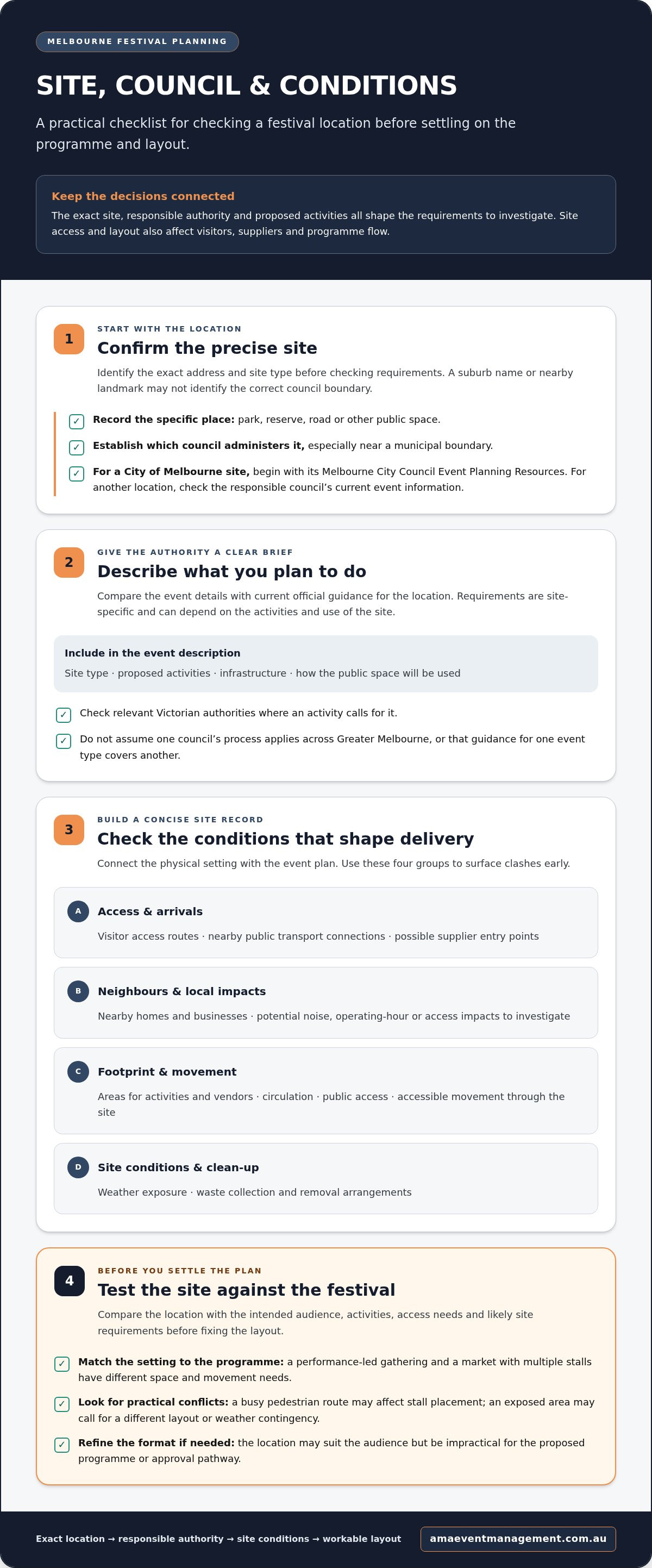
Build a concise site record that connects the physical setting with the event plan. Include:
Visitor access routes, nearby public transport connections and possible supplier entry points.
Nearby homes and businesses, with potential noise, operating-hour or access impacts to investigate.
The proposed event footprint, including areas for activities, vendors, circulation and public access.
Weather exposure, accessible movement through the site, and arrangements for waste collection and removal.
These details help expose clashes early. A busy pedestrian route, for example, may affect where stalls can go; an exposed area may call for a different layout or a weather contingency. Consider how sound may affect nearby residents and how visitors can move around without obstructing access. Record assumptions as questions for the relevant authority, rather than treating them as settled requirements.
Some planned activities may involve separate approvals or conditions. Check current official guidance for the site and event rather than relying on general advice or previous arrangements. If site choice, council requirements and logistics are difficult to align, AMA Event Management’s festival planning and coordination connects the concept with practical delivery planning.
Choose a Melbourne Festival Format, Programme and Vendor Mix
Once the purpose and site are taking shape, choose a format that brings them together. A market-led festival, a cultural programme and a mixed event can each serve a community, but they create different demands for space, timing and coordination. Choose according to the audience you want to welcome, the character of the location and the experience you want people to have.
When planning a community festival Melbourne organisers should compare formats through practical questions, not just a list of appealing activities. What needs to happen on site at the same time? Where will visitors gather or pass through? Which activities need dedicated space or oversight? The answers help shape a programme the site can support.
Which festival format fits the purpose and audience?
A market-focused format can centre local makers, community groups or small businesses. A cultural programme can foreground performances, demonstrations or shared traditions. A mixed format brings elements together, but needs careful scheduling and a layout that lets different activities operate alongside each other. None is automatically best. Match the choice to your purpose, audience and location.
Use the table as a starting point, then test the format against the actual site. A performance area may draw visitors to one part of the precinct, while stalls work best where people can browse without disrupting through-movement. Build accessibility into the layout from the outset. Include clear paths and places to pause instead of treating access as an adjustment after activities are assigned.
How can vendors and activities form one coherent programme?
Choose each vendor and activity for its relevance to the festival’s purpose and audience. Variety can make a programme feel welcoming, but unrelated additions may dilute its identity. Set selection criteria around the event theme, the experience you want to create and the practical fit with the site.
Plan placements alongside circulation, access and activity timing. For example, consider whether a stall near a performance area could affect audience movement, or whether a demonstration needs a clear viewing zone. Confirm how each participant’s space and operating needs fit into the wider layout. For market components, community market management in Australia involves coordinating vendors as part of the event plan, not as a separate task.
Before finalising the programme, check that every element has a clear role, a suitable place and a workable relationship with nearby activities. Then carry those decisions into the operational plan, including who coordinates each participant and how changes to timing or layout will be communicated.
Build a Melbourne Festival Delivery Plan for Event-Day Operations
A delivery plan turns the chosen format and site into coordinated actions. It should show how vendors, visitors, the programme and event operations fit together, from setup through pack-down. When planning a community festival Melbourne organisers should keep decisions in a shared working document, so suppliers and staff can follow the same plan.
Build the sequence in order. Each stage depends on the decisions made before it:
Confirm the concept and site. Record the festival purpose, programme, selected location and the relevant authority’s current requirements. Keep any conditions or approvals that affect delivery visible to the planning team.
Map the site. Mark activity areas, vendor positions, visitor routes, accessible paths, entry points and operational zones. Check the proposed layout against actual site conditions.
Coordinate people and timing. Set out delivery, setup, programme transitions and pack-down in a schedule. Assign responsibilities for each task, including vendor oversight and on-site operational decisions.
Confirm readiness. Review the plan with relevant suppliers and event staff. Check that roles, timings, contact arrangements and site information are understood before event day.
Oversee delivery and close-out. Use the agreed plan to coordinate activity on site, record changes and manage pack-down in line with the site arrangements.
What should a festival operations plan coordinate?
Bring the site map, schedule and responsibility list together, rather than treating them as separate documents. A vendor’s arrival time should align with site access; a performance transition should account for nearby visitor movement. Name the person responsible for each operational decision and make escalation routes clear to the people who need them. This gives the team a shared reference while activity is underway.
How can organisers prepare for changes on event day?
Consider plausible disruptions such as wet or windy weather, a delayed supplier or a programme change. For each, agree who assesses the situation, who can authorise a change and how the update reaches vendors, staff and attendees. Keep messages clear and consistent. Decide how the site plan or schedule will be updated so teams aren’t working from conflicting information.
Base safety and emergency arrangements on current official Victorian and relevant council guidance for the event and site. Requirements can depend on the activity and location, so a generic checklist is not a substitute for checking applicable guidance. Document the arrangements, share responsibilities with the people involved and make sure any changes follow the appropriate process.
Coordinating a festival from concept through execution takes oversight across planning, logistics and vendors. AMA Event Management’s festival planning and coordination brings those workstreams into the delivery plan.
Deliver a Community Festival in Melbourne with End-to-End Event Management
A festival brings together connected workstreams: its purpose, programme, site logistics, vendors and on-site delivery. Professional event management can keep these elements aligned from concept through execution, so decisions made during planning inform how the event is delivered. For organisers, this means approaching the festival lifecycle as connected work rather than a collection of separate tasks.
AMA Event Management plans and manages public events, festivals, expos and markets across Australia. Its professional event planners coordinate logistics and vendors as part of event management from concept through execution. This gives Melbourne organisers a way to connect community priorities, programme decisions and practical delivery requirements in one plan.
When does professional festival management make sense?
Consider coordinated oversight when planning tasks are spread across several people or when choices in one area affect another. A programme change may alter vendor arrangements; a site constraint may affect visitor movement and event timing. An integrated approach connects the event’s objectives with logistics and delivery, while keeping responsibilities and dependencies in view.
Several suppliers, vendors or community participants need to work to a shared plan.
Site arrangements, programme timing and visitor access need to be coordinated together.
Organisers need planning and on-site delivery to follow a consistent approach.
These are signs that bringing the workstreams together could make planning more manageable. For community festivals in Melbourne and Sydney, coordination links the event’s purpose with practical decisions about the programme, vendors, site and delivery.
What happens when you discuss a festival concept with AMA?
Start with the essentials: the festival’s purpose, intended audience, proposed location and current planning priorities. You can also outline the format under consideration, the activities that matter most and any known site or coordination questions. These details provide a useful starting point without requiring every operational decision to be settled in advance.
AMA’s professional event planners manage events from concept through execution, including logistics and vendor coordination. That end-to-end perspective connects early planning with the arrangements needed to deliver a public event. It also brings vendor activity and event operations into the broader festival plan instead of treating coordination as an isolated task.
What is the next step for Melbourne festival organisers?
Prepare a concise brief that captures the purpose, audience, proposed location, preferred format and main questions to resolve. Note what’s already decided and what remains open. A clear outline makes it easier to discuss priorities and understand how planning, logistics and delivery fit together.
Contact AMA’s expert event planners to discuss your Melbourne festival concept and next steps. You don’t need a finished plan to begin; a clear brief is a useful basis for shaping the festival and progressing its delivery.
Turn Your Festival Idea into a Clear Brief
Put your festival idea into a concise brief. Note the community purpose, intended audience, preferred location and decisions that still need to be made. This gives planning a practical starting point and focuses the next conversation on what matters most.
Planning a community festival Melbourne organisers can deliver takes coordination across the idea, the site and the work required on the day. AMA Event Management plans and manages public events, festivals, expos and markets across Australia, with professional event planners managing events from concept through execution. That support connects the festival brief with its delivery planning.
When you’re ready to take the idea further, contact AMA Event Management’s expert event planners to discuss your Melbourne festival. A considered brief is enough to begin shaping the next steps, one clear decision at a time.
Frequently Asked Questions
Do I need council approval to hold a community festival in Melbourne?
Sometimes. Requirements depend on the exact site and planned activities. The City of Melbourne requires an event permit for events on its roads, reserves, parks or other public land. Its guidance also identifies circumstances such as erecting infrastructure, requiring vehicle access or reserving a space. Other councils may have different processes. Check current requirements with the responsible council before finalising your site plan or publicising event arrangements.
How do I find out which council is responsible for my Melbourne festival site?
Start with the precise address, rather than relying on the suburb name or a nearby landmark. Use the relevant councils’ official boundary information, where available, or contact the council to establish who administers the location. This matters for parks, roads and reserves near municipal boundaries. Once you know the responsible council, review its current event guidance and identify whether another authority also has a role in your proposed activities.
What should a community festival planning checklist include?
A useful checklist for planning a community festival Melbourne organisers are preparing should cover the event purpose, audience, site, programme and available resources. Add council contacts, approval enquiries, vendor information, site access, waste arrangements, an event schedule and named responsibilities. Include a weather contingency and a way to communicate changes to staff and participants. Keep the checklist as a working document, updating it when decisions affect other tasks or dependencies.
Can I include market stalls at a community festival in Melbourne?
Yes, market stalls can be part of a community festival, provided the proposed setup fits the site and relevant council requirements. Select vendors whose goods or activities suit the festival’s purpose, then map their locations alongside visitor routes and programmed activities. Give each participant clear information about arrival, setup, operating arrangements and pack-down. Consider how stall activity may affect access, waste handling and the movement of people across the event area.
How do I plan for bad weather at an outdoor Melbourne festival?
Prepare a written weather contingency before event day. Identify which conditions could affect the site or activities, who will assess them and who can communicate a change. Consider whether the layout, schedule or stall arrangements need to be adjusted, and whether an alternate or sheltered area is suitable and permitted. Share the agreed process with vendors and staff, then monitor official weather information as the event approaches and during delivery.
When should I involve a professional festival event manager?
Involve a professional event manager when responsibilities are spread across multiple organisers, vendors and suppliers, or when a decision in one area could affect several others. Early involvement can connect the event brief with practical planning before arrangements become fixed. For example, if a programme change affects site use, access and supplier movements, coordinated oversight can keep those workstreams aligned and clarify who is responsible for each decision.
What does an event management company do for a community festival?
An event management company can coordinate the work involved in taking a festival from concept through execution. This includes planning, logistics, vendor coordination and oversight of event delivery. AMA Event Management manages public events, festivals, expos and markets across Australia, including for organisers in Melbourne and Sydney. Its professional event planners connect the event’s objectives with the practical arrangements needed to deliver it.

Comments