

How to Measure Event ROI: Guide for Event Organisers
Updated: Oct 16
What if you could tell whether an event was worth its investment before booking the first supplier? Attendance figures show who turned up, but they don’t reveal whether the event supported business goals, generated useful leads or strengthened community engagement. When costs are spread across teams and suppliers, and sales may follow months later, working out how to measure event ROI takes more than filling in a spreadsheet.
A reliable approach starts by agreeing what success means, then tracking relevant costs and outcomes from planning through to follow-up. This helps organisers assess financial returns alongside engagement, lead quality and attendee feedback, while being clear about what can and can’t be attributed to one event.
This guide sets out a repeatable process for choosing measures before the event, recording costs consistently, assessing results and sharing findings with stakeholders. Whether you’re planning a corporate conference, gala, community festival or brand activation in Sydney or Melbourne, you’ll learn how to use the evidence to make more informed decisions about future events. Measurement works best as part of the planning process, not as an afterthought once the event is over.
Table of Contents
How to measure event ROI: define what a successful event must deliver
Build a dependable event ROI calculation from complete cost and return data
Choose event ROI metrics that fit the event format and objective
Measure event ROI in five steps, from planning through post-event reporting
Make event ROI reporting useful for stakeholders and future planning
How to measure event ROI: define what a successful event must deliver
Event ROI compares the returns attributable to an event with the full investment required to plan and deliver it. Returns may be financial, strategic, operational or community-focused. The right measure depends on the event’s purpose, so define success before deciding which figures to collect.
Definition: Event return on investment (ROI) assesses the value attributable to an event against its total investment. Financial ROI expresses the net return as a percentage of that investment; broader event evaluation can also assess progress towards non-financial objectives.
Attendance and positive feedback are useful signals, but they describe activity and experience rather than proving business impact. A full room doesn’t show whether a conference created qualified opportunities, and favourable comments alone don’t establish whether a brand activation shifted audience perceptions. Distinguishing activity from impact helps stakeholders decide where to focus future investment.
“Outputs show what an event delivered; outcomes show what changed as a result.”
What does event ROI measure?
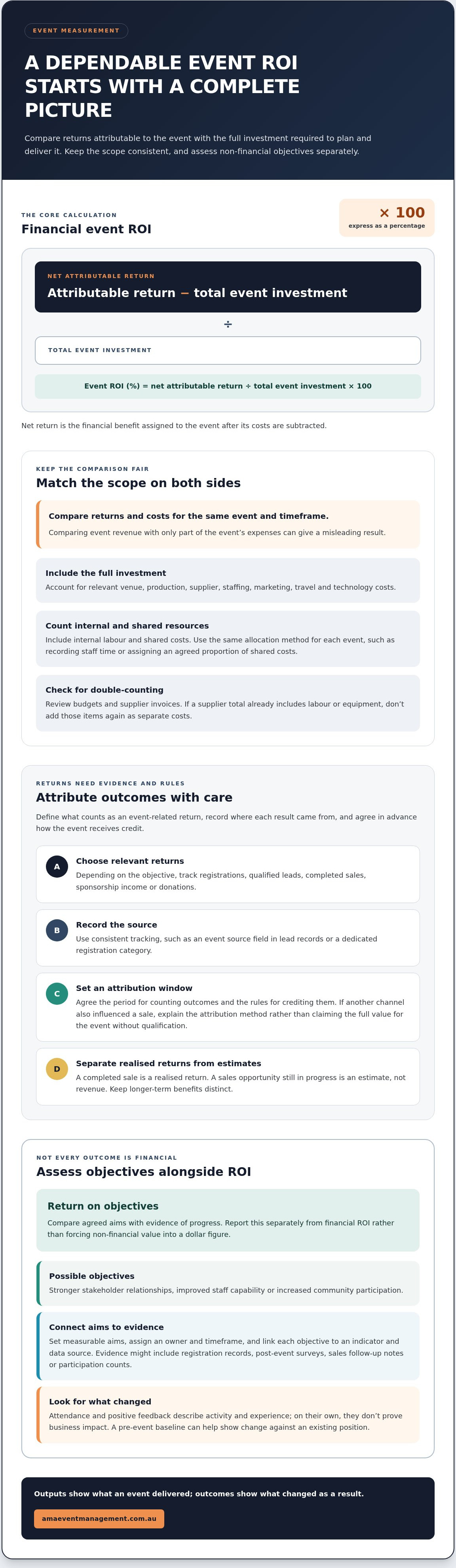
Financial ROI is calculated as net attributable return divided by investment, multiplied by 100. Net return means the financial benefit assigned to the event after subtracting its costs. For a meaningful result, include relevant benefits and costs within a consistent scope. Comparing revenue from one activity with only part of the event’s expenses can give a misleading picture. The foundational Return on Investment (ROI) concept follows the same principle of assessing return against investment.
Some objectives aren’t directly financial. Stronger stakeholder relationships, improved staff capability or increased community participation may be valuable without translating neatly into immediate revenue. Assess these through return on objectives: compare the agreed aims with evidence of progress, and report them separately from financial ROI rather than forcing them into a dollar figure.
Set event objectives before choosing metrics
Turn broad intentions into measurable aims. Instead of “raise awareness”, define the intended change, such as increasing recognition among a specified audience. For a corporate conference, an objective could be to generate follow-up conversations with target organisations; for a community festival in Sydney or Melbourne, it might be to increase participation from local groups. Assign each objective an owner and a timeframe for collecting and reviewing evidence.
Build a dependable event ROI calculation from complete cost and return data
Once objectives are clear, calculate financial ROI using costs and returns that cover the same event and timeframe. The formula is:
Event ROI (%) = ((attributable return − total event investment) ÷ total event investment) × 100
For example, don’t compare revenue attributed to a conference with only its production budget if the full investment also includes staffing, marketing and technology. A consistent scope makes the result more useful for comparison and decision-making. The ultimate guide to event ROI also explores how attribution models affect the returns assigned to events.
Which event costs belong in the calculation?
Build a complete cost record across teams and suppliers. Depending on the event, include venue, production, supplier, staffing, marketing, travel and technology costs. Include internal labour and shared resources too, using the same allocation method for each event, such as recording staff time or assigning an agreed proportion of shared costs.
Check project budgets and supplier invoices before adding figures together. If a supplier total already includes production labour or equipment, don’t count those items again as separate costs. Tracking budgets throughout planning and delivery makes it easier to reconcile the final investment rather than reconstructing it afterwards.
How should event returns be attributed?
Define what counts as an event-related return, then record the source of each result. Depending on the objective, this may include registrations, qualified leads, completed sales, sponsorship income or donations. Use consistent tracking, such as an event source field in your lead records or a dedicated registration category, so the evidence can be reviewed after the event.
Agree an attribution window before comparing results. A conference may generate enquiries that convert after the event, while a brand activation may contribute to a longer-term change in audience behaviour. Record the period you’ll use and the rules for crediting an outcome to the event. If another channel also influenced a sale, avoid claiming the full value for the event without explaining the attribution method.
Separate confirmed financial returns from estimates and longer-term benefits. A completed sale can be recorded as a realised return; a sales opportunity still in progress is an estimate, not revenue. Strategic or relationship benefits may be important, but report them separately unless there’s a defensible method for valuing them financially.
“A positive ROI figure is only as credible as the assumptions behind its costs, attribution and timeframe.”
For a corporate conference, clear budget management and supplier coordination can support a more complete record of investment from planning through delivery. Corporate conference planning brings these moving parts together as part of event delivery.
Choose event ROI metrics that fit the event format and objective
There isn’t one set of figures that proves every event’s value. Registrations show initial interest; attendance shows who arrived; engagement indicates participation; leads record potential opportunities; and revenue tracks financial results. Each answers a different question, so choose measures that connect directly to the event’s intended outcome. This objective-first approach is also reflected in Eventbrite’s 5-step guide to measuring event ROI.
“The right event metric depends on the objective: measure the change you want, not simply the activity that’s easiest to count.”
Which metrics suit corporate events and brand activations?
For a corporate conference, total attendance may matter less than whether the intended audience took part. If the goal is knowledge sharing, session participation and feedback may be relevant. If it’s business business development, track qualified leads and follow-up conversations, then assess later sales separately—an area where fractional marketing support from Budget Boosters can help B2B firms tie event results to broader revenue strategy. For an activation, interaction counts can show participation, while recall surveys can help assess whether the experience stayed with the audience. Connect each metric to a planned decision rather than collecting numbers without a clear use.
How can community events show value beyond ticket revenue?
A community festival or market may deliver value through local participation, vendor involvement and a stronger sense of connection, even if ticket revenue isn’t the main objective. Track participation in activities, vendor attendance or feedback, and attendee responses. These are useful proxies, not definitive proof of wider community change. For example, positive feedback can indicate a good experience, but it doesn’t by itself establish lasting local impact. Use the evidence alongside the event’s stated aims and explain what it can and can’t show.
When planning a community festival in Sydney or Melbourne, choose measures that reflect the event’s purpose, such as local participation, vendor involvement or attendee feedback. Use those measures alongside the event’s stated aims to assess what the evidence shows.
Measure event ROI in five steps, from planning through post-event reporting
A consistent process makes event results easier to interpret and compare. Assign an owner and a data source to every metric before delivery, then carry the same definitions and measurement periods from one event to the next. Here’s a practical way to organise how to measure event ROI from initial planning to final review.
Agree objectives. Confirm what the event needs to achieve and how you’ll recognise success. For example, a corporate conference might aim to generate follow-up meetings with target organisations, while a community event may focus on participation. Give each objective an accountable owner.
Set baselines and targets. Record the current position where it can be measured, then set a target and timeframe. A baseline could be existing registration levels, previous participation records or current lead activity. Note how each measure will be collected so the comparison is clear.
Plan tracking. For every metric, identify its source and owner. Coordinate registration and attendance records with supplier information, campaign activity and the event budget. Decide how records will be matched and when outcomes will be reviewed, particularly if leads or sales may develop after the event.
Capture results. During delivery, record the agreed measures and keep relevant budget and supplier information together. Document changes to event scope, objectives or tracking methods as they happen. This context helps explain differences between the original plan and the final results.
Evaluate and report. Compare actual outcomes with objectives, baselines and investment. Separate observed results from assumptions, estimates and external influences. Summarise what to continue, adjust or measure differently next time.
What should organisers track before and during an event?
Use a central record for the measures and supporting information, rather than relying on separate notes after the event. An event manager can coordinate logistics and budget records, while colleagues responsible for campaigns, registration or sales provide the data they own. Agreeing the handover in advance reduces gaps and makes the final review more dependable.
How do you turn post-event data into a decision?
Prepare a concise report that states the objectives, target and baseline, actual results, investment, measurement period, assumptions and next actions. Explain where attribution is uncertain or a result is still an estimate. Transparent limitations help stakeholders distinguish evidence from interpretation and make sound comparisons over time. Keep metric definitions and review periods consistent across events; if either changes, record it so differences aren’t mistaken for performance shifts.
Use the review to set practical changes for the next event, such as refining a data source or clarifying ownership. Coordinated planning, budgets and delivery can help keep records aligned across the event lifecycle. Corporate event management brings these elements together.
Make event ROI reporting useful for stakeholders and future planning
A useful ROI report does more than present a percentage. It gives stakeholders enough context to understand what the event set out to achieve, what it required and what the evidence shows. Keep the summary concise and include:
Objectives: What the event was designed to deliver.
Investment: The costs included and how they were grouped.
Outcomes: Results compared with targets and baselines.
Attribution assumptions: How event-related returns were identified, including timeframes and limitations.
Next actions: What to continue, change or measure differently.
Clear limitations build confidence. If a sale may have involved other marketing activity, say how the event was credited rather than presenting the full sale as a certain return. Separate confirmed results from estimates, and explain where external influences may have affected the outcome. A transparent account helps decision-makers interpret the figures without overstating the event’s impact.
How can event ROI reporting support better decisions?
Use the findings to refine future objectives, budget priorities, audience strategy and event format. Compare events only when their scope, objectives and measurement periods are sufficiently similar. A corporate gala and a conference may both support relationship-building, but differences in audience, programme and intended outcomes can make a direct comparison misleading. Note those differences in the report. When planning a corporate gala in Sydney or Melbourne, make sure its measures reflect the event’s specific aims rather than relying on a general benchmark.
Reviewing results alongside delivery details can reveal where measurement needs to be built into planning. Budget oversight, supplier coordination, logistics and on-site delivery all affect which costs and outcomes can be captured reliably. When these elements are organised as part of the event plan, it’s easier to reconcile investment, keep records aligned and carry useful lessons into the next event.
How AMA Event Management can support measurable event delivery
End-to-end event planning can align objectives with budgets, suppliers, logistics and on-site oversight, helping organisers prepare for measurement before the event begins. For corporate conferences, community festivals, markets and themed brand activations in Sydney and Melbourne, the relevant measures will differ, but the principle remains the same: decide what evidence is needed and how it will inform future planning.
Build clear objectives and measurement into your event planning with AMA Event Management.
Make your next event easier to measure
Reliable event measurement starts before delivery: define the outcomes that matter, choose metrics that fit the event’s purpose, and assign clear owners for tracking costs and results. Calculate financial ROI using attributable returns and the full event investment, while reporting strategic or community outcomes separately. A concise report that explains its assumptions and limitations gives stakeholders a sound basis for future decisions.
Knowing how to measure event ROI is not only about producing a figure. It’s about building a consistent process that helps you understand what worked, what needs adjustment and where to focus next time.
Founded by Amanda, AMA Event Management brings over 20 years of industry experience. The team manages event budgets, suppliers, logistics and on-site supervision, helping organisers build measurement into the planning and delivery process.
With clear objectives and disciplined follow-up, each event can provide useful insight for the next. Discuss your next event with AMA Event Management.
Frequently Asked Questions
How do you calculate event ROI?
Calculate financial event ROI by subtracting total event investment from attributable return, dividing the result by total investment, then multiplying by 100. The formula is: ((attributable return − total event investment) ÷ total event investment) × 100. Include costs and returns from the same event scope and timeframe. If a return is estimated or influenced by other channels, explain the attribution assumptions rather than presenting it as certain.
What costs should be included when measuring event ROI?
Include all relevant costs required to plan and deliver the event, such as venue, production, suppliers, staffing, marketing, travel and technology. Account for internal labour and shared resources with a consistent allocation method. Review project budgets and supplier invoices together, so costs already included in a supplier or project total aren’t counted twice. A complete cost record makes the ROI calculation more representative of the event’s actual investment.
Can you measure event ROI without ticket sales?
Yes. Ticket revenue isn’t required to assess event value. A corporate event may generate attributable sales, sponsorship income or qualified leads, while a community event may be assessed against participation, vendor involvement or attendee feedback. Calculate financial ROI only when you can identify financial returns and relevant costs. For non-financial outcomes, assess progress against agreed objectives and report it separately rather than assigning an unsupported dollar value.
How do you measure the ROI of a corporate event?
To understand how to measure event ROI for a corporate event, first agree its purpose, such as generating qualified leads, strengthening client relationships or supporting staff development. Choose indicators that fit that objective, assign an owner and record the source of each measure. Track relevant event costs, then review outcomes over an agreed timeframe. Compare financial returns with investment, and report strategic outcomes separately if they can’t be reliably valued as revenue.
What is the difference between event ROI and return on objectives?
Event ROI expresses attributable financial return in relation to the event’s investment, usually as a percentage. Return on objectives assesses whether the event achieved its agreed aims, which may be financial or non-financial. For example, a conference might create useful follow-up opportunities without producing immediate sales. Report any financial result using the ROI formula, then assess objectives such as engagement or capability separately with relevant evidence.
How soon after an event should you measure ROI?
Start capturing data during planning and delivery, then review results when the relevant outcomes can reasonably be assessed. Immediate measures, such as attendance or supplier costs, may be available soon after the event; sales or other longer-term results can take more time. Set the review timeframe and attribution window before delivery, based on the objective. If outcomes are still developing, label them as pending or estimated rather than final.
What metrics should I use to measure event success?
Choose metrics that match the event objective. For a corporate conference, useful measures might include attendance quality, session participation, qualified leads and follow-up. A brand activation could track audience interactions, brand recall and attributable conversions. For festivals or markets in Sydney or Melbourne, consider participation, vendor involvement and attendee feedback. Registrations, attendance, engagement, leads and revenue each answer different questions, so avoid treating one figure as a complete measure of success.



Comments