

How to Organise a Community Festival: A Strategic Guide to Composed Execution
Updated: Jul 13
What if the success of your next local event wasn't left to chance, but was instead the result of a quiet, invisible architecture? Many organisers begin with a vision of vibrant crowds and local music, yet they often find themselves quickly weighed down by the heavy lift of council permit fees or the strict requirements of Australian safety standards. It's common to feel a sense of trepidation when faced with the logistical weight of managing hundreds of stallholders and complex vendor expectations.
When you look at a truly seamless event, you might wonder, what does a community festival organiser do to maintain such poise under pressure? The answer lies in a methodical approach that prioritises precision over hype. This guide will show you how to master the complexities of festival planning with a disciplined, professional strategy that ensures a flawless experience for every attendee. We'll walk through creating a robust project timeline, securing essential compliance, and fostering the high level of community participation that defines a successful Australian festival. By the end of this guide, you'll have the tools to transform a high-pressure environment into a safe, engaging, and perfectly composed celebration.
Table of Contents
What Does a Community Festival Organiser Do? Defining the Architect’s Role
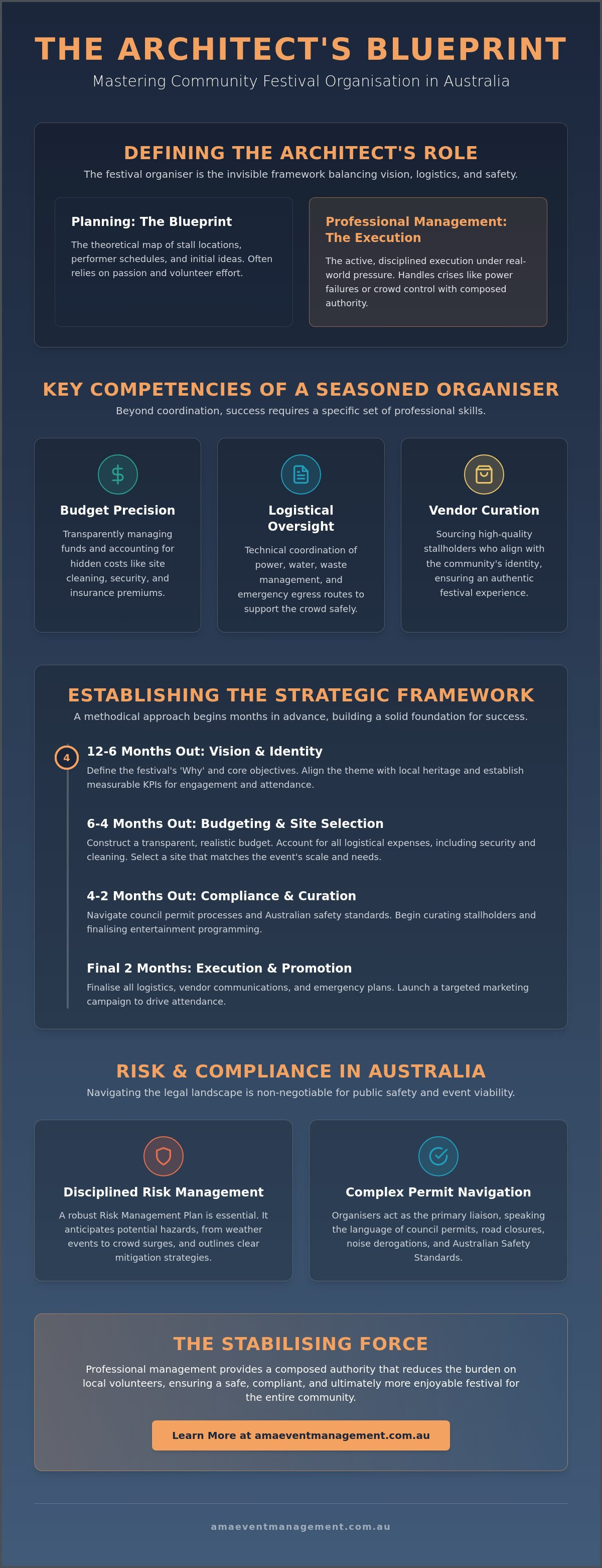
A community festival organiser serves as the invisible framework holding a complex public gathering together. They aren't just event planners; they're the central pillar balancing stakeholder interests, public safety, and creative vision. If you've ever wondered exactly what does a community festival organiser do, it's helpful to view them as a meticulous architect. They anticipate site challenges long before the first marquee is pegged into the ground, ensuring that every moving part integrates seamlessly. From end-to-end project management to site logistics and risk mitigation, their presence is the stabilising force that allows a community to celebrate without concern for the background mechanics.
The Difference Between Planning and Professional Management
Planning is the theoretical blueprint. It's the map of where stalls go and the schedule of performers. Professional management, however, is the active execution of that plan under real-world pressure. While volunteer-led models are built on passion, they often lack the composed authority required to handle a sudden power failure or a breach in crowd control. Professionalised structures bring a level of discipline that transforms a chaotic day into a structured success. This transition from a hobbyist approach to a professionalised event structure is what separates a local fair from a landmark community festival.
Key Competencies of a Seasoned Festival Organiser
Success in Event management relies on several core competencies that go beyond basic coordination. A seasoned expert brings a level of quiet confidence to the following areas:
Budget precision: Managing public funds or community grants requires total transparency. Every dollar must be accounted for, including hidden costs like site cleaning, security, and insurance premiums.
Logistical oversight: This involves the technical coordination of power distribution, water access, and emergency egress routes. It's about ensuring the infrastructure supports the crowd.
Vendor procurement: An organiser doesn't just fill space. They source high-quality stallholders who align with the community’s identity, ensuring the festival feels authentic.
The organiser also serves as the primary liaison between local councils, emergency services, and community vendors. When people ask what does a community festival organiser do, they're often surprised by the sheer volume of administrative and legal oversight required. They speak the language of permits, road closures, and noise derogations, acting as the bridge that ensures the event remains compliant with all Australian safety standards.
Establishing the Strategic Framework: Vision, Budget, and Site Selection
Successful execution begins with a foundation of strategic intent. While the previous section explored the overarching role of the architect, this phase focuses on the structural bones of the event. Defining the 'Why' is the first step. It establishes clear objectives for community engagement and social impact. Without this clarity, a festival risks becoming a collection of stalls rather than a cohesive experience. A master project timeline should be initiated at least 6 to 12 months before the event date, allowing for a steady, deliberate progression through the planning phases.
Constructing a realistic budget is a primary task when considering what does a community festival organiser do. It requires a high level of transparency and foresight. Beyond the obvious costs of entertainment and marketing, an organiser must account for significant logistical expenses such as professional cleaning crews and security personnel. These hidden costs are often where volunteer-led events struggle. They are essential for maintaining a safe and polished environment for every attendee.
Defining Your Festival’s Identity
Aligning the festival theme with local heritage ensures the event resonates with residents. By incorporating themed brand activation Sydney principles, organisers can create immersive brand stories that engage the senses. This approach moves beyond simple signage toward genuine storytelling. To ensure accountability, measurable KPIs should be set early, focusing on attendance numbers, vendor satisfaction, and community feedback loops.
Site Selection and Infrastructure Assessment
Selecting the right venue involves balancing accessibility with capacity and council requirements. Evaluating a venue's suitability is a core part of what does a community festival organiser do, as they must ensure the infrastructure supports the creative vision. An organiser must evaluate technical infrastructure, including site power distribution, water access, and public transport links. This assessment ensures the space can support high-density crowds without failure.
Site styling then plays a role in transforming a public park or street into a professional festival hub. Proper layout design is critical, ensuring the venue aligns with community market management Australia standards to optimise foot traffic and vendor visibility. If you require assistance in anchoring your event's logistical framework, exploring professional market management services can provide the necessary stability. For those seeking a comprehensive roadmap, this Step-by-Step Festival Guide offers additional insights into the strategic framework.
Managing Risk and Compliance in the Australian Landscape
Managing compliance in the Australian event sector requires a disciplined focus on legal and safety frameworks. A primary part of what does a community festival organiser do involves developing a comprehensive Risk Management Plan (RMP). This document must align with Australian standards, identifying potential hazards before they manifest on-site. The RMP is not a static document; it is a living framework that evolves as the site layout is finalised. It addresses everything from trip hazards and electrical safety to weather contingencies and crowd density. For festivals held in permanent timber-framed venues, a professional termite inspection sunshine coast can be a critical part of ensuring structural integrity for attendees. For instance, as of July 2026, organisers in the City of Melbourne face permit fees ranging from $70 to $3,112.70 depending on attendance. Navigating these costs and the associated paperwork requires a steady hand and a deep understanding of local government expectations.
Public liability insurance serves as a critical safeguard for all involved, including volunteers and participants. Policies providing $20 million in coverage are standard for public gatherings. Premiums for smaller events with up to 100 attendees typically start at $300.00, while larger festivals require more complex assessments; to ensure all risks are covered, many organisers choose to explore Business Package Insurance with AllCover Insurance Brokers. Alongside insurance, a robust Work Health and Safety (WHS) framework must be applied to every contractor on-site. This discipline ensures that marquee riggers, electricians, and staging crews adhere to the highest safety protocols. By enforcing these standards, the organiser protects the community and the event's reputation from avoidable incidents.
Council Liaison and Statutory Approvals
Liaising with local councils in Sydney, Melbourne, and regional hubs across NSW and Queensland requires patience and quiet confidence. Each jurisdiction has its own set of requirements for Development Application (DA) approvals and noise derogations. In Brisbane, self-assessable event permits were priced at $84.85 in 2025, but larger events often involve more rigorous assessment. Part of what does a community festival organiser do is managing these small but vital details, such as the $150.00 fee for sign permits in the City of Casey. Managing road closures and traffic management plans with professional precision is also vital. It minimises the impact on local residents and keeps the festival site accessible for emergency vehicles at all times.
Safety, Security, and Emergency Planning
Security planning is a collaborative effort that begins months before the gates open. Coordinating with NSW Police or reputable security firms ensures crowd control is handled with a firm yet approachable manner. First aid stations must be strategically placed throughout outdoor public spaces, with clear emergency evacuation procedures known to all staff. These plans must be communicated clearly to all stakeholders to ensure a rapid, composed response to any emergency. An Event Safety Officer is a mandatory stabilising force for any festival with more than 500 attendees.
Curating the Experience: Stallholders, Entertainment, and Programming
While the structural bones and safety protocols discussed in previous sections provide the foundation, the curation of the experience is what the public ultimately remembers. This phase is where the strategic vision becomes tangible through a diverse mix of food, craft, and service stalls, often complemented by professional Amusement and Carnival Ride Hire. A primary part of what does a community festival organiser do is acting as a curator, ensuring that every vendor contributes to a cohesive atmosphere that reflects the community’s unique identity. They manage the night market stallholder application process with total transparency, selecting participants who meet high standards of quality and presentation.
When evaluating what does a community festival organiser do on the day of the event, the focus shifts to the seamless scheduling of these moving parts. Programming must be logical. It begins with a welcoming opening ceremony and flows naturally toward a high-energy close. This requires an expert understanding of crowd dynamics and peak attendance times. By ensuring a steady rhythm of activities, the organiser prevents bottlenecks and maintains a high level of engagement throughout the day.
Vendor Procurement and Management
Setting high standards for stallholder presentation is essential for maintaining the festival's professional polish. A seasoned organiser utilises professional coordination to manage vendor bump-in and bump-out logistics, minimising disruption to the local area. This methodical approach ensures that every stall is ready before the first attendee arrives. To elevate the aesthetic, organisers often integrate bespoke private event planner Sydney level styling into public market stalls. This attention to detail transforms a standard market into a premium community experience, where every visual element feels intentional and high-quality.
Engaging the Community Through Immersive Programming
Effective programming balances main-stage entertainment with interactive roaming activations. This dual approach ensures that every corner of the site feels alive. Creating 'Instagrammable' moments is also a strategic priority, as these drive organic social media coverage and extend the festival's reach beyond the physical site. Most importantly, the programme must be inclusive. It should offer sensory-friendly zones and wheelchair-accessible staging to ensure the event is accessible for all age groups and abilities. This level of thoroughness fosters genuine community connection and positive feedback.
If you are ready to elevate your next public gathering with professional oversight, our team provides the expert market management and vendor coordination required for a truly seamless execution.
Why Professional Management is the Stabilising Force for Your Festival
The success of a public event often rests on the ability to remain calm when variables shift. While community spirit provides the spark for a festival, professional management provides the steady hand required to keep that spark from being extinguished by logistical complexity. Incorporating 20 years of industry experience into your planning process allows you to navigate unforeseen challenges with total composure. Whether it's a sudden change in weather or a technical fault on the main stage, a seasoned expert has likely encountered the situation before. Ultimately, understanding what does a community festival organiser do means recognising their role as a shield for the community, protecting both the organisers and the attendees from the risks of logistical failure.
Relying solely on volunteers for high-stakes logistics can lead to burnout and oversight. By providing expert oversight, professional managers reduce the burden on local committees, allowing them to focus on community engagement rather than the minutiae of WHS frameworks and traffic management. This partnership ensures the event remains a positive experience for those who work behind the scenes as well as those who attend. The final stage of any successful project is the post-event evaluation. This involves a thorough analysis of community impact and a detailed report on measurable KPIs, ensuring that the legacy of the festival is documented with total transparency.
The AMA Approach: Composed Authority Under Pressure
AMA Event Management is committed to delivering seamless, high-impact community festivals across Australia. Our "meticulous architect" persona ensures every detail is accounted for, from the initial site map to the final bump-out. We believe that professional fees are not merely an expense; they are a vital investment in the safety and longevity of your event. This composed authority allows councils and private clients to feel a sense of relief, knowing that their reputation is in capable hands. We manage the complex moving parts of an event so that the final execution feels effortless to the public.
Next Steps for Your 2026 Festival
Planning for the future requires a structured look at the past. Conducting a post-event debrief is essential to capture data and improve future iterations of your gathering. This methodical approach helps in building a recurring event model that the community can rely on year after year, fostering a sense of tradition and reliability. If you are ready to secure a stabilizing force for your next project, partner with AMA Event Management for your next community festival. We provide the disciplined oversight required to transform your vision into a safe, compliant, and perfectly executed reality.
Architecting Your Festival's Legacy
A successful community festival is more than a simple gathering; it is a meticulously designed experience where safety and creativity exist in perfect balance. We have explored how a disciplined strategic framework, rigorous compliance with Australian standards, and thoughtful vendor curation form the essential pillars of any high-impact event. It's common for stakeholders to wonder exactly what does a community festival organiser do to maintain such order. The reality is that professional oversight acts as the invisible anchor, transforming potential logistical chaos into a composed and seamless celebration.
With over 20 years of event management experience, AMA Event Management understands the nuanced requirements of the Australian landscape. As specialists in recurring markets across New South Wales and Queensland, we provide the professional oversight required to navigate high-pressure environments with quiet confidence. Our methodical approach ensures that your vision is realised with precision and care. We take the logistical weight off your shoulders, allowing you to focus on the community impact while we manage the complexities of execution.
Discover how AMA Event Management can architect your next community festival. We look forward to helping you build a safe, engaging, and enduring event that your residents will value for years to come.
Frequently Asked Questions
What is the first step in organising a community festival?
The first step in organising a community festival is defining the core vision and measurable objectives. This involves identifying the specific purpose of the event, such as celebrating local heritage or fostering social connection, and establishing a preliminary budget. A clear vision acts as the foundation for all subsequent logistical decisions, ensuring the project remains focused and financially viable from the outset.
How much does it cost to hire a community festival organiser in Australia?
Professional management fees vary significantly based on the scale of the event, the number of attendees, and the level of oversight required. Most organisers provide bespoke quotes after assessing the complexity of the site and the specific vendor coordination needs. Investing in professional management is a strategic move that enhances safety and logistical precision, often preventing costly errors associated with mismanagement.
Do I need a permit to hold an event in a public park in NSW?
You typically require an event permit from the local council to hold any public gathering in a park across New South Wales. The process often involves submitting a Development Application or a minor event notification, depending on the expected crowd size and the impact on the local area. Early consultation with the council's events team is essential to navigate these regulatory requirements with composure and professional discipline.
How do I find reliable stallholders for a local community market?
Finding reliable stallholders requires a structured procurement process and a transparent application system. A primary part of what does a community festival organiser do is maintaining a database of vetted vendors who meet high standards of quality and presentation. Utilising established market networks and conducting thorough reference checks ensures that each stallholder aligns with the community’s values and expectations.
What insurance is required for a community festival?
Public liability insurance is a mandatory requirement for any community festival in Australia, with a standard coverage limit typically set at $20 million. You should also consider volunteer insurance, workers' compensation for staff, and specific cover for event cancellation or equipment damage. Ensuring all vendors provide their own certificates of currency is a critical component of a robust and professional risk management framework.
How long does it take to plan a large-scale public event?
Planning a large-scale public event generally requires a lead time of 6 to 12 months. This duration allows sufficient space for securing council permits, managing vendor applications, and finalising site logistics without the pressure of a rushed execution. A methodical approach to the project timeline ensures that every moving part is integrated seamlessly long before the day of the event.
Can a community festival be run entirely by volunteers?
While many festivals begin as volunteer-led initiatives, professional oversight is often necessary as the event grows in scale and complexity. When considering what does a community festival organiser do, they provide the stabilising force that reduces the burden on local committees. Engaging an expert ensures that technical logistics, such as power distribution and traffic management, are handled with the precision required for public safety.
What happens if it rains on the day of my outdoor festival?
Managing rain requires a comprehensive wet weather contingency plan that is established during the initial planning phases. This plan should outline specific triggers for moving activities to sheltered areas, utilising marquee flooring, or rescheduling the gathering if conditions become unsafe. Having a clear communication strategy for attendees and vendors ensures that the situation is managed with quiet confidence and minimal disruption.



Comments