

Managing Event Day Logistics: Australian Checklist
A managing event day logistics checklist needs to do more than record tasks. It should help your team coordinate suppliers, staff, venue operations and attendee movement as conditions shift. For events in Sydney, Melbourne and across Australia, clear task ownership and reliable communication can help a small delay stay manageable instead of disrupting the wider schedule.
When access changes, a supplier runs late or responsibilities become unclear, a shared operational plan gives the team a practical way to respond. Use this checklist to organise the day, from pre-opening checks and supplier arrivals to live communications, contingencies and close-down. Tailor it to the event, venue and operating requirements so people know what to do, who is responsible and how to raise an issue.
Table of Contents
What belongs in an event day logistics checklist?
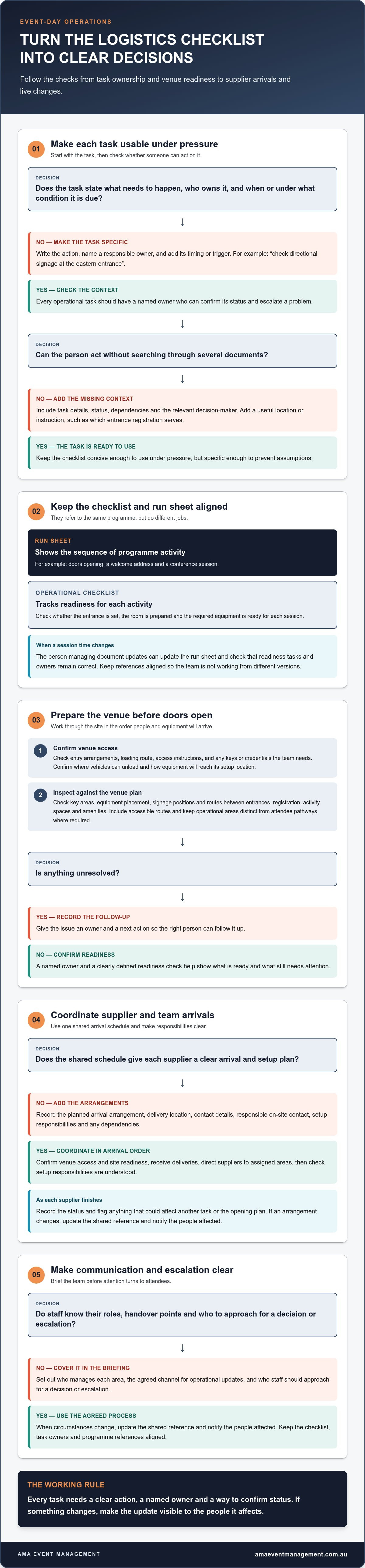
A useful checklist turns the event plan into a working reference for the people delivering it. For each task, record what needs to happen, who owns it, when or under what condition it is due, and how changes or decisions will be handled. Every operational task should have a named owner who can confirm its status and escalate a problem.
Include enough context for someone to act without searching through several documents: task details, responsible person, timing or trigger, status, dependencies and the relevant decision-maker. Instead of writing “prepare registration”, specify which entrance it serves, who is responsible and what needs to be ready before attendees arrive. Keep the managing event day logistics checklist concise enough to use under pressure, but specific enough to prevent assumptions.
How is an event day checklist different from a run sheet?
A run sheet shows the sequence of programme activity, such as doors opening, a welcome address and a conference session. The checklist tracks operational readiness: whether the entrance is set, the room is prepared and the required equipment is ready for each session. The documents can refer to the same activity without duplicating every detail. For broader context on the principles of event management, planning and coordination are connected parts of delivery.
Assign one person to manage document updates and keep references aligned. If a session time changes, that person can update the run sheet and check that the readiness tasks and owners remain correct. This reduces the risk of team members working from different versions.
Which event details should shape the checklist?
Start with the event format, then identify what people, suppliers and spaces need on the day. For corporate conferences and presentations, reviewing technical essentials with specialists like Debut Media AV and Production helps ensure audio, visual and stage logistics are thoroughly tracked alongside room transitions. An expo or market needs clear supplier arrival arrangements, delivery locations and access to operating areas. A festival may need checks suited to an outdoor site, while a private function may place more emphasis on guest arrival and movement between spaces.
Adapt the details to the venue. Map entrances, loading and delivery access, service points, audience routes and restricted areas. Consider where queues could form and how attendees will move between key spaces. For outdoor events in Australia, include local weather monitoring and identify which tasks, equipment or site arrangements may need review if conditions change.
Test each checklist item with the same questions: what needs to be ready, who is accountable, what does it depend on, and who makes the call if circumstances change? This keeps the document tailored to the venue and audience rather than relying on a generic template. The checklist becomes a shared operational reference, while the run sheet guides the programme.
How to prepare the venue, suppliers and team before doors open
A controlled opening starts with a clear sequence. Work through the site in the order people and equipment will arrive, from venue access to the final check of attendee-facing areas. This gives the team time to assign a response if an issue comes up before guests enter.
What should organisers check during venue access and setup?
Start with the venue contact. Confirm the agreed entry arrangements, loading route, access instructions and any keys or credentials the team needs. Check where vehicles can unload and how equipment will move from the delivery point to its setup location. Clear instructions help suppliers arrive with a defined route and contact.
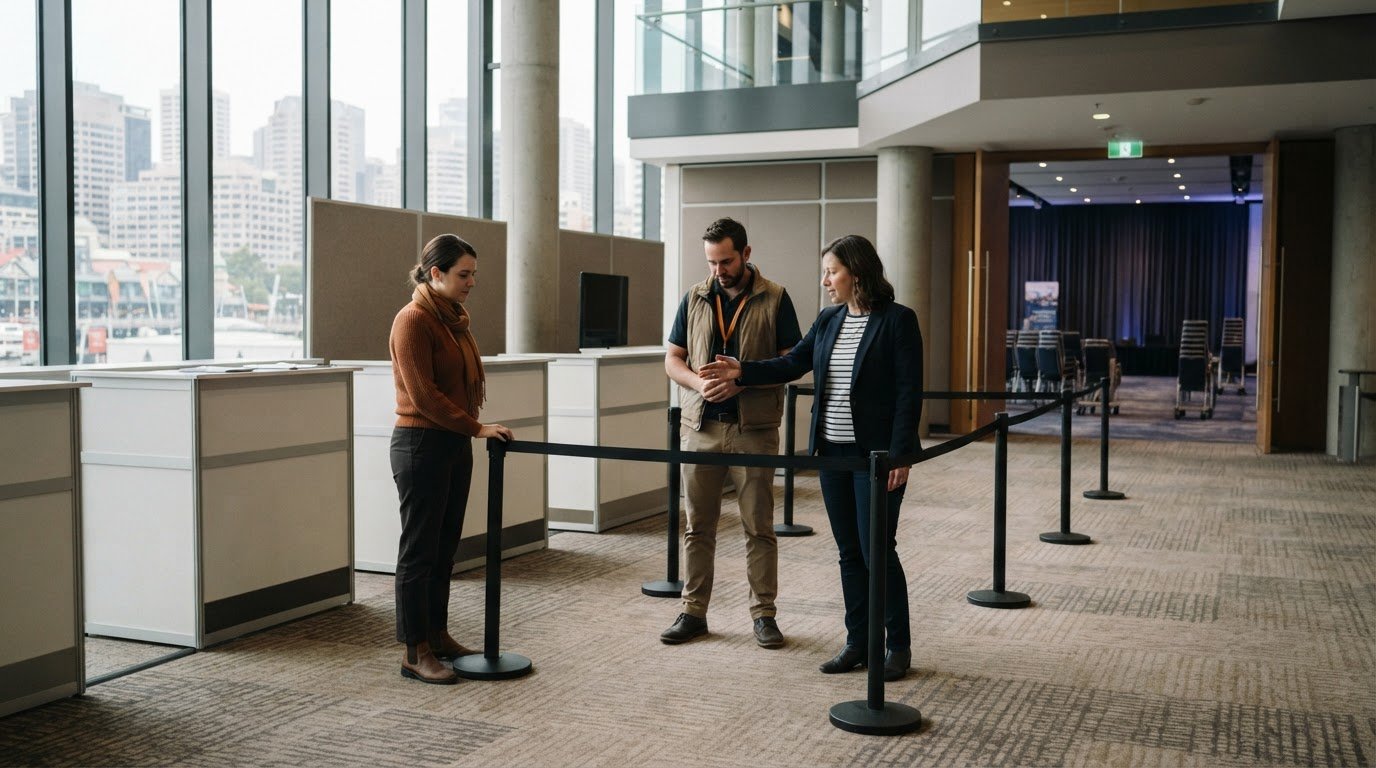
Once access is established, inspect the site against the venue plan. Check the condition of key areas, equipment placement, signage positions and routes between entrances, registration, activity spaces and amenities. Consider the attendee experience: can people find the right entrance, understand where to go and move through the space without avoidable confusion? Include accessible routes and keep operational areas distinct from attendee pathways where required.
Record any unresolved issue with an owner and next action. A named task owner and a clearly defined readiness check make it easier to confirm what is ready, identify what is not and direct follow-up to the right person. For example, “check directional signage at the eastern entrance” is easier to verify than “sort signage”.
How should supplier and team arrivals be coordinated?
Keep one shared arrival schedule with each supplier’s planned arrival arrangement, delivery location, contact details and responsible on-site contact. When coordinating staging or furnishings with event rental specialists like Valley Decors, record setup responsibilities and dependencies, such as needing access to a particular area before equipment can be positioned. If an arrangement changes, update the shared reference and notify the people affected.
Coordinate arrivals in a practical order. First confirm venue access and site readiness. Then receive deliveries, direct suppliers to their assigned areas and check that setup responsibilities are understood. As each supplier completes their work, record the status and flag anything that could affect another task or the opening plan.
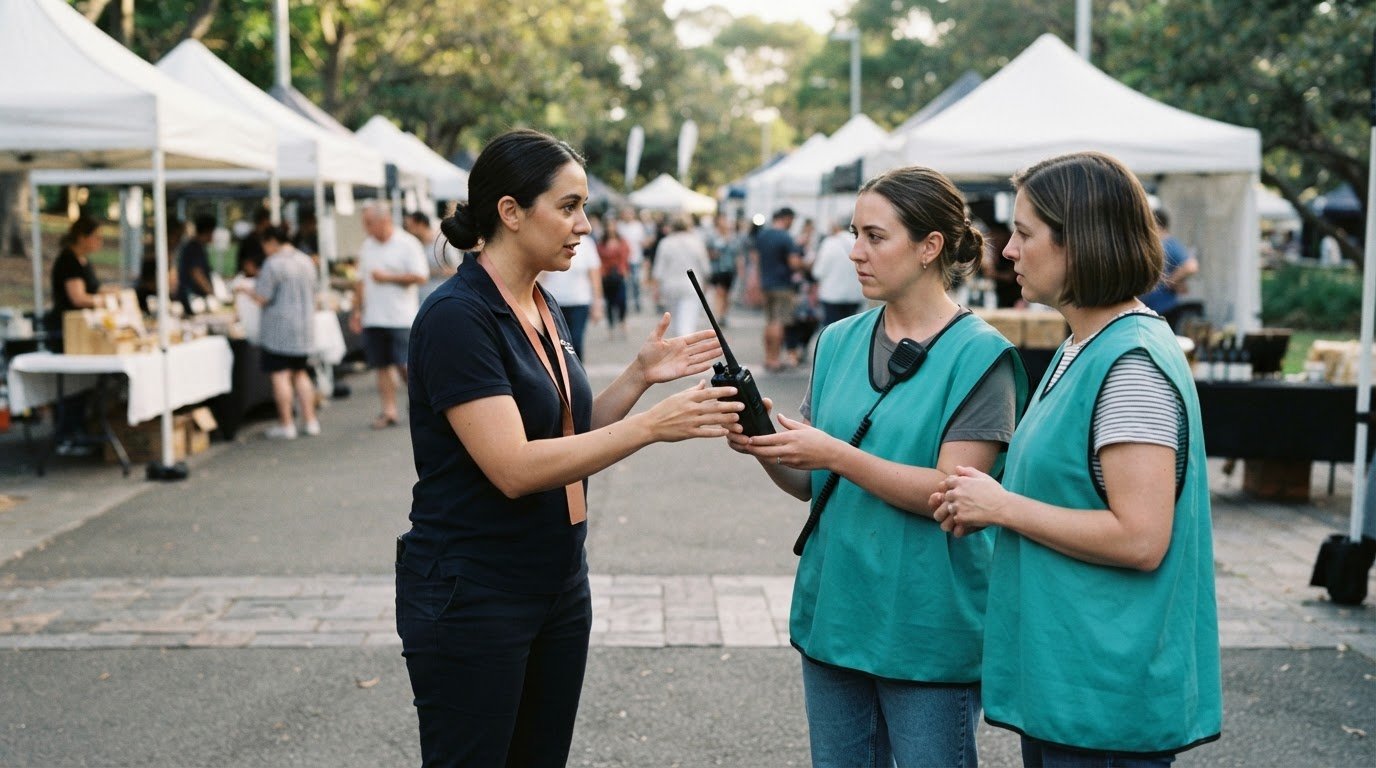
Brief staff on their roles, handover points and the agreed channel for operational updates. Make clear who manages each area and who staff should approach for a decision or escalation. A focused briefing gives the team a shared understanding of priorities before attention turns to attendees.
For markets and festivals, vendor placement and arrival coordination go hand in hand. A clear delivery location and site contact help keep setup organised. The community market management guide offers further context for planning these environments. AMA Event Management provides event planning and management across Australia, bringing planning and on-site execution together.
How to manage event-day communication, changes and contingencies
Clear communication helps an event team respond without creating competing instructions. Agree on one primary channel for operational updates, such as a dedicated group message or radio channel, and define a separate escalation method for urgent issues. Everyone should know what belongs in routine updates, who can make operational decisions and how to reach that person if the usual channel is unsuitable.
Build scenario prompts into the managing event day logistics checklist so the team can respond methodically rather than improvise under pressure. Prompts might cover changing weather, a delayed supplier, equipment that stops working or unexpected attendee movement. For each scenario, note who assesses it, who makes the decision, who needs an update and what information they need. A contingency plan cannot remove disruption, but it can help people make clearer decisions.
What should happen when an event-day plan changes?
Before changing an arrangement, assess the practical effects. Consider safety, the programme, venue constraints and everyone affected, including attendees, staff and suppliers. A small adjustment can have wider consequences: moving a session, for instance, may affect room access, equipment setup and the next activity. Separate what is known from what still needs to be established.
Give one person clear authority to approve operational adjustments. Others can provide information or recommend options, but a defined decision-maker helps avoid conflicting directions. Once approved, record the change in the live plan, including the decision, responsible person and follow-up required. Brief the staff and suppliers whose tasks or timing are affected, using the agreed channel. When a change has immediate operational consequences, confirm that they have received the update.
Keep the message concise: state what has changed, what people should do now and where to direct questions. Do not present an unapproved possibility as a final instruction. This distinction limits confusion while a decision is being made.
How can an Australian event team prepare for local conditions?
For outdoor events, monitor relevant Bureau of Meteorology updates and make weather a planned decision point. The event plan should say who checks conditions, who assesses their implications and who can decide on an operational response. Set out agreed actions for relevant scenarios, such as reviewing an outdoor activity or changing how attendees are directed around the site. Tailor these prompts to the event and venue rather than relying on a generic weather response.
Include a process for sharing decisions with the people who need to act on them. Staff directing attendees, suppliers working outdoors and those managing programme activity may need different instructions. Keep the overall message consistent, while making each person’s action clear. Festival planning also benefits from clear coordination across site operations, suppliers and programme activity.
After an issue, note what happened and whether the response worked as intended. These observations can inform future planning and make the checklist more useful at the next event.
Event day logistics checklist: run checks, handovers and close-out
A practical event-day sequence gives the event lead a consistent way to track readiness, live activity and the final handback. Keep the checklist open to updates throughout the day rather than treating it as a form to complete once. Each item should show the task, owner, status, escalation contact and notes. Use an agreed time or a clear trigger, such as “before doors open” or “after the final session”, where fixed timings are not appropriate.
Organise checks in the order the team needs to complete them:
Pre-opening readiness: confirm spaces, access routes, signage, registration and agreed supplier setup.
Live operations: record progress on operational tasks and note issues that need a decision or follow-up.
Programme transitions: check that the next space, equipment and responsible staff are ready before activity moves on.
Site close-out: coordinate pack-down, equipment collection and the venue handback.
This structure turns a managing event day logistics checklist into a working record. The event lead can see what is complete, what remains open and where support is needed, while task owners focus on their assigned actions.
What should the event lead review before attendees arrive?
Walk through the venue plan and check that spaces, access routes, signage and registration are ready for use. Confirm supplier setup and make sure team members understand their responsibilities and reporting route. Do not bury an unresolved issue in a general note: record its owner and next action, then identify whether it affects opening readiness or another task.
During handovers, ask the outgoing owner to state the current status, outstanding work and any decision required. Update the checklist so the incoming person can act on a clear record instead of relying on memory or a verbal message passed between several people.
How should organisers close out event-day operations?
Close-out needs clear ownership too. Coordinate pack-down, equipment collection and venue handback with the responsible contacts, and record when each area is ready to be handed over. Keep unresolved supplier matters and operational incidents visible, with a named follow-up owner and next action.
Capture practical lessons while recollections are current. Note what caused delays, where a handover was unclear and which checklist item helped the team respond. Separate observations from agreed changes so future planning can use the record thoughtfully rather than treating every one-off issue as a permanent rule.
When planning and on-site coordination need to work together, explore event management with AMA Event Management for public and private events across Australia.
How professional event management brings the logistics together
A checklist is most effective when it connects planning decisions with the work happening on site. Professional event management brings those stages together: event objectives inform the plan, supplier coordination supports delivery and on-site oversight helps the team respond as the day unfolds. The checklist then serves as a shared operational reference, rather than a separate document that sits apart from the people carrying out the work.
This joined-up approach is useful when an event involves several spaces, suppliers or programme elements that depend on one another. A change to one part of the plan may affect another, so a clear view of responsibilities and communication helps the team see what needs attention. It does not remove uncertainty or guarantee a smooth event. It gives the people involved a structured basis for coordinating tasks and making decisions.
When can an event management team reduce operational pressure?
An event planning team can help organisers coordinate moving parts while keeping sight of the event’s purpose. The checklist can be tailored to a corporate conference, festival, expo, market or private function, with operational details shaped around the format, venue and audience. The same core discipline can support different events without forcing them into a one-size-fits-all plan.
For a corporate gala, for example, planning the sequence of activities and coordinating the associated operational needs are connected tasks. This corporate gala planning guide offers further context for that event format. AMA Event Management’s professional team manages public and private events across Australia, from concept through execution.
Integrated coordination means considering the event plan, supplier activity and site operations together. The event team can use the managing event day logistics checklist to clarify who owns each action, keep relevant information accessible and track outstanding work. These fundamentals help staff and suppliers work in an organised way, while leaving room to adapt the plan to the event.
Discuss event-day logistics with AMA Event Management
For your next event, outline its format, objectives and operational requirements. Consider what the event needs to achieve, how the venue will be used and which moving parts need close coordination. These details help shape a practical approach around the event, rather than relying on a generic template.
AMA Event Management plans and manages events from concept through execution, supporting conferences, festivals, expos, markets and private functions across Australia. If you want a professional team to bring the planning and logistics together, discuss your next event with AMA Event Management.
Set your next event up with a clear operational plan
Build your next event’s logistics plan around what matters most: the experience you want to create and the people responsible for delivering it. Treat the managing event day logistics checklist as a working document, tailored to your event and refined as requirements become clearer. When tasks have clear owners and decisions have a defined path, your team has a stronger foundation for handling the day.
AMA Event Management’s professional planners support public and private events across Australia, including in Sydney and Melbourne, from early concept through execution. If you are preparing a conference, festival, market or private function, bring your event format, objectives and operational requirements into the conversation. Contact AMA Event Management’s expert team about your next event.
Frequently Asked Questions
Is an event day logistics checklist useful for a small event?
Yes. A checklist can make even a small event easier to coordinate by showing who is responsible for each essential task. It does not need to be lengthy: focus on the venue, programme, suppliers and attendee needs that apply. For a private function, you might track room access, a key delivery and guest arrival arrangements. Remove irrelevant tasks so the document stays practical.
Can one event day checklist work for different event types?
Yes. Use the same basic structure, then tailor the tasks to each event. A conference may need speaker and session handovers, while a market may depend more on vendor access and stall setup. Before reusing a checklist in Sydney, Melbourne or elsewhere, review the venue layout, audience movement, supplier arrangements and programme. Treat the old version as a prompt, not proof that every detail suits the new event.
What happens if a supplier is delayed on event day?
Use the agreed supplier contact and escalation details to establish the delay and its likely effect. Identify which tasks depend on that delivery, such as setting up a registration point or preparing a presentation space. The authorised decision-maker can assess possible adjustments and direct the next steps. Tell affected staff or suppliers what has changed, update the live record and note the outcome for follow-up after the event.
Should an event day checklist include weather contingencies?
Yes, if conditions could affect the site, access, attendee comfort or programme. Identify who checks relevant Bureau of Meteorology updates and who makes operational decisions. For example, an outdoor market may need a decision point about whether a planned activity or site arrangement needs review, while an indoor event may have different concerns. Set prompts around the specific venue and event rather than relying on a universal response.
How can organisers make sure the team uses the checklist?
Introduce the checklist during the team briefing and show staff where to find the current version. Explain who updates it, how owners mark tasks complete and how to flag an issue that affects another person’s work. Keep it easy to access during operations. At handover, review open items together and confirm who is taking responsibility. This makes the checklist part of the team’s working routine, not just a planning file.
What records should an event team keep after the event?
Keep concise notes on outstanding supplier matters, equipment handback, incidents requiring follow-up and decisions that may inform future planning. Record what remains unresolved, who will handle it and what action comes next. Store the information in the organisation’s usual record-keeping system, and handle personal or sensitive details appropriately. A focused record supports follow-through without turning event close-out into unnecessary paperwork.

Comments