

Market Stallholder Success: The Architect’s Guide
A thriving market stall is rarely the result of a lucky weekend or a charming product alone. It is a structured achievement of logistical precision and deliberate branding. If you've ever felt the pressure of a chaotic "bump-in" or the uncertainty of council permits, you know that passion only carries you so far. Truly understanding how to be a successful market stall holder requires a shift from a casual mindset to a disciplined, professional operation.
You've likely felt the weight of inconsistent sales despite high foot traffic, or perhaps you're struggling to keep up with the evolving regulatory standards in the Australian market. This guide provides the methodical roadmap you need to master these complexities with quiet confidence. We will outline exactly how to manage insurance requirements, streamline your logistics, and implement the creative strategies that secure long-term brand visibility and sales consistency.
Table of Contents
Developing the professional stallholder mindset
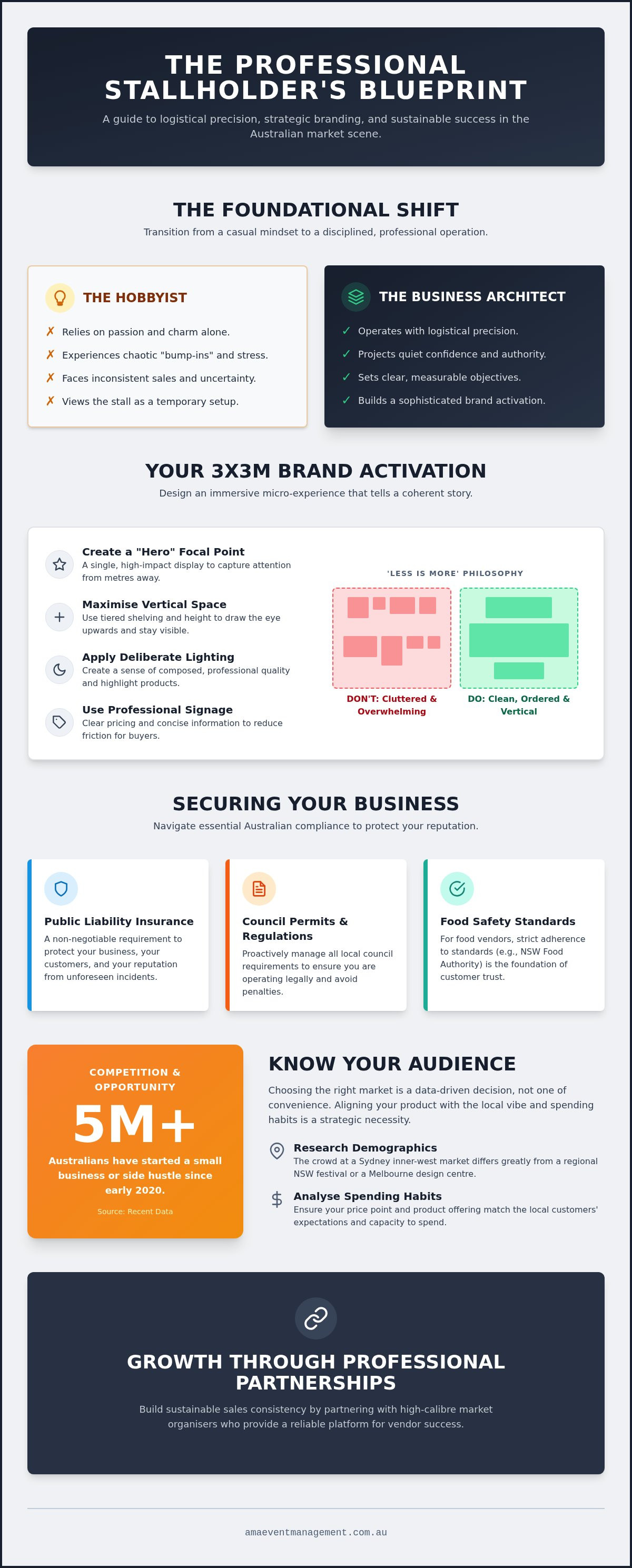
Success in the Australian market scene requires more than a high-quality product and a friendly smile. To truly understand how to be a successful market stall holder, you must adopt the mindset of a business architect. This means viewing your 3x3 metre space not as a temporary hobby, but as a sophisticated brand activation that demands logistical precision and strategic foresight. A grounded, disciplined approach serves as the essential foundation for a sustainable business, allowing you to remain unfazed by the inherent pressures of a live event environment; to help bridge this gap, you can discover SY Mathews and their on-site advisory services for small businesses.
Professional stallholders project a sense of composed authority. They maintain a polished presence that reassures customers and builds rapport with fellow vendors and market organisers. Instead of relying on high-energy hype, they use quiet confidence to establish a feeling of security for the buyer. This professional dialogue is reinforced by setting clear, measurable objectives for every appearance. Whether your goal is a specific sales target, a set number of new email subscribers, or testing a new product line, having defined benchmarks ensures every market day is a step toward long-term growth.
The shift from hobby to high-standards business
Establishing a professional brand identity involves more than just a logo. It requires a methodical routine for pre-market preparation that ensures every detail is overseen before the first customer arrives. Reliability is the quiet driver of customer loyalty. When you provide a consistent experience, you build a reputation for sophisticated competence. This includes everything from inventory management to ensuring your display aligns with established visual merchandising principles. A well-organised operation suggests to the customer that your products are handled with the same level of care and precision.
Identifying your target Australian market
Choosing the right location is a data-driven decision rather than a matter of convenience. The demographics of a weekend market in Sydney's inner west differ significantly from a community festival in regional NSW or a high-end design centre in Melbourne. Researching these nuances ensures your offering aligns with the specific local vibe and consumer spending habits. Recent data indicates that approximately 5 million Australians have started a small business or side hustle since early 2020. With this increased competition, identifying your specific target market through rigorous research is the only way to avoid mismatched locations. Aligning your product with the right audience is a strategic necessity that prevents wasted resources and ensures your brand reaches those most likely to convert.
Visual merchandising: Designing an immersive micro-experience
Transforming a standard 3x3 metre gazebo into a professional brand activation requires a strategic eye for detail. While some might suggest simply making a stall "look pretty," the architect's approach focuses on logistical flow and sensory engagement. Australian shoppers are increasingly drawn to immersive environments that tell a coherent story. Understanding how to be a successful market stall holder involves curating a space that feels both premium and approachable, acting as a physical extension of your brand values.
A common error is over-cluttering the display. In a high-pressure market environment, a "less is more" philosophy often yields better results. Cluttered stalls overwhelm the senses and create physical barriers for potential customers. Instead, use height and deliberate lighting to create a sense of composed, professional quality. Elevating your products onto tiered shelving or bespoke plinths allows you to maximise your vertical footprint while keeping the ground level clear and accessible. This vertical strategy ensures your brand is visible even when the market is at its most crowded.
The architect’s approach to stall layout
Every successful stall needs a "hero" focal point. This is a single, high-impact display element designed to capture foot traffic from several metres away. Once customers are drawn in, the layout should guide them naturally through your offerings. Ensure there is enough space for ease of movement; shoppers shouldn't feel trapped or crowded. Professional signage is equally vital. It should reflect quiet confidence through clear pricing and concise product information, reducing the friction of the initial interaction and allowing the product to speak for itself.
Inventory management and presentation
There is a specific logic to maintaining a sense of abundance. A "full" stall signals success and reliability to buyers, suggesting your products are in high demand. However, this abundance must be managed with meticulous order. For those in the food sector, adhering to food stall safety requirements is the non-negotiable standard for maintaining a professional reputation and ensuring customer security.
Packaging acts as the final touch of bespoke quality. It's the physical reminder of the brand experience the customer takes home. To maintain this high standard during peak periods, organise your back-stock for quick replenishment. A well-prepared stallholder is never caught off guard by a sudden rush. If you're looking to elevate your presence at high-traffic events, partnering with specialists in vendor coordination and site management can provide the professional infrastructure needed for your brand to thrive.
Operations, logistics, and Australian compliance
Mastering the invisible mechanics of the trade is central to learning how to be a successful market stall holder. While a polished aesthetic captures attention, it's your logistical precision that ensures long-term viability. Operating a stall in Australia involves a complex layer of regulatory requirements and site-specific safety standards. Approaching these tasks with a methodical discipline transforms potential stressors into a predictable, manageable routine. This structural integrity is what separates a professional business from a casual hobbyist.
Public Liability Insurance (PLI) is the primary safeguard for your business. Most Australian market organisers require a minimum of $10 million in coverage, though $20 million is increasingly becoming the industry standard. This protection is a vital layer of security that protects your assets from unforeseen incidents. For those unsure of their specific obligations, the Australian Business Licence and Information Service (ABLIS) provides a clear roadmap for identifying necessary permits. Additionally, if you're operating in the food sector, you must secure relevant council permits and food safety certifications, such as a 'Statement of Trade' for Victorian vendors or specific council registrations across NSW and Queensland.
Physical safety is another non-negotiable pillar of your operation. Every piece of equipment, from your marquee to your display tables, must meet Australian safety standards. This includes the mandatory use of heavy-duty weights for every leg of your gazebo. Sandbags or water weights are essential to prevent accidents during sudden weather shifts. Managing these logistics with thoroughness projects an image of sophisticated competence to both organisers and customers.
The essential compliance checklist
Insurance: Secure $10M or $20M Public Liability Insurance before applying for your first site.
Permits: Register for an Australian Business Number (ABN) via abr.gov.au; it's a free process that establishes your professional status.
Food Safety: Ensure all food handlers have current certifications and that your temporary stall permit is approved at least 28 days before trading.
Equipment: Verify that all electrical equipment is tagged and tested by a professional if you require site power.
Efficient site logistics and bump-in
The 'bump-in' process is a high-pressure window where your organisation is tested. Arriving early is a strategic choice. It allows you to secure your position and assemble your stall without the frantic energy of a last-minute setup. Organise your vehicle so that equipment is accessible in the order you need it. This sequential approach reduces physical strain and ensures a frictionless start to the day.
Successful vendors work collaboratively with the professional community market management team. These coordinators are your primary allies on-site. Following their directions regarding vehicle movement and stall placement demonstrates your professionalism and helps maintain a safe, orderly environment for everyone. By treating logistics as a core business function, you position yourself as a reliable partner in the market community.
Sales strategy and the art of the 'Aussie' chat
Interaction at an Australian market is a delicate balance of approachability and professional distance. Moving beyond the "hard sell" requires a shift toward a reassuring dialogue that establishes trust. Understanding how to be a successful market stall holder involves using authentic storytelling to bridge the gap between the maker and the consumer. Australians value the narrative behind a product, often prioritising the "maker story" as much as the item itself. By sharing your process with quiet confidence, you transform a simple transaction into a memorable brand interaction.
Efficiency during high-pressure peak periods is maintained through methodical preparation. In 2026, providing seamless payment solutions is a non-negotiable standard for professional vendors. While cash remains a secondary option, reliable EFTPOS systems are essential for capturing every potential sale. Offering multiple payment methods caters to modern consumer preferences and reinforces your status as a sophisticated, modern business. This technical reliability ensures that even during the busiest hours, your operation remains calm and organised.
Engaging the customer with quiet confidence
Open body language is your first tool of engagement. Avoid crossing your arms or looking at your phone; instead, maintain a disciplined, welcoming posture that suggests you are ready to assist. Craft a 30-second explanation of your brand’s origin that highlights the bespoke quality of your work. When customers raise questions or objections, respond with professional poise. Helpful, factual answers are far more persuasive than defensive sales tactics, as they position you as an expert who values the customer's security and satisfaction.
Maximising ROI through strategic pricing
Pricing for profit requires a broad strategic view of your overheads and current Australian market conditions. While remaining competitive within a community setting is important, you shouldn't undervalue your expertise or the quality of your materials. Consider the logic of "market-only" exclusives or product bundles to increase your average transaction value without appearing aggressive. Use each event as a lead generation tool for your online store by capturing email data or social media follows. This allows you to build a recurring relationship with customers long after the market concludes. To find a stable platform for this growth, consider joining an event with professional vendor coordination and site management.
Growth strategies and professional market partnerships
Selecting the right event organiser is the most critical decision in your journey toward long-term profitability. While your internal operations must be precise, your growth is ultimately tied to the platform you choose. A professional organiser provides more than just a patch of bitumen; they offer the marketing reach, site security, and foot traffic necessary for a brand to scale. Truly understanding how to be a successful market stall holder involves recognising that your business is part of a larger, managed ecosystem. When you partner with an experienced team, you benefit from their established reputation and logistical oversight, allowing you to focus entirely on your product and customer engagement.
Building brand recognition requires consistency. Recurring markets allow you to transition from a one-off vendor to a reliable local fixture. Australian consumers value reliability; they want to know that the maker they met last month will be there again today. This repeat presence builds a layer of trust that is difficult to replicate through online channels alone. As your brand matures, you may consider scaling your operation from a single stall to a multi-market regional presence, leveraging the infrastructure of major events to reach diverse demographics across NSW and Queensland.
Evaluating market organisers for your brand
Look for event management teams with a proven track record, such as the 20-year industry mark held by AMA Event Management. High-calibre organisers invest heavily in site infrastructure and targeted marketing campaigns that attract qualified buyers. It's essential to link your growth to community festival organisers in Australia who prioritise quality over quantity. An organiser who maintains high standards for all vendors creates a premium environment that elevates every brand within the market. This structural support ensures that your business is positioned alongside other high-quality professionals, reinforcing your brand’s value.
Scaling with Aussie Night Markets
Major night markets offer a high-traffic environment that serves as an ideal testing ground for expansion. These events provide the professional logistics required to manage large crowds with composed authority. For many, this is the path from being a local stallholder to becoming a featured vendor at themed brand activations in Sydney. These high-tier activations offer a platform for immersive storytelling and direct consumer connection. If you are ready to transition from a hobbyist to a meticulous business architect, apply to become a stallholder with AMA Event Management today and secure your place in a professional, managed market environment.
Securing your professional future in the Australian market scene
Transforming a creative passion into a sustainable business requires the disciplined integration of logistical precision and strategic branding. By mastering the complexities of Australian compliance and refining your visual storytelling, you establish a foundation of reliability that resonates with local shoppers. Understanding how to be a successful market stall holder is ultimately about maintaining a composed, professional presence while navigating the high-pressure environment of live events. Success isn't found in chance; it's built through methodical preparation and the choice of a stable, well-managed platform.
With over 20 years of event management experience and a proven track record as the organisers of the popular Aussie Night Markets, our team provides the composed, professional support every vendor needs to thrive. We invite you to take the next step in your business journey and partner with AMA Event Management for your next market stall opportunity. The path to scaling your brand is clear, and we're here to provide the structural coordination required for your long-term success. Your professional legacy starts with the right partnership.
Frequently Asked Questions
What insurance does a market stallholder need in Australia?
Public Liability Insurance is the non-negotiable standard for any professional vendor. Most Australian market organisers require a minimum of $10 million in coverage, though $20 million is increasingly requested to ensure complete security. This policy protects you against claims for personal injury or property damage occurring at your stall. Having this in place is a key step in learning how to be a successful market stall holder, as it provides a necessary safety net for your business assets.
How much stock should I bring to my first market?
Aim for a display that looks abundant and "full" without being cluttered. A well-stocked stall signals success and reliability to shoppers. For your first event, calculate the volume required to cover your site fees and desired profit margin, then add a small buffer. Use this initial appearance as a research opportunity to track which items attract the most engagement. This data-driven approach allows you to refine your inventory for future market dates.
Do I need an ABN to operate a market stall in NSW?
Yes, securing an Australian Business Number (ABN) is a vital requirement for operating a professional business in NSW. Registering for an ABN is a free process through the Australian Business Register website. It establishes your professional identity and is typically required by market organisers during the application process. Holding an ABN also allows you to claim business expenses and manage your tax obligations with the precision expected of a disciplined business architect; for those seeking strategic financial advice, creditte.com.au provides virtual CFO services to support small business growth.
Finding the ideal location requires thorough demographic research. Evaluate whether your product aligns with the local "vibe" of specific Sydney or Melbourne suburbs. Look for events with established foot traffic and professional coordination, such as those managed by AMA Event Management. High-calibre organisers provide the marketing support and site infrastructure that allow vendors to thrive. Visiting a market as a customer first can provide valuable insight into the audience and competition.
What are the most common mistakes new stallholders make?
Many new vendors struggle with cluttered displays and poor logistical planning. Overloading a 3x3 metre space can overwhelm customers, leading to lower conversion rates. Other common errors include arriving late for "bump-in," failing to provide EFTPOS payment options, and neglecting essential safety standards like marquee weights. Avoiding these mistakes is central to how to be a successful market stall holder. Success requires a shift from a hobbyist mindset to a more methodical, disciplined business strategy.
How can I make my stall stand out from the competition?
Creating an immersive micro-experience is the most effective way to stand out. Use professional visual merchandising principles to guide customers through your space. Establish a "hero" focal point that captures attention from a distance and use height to maximise your display area. Clear, polished signage and open body language project quiet confidence, making your stall feel like a premium destination rather than just another temporary table in a crowded row.
What equipment is essential for a professional market setup?
A professional setup requires high-quality, reliable equipment. Your list should include a heavy-duty marquee, mandatory leg weights (minimum 10-20kg per leg), and sturdy display tables. In 2026, a reliable EFTPOS terminal is essential for capturing modern sales. If you are participating in night markets, professional lighting is a non-negotiable requirement. Ensure all electrical gear is tagged and tested to meet Australian safety standards, demonstrating your commitment to high operational standards and site security.
How do I handle bad weather at an outdoor market?
Preparation and composure are your best defences against unpredictable weather. Always use the mandatory heavy-duty weights for your marquee, regardless of the forecast. Keep transparent rain covers or tarps accessible for quick deployment during sudden showers. In high-wind situations, follow the directions of the site management team immediately. Maintaining a calm, methodical approach during weather shifts ensures the safety of your stock and projects an image of reliability to everyone on-site.


Comments