

Mastering the Art: Negotiating with Event Vendors and Suppliers in Australia
In the high-stakes environment of Sydney and Melbourne event planning, the most successful negotiations don't happen across a boardroom table; they are won weeks earlier through meticulous preparation. For many organisers, the process of negotiating with event vendors and suppliers feels like a defensive manoeuvre against being overcharged or a gamble on reliability. It's common to feel a sense of unease when scrutinising quotes or worrying about whether a supplier will remain committed as your event date approaches.
Securing exceptional value doesn't have to be a source of stress. This guide provides the methodical frameworks used by seasoned professionals to secure high-quality event partnerships and exceptional value. You will learn how to approach every discussion with quiet confidence, ensuring that contract terms are robust and transparent. We will explore current Australian market benchmarks, provide a structured framework for your vendor discussions, and outline how to build the kind of reliable, long-term supplier relationships that serve as a stabilising force for even the most complex projects.
Table of Contents
The Philosophy of Composed Negotiation: Beyond the Bottom Line
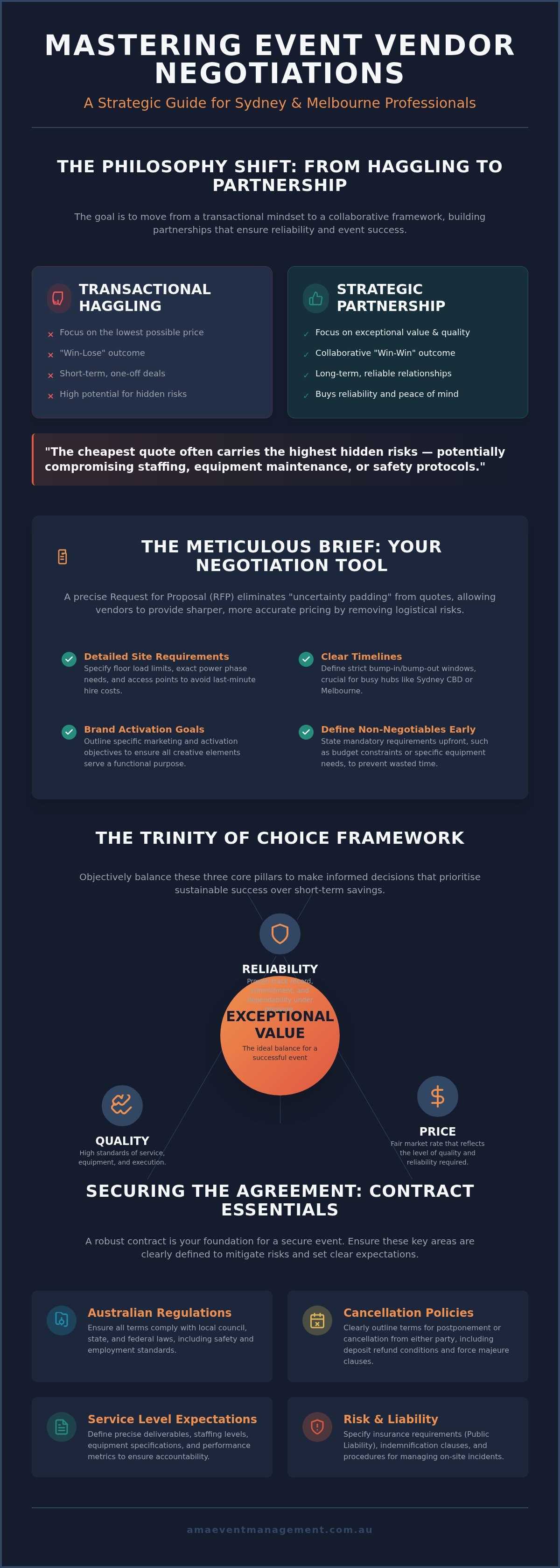
Successful negotiation is rarely about aggressive posturing or demanding the lowest possible price. Instead, it's a disciplined exercise in relationship management. When you're negotiating with event vendors and suppliers, your objective is to move away from a transactional "win-lose" mindset toward a partnership-based framework. This approach is rooted in established negotiation theory, which suggests that collaborative outcomes create more sustainable value for both parties. By positioning yourself as a partner rather than a punter, you secure a higher level of commitment to your event's success.
The cheapest quote often carries the highest hidden risks. In a high-pressure environment, a supplier who has been squeezed on price may cut corners on staffing levels, equipment maintenance, or safety protocols. A composed professional recognises that paying a fair market rate secures more than just a service; it buys reliability and peace of mind. By establishing mutual respect early, you create a space where vendors feel invested in your project. This often leads to "value-adds" that don't cost the supplier extra but can save you thousands in logistical headaches. These might include extended bump-in windows, marketing collaborations, or priority access to premium equipment.
The Stabilising Force: Why Professionalism Matters
A grounded tone acts as a stabilising force during the often chaotic planning phase. When you project quiet confidence, you signal to senior suppliers that you're an experienced operator who values order and precision. This professional posture prevents emotional decision-making when challenges arise; it keeps the focus on the strategic objective. Establishing a collaborative atmosphere encourages vendor flexibility. Suppliers are far more likely to accommodate last-minute adjustments for a client who remains unfazed by pressure and communicates with disciplined clarity.
Defining Value in the Australian Event Market
In major hubs like Sydney and Melbourne, the cost of excellence is reflective of the local market's high standards. Value isn't merely a low figure on an invoice. It's the seamless integration of logistics, bespoke quality, and technical precision. High-standard Australian suppliers demonstrate thoroughness in their risk assessments and transparency in their pricing structures. Recognising these hallmarks allows you to distinguish between a "cheap" quote and a truly cost-effective partnership. For organisers who want to understand the technical benchmarks for professional audio and digital broadcasting, you can visit Book a DJ Studio. Choosing a vendor based on their ability to execute at a high level protects your brand's reputation and ensures a frictionless experience for your guests.
A precise brief is the most powerful instrument you possess when negotiating with event vendors and suppliers. It serves as a definitive roadmap that eliminates "uncertainty padding," which is the extra margin vendors often add to quotes when project details are vague. When a supplier receives a high-standard Request for Proposal (RFP), they recognise they are dealing with a disciplined organiser who understands the project's scope. This clarity allows them to provide sharper, more accurate pricing because the logistical risks associated with the unknown have been removed.
Approach your brief with the logic of an architect. Before a single structure is erected, every measurement must be confirmed and every material specified. You should define your non-negotiables before the first consultation. Whether it's a strict adherence to a specific cocktail package rate or a mandatory 4:00 AM bump-out requirement in the Sydney CBD, stating these early prevents wasted time. It establishes a professional boundary and ensures your vision is communicated with grounded authority rather than abstract ideas.
Components of a Professional Event Brief
A professional brief must go beyond basic dates and times to address the granular details of the execution. It should include detailed site requirements, such as floor load limits or specific power phase needs, to avoid last-minute hire costs. Clear timelines for bump-in and bump-out are essential, particularly in busy urban centres like Melbourne where loading dock access is often restricted to tight windows. For themed events, the brief must outline specific brand activation goals, ensuring that every creative element serves a functional purpose. Providing this level of detail demonstrates a commitment to expert vendor coordination that protects the event's overall integrity.
Using Data to Drive Discussions
Transparency is a highly effective tool for building trust with stallholders and caterers. By sharing previous event statistics, such as historical beverage consumption or attendee flow patterns, you provide suppliers with the data they need to forecast accurately. This transparency reduces their operational risk and often results in more competitive base rates. When you use data to justify your requirements, your requests are seen as logical necessities rather than arbitrary demands. The perfect brief is the comprehensive blueprint that transforms an abstract vision into a flawlessly executed event reality.
Strategic Frameworks for Australian Vendor Selection
Strategic selection requires a framework that moves beyond gut feeling. The Trinity of Choice, comprising reliability, quality, and price, serves as the foundation for this process. When negotiating with event vendors and suppliers, you must evaluate whether a lower price compromises the reliability required for a high-stakes brand activation. A vendor who cannot guarantee their presence or the quality of their output is an expensive liability, regardless of their initial quote. A disciplined organiser prioritises vendors who demonstrate a methodical approach to their own logistics.
In Australia, the "Fair Go" principle is a practical negotiation tool. Pushing a supplier to a point where their profit margin disappears often results in poor on-site performance or last-minute cancellations. Instead, aim for a sustainable agreement that ensures on-site excellence. You can also gain leverage by targeting seasonal lulls in the Sydney corporate calendar. The post-Christmas period in January or the mid-winter slump are times when premium suppliers may offer more flexible terms or additional value-adds to secure consistent bookings.
Price vs. Value: A Comparison Framework
A sophisticated organiser looks at the "all-in" cost of a service. This evaluation must include logistics, insurance, and the necessity of on-site supervision. A suspiciously low quote is often a red flag, signalling a lack of thoroughness or significant hidden exclusions. Experienced corporate gala planners Sydney consistently weigh proven expertise over a low base price. They recognise that a seasoned vendor acts as an insurance policy against the unforeseen challenges of a live event.
Market-Specific Considerations
Navigating local dynamics is critical for community festivals across NSW and Queensland. When negotiating with event vendors and suppliers for recurring night markets, the discussion should involve balancing stallholder fees with expected footfall data. You must also account for specific local council requirements in areas like Penrith, where permits and safety regulations require precise adherence. Managing the logistics of multi-state vendor coordination adds another layer of complexity. It requires a highly structured approach to ensure that brand standards remain consistent, whether the event is held in a Brisbane park or a Sydney convention centre.
Securing the Agreement: Contracts and Risk Mitigation
Viewing an event contract through the lens of an architect allows you to build a project on a stable foundation. These documents are not mere formalities; they are the structural blueprints that protect your investment and reputation. When negotiating with event vendors and suppliers, you must ensure that every verbal promise is translated into a precise, enforceable clause. This disciplined approach provides a sense of security, allowing you to manage complex logistics with the certainty that your partners are legally aligned with your objectives.
Essential clauses must address the specific realities of the Australian market. Cancellation policies should be balanced and transparent, clearly outlining the financial implications for both parties at different stages of the timeline. Force majeure clauses require careful wording to account for local environmental factors or sudden regulatory shifts. Beyond these, you should negotiate payment terms that favour your project’s cash flow, such as staggered deposits linked to specific delivery milestones. Defining clear Key Performance Indicators (KPIs) for on-site performance ensures that vendors are held to a measurable standard of excellence.
Mitigating Professional Risks
Risk management begins with the verification of essential credentials. You must confirm that every supplier holds current public liability insurance and appropriate workers compensation before they set foot on-site. Building "Plan B" contingencies directly into your vendor agreements is a hallmark of a meticulous organiser. For themed activations with strict styling and installation deadlines, these contingencies act as a fail-safe. If a primary supplier encounters a logistical failure, a pre-negotiated alternative ensures the event continues without disruption. For complex projects, engaging a partner for professional vendor coordination and risk management can provide the oversight needed to ensure all compliance standards are met.
The Role of On-site Supervision
A contract is only as effective as its execution during the live event. On-site supervision is the mechanism that ensures every vendor delivers exactly what was agreed upon in the negotiation phase. When you possess a deep understanding of the contract terms, you can handle vendor disputes with composed authority. This ensures that any service deviations are corrected immediately with minimal disruption to the guest experience. Once the event concludes, a methodical debrief with all suppliers is essential. This process allows you to review performance against the established KPIs and identify opportunities to refine your approach for future collaborations. This structured feedback loop is what transforms a one-off hire into a reliable, long-term partnership.
The Professional Advantage: Why Expert Management Yields Better Results
Industry experience of 20 years represents more than a timeline; it is a repository of trust and leverage. When we are negotiating with event vendors and suppliers, we aren't starting from a point of discovery. We draw upon established relationships with the most reliable suppliers in Sydney and Melbourne to secure terms that are often inaccessible to one-off organisers. This established rapport allows us to bypass the standard barriers to entry, ensuring your project receives priority status and the highest level of service commitment.
DIY management carries significant hidden costs. It drains internal resources. It increases the risk of logistical failure. By engaging expert coordination, you effectively remove the "stress tax" from your internal team. They remain focused on their primary objectives while we manage the complex web of vendor procurement and end-to-end logistics. This professional oversight ensures that the vision you've planned is the reality that's delivered, with every moving part integrated into a seamless, frictionless experience for your guests.
The AMA Method: Composed Excellence
We act as the stabilising force between you and your vendors, ensuring that every project remains grounded and orderly. Our methodical approach to community market management Australia provides a clear, disciplined framework for high-traffic public events. We apply this same architectural precision to bespoke executive retreats and national expos. By maintaining oversight of every detail, we ensure that vendors adhere to the high standards required for a successful brand activation or corporate gala.
Taking the Next Step
Evaluating whether your internal team has the capacity for complex negotiations is a critical first step in project planning. The return on investment for professional procurement goes far beyond the initial invoice. It's found in the mitigation of costly errors, the securing of premium dates, and the peace of mind that comes from expert logistical oversight. A professional manager doesn't just hire vendors; they curate a high-performing team of partners. Contact AMA for a methodical consultation to discuss how we can bring composed authority and expert coordination to your next project.
Establishing Your Foundation for Event Excellence
Mastering the art of negotiating with event vendors and suppliers requires a shift from transactional haggling toward disciplined, partnership-first frameworks. By prioritising a meticulous brief and robust contract terms, you eliminate the uncertainty that often inflates costs and compromises quality. Successful execution isn't a matter of chance; it's the result of a methodical approach that balances logistics with a clear strategic vision.
When the complexities of vendor procurement and multi-state coordination demand a higher level of oversight, professional management provides the necessary stabilising force. With 20+ years of industry experience, AMA Event Management specialises in high-impact community and corporate events, ensuring composed and methodical project execution from the first consultation to the final debrief.
If you're ready to secure exceptional value and reliability for your next project, enquire about our professional event management and vendor coordination services. You possess the tools to transform a complex plan into a flawlessly executed reality.
Frequently Asked Questions
How do I ask an event vendor for a discount without offending them?
Frame the request as a search for mutual value rather than a demand for a lower price. You might ask if there are cost efficiencies in the logistics or if certain non-essential elements can be removed to meet a specific budget. Vendors are rarely offended by professional transparency. By focusing on a long-term partnership, you encourage them to offer "value-adds" like extra equipment or extended hire periods that don't increase their overheads.
What are the standard payment terms for Australian event suppliers in 2026?
In 2026, standard Australian event payment terms typically involve a 25% to 50% deposit to secure the date. The final balance is generally required 14 to 30 days before the event commences. For large-scale projects, you can negotiate milestone payments linked to specific delivery stages. This approach improves your project's cash flow while providing the supplier with the security they need to procure materials and schedule staff in a high-demand market.
How should I handle a vendor who is not meeting the agreed standards during an event?
Address the issue immediately by referencing the specific KPIs and service levels outlined in your contract. Maintain a composed authority to prevent the situation from escalating in front of guests. Clearly state the deviation from the agreed standard and request a corrective action within a specific timeframe. Having a meticulous brief on hand allows you to point to documented requirements, ensuring the vendor understands their obligations without ambiguity or emotional friction.
Are deposits for event venues and caterers in NSW usually refundable?
Deposits for NSW venues and caterers are typically non-refundable to cover the supplier's administrative costs and lost opportunity. However, under Australian Consumer Law, these terms must be fair. You can often negotiate "sliding scale" cancellation clauses where a portion of the deposit is returned if the venue is re-booked. Always check for a "transferability" clause that allows you to move the deposit to a future date if the event is postponed.
What is the best way to compare quotes from different themed activation stylists?
Use the "Trinity of Choice" framework to evaluate reliability, quality, and price simultaneously. A low quote from a stylist might exclude essential on-site supervision or high-grade materials. Ensure every quote is based on the same meticulous brief to eliminate "uncertainty padding." When negotiating with event vendors and suppliers, ask for a detailed breakdown of logistics and labour to ensure you are comparing like-for-like services rather than just the final figure.
How far in advance should I start negotiating with vendors for a large Sydney gala?
For a large Sydney gala, you should begin the process of negotiating with event vendors and suppliers at least 12 to 18 months in advance. Premium Sydney venues often have standard lead times extending into 2026 and beyond. Securing your anchor suppliers early allows you to lock in current market rates and ensures you have the pick of the most reliable partners before their calendars fill up for the peak season.
Can I negotiate the terms of a standard venue hire agreement?
Most standard venue hire agreements are open to negotiation, particularly regarding logistical clauses that impact your budget. Focus on extending bump-in and bump-out windows to reduce overtime labour costs for your other suppliers. You should also scrutinise exclusivity clauses for AV or catering. If the venue's preferred suppliers don't meet your quality standards, negotiate the right to bring in your own specialised partners by demonstrating their professional credentials.
What should I do if a key vendor pulls out of my community festival at the last minute?
Activate your pre-negotiated "Plan B" contingencies immediately. A meticulous organiser always maintains a secondary list of vetted suppliers who can step in at short notice. If you're managing a complex community festival, having a professional manager acts as a stabilising force during these high-pressure moments. They use their established industry relationships to source a replacement vendor who can meet the original brief, ensuring the event proceeds with minimal disruption to the attendee experience.


Comments