

Measuring Attendee Engagement: A 2026 Practical Guide
What does a full room tell you about whether your event worked? Not enough on its own. Strong attendance can sit alongside quiet sessions, limited participation or few meaningful connections. Measuring attendee engagement at events means looking beyond who showed up to understand how people took part and whether their activity supported your objectives.
It’s easy to reach for familiar numbers such as registrations and attendance. The challenge is choosing useful measures from the many available, then collecting evidence that reflects the whole experience. Feedback can be incomplete or skewed towards people most willing to respond, while activity data may not explain what attendees valued.
This practical guide will help you connect each objective to observable signals and informed decisions. You’ll learn how to select indicators suited to your event format, gather evidence before, during and after the event, and interpret the results with care. Whether you’re planning a conference, festival, market or celebration in Sydney or Melbourne, you can use what you learn to make clear, achievable improvements next time.
Table of Contents
What measuring attendee engagement at events actually tells you
How to choose attendee engagement metrics that match your event goals
Which event engagement measurement methods should you compare?
How to measure attendee engagement before, during and after an event
How event organisers can turn engagement findings into better events
What measuring attendee engagement at events actually tells you
Attendee engagement is observable involvement that shows whether people are taking part in ways connected to an event’s objectives. Measuring attendee engagement at events is more than counting who arrived. It means interpreting relevant behaviour, feedback and follow-up in context.
Engagement has both an internal and an observable side. The broader concept of customer engagement helps explain why people’s interest or connection can matter, but event organisers need evidence they can assess. Separate these dimensions rather than treating them as interchangeable:
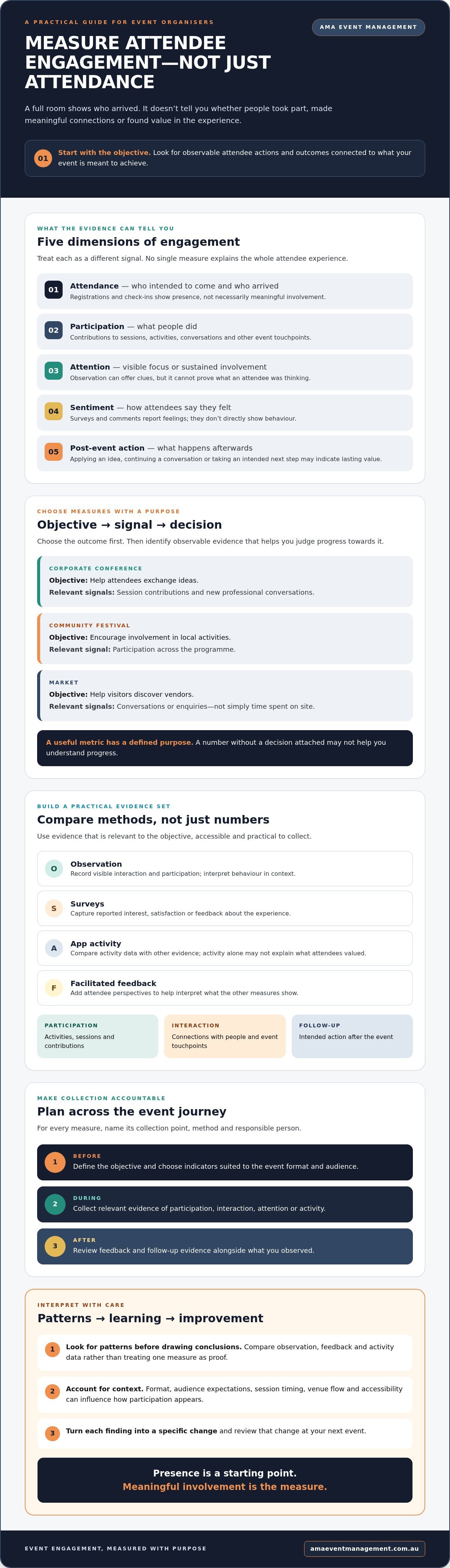
Attendance: Registrations and check-ins show who intended to come and who arrived.
Participation: Contributions to sessions, activities, conversations or other event touchpoints show what people did.
Attention: Observed focus or sustained involvement can offer clues, but doesn’t prove what someone was thinking.
Sentiment: Survey responses and comments report how attendees felt, rather than directly showing their behaviour.
Post-event action: Follow-up, such as applying an idea, continuing a conversation or taking an intended next step, can indicate lasting value.
Consider three different objectives. At a corporate conference, the organiser may want attendees to exchange ideas, so session contributions and new professional conversations could be relevant signals. A community festival might aim to encourage involvement in local activities, making participation across its programme more useful to assess. At a market, the objective could be to help visitors discover vendors, so conversations or enquiries may matter more than time spent on site. The right evidence depends on the purpose.
Which dimensions of attendee engagement should you assess?
Start with the experience you want to understand: participation in sessions, activities, conversations or key touchpoints. Then choose evidence suited to the question. Staff observations can record visible interaction, while attendee feedback can capture reported interest or satisfaction. Neither tells the whole story alone. Audience expectations, event format and purpose all influence which dimensions are meaningful.
Why attendance numbers alone are not an engagement measure
A full room or busy programme shows activity, not necessarily meaningful involvement. Registrations and check-ins don’t reveal whether attendees joined discussions, explored activities or made useful connections. Even visible behaviour needs context. A quiet session may reflect its format, while movement around a venue may be shaped by layout, timing or access. Treat each metric as one piece of evidence, not proof of overall success.
For a more reliable reading, compare attendance with indicators tied to the objective and consider how the event was delivered. Session timing, venue flow and the accessibility of activities can affect who participates and how participation appears. This context helps you distinguish an engagement pattern from a number that looks impressive but says little about the attendee experience.
How to choose attendee engagement metrics that match your event goals
Choose the outcome first, then decide what observable evidence would support it. If your aim is to help conference attendees exchange ideas, count relevant questions or facilitated introductions rather than relying on registrations. A metric is useful only when it helps you judge progress towards a defined objective.
Every metric needs a defined purpose, or it’s just a number without a decision attached. A scholarly conceptual framework for attendee engagement can also help organisers consider the quality of the attendee experience, not only what’s easiest to count.
Group possible indicators by what they reveal: participation in activities, interaction between attendees or with event touchpoints, feedback about the experience, retention through sessions or programme stages, and intended follow-up after the event. These are different signals. A positive survey response reports sentiment; it doesn’t prove someone took part or acted afterwards.
Match engagement indicators to event format and audience
For a conference, consider session attendance alongside questions asked and relevant session feedback. At a festival or market, activity participation, movement through areas and conversations with vendors may better reflect the intended experience. For a brand activation, measure meaningful product or brand interactions rather than impressions alone. The right measures depend on the audience and objective. For planning community events, see this guide to community festival organisers in Australia.
Set a baseline and define success before event day
Record who the event is for, which behaviours matter and what you’ll compare results with, such as a previous event or an agreed target. Document how each indicator will be counted, its data source and who owns collection and reporting. Set realistic thresholds with stakeholders for this event. There’s no universal engagement benchmark that applies across formats and audiences.
Be precise about rates. For a post-event survey response rate, divide completed responses by the number of attendees invited to respond, then report both the percentage and the counts. A different denominator, such as total registrations, answers a different question. Clear definitions make comparisons more reliable and help teams interpret what the evidence can and can’t show.
Planning a community festival or market? Explore AMA Event Management’s event services as you consider how objectives, audience touchpoints and delivery logistics shape the measures you’ll use.
Which event engagement measurement methods should you compare?
No single method captures the whole attendee experience. Compare each option against the question you need to answer, the effort required, when evidence is available, who can access it and how dependable the result is. A simple method that measures the right behaviour can be more useful than a detailed report full of data that doesn’t inform a decision.
Structured observation: Useful for visible participation, such as joining an activity or starting a conversation. It takes staff time, and findings can vary between observers unless they use shared categories.
Attendee surveys: Capture reported experience, preferences and sentiment. Keep questions brief and accessible, and remember that people who respond may not represent everyone invited.
Event-app activity: Can show interactions recorded within the platform, such as a poll response or session selection. It captures only activity available through that platform, not every conversation or moment of attention.
Registration and check-in records: Help establish who registered or arrived, but don’t show what attendees did after checking in.
Facilitated feedback: Brief conversations or group discussions can explain why people acted or felt a certain way. They offer depth, but cover fewer attendees and require consistent note-taking.
When should you use observation, surveys or digital data?
Choose the method that fits the behaviour. Use observation for visible participation, with clear definitions and a note of where and when staff watched. Use short surveys to ask about the experience directly, while considering response and sampling bias. Use digital records only when the platform captures a relevant interaction and you can interpret what it means. A click isn’t equivalent to in-person attention, interest or connection.
Interactive experiences, including those shaped by themed brand activation planning, may call for a combination of observed participation and attendee feedback. Impressions alone won’t show whether people engaged meaningfully with the experience.
How to combine quantitative and qualitative evidence
Pair counts or rates with open-text survey responses or brief attendee conversations. For example, a count of activity participants shows how many took part; comments may help explain what attracted them or created friction. Use the same observation categories across staff so their records can be compared, and record the context rather than treating every observation as conclusive.
Before collecting personal information, explain what you’re collecting and why, limit collection to what you need, and consider consent and access. Verify current Australian privacy requirements for your organisation and event, using authoritative guidance or qualified advice where needed. This is particularly relevant when registration, app and feedback data are combined or shared.
How to measure attendee engagement before, during and after an event
A reliable measurement process starts before attendees arrive and continues after the event closes. For measuring attendee engagement at events, make each measure operational: assign an owner, a collection point, a method and a person responsible for reporting the result. This avoids gaps when different teams manage check-in, programme delivery and feedback.
Prepare the measurement plan before event day
Map the attendee journey, then decide where each indicator can be captured. For a market in Sydney or Melbourne, that might mean identifying activity areas for observation and agreeing on a consistent way to record visitor interactions. For market-specific planning context, see this guide to community market management in Australia.
Confirm the objective and baseline. Record the intended audience, the behaviour you want to understand and the comparison point, such as an agreed target or a previous event.
Assign each measure. Note its owner, collection point, method and reporting responsibility. Specify how observations will be recorded and which data source will be used.
Test the process. Check survey questions, check-in steps and digital reports in advance. Make feedback options accessible, and provide a practical alternative for attendees who can’t or prefer not to use a digital channel.
Brief the team. Explain what to record, when to record it and how to raise issues. Shared instructions help staff and suppliers capture evidence consistently.
Tell attendees what information you’re collecting, why you need it and how it will be handled. Limit collection to what supports the stated purpose, and verify current Australian privacy requirements for your event and organisation before collecting or sharing personal information.
Collect and interpret evidence during and after the event
During the event, record relevant context alongside observations. A programme change, crowded pathway or access issue may affect participation, so note what happened rather than interpreting a count in isolation. After the event, check response rates and missing data before comparing results with your objective and baseline.
A simple engagement rate is the number of attendees who completed a defined action divided by the number eligible to complete it, multiplied by 100. State the action and denominator clearly. For example, report poll responses as a share of attendees present in that session, not total registrations. This keeps the result interpretable.
Finally, identify a specific improvement from the evidence, assign someone to follow it up and set a review point for the next event. AMA Event Management plans corporate conferences, community festivals, markets and themed activations. Explore event management services to see how event logistics and on-site supervision can support a consistent delivery plan.
How event organisers can turn engagement findings into better events
Evidence becomes useful when it changes a decision. Before adjusting a programme or activity, check whether the finding appears across more than one signal, such as observation and attendee feedback, or recurs at different points in the event. A single comment or unusual moment can point to something worth investigating, but it isn’t enough on its own to establish a wider pattern.
Compare findings with the event objective and baseline, and note factors that may have influenced behaviour. For example, lower participation in one session could relate to a programme change or a difficult transition between spaces, rather than a lack of interest. Separate what the evidence shows from your interpretation, then choose a specific change, assign an owner and set a review point for the next event.
How to report engagement results clearly to stakeholders
Keep the report concise and lead with the objective. A simple dashboard can connect the purpose of each measure to the finding and next step:
Objective: What did the event aim to achieve?
Indicator and result: What evidence was collected, and what did it show?
Limitations: Were there estimates, missing responses or collection gaps?
Action: What change is recommended, who owns it and when will it be reviewed?
Prioritise one or two recommendations and show the evidence behind each. Label estimates and gaps clearly. If survey responses came from only some attendees, say so; don’t present their views as representative of everyone. This approach makes measuring attendee engagement at events more useful for planning than a dashboard of unexplained figures.
When event management support can improve measurement
Measurement is easier to coordinate when programme design, audience touchpoints and delivery logistics are considered together. Clear responsibilities can help the team collect consistent evidence while managing event operations. AMA Event Management plans corporate conferences, community festivals, markets and themed activations, with services including event logistics and on-site supervision. Founder Amanda brings more than 20 years of industry experience to the team’s event planning and delivery.
For a corporate or community event in Sydney or Melbourne, consider how a measurement plan could align with your objectives and delivery requirements. Discuss an event with AMA Event Management.
Make your next event more intentional
Useful engagement measurement starts with a clear event objective, not a long list of metrics. Choose indicators that show whether attendees took part, interacted or followed through, then interpret those signals alongside feedback and the circumstances of delivery. The aim isn’t to collect more data. It’s to understand what it suggests and decide what to improve.
Measuring attendee engagement at events becomes more practical when responsibilities are clear and findings lead to a specific next step. Keep your reporting focused on the objective, the evidence, its limitations and the action you’ll review at your next event.
AMA Event Management plans and delivers corporate conferences, community festivals, markets and themed activations. Its services include event planning, logistics, vendor coordination and on-site supervision. Founder Amanda brings more than 20 years of industry experience to coordinating event details.
To discuss your next event in Sydney or Melbourne, contact AMA Event Management about event planning, logistics and delivery. A considered plan can support both the event itself and how you measure its results.
Frequently Asked Questions
What is attendee engagement at an event?
Attendee engagement is the observable involvement of guests in activities that support an event’s purpose. It can include asking questions at a conference, joining an activity at a community festival or speaking with vendors at a market. Engagement isn’t the same as attendance: a check-in confirms someone arrived, but doesn’t show whether they participated, felt connected or took a relevant next step.
How do you measure attendee engagement at events?
Start with the event objective, then choose behaviours or feedback that can help show progress towards it. For measuring attendee engagement at events, you might combine session participation records with attendee feedback, or observe how guests interact with an activation. Define how each measure will be collected, who is responsible and what limitations apply. This makes results easier to interpret for events in Sydney, Melbourne and beyond.
What are the best metrics for measuring event engagement?
The best metrics depend on the event’s purpose and format. A conference might track session participation, questions and relevant feedback; a festival could assess involvement in activities; a market may focus on visitor interactions with vendors. Consider participation, interaction, sentiment, retention or follow-up, but avoid treating any single indicator as proof of overall success. Choose a manageable set that gives useful evidence against your objectives.
Can attendee engagement be measured without an event app?
Yes. An app is optional. Organisers can use structured observation, registration and check-in records, short surveys, facilitated conversations or paper feedback forms. For example, staff at a community festival could record participation in an activity using agreed categories, then review comments from attendees to understand their experience. Choose accessible methods that suit the event and audience, and be clear about what each one can and can’t reveal.
How do you calculate an event engagement rate?
Divide the number of eligible attendees who completed a clearly defined action by the total number eligible to complete it, then multiply by 100. For example, calculate a session poll response rate using poll respondents divided by attendees present in that session, not total event registrations. State the action and denominator beside the result. That context prevents the percentage from appearing more conclusive than it is.
When should you collect attendee feedback after an event?
Collect initial feedback soon after the event, while the experience is still fresh and attendees can recall specific sessions, activities or access issues. If you also want to understand later action, such as whether people applied an idea or continued a conversation, plan a separate follow-up at a suitable interval. Explain why you’re asking, keep questions focused and report how many people responded so readers can assess the evidence.
How can event organisers measure engagement while respecting attendee privacy?
Explain what information you’re collecting, why it’s relevant and how you intend to use it. Collect only what’s needed for the stated purpose, restrict access appropriately and decide how long information needs to be retained. Offer suitable ways to provide feedback without requiring unnecessary personal details. Privacy obligations can depend on the organisation and circumstances, so check current Australian requirements with authoritative guidance or a qualified adviser before collecting or sharing attendee data.


Comments