

Outsourcing Corporate Events: Australian Business Guide
Updated: Oct 11
What if your team could stay in control of an event without managing every supplier call, schedule update and event-day detail? The benefits of outsourcing corporate events aren’t about handing over the purpose or the decisions. They come from delegating operational coordination to specialists, so staff can focus on their usual responsibilities while the event moves forward with clear oversight.
It’s understandable to wonder whether an external event manager will make delivery more reliable or leave your team feeling removed from the process. The difference lies in agreeing who owns what: your business retains its objectives, budget parameters and key approvals, while the event manager coordinates planning, logistics, suppliers and on-site delivery within the agreed scope.
This guide compares outsourced event management with in-house planning using practical criteria, including workload, coordination and oversight. It also explains which responsibilities can be managed externally and what information and decisions your team should retain, with examples relevant to corporate conferences and galas in Sydney and Melbourne.
Table of Contents
Benefits of outsourcing corporate events: what changes for your team?
What corporate event outsourcing can include, from brief to event day
Outsourced versus in-house corporate event planning: compare control and capacity
How to scope outsourced corporate event management with confidence
How AMA Event Management supports outsourced corporate events
Benefits of outsourcing corporate events: what changes for your team?
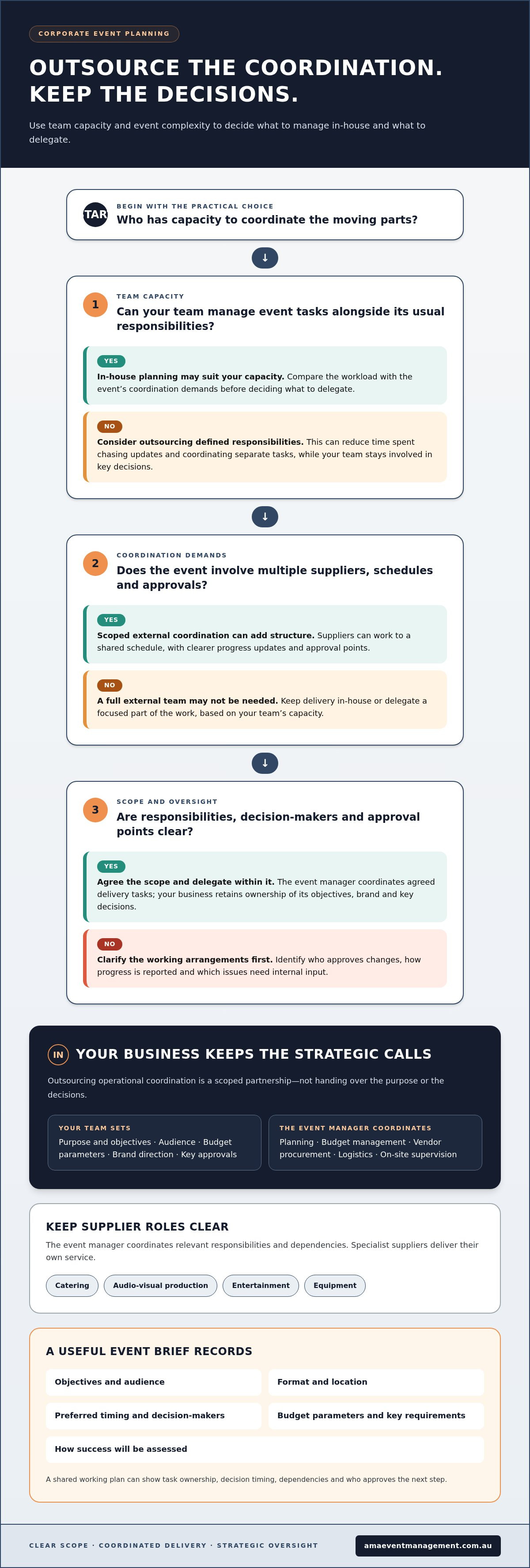
Every business planning an event faces a practical choice: keep delivery in-house, with staff coordinating each moving part alongside their regular work, or delegate defined responsibilities to an external event manager. The right approach depends on your team’s capacity and the demands of the event. For a conference or gala with multiple suppliers, schedules and approvals, outsourcing can create a clearer structure while keeping your organisation involved in the decisions that matter.
The general definition of outsourcing describes the wider business practice. In event planning, its value depends on how clearly responsibilities are scoped. Corporate event outsourcing is a scoped partnership: specialists coordinate agreed delivery tasks while your business retains ownership of its objectives, brand and key decisions. Your team sets the purpose, audience, budget parameters and approval points; the event manager organises operational work within those boundaries.
The benefits of outsourcing corporate events are practical. Staff spend less time chasing updates and coordinating separate tasks, suppliers work to a shared schedule, and decision-makers get a clearer view of progress. Depending on the agreed scope, delegated work may include planning, budget management, vendor procurement, logistics and on-site supervision. Your team stays involved where its knowledge and authority are essential without personally managing every detail.
Which corporate events can benefit from external management?
Conferences, galas, executive retreats and expos can all involve substantial coordination, though each has different demands. The event’s complexity and mix of suppliers can increase internal workload, particularly when staff must also manage their usual responsibilities. AMA Event Management works across these event types, from executive retreats to large-scale national expos. Not every event needs a full external team: responsibilities can be delegated in a focused scope or across a broader workstream.
What changes for the internal team?
Instead of personally coordinating every task, internal staff set direction, share subject-matter knowledge and approve milestones. They continue to shape the attendee experience and make decisions affecting stakeholders, brand or business objectives. A single communication process, with clear responsibilities and approval points, helps route updates consistently and reduces duplicated effort or conflicting instructions.
The result is a more deliberate division of work, not distance from the event. Your team contributes context and makes strategic decisions, while the event manager maintains momentum across agreed delivery tasks. Before delegating, clarify who approves changes, how progress is reported and which issues need internal input. This keeps oversight clear while easing the coordination load.
What corporate event outsourcing can include, from brief to event day
Event management can cover a defined part of a project or coordinate a workstream from the initial brief through to delivery. Scope should reflect the event’s objectives, complexity and your team’s capacity. For a Sydney corporate conference, that might mean coordinating planning milestones and suppliers. For a gala in Melbourne, the focus could be aligning the programme, production schedule and approvals.
The distinction between management and delivery is useful. Depending on the scope, an event manager can oversee planning, budget management, vendor procurement, logistics and on-site supervision. Specialist suppliers may provide catering, audio-visual production, entertainment or equipment. For complex sound, lighting and staging requirements, corporate planners often collaborate with commercial AV specialists like JVG Sound Lighting & Visual Pty Ltd. The event manager coordinates relevant responsibilities and dependencies; each supplier delivers its specialist service. This makes it clearer who is accountable for each task.
From event brief to coordinated plan
A useful brief records the event’s objectives, audience, format, location, preferred timing and decision-makers. Include budget parameters, key requirements and how success will be assessed. With that context, planning milestones can be set, procurement coordinated and budget oversight aligned with your business’s approval process. The scope is project-specific: your business defines what it wants managed, and the event plan reflects that agreement.
A single working plan connects the moving parts. It should show who owns each task, when a decision is needed, what depends on it and who approves the next step. For example, a programme change may affect supplier schedules, room arrangements and attendee communications. Making those connections visible helps the team consider the impact before confirming a change.
What event-day management contributes
On the day, on-site supervision focuses on coordinating the agreed schedule, suppliers and operational details. The event manager can track progress against the run sheet, direct queries through the agreed process and raise relevant issues with the designated decision-maker. Clear roles let internal stakeholders focus on guests, speakers or business priorities instead of overseeing every operational task.
This structure supports informed responses when plans need attention, though it can’t remove every factor outside the team’s control. Clear escalation points show who can make a decision and when internal input is needed. For a gala, the programme, guest experience and supplier coordination all need to work together. AMA’s corporate gala planning in Sydney is a useful reference for considering how those elements fit into an event scope.
The benefits of outsourcing corporate events are strongest when responsibilities are explicit from the start. A clear brief, coordinated plan and defined event-day roles distinguish management oversight from specialist delivery. They also help internal teams stay involved in decisions that shape the event while delegating agreed logistics and coordination.
Outsourced versus in-house corporate event planning: compare control and capacity
Choosing between in-house planning and outsourcing isn’t a judgement about which approach is more professional. It’s a question of fit: what does the event require, what capacity does your team have, and how much coordination can it absorb alongside other responsibilities? A smaller, straightforward gathering may be manageable internally. A programme involving several suppliers, detailed logistics and competing deadlines may benefit from dedicated external coordination.
Control depends on agreed decision rights, approvals and reporting, not on whether planning happens inside or outside the business. Your organisation can retain authority over objectives, brand direction, budget parameters and significant changes while delegating agreed operational tasks. That’s central to the benefits of outsourcing corporate events: gaining coordination capacity without giving up strategic ownership.
When in-house planning may be a practical fit
Internal planning can work well for a smaller event with a straightforward format, manageable supplier requirements and staff who have time to coordinate it. Existing supplier relationships and previous event experience may also make planning more familiar. Account for the full internal effort, including time spent on schedules, communication and event-day tasks, rather than treating those responsibilities as cost-free.
When outsourcing may better match the event
Multiple suppliers, complex logistics or staff already balancing competing priorities are reasons to consider external coordination. This can suit a business planning a conference or gala in Sydney or managing an event in Melbourne alongside other priorities. An event manager brings focused coordination capacity when no internal role is dedicated to delivery. The scope can match the work required, rather than defaulting to full-service management.
Compare both approaches against your real constraints: internal availability, coordination demands, existing experience and the oversight decision-makers need. The right model gives the event clear ownership while keeping business priorities and team capacity in view.
How to scope outsourced corporate event management with confidence
A well-scoped brief turns the decision to outsource into a workable plan. It gives the event manager enough context to coordinate delivery and makes clear which decisions stay with your organisation. Use this sequence to set expectations before planning gets underway.
Define the outcomes. State what the event needs to achieve for the business and its attendees. Describe the experience you want people to have, not just the event format.
Set the scope. Record which planning and delivery responsibilities you want managed, and what remains with your team. Include the audience, format, location, preferred timing and budget parameters.
Assign decision-makers. Name a client lead and identify who can approve programme, brand or budget decisions. Set out when a decision needs escalation.
Agree reporting. Decide how progress, risks, supplier commitments and decisions will be communicated, and how often stakeholders need updates.
Review delivery. Agree how you’ll assess the event against its objectives and capture feedback or lessons for future planning.
Set the event scope and success measures
Translate business objectives into attendee experience and event priorities. A conference focused on knowledge-sharing may prioritise relevant sessions and active participation. A gala may place more weight on guest experience and stakeholder engagement. Choose measures that reflect the purpose, such as attendance, participation or stakeholder feedback. Decide how each measure will be assessed before delivery, so the review reflects the event’s intended outcomes.
A useful brief also captures decision-makers, key requirements and important dependencies. The clearer the scope, the easier it is to distinguish event-manager coordination from client approvals as plans develop.
Agree communication, approvals and budget oversight
Keep the working relationship clear with a named client lead, documented approval stages and an escalation path for decisions outside the agreed scope. Concise updates can keep stakeholders informed without adding unnecessary meetings. Set expectations for what an update covers, such as completed milestones, upcoming approvals, open issues and changes that need a decision.
Budget oversight should provide visibility over approved allocations and commitments, not imply guaranteed savings. Agree how costs and proposed changes will be reported, who can approve adjustments and how decisions will be recorded. This gives decision-makers a clearer view of the event’s financial position as planning progresses.
Simple responsibility matrix
Client team: sets objectives and brand direction, provides internal knowledge, approves budget parameters and makes agreed strategic decisions.
Event manager: coordinates responsibilities in scope, tracks milestones and commitments, and reports issues or decisions requiring client input.
Shared: reviews progress, resolves escalated questions and assesses delivery against the agreed success measures.
Clear scoping makes the benefits of outsourcing corporate events practical: defined ownership, informed approvals and a review tied to business purpose. To discuss a tailored scope for your corporate event, speak with AMA Event Management.
How AMA Event Management supports outsourced corporate events
Outsourcing works best when the event manager understands the business purpose and the internal team knows what it will retain. AMA Event Management is an Australian-owned business founded by Amanda, who brings over 20 years of industry experience. AMA plans and delivers corporate conferences, galas, executive retreats and large-scale expos, shaping each project around its objectives and requirements.
Depending on the agreed scope, AMA coordinates planning, budget management, vendor procurement, logistics and on-site supervision. These responsibilities can be aligned with the event’s needs rather than treated as a fixed package. A conference may require close attention to programme logistics and supplier schedules, while a gala or executive retreat may have different priorities. The brief establishes what matters and where external coordination will help.
A tailored scope for conferences, galas and business events
Planning should reflect your objectives, audience and chosen format. Your business can retain brand direction, stakeholder relationships and approval authority while AMA coordinates the agreed operational work. That division keeps the event connected to your organisation’s priorities without requiring internal staff to manage every planning detail. Use AMA’s guide to selecting a corporate event management agency alongside your project brief to assess responsibilities and the working relationship.
A clear scope also distinguishes management from specialist delivery. AMA coordinates vendor procurement and related logistics, while individual suppliers deliver their own services. Defining responsibilities, approvals and reporting early gives the internal team and event manager a shared reference as plans progress.
Make the next decision straightforward
You don’t need a complete plan before starting a conversation. A few details can help clarify the brief and identify planning priorities:
Purpose: what the event needs to achieve for the business.
Audience: who will attend and any known attendee considerations.
Timing and location: preferred dates or timing, and the intended location.
Requirements: known format, programme elements, suppliers or internal constraints.
Responsibilities: what your team wants to retain and where it needs coordination support.
An initial discussion can align these details, clarify responsibilities and establish practical next steps. It also gives your team a chance to explain what success looks like before operational planning begins. The benefits of outsourcing corporate events are easier to realise when the scope reflects your business priorities and gives everyone a clear role.
To discuss your event brief and planning priorities with AMA Event Management, Discuss your corporate event with AMA Event Management.
Set your event in motion with a clear first step
Your next move doesn’t need to be a complete event plan. Start with the decision that will shape everything else: what should attendees think, feel or be able to do as a result of the event? A clear answer gives planning conversations a useful centre and helps your team distinguish essential requirements from ideas to refine later.
The benefits of outsourcing corporate events become tangible when the brief gives your business and event manager a shared starting point, rather than leaving staff with another open-ended task. Bring your purpose, audience and early priorities to a conversation, then discuss what coordination would suit your event.
Discuss your corporate event with AMA Event Management and take the next step towards a plan that feels considered, manageable and true to your organisation.
Frequently Asked Questions
Is outsourcing corporate event planning worth it for a small business?
It can be worthwhile if planning an event would pull staff away from work the business needs them to do. Consider the coordination involved, your team’s available time and whether a defined external role would ease pressure. The benefits of outsourcing corporate events aren’t automatic: compare the management fee and internal effort with the value of staff time released, then choose a scope that fits the event rather than defaulting to full-service support.
Can we retain control of our brand and decisions when outsourcing an event?
Yes. Your business can set the brand direction, approve important creative choices and retain authority over decisions that affect stakeholders or business priorities. Document those rights, including who signs off on changes and how decisions are recorded. For example, an event manager may coordinate production details while your marketing lead approves the final use of brand assets. Clear boundaries support collaboration without blurring accountability.
What should a business include in a corporate event brief?
Include the event’s purpose, intended audience, format, preferred location and timing, plus known requirements and budget parameters. Add the internal contact responsible for decisions, approval stages and important constraints, such as a fixed date or access needs. A staff conference brief might also state what attendees should take away from the programme. Mark undecided details as open questions rather than waiting until everything is settled.
How far in advance should we engage an event management team?
Engage support as soon as you know an event is likely to proceed, especially if it has a fixed date, complex logistics or several suppliers. Starting earlier leaves more time to develop the brief, coordinate dependencies and work through decisions before delivery. The right lead time varies with the event’s scale and requirements, so share what you know even if the date or format is still being refined.
What happens if an event requirement changes during planning?
Raise the change through the agreed communication channel and make its impact visible before approving it. A revised speaker schedule, for instance, could affect production timings, supplier instructions and attendee communications. The event manager can identify dependencies and outline decisions needed from the client team. Record the approved change, its owner and any updates to the plan so stakeholders work from the same information.
Can a business outsource only selected parts of a corporate event?
Yes. A business can define a focused scope around the tasks creating the greatest pressure rather than delegate the entire event. Internal staff might lead the programme and guest communications while external management coordinates procurement or event-day logistics. Name what is included, what stays internal and how handovers will work. This helps prevent gaps and lets the business retain work its team is equipped to manage.
How can a business measure whether a corporate event was successful?
Choose measures that match the event’s purpose, then decide how to collect them before the event takes place. A learning-focused conference could track session attendance and gather attendee feedback; a stakeholder event may assess participation and responses from key guests. Compare results with the objectives in the brief, not just with how smoothly the day appeared to run. A short review can capture what to retain or adjust for the next event.



Comments