

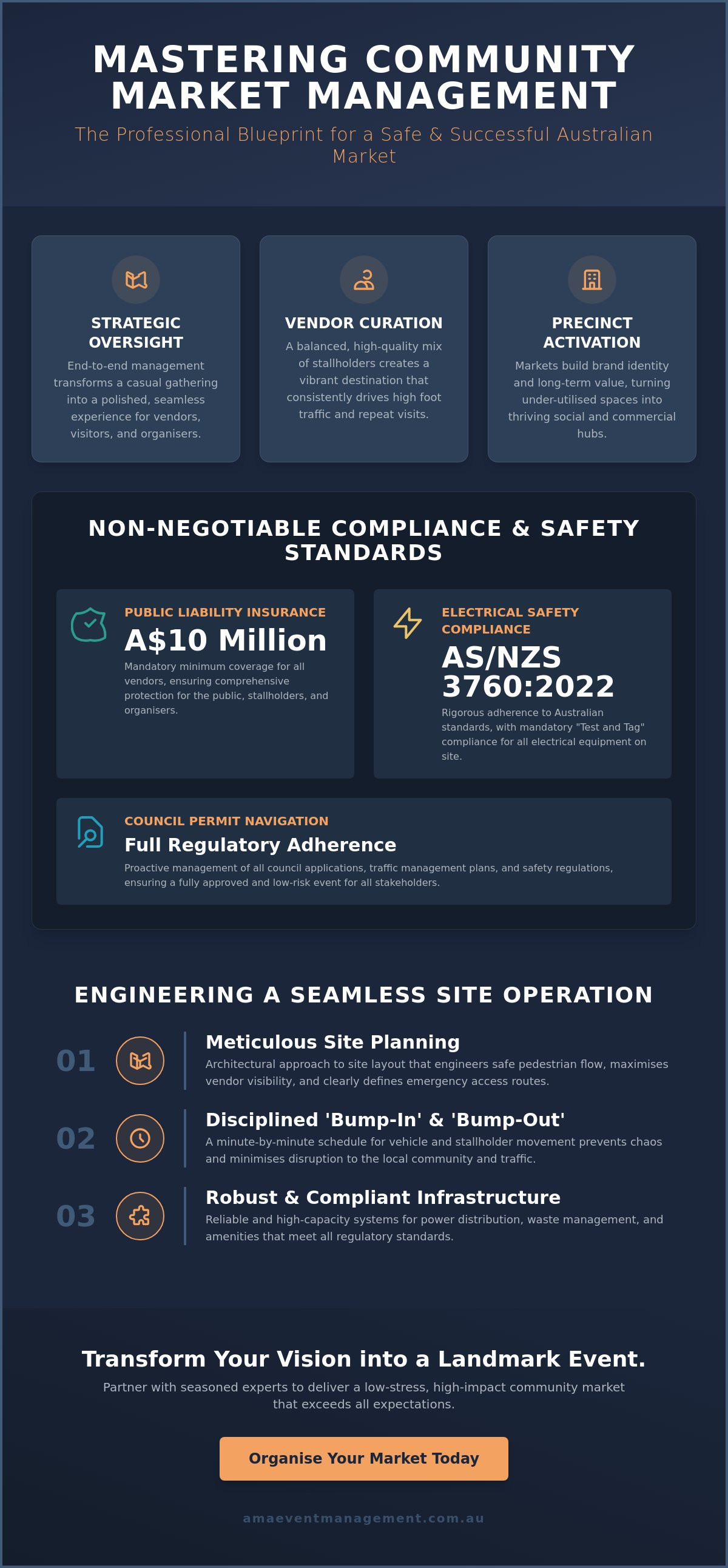
Professional Community Market Management in Australia: A Strategic Guide
A successful community market is far more than a collection of gazebos and card readers; it is a meticulously engineered ecosystem where logistics and curation meet. When the pressure of coordinating stallholder applications and deciphering complex council permits becomes overwhelming, the original vision for a vibrant local hub often fades. You likely recognise that a truly impactful event requires a disciplined approach to community market management Australia that prioritises safety and quality over simple administrative convenience.
This guide demonstrates how professional oversight transforms these logistical burdens into a seamless, high-quality experience. You'll discover the strategies used to curate a vendor mix that drives foot traffic while ensuring full compliance with Australian safety standards, including the rigorous AS/NZS 3760:2022 electrical requirements and mandatory public liability insurance of at least A$10 million. We'll outline a structured path toward a low-stress market day that satisfies both local authorities and the community at large.
Key Takeaways
Understand how end-to-end strategic oversight distinguishes a professionally managed event from a casual gathering, ensuring a polished experience for all stakeholders.
Master the complexities of site logistics and regulatory compliance to ensure your community market management Australia project meets every safety standard and council requirement.
Discover the art of vendor curation and how a balanced stallholder mix creates a recurring, vibrant destination that consistently attracts high foot traffic.
Explore the role of markets as powerful precinct activations that build brand identity and long-term value for developers and local government authorities.
Learn how twenty years of industry experience translates into a seamless, low-stress market day through proactive problem-solving and meticulous coordination.
Table of Contents
Defining Professional Community Market Management in Australia
Professional community market management Australia represents a significant shift from the informal gatherings of the past toward highly structured, strategic activations. While the foundational definition of a marketplace focuses on the exchange of goods and services, the modern Australian iteration is a complex logistical operation. It's a process that involves end-to-end oversight beginning months before the first stall is erected. This discipline ensures that every element, from vendor selection to emergency egress, functions as part of a cohesive strategy rather than a series of ad-hoc decisions.
Distinguishing between a "casual" market and a "professionally managed" community activation is essential for stakeholders. A casual market may rely on inconsistent bookings and minimal site oversight, which often leads to logistical friction. In contrast, a professionally managed event is a curated experience designed to reflect the character of its location. For precincts in Sydney and Melbourne, this level of management has become the non-negotiable standard. It provides a stabilizing force that bridges the gap between local councils, diverse stallholders, and the general public. The management agency acts as a proactive architect; they navigate the complexities of council permits and safety regulations so that vendors can focus on their craft.
The Evolution of the Australian Market Fair
The landscape of local trading has evolved from simple weekend car-boot sales into immersive, themed community festivals. In NSW, the rise of the night market has become a critical driver for evening economies, turning quiet streets into vibrant social hubs after dark. This evolution reflects a broader trend toward intentional living, where 49% of Australian consumers are seeking value-driven, local experiences. These modern markets are no longer just places to shop; they serve as vital social anchors for new residential developments. They help to build a sense of community in rapidly growing urban corridors where residents crave authentic connection and high-quality local produce.
Core Objectives of a Managed Market
A professionally overseen market operates with clear, measurable goals that align with the interests of both developers and the community. These include:
Fostering local entrepreneurship: Providing a low-risk platform for small business vendors to test products and build a loyal customer base without the overheads of permanent venue hire.
Creating safe, inclusive environments: Implementing disciplined safety protocols, such as strict "test and tag" compliance for electrical equipment, to protect all attendees.
Driving urban activation: Converting under-utilised car parks or plazas into high-traffic destinations that support surrounding permanent retailers through increased foot traffic.
By maintaining this focused approach, community market management Australia ensures that every event contributes positively to the precinct's long-term commercial and social health. This methodical oversight provides a sense of relief for organisers who need a reliable partner to manage the moving parts of a high-pressure environment.
Navigating Logistics: Site Management and Compliance
While the vision for a market is often centred on community and culture, the operational reality is built on a foundation of rigorous logistics. Successful community market management Australia requires an architectural approach to site planning. This involves more than just allocating stall spaces; it's about engineering a pedestrian flow that ensures safety while maximising vendor visibility. A meticulous site plan accounts for emergency access, crowd density, and the seamless integration of temporary infrastructure into the existing urban fabric.
The "bump-in" and "bump-out" phases are perhaps the most high-pressure windows of any event. Managing dozens of vehicles in a confined space requires a disciplined, minute-by-minute schedule to minimise local traffic disruption. This level of coordination prevents the chaos that often plagues unmanaged events. It's a methodical process that respects the surrounding neighbourhood and maintains the goodwill of local residents and permanent retailers alike.
Infrastructure must be both robust and compliant. From high-capacity power distribution to waste management systems, every component must be reliable. Adhering to local government market guidelines ensures that the event meets the high standards expected by Australian authorities. For organisers who require a seasoned expert to oversee these complexities, professional market management coordination provides a stabilising force throughout the project lifecycle.
Risk Management and Public Safety
Public safety is a non-negotiable priority. Implementing comprehensive Work Health and Safety (WHS) protocols protects the organiser, the vendors, and the public. This includes enforcing strict electrical safety; all portable equipment must undergo regular inspection and "test and tag" procedures under the AS/NZS 3760:2022 standard. Insurance is equally critical. Most Australian markets now mandate a minimum of A$10 million in public liability coverage, with many councils increasing this requirement to A$20 million for high-traffic precincts. A composed response to unpredictable weather conditions, using pre-defined contingency plans, ensures the event remains secure even when the environment shifts.
Regulatory Compliance in NSW and Victoria
Operating across different states requires a deep understanding of varying regulatory frameworks. In NSW and Victoria, temporary food stalls must comply with the Australia New Zealand Food Standards Code, specifically Standard 3.2.2A. This requires qualified food safety supervisors and trained handlers for any potentially hazardous products. On-site supervision plays a vital role here. It ensures that noise ordinances and trading hours are strictly observed, maintaining a professional atmosphere that satisfies council permits and regulatory bodies. This disciplined oversight ensures that the market remains a welcome addition to the local evening economy.
Strategic Vendor Coordination and Curation
The heartbeat of any thriving market is its vendor mix. Curation is a deliberate act of architectural design; it requires a deep understanding of local demographics and evolving consumer trends. For instance, with recent market research indicating that a notable proportion of Australians, such as 47%, are decreasing their purchase of animal-based products, a professional manager prioritises a balanced selection of plant-based and sustainable food options. This isn't merely about filling available spaces. It's about ensuring that the "vibe" of the market remains consistent and high-quality, which in turn secures recurring foot traffic and community trust.
Effective community market management Australia avoids the pitfalls of over-automation. While digital tools can assist with data entry, they cannot replace the seasoned eye needed to vet a stallholder’s aesthetic or product quality. A disciplined management approach involves reviewing the administrative lifecycle of every vendor, from the initial expression of interest through to post-event performance reporting. This meticulous oversight ensures that only premium, reliable vendors occupy the site, protecting the commercial reputation of the precinct and the safety of the public.
The Stallholder Application Process
A streamlined application process is essential for attracting high-calibre small businesses and local artisans. Clear criteria must be established from the outset, favouring handmade, local, or bespoke merchandise that resonates with the community's values. Before any approval is granted, a professional manager verifies that all vendors comply with the Australian government guide to market stall regulations. This includes confirming a valid Australian Business Number (ABN), current public liability insurance, and necessary food safety certifications. By setting these high standards early, you eliminate logistical friction and ensure a professional standard across the entire event.
Maximising Vendor Success
Curation doesn't end when the bookings are confirmed. Professional management involves guiding vendors to present their best possible work. This includes providing advice on stall styling or layout to drive sales and enhance the overall market aesthetic. Providing detailed vendor briefings ensures every participant understands the site logistics and "bump-in" procedures, creating a frictionless experience for everyone involved. Finally, collecting and analysing vendor feedback after the event allows for continuous improvement. It builds a collaborative partnership where stallholders feel supported, leading to long-term loyalty and a more stable, successful market calendar for the organiser.
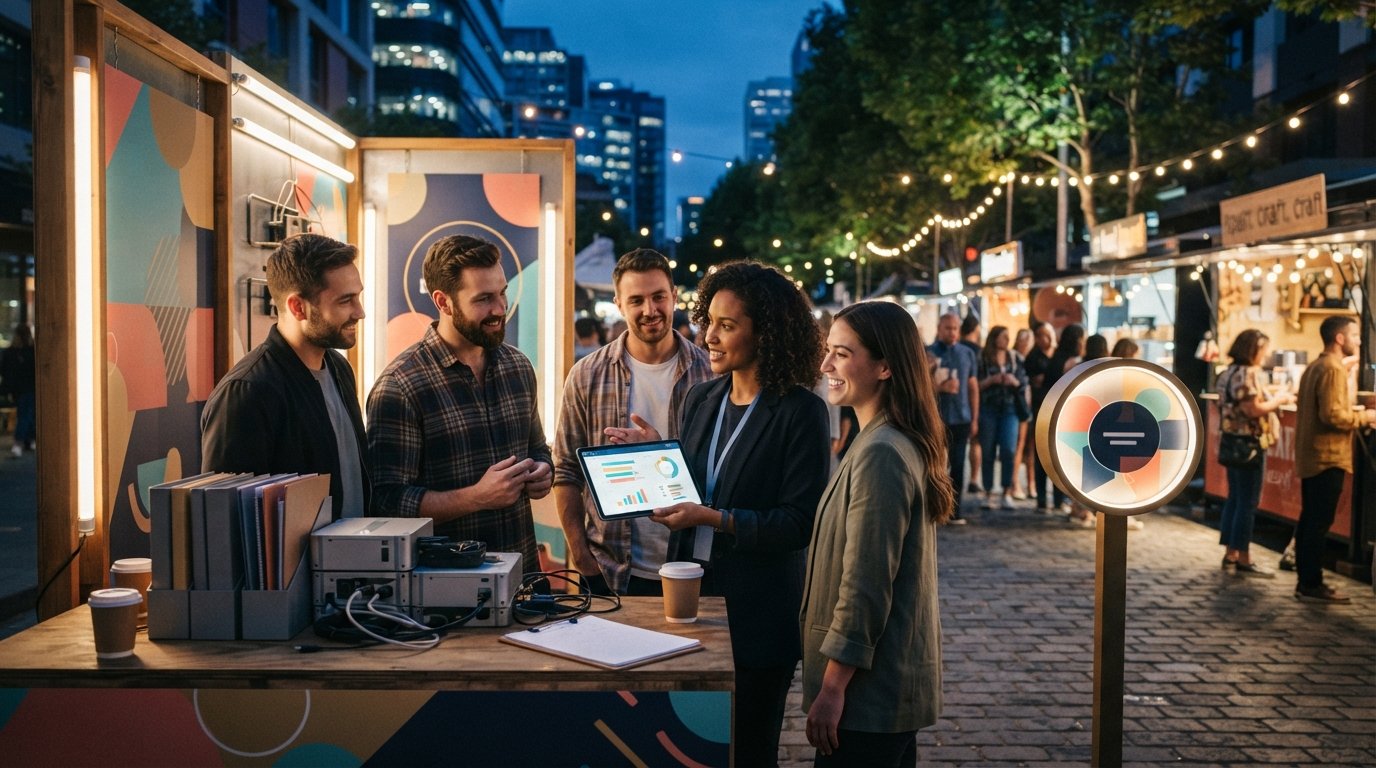
Markets as Strategic Brand and Precinct Activations
A professionally managed market serves as a powerful instrument for brand identity and precinct activation. While previous sections detailed the logistical and curatorial foundations, the strategic value of a market lies in its ability to transform a physical space into a destination. In the competitive landscape of community market management Australia, a market is no longer just a place for trade; it's a themed activation designed to communicate the values of a location to its residents and visitors. This shift from utility to experience is what builds long-term loyalty and emotional resonance within a community.
A disciplined approach to activation involves integrating layers of entertainment, live music, and high-end styling to create an immersive environment. When these elements are coordinated with precision, the market becomes a reliable social anchor. It provides a reason for people to return to a precinct week after week, fostering sustainable community bonds that benefit both the local social fabric and the surrounding commercial interests. This methodical brand-building ensures that the market isn't just an event, but a vital part of the area's ongoing narrative.
Placemaking for Sydney and Melbourne Developers
For developers in Sydney and Melbourne, markets are essential tools for early-stage placemaking. They provide a unique opportunity to turn construction hoardings, vacant lots, or under-utilised plazas into vibrant hubs long before permanent retail spaces are fully tenanted. This proactive strategy drives early engagement with new residential and commercial precincts, establishing a sense of place and "vibe" that attracts future residents and investors. The long-term economic impact is significant; a well-managed community event increases the perceived value of the precinct and supports the viability of nearby permanent businesses by establishing consistent foot traffic patterns.
Immersive Theming and Styling
Modern market management requires moving beyond the standard white marquee to create a bespoke visual identity. This involves a meticulous focus on styling and aesthetics that reflect the specific character of the neighbourhood. Integrating seasonal themes, such as winter night markets or spring floral festivals, keeps the recurring calendar fresh and engaging for a diverse demographic. There is also a practical necessity for "Instagrammable" moments; visually striking installations and curated vendor displays encourage organic social media promotion, extending the market's reach far beyond its physical boundaries. If you are ready to elevate your precinct's identity through professional oversight, consider how our themed brand activation services can deliver a polished, high-impact experience.
The AMA Advantage: 20 Years of Composed Excellence
Experience is the anchor of any successful event. AMA Event Management provides the stabilising force required to execute complex public gatherings with quiet confidence. With over twenty years of industry presence, our team has refined the art of community market management Australia into a disciplined science. We don't simply react to the day's events; we act as a composed guide, staying several steps ahead of logistical challenges to ensure a frictionless experience for every stakeholder. This proactive oversight is the result of decades spent managing the fine details that others might overlook.
Our end-to-end service covers the entire project timeline. We begin with the initial concept design and move through to meticulous on-site supervision. Throughout this process, our commitment to supporting local Australian vendors remains central. We understand that a market's success is tied to the growth of its participants; therefore, we foster an environment where small businesses can thrive under professional standards. This methodical approach ensures that every market we manage becomes a reliable, high-quality hub for the local community.
Why Councils and Corporations Trust AMA
Government bodies and corporate developers require a partner who prioritises precision and reliability above all else. Our track record is extensive, spanning from the management of large-scale national expos to the curation of intimate local night markets. We handle the heavy lifting of council liaison and regulatory compliance, ensuring that every permit is secured and every safety standard is met without compromise. This methodical execution allows our clients to feel a sense of relief, knowing that the operational intricacies are in expert hands. We focus on high-standard execution so that the precinct's reputation remains untarnished.
Getting Started with Your Community Event
Every precinct possesses a unique character that requires a bespoke approach. We collaborate closely with you to design a market concept that aligns with your specific vision for the space. Whether you're a developer looking to initialise a new residential hub or a council seeking to revitalise an existing local plaza, our team provides the architectural oversight needed for long-term success. The process is logical and structured, leading from an initial consultation to a fully realised, thriving community destination. To begin this collaborative partnership, you can enquire about our professional market management services and discover how twenty years of composed excellence can transform your next community event.
Elevating Your Precinct Through Strategic Oversight
Transforming a public space into a vibrant destination requires more than just a collection of stalls; it demands a disciplined approach to community market management Australia. By prioritising meticulous site logistics, rigorous compliance with Australian safety standards, and a curated vendor mix, you create an environment where both small businesses and local residents can flourish. This strategic oversight ensures that every market day is a seamless, low-stress operation that enhances the long-term value and brand identity of your precinct.
With over 20 years of event management experience, AMA Event Management provides the composed guidance needed to navigate these complexities. As specialists in recurring markets across NSW and VIC, we offer end-to-end site management and comprehensive compliance oversight, allowing you to focus on the broader vision for your community. Partner with AMA for your next community market activation and secure a polished, high-standard experience that resonates with your audience. We look forward to helping you build a thriving social anchor for your location.
Frequently Asked Questions
What is the difference between a community market and a commercial fair?
A community market prioritises local social connection and precinct activation, whereas a commercial fair is typically driven by large-scale retail and volume sales. Professional community market management Australia ensures these events serve as social anchors by curating vendors that reflect the neighbourhood's specific character. While commercial fairs often focus on mass-produced goods, community markets emphasise handmade, local, and bespoke offerings that build long-term loyalty.
How long does the night market stallholder application process typically take?
The vetting process for a night market stallholder application generally takes between two and four weeks. This timeframe allows for a meticulous review of product quality, stall aesthetics, and mandatory compliance documents. We ensure that every participant meets the high standards required for a polished event, which involves verifying everything from ABNs to food safety certifications before final approval is granted.
Do I need my own public liability insurance as a market vendor in NSW?
Yes, all market vendors in NSW must hold their own public liability insurance to operate legally and safely. Most local councils and management agencies require a minimum of A$10 million in coverage; however, A$20 million is increasingly the standard for high-traffic precincts. This protects both the individual stallholder and the event organiser from potential risks associated with public trading.
How does professional management handle bad weather for outdoor markets?
Professional management uses pre-defined weather contingency plans to ensure a composed and disciplined response to unpredictable conditions. Decisions regarding event adjustments or cancellations are made early based on safety-first protocols and real-time meteorological data. This methodical approach minimises disruption and ensures that all site infrastructure remains secure, providing a sense of relief for both vendors and stakeholders.
Can you help with market stallholder applications in Queensland as well as NSW?
We coordinate vendor applications and site logistics for markets in both Queensland and New South Wales. Our team possesses a deep understanding of the regulatory frameworks in both states, including local government market guidelines and state-specific food authority standards. This cross-border expertise allows us to deliver a consistent, high-standard experience for developers and councils operating in multiple regions.
What types of vendors are most successful at recurring community markets?
Vendors who offer unique, high-quality products and maintain an engaging stall aesthetic tend to be the most successful at recurring markets. Artisanal food producers, sustainable craftspeople, and bespoke gift designers often draw the highest foot traffic. Success is also tied to a vendor's ability to create a visual identity that aligns with the market's curated "vibe," which encourages organic social media promotion.
How much does it cost to hire an event management company for a local market?
The cost of engaging a professional management agency varies based on the scale, frequency, and specific requirements of the precinct activation. Factors such as end-to-end site management, council liaison, and the complexity of vendor coordination all influence the final investment. We recommend a consultation to design a bespoke management plan that aligns with your precinct's goals and budgetary considerations.
Why is curation more important than simply filling every available stall space?
Curation is essential because it protects the market's brand identity and ensures the long-term commercial health of the precinct. Simply filling spaces with any available vendor often results in a generic experience that fails to attract recurring foot traffic. A disciplined selection process ensures a balanced mix of high-quality offerings, which is the secret to creating a vibrant and sustainable community hub.

Comments