

Sydney Corporate Conference Planning Checklist 2026
What if the most important conference planning decision isn’t the venue, but the business objective guiding every choice that follows? This corporate conference planning checklist Sydney organisers can use starts with that purpose, helping you set priorities, coordinate suppliers and shape an event that works for delegates.
Planning can quickly become complex when deadlines, venue requirements, travel arrangements and event-day details all need attention. This checklist sets out a practical sequence, from defining the brief and selecting a suitable venue to managing delegate logistics, preparing for risks and following up after the event.
You’ll find a structured way to connect each task to your audience and objectives while accounting for the practicalities of hosting a conference in Sydney. Founded by Amanda, AMA Event Management draws on her more than 20 years of industry experience to bring planning, suppliers and on-site delivery into one coordinated process. Use the checklist to keep the moving parts in view and make considered decisions from the first brief through to post-event review.
Table of Contents
Start your Sydney corporate conference checklist with clear objectives
A conference planning checklist is a working guide to the decisions, tasks and dependencies that shape an event. It helps organisers keep the purpose, people, deadlines and resources in view, rather than treating venue selection or programme design as the starting point. A corporate conference planning checklist Sydney businesses can use should begin with the outcome the organisation needs, then translate it into practical choices.
Be specific about the business objective. Is the conference intended to share knowledge, align teams around a strategy or strengthen engagement with stakeholders? These aims call for different content and measures. Knowledge-sharing might be assessed through participation in sessions or feedback on what delegates learned. Alignment may call for clear messages and follow-up actions, while stakeholder engagement could focus on the quality of discussion and relationships developed.
Objectives should shape the programme, format and success measures, so every planning decision supports the outcome the organisation needs.
Before discussing venues, establish who the conference is for and what they need to participate comfortably. Record an estimated delegate number, the decision-makers responsible for approvals and any accessibility requirements. Consider whether attendees will need step-free access, clear wayfinding, accessible facilities or particular arrangements for participating in sessions. These details influence room layouts, registration, communications and the practical experience of the day.
Write a conference brief that guides every decision
Bring the working requirements together in one brief: purpose, audience, preferred dates, format, location and key stakeholders. Add success measures that connect directly to the objective, such as agreed actions, useful feedback or participation in priority sessions. The brief should also record constraints and dependencies, including approval stages, internal communications and decision deadlines. For a useful overview of the disciplines involved, see the Event Management Overview.
Purpose: State the business need and intended outcome.
Audience: Describe delegates, expected numbers and access needs.
Governance: Identify decision-makers, approvers and stakeholders.
Measures: Decide how you’ll judge whether the objectives were met.
Set the Sydney location around delegate needs
Map where delegates are travelling from before narrowing the location. Sydney-based attendees may prioritise public transport connections, while interstate or overseas guests may need a straightforward route between the airport, accommodation and conference. Where relevant, consider how delegates will move between sessions, hotels and off-site activities. ICC Sydney and Barangaroo are examples of Sydney-area context, not recommendations. The right location depends on your audience, format and access requirements.
For organisations considering events in Sydney or Melbourne, start with the delegate journey and programme requirements rather than choosing a location first and trying to make the event fit. Once the foundations are clear, venue discussions become more purposeful. The brief also gives decision-makers a shared reference point as planning progresses.
Follow this timeline for planning a corporate conference in Sydney
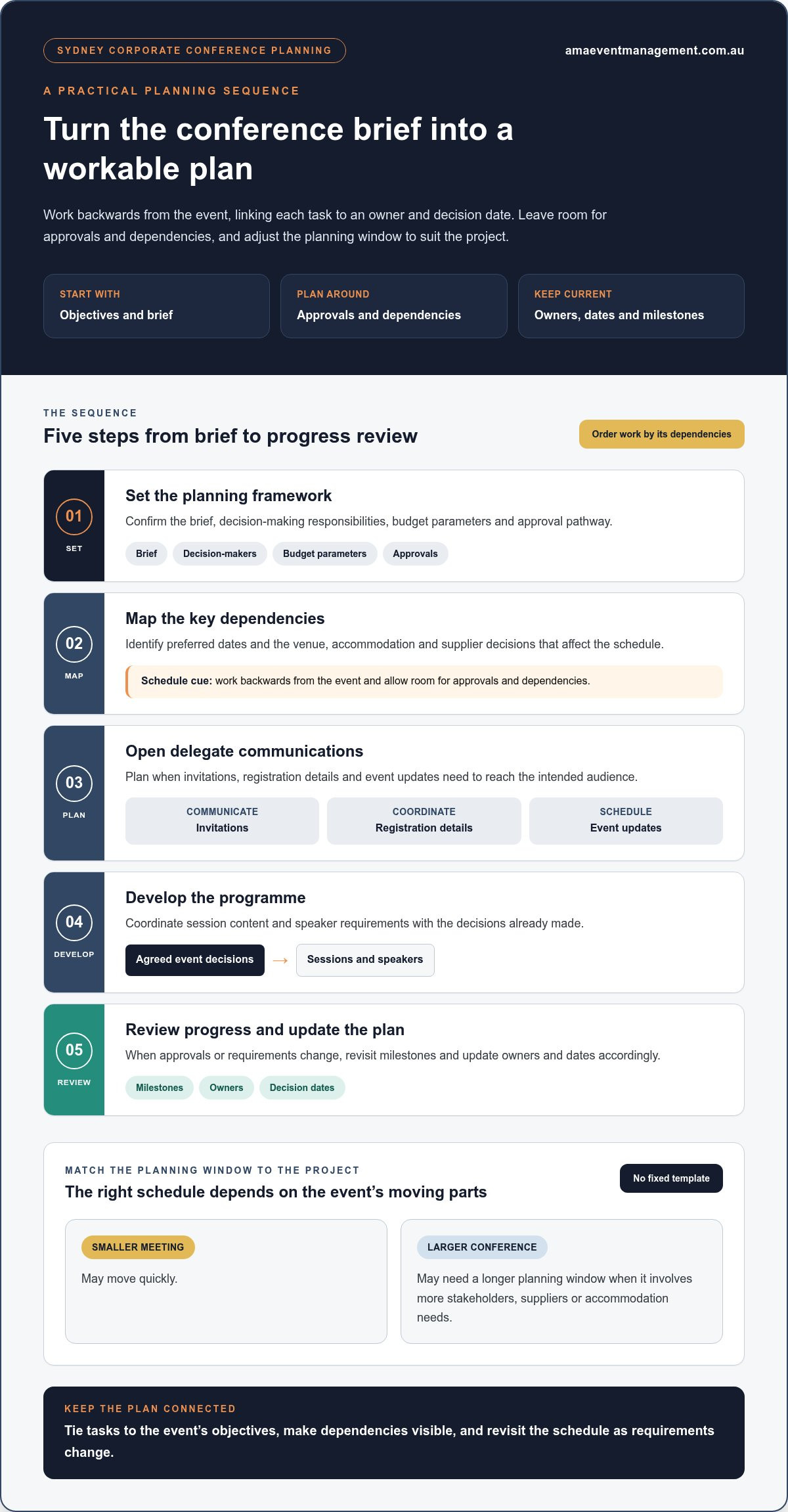
A clear sequence turns the brief into manageable decisions, with each milestone informing the next. Use a corporate conference planning checklist Sydney teams can adapt to the event’s scale, venue requirements and internal approval process. A smaller meeting may move quickly; a larger conference with more stakeholders, suppliers or accommodation needs may require a longer planning window. Set dates by working backwards from the event, leaving room for approvals and dependencies instead of relying on a fixed template.
Early decisions should protect the event’s critical dependencies, including approvals, dates, suppliers and delegate communications.
Early planning: brief, approvals and venue requirements
Start by confirming the objectives, stakeholders, budget parameters and who can make or approve decisions. Establish preferred dates, then map dependencies such as venue requirements, accommodation needs and supplier commitments. Build a working schedule showing when approvals, internal communications, registration and programme development need to happen. Link each task to an owner and decision date so delays are visible while there’s still room to adjust.
Set the planning framework: Confirm the brief, decision-making responsibilities, budget parameters and approval pathway.
Map the key dependencies: Identify preferred dates and the venue, accommodation and supplier decisions that affect the schedule.
Open delegate communications: Plan when invitations, registration details and event updates need to reach the intended audience.
Develop the programme: Coordinate session content and speaker requirements with the decisions already made.
Review progress: Revisit milestones when approvals or requirements change, and update owners and dates accordingly.
Use dependencies to determine the order of work. For example, registration communications rely on agreed event details, while programme development may depend on speaker confirmation. Keep the schedule live, not just as a launch document. If an approval takes longer than expected, identify the tasks it affects and reset the relevant dates promptly.
Final preparation: confirmations, run sheet and briefing
As the event approaches, consolidate supplier responsibilities, delivery timings and points of contact in one working document. Prepare a run sheet that aligns speakers, sessions, breaks and room transitions, with clear time cues and named owners. Brief event staff and key stakeholders on their responsibilities, escalation paths and how final changes will be communicated. This shared version helps the team work from the same plan on the day.
During delivery, use the run sheet to keep the programme moving and make decisions through the agreed escalation path. Record material changes that could affect the event’s objectives or follow-up. After the conference, schedule a review while details remain fresh: compare outcomes with the measures set in the brief, capture feedback and note lessons for future planning.
Keeping planning, supplier coordination and on-site oversight connected can reduce the organiser’s coordination burden. AMA Event Management manages corporate conferences and galas, bringing these elements together. Learn about corporate conference management and the support available from planning through delivery.
Compare Sydney conference formats, venues and delegate logistics
With the planning sequence in place, compare format and location against the audience’s needs. A useful corporate conference planning checklist Sydney organisers can apply considers how delegates will participate, how the programme will run and what the venue must support. No format suits every event: audience location, programme length and the level of interaction all affect the decision.
Choose a conference format that suits the audience
In-person events support direct discussion and shared experiences, while hybrid formats can include people who can’t attend in person but require additional technical coordination. Multi-session conferences offer more targeted content, though delegates may need to choose between concurrent sessions. Match the format to the intended interaction and speaker access, then plan the transitions and support each option requires.
If the programme includes a separate corporate gala, treat it as a distinct format with its own audience experience and logistics, rather than simply extending the conference day.
Assess venues through access, flow and technical fit
Test each venue against the draft programme, not just the expected headcount. Confirm that room capacity and configuration suit the sessions, accessibility needs can be accommodated, and technical requirements align with presentations or remote participation. Then trace the delegate journey from arrival and registration through session changes and breaks to departure. This can reveal pinch points, long transitions or competing demands on shared spaces.
Capacity and layout: Match room size and seating style to session purpose and attendance.
Accessibility: Consider entry, circulation, facilities and the route between event spaces.
Technical fit: Align presentation and participation needs with the planned format.
Delegate flow: Allow clear movement between registration, sessions, breaks and exits.
Sydney travel patterns matter too. Delegates travelling from interstate or overseas may value a location that makes the journey between Sydney Airport, accommodation and the conference straightforward. For local attendees, public transport connections and the route from arrival points to the venue can affect how smoothly the day begins. Assess accommodation proximity alongside programme start and finish times, especially if attendees need to travel between locations.
Use these comparisons to create a shortlist based on practical fit. A central location may simplify some journeys, while another setting may better suit the programme or delegate experience. The strongest choice is the one that supports participation, access and movement without adding avoidable friction.
Build risk, budget and supplier checks into your conference plan
A dependable conference plan makes risks, costs and responsibilities visible before event day. Add a working risk register to your corporate conference planning checklist Sydney and keep it current as decisions change. For each risk, record what could happen, who owns the response, what action will reduce the impact and when the plan needs review. Focus on realistic dependencies rather than trying to predict every possibility.
Schedule: Identify approvals or late programme changes that could affect milestones, and nominate who can reset priorities.
Suppliers: Note possible delivery delays or changes in requirements, with a contact and an agreed escalation route.
Attendance: Consider how delegate numbers differing from expectations could affect room use, registration or programme flow.
Accessibility: Record access needs and who will coordinate adjustments across relevant event spaces and activities.
Technical: Identify dependencies such as presentation equipment or hybrid participation, and document the response if they fail.
Track budget decisions and supplier responsibilities
Keep budget assumptions, approved allocations, committed supplier costs and documented changes in one controlled record. Distinguish approved spending from estimated or proposed items, and note who authorised each change. This gives decision-makers a clear view of changing commitments without relying on scattered emails or outdated versions.
For each supplier, document the agreed deliverables, timings, key contact and escalation responsibility. Make dependencies clear: a delivery time, access window or programme change may affect other suppliers and event operations. AMA Event Management includes budget management and vendor procurement in its corporate event work, bringing these planning decisions into a coordinated process.
Prepare contingencies and an event-day control plan
A useful run sheet is the shared reference for event-day timing, responsibilities and decision points. Include session cues, supplier timings, room transitions and the person responsible for each action. Pair it with a control plan that states how the team will communicate schedule changes, technical issues or supplier delays, and who can escalate a decision.
Before finalising the plan, verify the requirements that apply to the specific venue and event. Venue procedures, council conditions and other regulatory requirements can vary by site and activity, so don’t assume one event’s arrangements apply to another. Confirm relevant access arrangements, venue-specific procedures and the event team’s roles, then circulate the final working documents to those who need to act on them.
AMA Event Management coordinates corporate event logistics, suppliers and on-site supervision. Explore conference planning support for coordinated budget oversight and event-day delivery.
Close the loop after your Sydney corporate conference
The conference’s final session isn’t the end of the planning process. Prompt follow-up helps preserve useful feedback, clarify next steps and show whether the event achieved its purpose. Add this stage to your corporate conference planning checklist Sydney so evaluation and communications have clear owners instead of becoming tasks that disappear once the event team packs down.
Evaluate outcomes and capture lessons
Collect feedback while the programme and conversations are still fresh. Invite delegates to comment on session relevance, participation and the overall experience. Ask speakers about preparation and delivery, stakeholders whether the event met its business needs, and suppliers what could improve coordination. Keep questions focused so responses are useful, not just favourable.
Compare findings with the objectives and success measures established in the initial brief. Look at attendance and participation alongside feedback and delivery. If the aim was knowledge-sharing, consider whether delegates found the sessions relevant and what learning or actions they reported. If the goal was stakeholder engagement, review the quality of interaction and any agreed next steps. Avoid treating attendance alone as proof of success.
Record what worked, issues encountered and practical actions for the next event. A concise review might note a programme transition that ran smoothly, a communication gap that caused confusion or a session format that encouraged discussion. Share the findings with stakeholders responsible for future event decisions, so lessons can inform the next brief, schedule and budget planning.
Plan follow-up and decide what support you need next
Assign an owner and timeframe for each follow-up. Delegates may need a concise thank-you and relevant materials or agreed actions. Speakers may value a note that recognises their contribution and captures promised next steps. Stakeholders may need a summary of outcomes, while suppliers can provide observations to improve future coordination. Tailor each message to the relationship and the next useful action; avoid sending one generic update to everyone.
Close the loop internally, too. Confirm who will progress decisions raised at the conference, where those actions will be tracked and when they’ll be reviewed. For Australian businesses seeking to streamline ongoing attendee communication and post-event lead management, utilising Marketing System Solutions can help ensure no opportunities slip through the cracks. This turns discussion into follow-through and connects the event more clearly to business priorities.
If planning, supplier coordination and event-day delivery are stretching internal capacity, end-to-end support can help manage the moving parts. AMA Event Management plans and manages corporate conferences, including logistics, budget management, vendor procurement and on-site supervision. To discuss support for your next event, discuss corporate conference planning with AMA Event Management.
Turn your conference checklist into a clear next step
Turn the checklist into a working plan that fits your organisation’s decision-making process and the experience you want delegates to have. Use the corporate conference planning checklist Sydney as a practical starting point, then assign owners and dates to the decisions that need to move first. A clear owner for each task helps keep planning active between approval points and makes changes easier to manage.
If the scope is difficult to coordinate alongside your team’s other responsibilities, experienced event management support can help make the process more manageable. Discuss your objectives, audience and planning priorities to identify the support that fits your event.
Discuss your Sydney corporate conference with AMA Event Management and take the next step with a plan shaped around your business goals.
Frequently Asked Questions
How far in advance should you start planning a corporate conference in Sydney?
Start as soon as you know the event’s purpose and preferred timing, then set lead times around the event’s scale and dependencies. A Sydney conference requiring several approval rounds, multiple rooms or interstate travel may need more preparation than a smaller internal gathering. Work backwards from the event date, allowing time for decisions that affect later tasks. If dates are flexible, identify alternatives early to give planning more room to adjust.
What should a corporate conference planning checklist include?
A useful checklist should show more than tasks. Include an owner, due date, status and any decision or dependency for each action, so the team can see what’s progressing and what’s holding up other work. A corporate conference planning checklist Sydney teams can share should give stakeholders one place to check current information. Keep a record of changes, and flag items that need approval rather than treating them as completed tasks.
How do I choose a conference venue in Sydney?
Choose a venue by testing it against the audience and draft programme, then consider how delegates will reach it. For example, attendees travelling from Melbourne or elsewhere interstate may need convenient links between Sydney Airport, accommodation and the venue, while local participants may rely on public transport. Assess the space’s layout, access and technical fit, and consider how room changes or peak arrival times will affect the delegate experience.
What is the difference between a conference run sheet and a planning checklist?
A planning checklist tracks the work required to prepare the conference, such as approvals, communications and supplier confirmations. A run sheet is the timed event-day document that tells the team what happens, when it happens and who is responsible. For example, a checklist might track that a speaker is confirmed; the run sheet records their session time, introduction and transition. Keep both current, but use them for different purposes.
How can I keep a corporate conference on budget?
Set an approved budget baseline and record assumptions before commitments accumulate. Track supplier costs as they’re approved, distinguish confirmed commitments from estimates, and document scope or timing changes with the decision-maker’s approval. Review the forecast regularly against remaining funds, not just amounts already paid. If a new request arises, record its cost implication and what it may displace before adding it to the plan.
What should happen after a corporate conference?
Close outstanding actions while the event is still fresh. Reconcile supplier records, assign owners to business actions raised during sessions, and gather feedback from the groups involved. Compare the results with the measures set before the event, then prepare a short findings note for decision-makers. Record recommendations in a format the next planning team can use, rather than leaving lessons in individual inboxes or informal conversations.
Should I manage a Sydney corporate conference in-house or use an event management team?
Manage it in-house if your team has the time, clear decision-making authority and capacity to coordinate the moving parts alongside its usual work. An event management team may be useful when supplier coordination, logistics and on-site responsibilities would stretch internal resources or distract staff from their core roles. Agree who owns approvals and business decisions, and who manages delivery tasks, so responsibilities stay clear whichever approach you choose.


Comments