

Team building retreat ideas NSW: 12 ways to bring a team together
The most adventurous retreat isn’t automatically the most effective. The best team building retreat ideas NSW offers are the ones that match the setting and activities to your team’s needs, while staying practical to organise.
A retreat should feel worthwhile without making anyone uncomfortable or losing sight of the business goal. Different personalities, abilities and travel needs can make the choice harder, especially when you’re balancing activities with focused discussion and downtime.
This article compares 12 practical retreat formats across NSW, from outdoor challenges and creative workshops to wellbeing-focused stays. You’ll see how to match each option to goals such as building trust, strengthening communication or aligning leaders, then weigh location, access, schedules and supplier coordination. With a clear purpose and a considered plan, the retreat can feel inclusive and useful rather than forced. Event coordination can bring activities, schedules and suppliers together into one coherent experience.
Table of Contents
Team building retreat ideas NSW: start with the outcome, not the activity
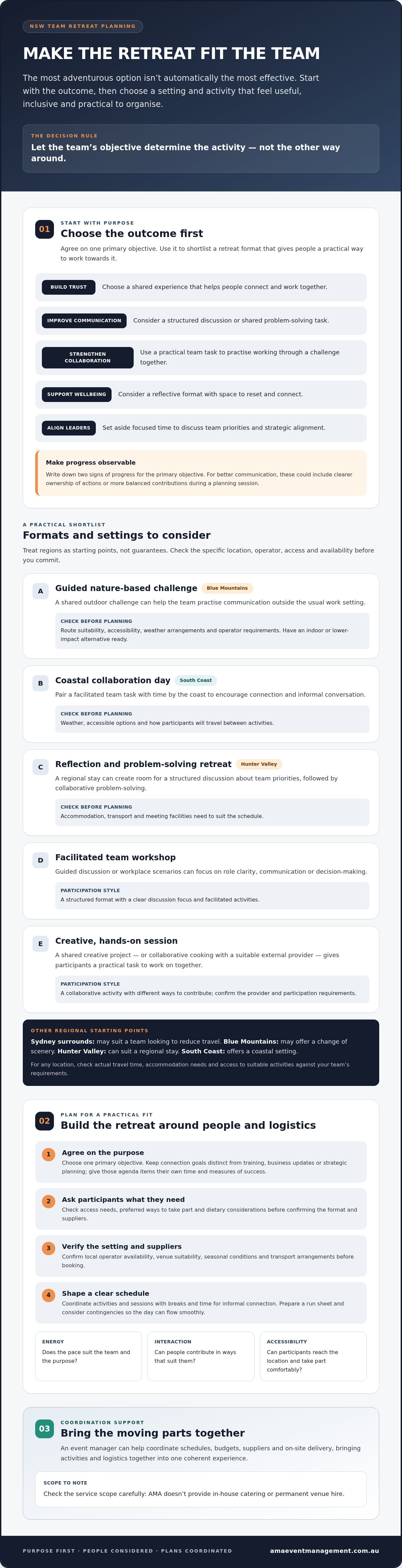
A retreat should be enjoyable, serve a business purpose and be straightforward to organise. Choosing an activity before agreeing on the purpose can make those aims harder to balance. Start by deciding whether the priority is trust, communication, collaboration, wellbeing or strategic alignment. Then choose a format that gives the team a practical way to work towards it.
Team building can involve setting goals, clarifying roles, solving problems or strengthening interpersonal relationships. These foundations of organizational development offer a useful starting point for turning a broad intention into a focused retreat. For example, a team that needs clearer collaboration may benefit from a shared problem-solving exercise, while a group seeking space to reset may prefer a reflective format.
Let the team’s objective determine the activity, not the other way around. As a starting shortlist, consider active experiences for a shared challenge, reflective sessions for wellbeing and connection, creative workshops for fresh perspectives, or structured problem-solving for collaboration and decision-making. Each format can accommodate different participation styles, so involvement doesn’t have to depend on physical activity or speaking in front of the whole group.
How to define a useful retreat outcome
Write down one primary objective and two observable signs of progress. If the goal is better communication, signs might include clearer ownership of actions or more balanced contributions during a planning session. Keep these connection goals distinct from training, business updates or strategic planning. Those agenda items may belong in the retreat, but they need their own time and measures of success.
Ask participants about access needs, preferred ways to take part and dietary considerations before confirming the format and suppliers. This helps identify adjustments early, instead of assuming one activity or schedule will suit everyone.
Which NSW setting fits your team?
Think of each region as a broad setting, not a guarantee of a particular experience. Sydney surrounds may suit a team looking to reduce travel. The Blue Mountains may appeal to teams seeking a change of scenery, the Hunter Valley can suit a regional stay, and the South Coast offers a coastal setting. In every case, check actual travel time, accommodation needs and access to suitable activities against your team’s requirements.
Before booking a venue or activity, confirm local operator availability, venue suitability, seasonal conditions and transport arrangements. The best team building retreat ideas NSW has to offer are only practical if participants can reach the location, take part comfortably and move through the schedule without avoidable friction.
Six NSW retreat ideas, from Blue Mountains challenges to coastal collaboration
These team building retreat ideas NSW teams can consider differ in pace, participation and preparation. Treat the regions as starting points, then check specific locations, operators, access and availability before making plans.
Guided nature-based challenge in the Blue Mountains: A guided outdoor activity gives teams a shared challenge and a chance to practise communication outside the usual work setting. Check the route, accessibility, weather arrangements and operator requirements. Have an indoor or lower-impact alternative ready.
Coastal collaboration day on the South Coast: Pair a facilitated team task with time by the coast to encourage connection and informal conversation. Plan for weather, confirm accessible options and consider how participants will travel between activities.
Hunter Valley reflection and problem-solving retreat: A regional stay can create room for a structured discussion about team priorities, followed by collaborative problem-solving. Before choosing this format, check that accommodation, transport and meeting facilities suit the schedule.
Facilitated team workshop: Use guided discussion or workplace scenarios to focus on role clarity, communication or decision-making. The University of California, Berkeley’s Building an Effective Team guidance offers useful prompts around leadership, communication and delegating problem-solving.
Creative, hands-on session: A shared creative project, or collaborative cooking with a suitable external provider, gives participants a practical task to complete together. Check that the provider can accommodate different abilities and participation preferences, and clarify who is responsible for food arrangements.
Low-pressure wellbeing retreat: Offer optional activities, such as gentle movement or quiet reflection, alongside space to pause. This format supports different ways of participating without requiring everyone to do the same thing. Confirm access, facilities and suitable alternatives in advance.
For a purpose-led session, consider engaging an appropriate local First Nations provider. Discuss protocols, permissions, cultural context and the provider’s preferred approach directly, rather than treating cultural knowledge as a generic activity.
The right choice depends on the outcome, the people attending and the practical demands of the location. AMA Event Management can help coordinate event schedules, suppliers, budgets and on-site delivery. It doesn’t provide in-house catering or permanent venue hire. Explore AMA event planning support to see whether coordination fits your planning needs.
Compare team building retreat ideas by team needs and practical fit
A memorable activity can create a talking point, but it won’t automatically address a workplace need. Harvard Business School’s discussion of dynamic collaboration supports a useful planning principle: start with the outcome, then assess which format can help the team practise it. Use the comparison below to weigh participation and delivery alongside the intended objective.
Match the retreat format to your team
Active challenges may suit a team that wants to practise coordination under pressure. Reflective workshops can be a better fit when participants need space to listen, plan or build confidence gradually. A shared creative task offers another route: people can contribute ideas and practical skills without making physical competition the measure of success. Before deciding, ask participants about accessibility, confidence levels and cultural inclusivity, then use their feedback to shape the format.
These distinctions matter for both small executive groups and broader teams. A focused workshop can give a leadership group room for detailed discussion, while a larger team may need clear facilitation and varied ways to contribute. Neither format has a fixed group-size rule, so check requirements with the facilitator or provider.
Assess location, travel and delivery requirements
Sydney-based options may reduce regional travel for teams already nearby. A Blue Mountains, Hunter Valley or South Coast setting may involve more transport and accommodation planning, depending on where participants are travelling from and the specific location. Check journey times, accessible facilities, weather cover and how participants will move between sessions before confirming the programme.
A good-fit retreat balances purpose, participation and logistics, so the experience works for the team as well as the schedule. When evaluating suppliers and event-management support, the corporate event coordination guide can help you consider how planning and delivery responsibilities fit together.
Plan a NSW team retreat with a clear schedule and contingencies
A clear plan helps turn promising team building retreat ideas NSW into an event that runs smoothly. Start with the purpose, then work through the budget, location, format and participant needs before confirming suppliers. Give one person authority to make event-day decisions, and make sure suppliers and team leads know who that is.
1. Set the brief and budget. Confirm the retreat objective, who’s attending and what the budget needs to cover, including travel, accommodation, activities and meals.
2. Choose the location and format. Assess access, facilities and the journey for participants before settling on a venue or activity.
3. Confirm suppliers and responsibilities. Check arrangements, timings, access needs, cancellation terms and contact details with each supplier. For meals, confirm arrangements with the venue or a suitable external provider.
4. Prepare the run sheet and contingencies. Map each session, transition and break, then decide what will change if weather or transport disrupts the plan.
5. Brief participants and deliver the event. Share practical details before departure, keep participants updated if plans change, and have the designated decision-maker coordinate event-day responses.
Build a practical retreat run sheet
Give the day a steady rhythm: arrival and orientation, a core activity, breaks, a reflection or discussion session, and a clear close. Place meals and informal connection where they support the flow, rather than squeezing them between back-to-back sessions. Allow time to move between spaces and recover after more demanding activities. A coherent theme can help participants understand how each part connects; AMA’s themed event experience guide offers ideas for creating that sense of continuity.
Assign a lead contact for each activity and supplier, as well as for participant updates. Make key information easy to find, including meeting points, transport details and who to contact with an access or schedule question.
Prepare for NSW location and event-day variables
Before departure, reconfirm venue access, activity permissions, transport arrangements and current local conditions. For outdoor plans, identify an indoor or low-impact alternative and agree who decides when to use it. Check that the alternative still supports the retreat objective instead of becoming unstructured downtime.
Confirm accessibility arrangements, emergency contacts and participant communications in advance. If transport is delayed or conditions change, the decision-maker should know the agreed response and how updates will reach the group. AMA Event Management can help coordinate event logistics, suppliers, budgets and on-site delivery. Explore event planning support to discuss how coordination may fit your retreat.
When an event manager can make your NSW team retreat easier
A retreat may involve a venue, transport, activities, accommodation and several suppliers, each with its own timings and requirements. An event manager can help coordinate these moving parts, manage the budget and provide on-site oversight. That can give your internal team more capacity to focus on the retreat’s objectives and participant needs, without promising a particular outcome or saving.
For team building retreat ideas NSW organisations are considering, the decision to delegate often comes down to complexity. A straightforward local session may be manageable in-house. A regional, multi-day retreat with several suppliers and a detailed run sheet may require more coordination than the team can comfortably absorb.
What to manage in-house and what to delegate
Keep ownership of the purpose, participant priorities and internal approvals with your team. These decisions depend on organisational context and should guide the event plan. You could delegate supplier communication, schedule integration, budget tracking and event-day logistics when those tasks compete with staff members’ other responsibilities.
Before dividing the work, map the moving parts: how many suppliers are involved, how complex the schedule is, and what internal capacity is available. Agree who approves changes and who makes time-sensitive decisions on the day. A clearly defined scope helps the event manager and client team work from the same plan.
Questions to ask before appointing an event partner
Ask who will manage planning, supplier communication and on-site coordination. Confirm in writing what’s included in the scope, which decisions remain with your team, how the budget will be monitored and how contingencies will be handled. Clarify how updates will be shared and who to contact if plans change.
Also check that the partner’s experience fits the event. AMA Event Management coordinates corporate events, including small executive retreats, and can manage logistics, budgets, suppliers and on-site delivery. Founder Amanda has more than 20 years of industry experience. Confirm the current service scope and NSW coverage when discussing your requirements.
AMA supports planning and execution, but doesn’t provide in-house catering or permanent venue hire. Catering and accommodation arrangements therefore need to be confirmed with suitable external providers. A coordinated plan can make responsibilities clearer and help keep schedules, suppliers and delivery aligned, while the team retains control of its objectives and approvals.
If you’re weighing up support for your retreat, discuss your NSW team retreat with AMA.
Make your team retreat purposeful and manageable
The strongest team building retreat ideas NSW has to offer begin with a clear objective, then bring together a suitable activity, setting and schedule. Choose a format that respects different access needs and participation styles, and make room for discussion, breaks and informal connection. Confirming suppliers, transport and contingencies early helps keep the plan practical.
Coordinating those details can take time, particularly when a retreat involves several providers or a regional location. AMA Event Management supports corporate event planning, logistics and on-site supervision for events in Sydney and Melbourne. Founder Amanda brings more than 20 years of industry experience.
If you’re ready to shape a retreat around your team’s goals, discuss your NSW team retreat with AMA. A considered plan can help your team spend less energy managing the moving parts and more time making the experience count.
Frequently Asked Questions
What are some good team building retreat ideas in NSW?
Useful team building retreat ideas NSW teams can explore include guided outdoor challenges, facilitated workshops, creative group tasks, wellbeing programmes and regional retreats. The best fit depends on your objective, participants’ preferred activity levels, accessibility needs and travel tolerance. Compare Sydney surrounds with settings such as the Blue Mountains, Hunter Valley and South Coast. Before committing, confirm the operator, venue suitability, access arrangements and availability for your preferred dates.
How do I choose a team building retreat activity for different personalities?
Choose an activity that supports the retreat’s objective without relying on one personality type or physical ability. Ask participants about access needs and comfort levels, then offer more than one way to contribute. A facilitated workshop can suit people who prefer structured discussion, while a creative task offers hands-on participation without physical competition. If you include an outdoor activity, make participation options and alternatives clear before the day.
Can a team building retreat be held in the Blue Mountains?
Yes, the Blue Mountains may suit teams looking for a regional setting and nature-based activities. Check travel time, accommodation, accessible facilities and transport before choosing a location. Confirm current venue and operator availability, activity permissions and weather contingencies directly with the relevant providers. Scenery is only one consideration: make sure the programme supports your team’s objective and that participants can take part comfortably.
How much time should a team building retreat take?
There’s no single ideal duration for a team retreat. A focused day may allow time for a workshop and shared activity, while regional travel can make an overnight programme more practical. Base the schedule on your objective, journey, participant availability and the time needed for reflection. Include breaks and transitions instead of filling every moment, and check the proposed format with participants before confirming bookings.
What happens if bad weather disrupts an outdoor retreat activity?
Agree on a weather decision process before the event and confirm an indoor or lower-impact alternative with the venue or activity provider. Choose a backup that still supports the retreat’s objective, such as a facilitated problem-solving session instead of an outdoor challenge. Tell participants promptly if plans change, including any updated transport or clothing details. Check cancellation and rescheduling terms directly with each provider before confirming arrangements.
Is a team building retreat suitable for a small executive team?
Yes, a retreat can suit a small executive team if the format matches its purpose. A strategy session, structured reflection or collaborative problem-solving activity may allow more focused discussion than a large-group challenge. Confirm priorities, privacy requirements, accessibility needs and preferred setting before planning the schedule. Allow deliberate breaks as well as discussion time, so participants can reflect and return to the work with a clear focus.
Do we need an event manager to organise a team retreat in NSW?
Not every retreat needs an event manager. Consider your team’s internal capacity, travel arrangements, number of suppliers, schedule complexity and need for on-site coordination. AMA Event Management coordinates corporate events and can assist with planning, logistics, budgets, suppliers and on-site supervision. Founder Amanda has more than 20 years of industry experience. Teams in Sydney or Melbourne should confirm the current service scope and NSW coverage when discussing a retreat.



Comments