

The Architect’s Guide to Community Festival Organisers in Australia
What if the true measure of a community festival's success is not found in the creative spectacle, but in the invisible precision of its logistical framework? Many community festival organisers Australia-wide feel the weight of complex local council requirements, vendor coordination, and the ever-present risk of safety incidents. You understand that while the vision is the heart of the event, the underlying structure is what prevents a budget blowout or a logistical failure.
This guide offers a clear, professional pathway to transforming your ideas into a safe and immersive reality. We'll examine the critical planning timelines and compliance measures, including Work Health and Safety standards, that ensure every moving part works in harmony. By the end, you'll have the assurance that all safety risks are managed, allowing you to host a seamless event that strengthens your community's reputation and provides a secure environment for every attendee.
Table of Contents
The Role of Community Festival Organisers in Australia
A festival organiser serves as the central architect of public experiences. They don't simply book a venue; they design an environment. This role requires a disciplined shift from basic event planning to the rigorous application of event management principles. In high-pressure public environments, community festival organisers Australia-wide act as a stabilising force. They ensure that the complex machinery of a large-scale gathering remains functional and safe. Their core responsibilities cover three critical pillars: logistics, compliance, and stakeholder engagement. Without a professional manager to oversee these moving parts, even the most inspired creative vision can succumb to the weight of its own complexity.
Beyond the Creative Vision: Why Logistics Matter
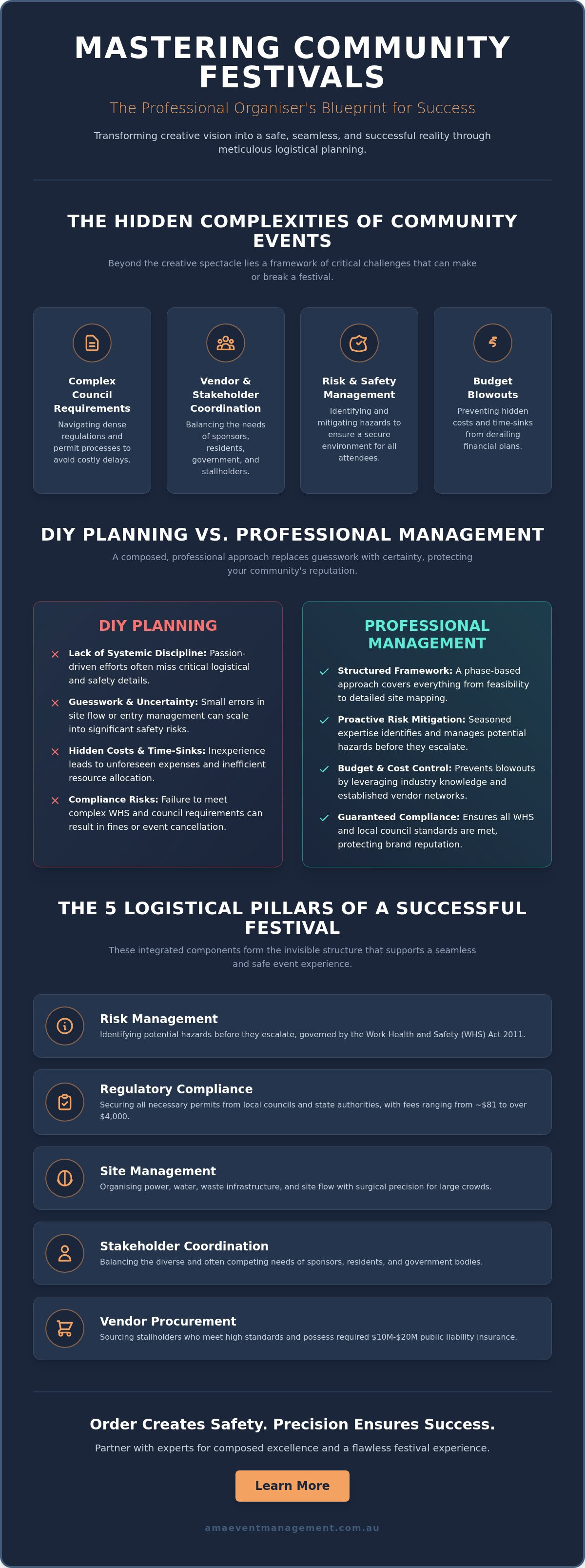
Creative ideas provide the heart of a festival, but logistics provide the skeleton. Meticulous planning is the only reliable barrier against the chaos that often accompanies large crowds. When thousands of people occupy a single space, small errors in site flow or entry management scale into significant safety risks. Professional oversight protects the brand reputation of the host organisation by ensuring every touchpoint is polished and predictable. While DIY volunteer efforts are often driven by passion, they frequently lack the systemic discipline required to manage high-stakes variables. A composed, professional approach replaces guesswork with certainty, ensuring that the event remains a positive reflection of the community it serves.
The Australian Festival Landscape in 2026
The Australian events industry has become a significant economic driver. In 2023, the sector contributed $78.2 billion to the national GDP and employed 243,000 direct workers. This growth has led to a more sophisticated landscape where attendees expect immersive, seamless experiences. However, increased attendance brings increased regulatory scrutiny. Whether managing a harbour-side activation in Sydney or a regional fair in the outback, community festival organisers Australia must navigate a dense thicket of requirements.
The primary framework is the Work Health and Safety (WHS) Act 2011, which demands comprehensive risk management and detailed Event Management Plans. Local council requirements vary significantly. For instance, Brisbane City Council might charge a permit fee of approximately $81 for a self-assessable event, whereas major impact events in Perth face application fees of $220 plus venue hire that can reach $4,125 per day. Managing these variables requires a seasoned expert who possesses both a broad strategic view and an intense focus on the smallest regulatory details. Order creates safety. Precision ensures success.
The Logistical Pillars of a Successful Community Event
A successful community festival operates like a well-oiled machine. While the public sees the celebration, community festival organisers Australia-wide focus on the invisible pillars that support the entire structure. These pillars include risk management, regulatory compliance, site logistics, stakeholder coordination, and vendor procurement. Each element requires a methodical approach to ensure that the creative vision isn't overshadowed by operational failure. When these components are integrated with precision, the result is an event that feels effortless to the attendee but is strictly disciplined behind the scenes.
Risk Management: Identifying potential hazards before they escalate into incidents.
Compliance: Securing necessary permits from local councils and state authorities.
Site Management: Organising power, water, and waste infrastructure with surgical precision.
Stakeholder Coordination: Balancing the diverse needs of sponsors, residents, and government bodies.
Vendor Procurement: Sourcing stallholders who meet high standards of quality and safety.
Securing the right partners is essential for maintaining the festival's theme and safety. Professional market management and vendor coordination ensures that every stallholder possesses the required $10 million to $20 million in public liability insurance, protecting both the organiser and the community from unforeseen liabilities.
Risk Mitigation and Safety Standards
The primary legislation governing event safety is the Work Health and Safety (WHS) Act 2011. This act places a legal duty on organisers to ensure the health and safety of workers and visitors alike. A robust emergency response plan provides the quiet confidence needed to handle high-pressure situations without panic. A Safety Audit is a non-negotiable, systematic evaluation of all site hazards and control measures—including environmental risks like local pests—conducted before any member of the public enters the event space. To better understand how to manage these specific site safety concerns, particularly for outdoor venues in Sydney, you can learn more about Pest Elite and their professional identification guides. This disciplined oversight transforms a potentially chaotic environment into a secure, professional experience for every participant.
Site Logistics: The Art of Crowd Flow
Mapping a festival site requires an architectural mindset. Organisers must account for optimal movement, ensuring that bottlenecks don't form at entry points or near popular attractions. Effective site mapping considers the placement of infrastructure relative to expected foot traffic, ensuring the event is inclusive for all attendees, including those who rely on the specialised disability support services of Accessible Care. While the public enjoys the front-of-house experience, the success of the event often rests on back-of-house logistics. This includes hidden service corridors for waste removal and discreet access points for emergency vehicles. On-site supervision allows for real-time logistical shifts, such as redirecting crowds or managing power loads as the day progresses. This proactive management keeps the event flowing smoothly from start to finish.
DIY Planning vs. Professional Festival Management
Choosing between a volunteer committee and a professional management team often comes down to the appetite for risk. While the DIY approach is common for smaller local gatherings, the hidden costs of managing a festival without professional oversight are rarely found on a budget spreadsheet. These costs manifest as "time-poverty," where volunteers are overwhelmed by hundreds of hours of logistical coordination, and in the potential for expensive errors. A professional agency acts as a stabilising force, bringing twenty years of industry experience to navigate the unforeseen challenges that typically derail less experienced groups. This seasoned perspective ensures that the event remains focused on its creative goals while the logistical foundation stays secure.
The difference in vendor networks is another critical factor. Professional community festival organisers Australia-wide maintain established relationships with high-quality vendors who are vetted for reliability and safety. A one-off committee often finds itself in a reactive position, accepting any stallholder who applies. In contrast, a professional manager proactively curates a selection that aligns with the festival's theme, ensuring a polished and cohesive public experience. This methodical oversight transforms a simple gathering into a sophisticated brand activation that enhances the host's reputation.
The Burden of Compliance
Australian regulatory requirements are increasingly complex. For example, a high-impact event application in Perth requires a $220 fee, while Brisbane City Council charges approximately $81 for a self-assessable event. Navigating these variations, alongside the strict demands of the Work Health and Safety (WHS) Act, is a significant administrative weight. Professional organisers handle the heavy lifting of these council applications, ensuring every permit is secured and every deadline met. They also provide the peace of mind that comes from robust liability coverage, as even a single-day event typically requires between $10 million and $20 million in public liability insurance. This professional oversight ensures that all compliance risks are mitigated before the first stall is ever erected.
Vendor and Stallholder Management
The vendor application process is where the gap between DIY and professional management becomes most visible. A volunteer group might struggle to collect current insurance certificates or food safety permits from every stallholder. A professional manager uses a disciplined, systematic approach to ensure every vendor is compliant and their offering is curated for quality. This level of detail is essential for maintaining the event styling and theming. For those seeking a deeper understanding of these processes, it's helpful to review a Professional Community Market Management in Australia: A Strategic Guide. This methodical coordination ensures that the market component of a festival is a seamless, professional asset rather than a logistical liability.
A Step-by-Step Framework for Organising a Festival
A successful community gathering isn't built on chance. It's built on a steady, deliberate sequence of actions that transform a high-level vision into a functional reality. Professional community festival organisers Australia-wide follow a disciplined framework to ensure every moving part is integrated seamlessly. This methodology moves through five distinct phases, providing a logical progression from the first creative spark to the final site pack-down. By adhering to this structured approach, organisers maintain control over budgets, timelines, and safety standards.
Phase 1: Conceptualisation and Feasibility. Define the core purpose of the event and establish a realistic budget. This phase determines if the vision aligns with available resources and community needs.
Phase 2: The Logistical Blueprint. Create detailed site maps, submit permit applications, and conduct comprehensive risk assessments. Precision is the priority here.
Phase 3: Stakeholder and Vendor Engagement. Curate a selection of vendors and sponsors who enhance the event's theme. Clear communication ensures all parties understand their responsibilities.
Phase 4: Execution and On-site Supervision. Manage the live event with a focus on crowd dynamics and real-time problem-solving. The manager acts as a composed guide for staff and patrons.
Phase 5: Post-Event Analysis. Review the event against original goals. Measuring community impact and financial performance provides the data needed for future growth.
Phase 2: Navigating Australian Regulations
The timeline for local council permit submissions in NSW and Victoria often requires 16 to 24 weeks of lead time for major public events. This period allows for the review of bespoke site plans that must account for local geographic features, such as heritage trees or specific terrain challenges. A Site Induction is a critical safety step where all festival staff and contractors are briefed on hazard locations and emergency procedures before work begins. This disciplined oversight ensures that the event meets the high standards of the Work Health and Safety (WHS) Act 2011.
Phase 4: The Importance of On-site Supervision
During the live event, the manager serves as the central anchor. They manage real-time vendor logistics and crowd dynamics with quiet authority, ensuring that any minor issues are resolved before they escalate. This level of coordination is similar to the meticulous oversight required by a Bespoke Private Event Planner Sydney, where every detail must be perfect. On-site supervision allows the hosting committee to focus on guest engagement while the professional team maintains the operational framework.
If you're ready to transition from overwhelming DIY planning to a structured, professional environment, consider our expert professional community festival and fair management services to secure your next event's success.
AMA Event Management: Your Partner in Composed Excellence
AMA Event Management brings more than 20 years of seasoned expertise to the Australian events sector. We operate with the precision of a meticulous architect, ensuring that every structural and logistical detail is accounted for long before the first guest arrives. As one of the leading community festival organisers Australia has to offer, our role is to act as a stabilising force in high-pressure environments. We don't just manage events; we build reliable frameworks that allow creative visions to thrive without the risk of operational failure.
Our capabilities extend across a broad spectrum of requirements. Whether we're coordinating executive retreats for corporate leaders or managing sprawling national expos, our approach remains strictly disciplined. We favour a collaborative partnership model, working closely with local councils, committees, and stakeholders to build lasting community bonds. This methodical oversight ensures that every event is a polished, professional representation of the host's brand. Reliability is our standard.
Our Approach to Community Festivals
We provide an end-to-end service that removes the administrative and logistical burden from your team. This comprehensive oversight includes initial feasibility studies, strict budget management, and on-site supervision. Our success with recurring large-scale community markets and significant public festivals serves as a practical proof of concept. These projects demonstrate our ability to manage high-volume attendance and complex vendor coordination with quiet authority. We ensure that every stallholder is vetted and every safety permit is in place well before the gates open.
Beyond traditional fairs and festivals, we specialise in creating immersive environments through themed brand activations. By integrating storytelling with logistical precision, we transform public spaces into memorable experiences that engage the community on a deeper level. Every activation is designed with a focus on flow, safety, and aesthetic consistency. This ensures the final result is both beautiful and functional, acting as a reliable anchor for your community's engagement strategy.
Secure Your Festival’s Success
The complexity of modern public events requires more than just passion; it requires a professional, stabilising force. By partnering with a team that is always several steps ahead, you mitigate the risks of budget blowouts, compliance failures, and safety incidents. We invite you to discuss your vision with a team that values order and high-level execution above all else. Our goal is to provide a seamless, frictionless experience from the first planning meeting to the final pack-down.
If you're looking for a partner who remains unfazed by challenges and delivers a polished result, we're ready to guide you. Consult with AMA Event Management to organise your next festival and discover the relief that comes from professional, architectural oversight.
Building Your Legacy Through Precise Execution
Transforming a creative vision into a successful community event requires more than just inspiration. It demands a disciplined framework where logistics, safety, and compliance serve as the foundation. By moving through a structured planning phase and prioritising meticulous site management, you ensure that your festival remains a safe and immersive experience for all attendees. Choosing to work with professional community festival organisers Australia-wide allows your committee to focus on engagement while an expert team handles the complexities of council permits and risk mitigation.
AMA Event Management brings over 20 years of experience to the Australian event sector, with a proven track record in delivering recurring local markets and large-scale public expos. Our specialised expertise in navigating WHS legislation and local council regulations provides the quiet confidence you need to host a seamless celebration. Partner with the meticulous architects at AMA Event Management for your next community festival and experience the relief of having a seasoned guide by your side. We look forward to helping you create an event that strengthens community bonds and enhances your reputation for years to come.
Frequently Asked Questions
How far in advance should we hire community festival organisers in Australia?
You should ideally engage professional management six to twelve months before your event date. This timeframe is necessary because major council permits in states like New South Wales and Victoria often require lead times of 16 to 24 weeks for thorough review. Early engagement ensures that the logistical blueprint is established before creative commitments are made, preventing costly revisions later in the project.
What are the typical council permits required for a festival in NSW?
Most NSW festivals require a Section 68 approval under the Local Government Act for activities on community land, such as installing temporary structures or operating food stalls. You may also need a road occupancy permit if your event impacts traffic flow. Professional community festival organisers Australia-wide will manage these applications to ensure all technical drawings and risk assessments meet specific local government standards.
Can professional organisers help with community engagement and volunteer management?
Yes, professional managers act as a stabilising force for local committees and volunteer groups. While volunteers often provide the passion and local knowledge, a professional organiser provides the disciplined framework required to coordinate their efforts safely. This partnership ensures that community members are placed in roles that match their skills while remaining under the oversight of a seasoned expert who understands WHS obligations.
Is it possible to organise a community festival on a limited budget?
Organising a successful event on a restricted budget is possible if you prioritise core logistical pillars over non-essential spectacles. Many organisers secure additional funding through local council grants, which are often less competitive than state programs. A professional manager helps prevent budget blowouts by identifying "hidden costs" early and ensuring that every dollar spent contributes to a safe and professional attendee experience.
What is the difference between an event planner and an event manager for festivals?
The difference lies in the shift from creative conceptualisation to rigorous operational execution. An event planner typically focuses on the "why" and the aesthetic vision of the day. In contrast, an event manager acts as the architect of the live environment, focusing on the "how" through site mapping, permit compliance, and safety audits. For public festivals, the manager's role is critical for maintaining order under pressure.
How do organisers ensure the safety of large crowds at public events?
Safety is ensured through the application of the Work Health and Safety (WHS) Act 2011 and meticulous site mapping. Organisers use crowd flow analysis to prevent bottlenecks at entry points and ensure emergency vehicle access is never compromised. Community festival organisers Australia also conduct mandatory site inductions for all staff and contractors, ensuring everyone on-site understands the emergency response plan before the public arrives.
What role do stallholders play in the success of a community festival?
Stallholders are essential for creating the variety and immersive atmosphere that draws large crowds. However, they also represent a logistical variable that must be managed with precision. Every vendor must be vetted to ensure they hold current public liability insurance, typically between $10 million and $20 million. This disciplined procurement process ensures that the market component of your festival is both high-quality and compliant.
How do you measure the success of a community festival after it has finished?
Success is measured through a combination of attendance data, economic impact, and safety performance. Beyond the numbers, professional organisers look at community feedback and the seamlessness of the pack-down process. A successful festival is one that enhances the host's reputation and leaves the site in its original condition, providing a clear proof of concept for future annual events.


Comments