

The Cost of a Market Stall in Sydney: A Comprehensive 2026 Financial Guide
Updated: Jul 9
With over five million annual visitors passing through Paddy's Haymarket alone, the potential for retail success in New South Wales is immense, yet many aspiring vendors overlook the intricate financial architecture required to actually stand on that pavement. Determining the true cost of a market stall Sydney involves far more than just the Saturday morning site fee. It requires a meticulous approach to logistics, compliance, and equipment procurement to ensure your venture remains profitable from day one.
It is common to feel a sense of hesitation when faced with varying council requirements or the sudden fee increases seen at major hubs like Kirribilli this year. You don't want to lose sleep over unexpected public liability costs or equipment failures when you should be focusing on your customers. This guide provides a disciplined breakdown of the 2026 financial landscape, allowing you to launch with a precise first month budget and total confidence in your compliance status. We will examine the current site rates across the city, clarify insurance mandates, and help you distinguish between essential gear and unnecessary overheads.
Table of Contents
The Financial Architecture of Sydney Market Stalls
A market stall is more than a simple weekend trade opportunity; it is a sophisticated, temporary retail activation that allows brands to engage directly with their demographic. This model provides a low-risk environment to refine product offerings and test pricing strategies without the overheads of a long-term commercial lease. A market stall is a strategic entry point into the Sydney retail landscape.
The total cost of a market stall Sydney is determined by a combination of geographic prestige and the volume of pedestrian traffic. Sites in the 2000 postcode or high-exposure coastal areas command higher premiums because they offer guaranteed visibility. Conversely, suburban community markets may offer lower entry points but require more intensive local marketing to drive sales. Understanding these variables is essential for any vendor aiming to build a sustainable business model.
Classifying Sydney Market Types
Sydney's market ecosystem is diverse, and each category carries its own financial expectations. Artisan and craft markets, such as those at The Rocks or Kirribilli, focus on bespoke goods and often require a higher standard of visual presentation. Farmers and produce markets, like Carriageworks or Marrickville, prioritise high-frequency trade and recurring local shoppers. For a broader overview of the options available to you, consulting a comprehensive list of Sydney markets can help you identify which environment aligns with your brand's specific goals. Night markets and large-scale food festivals represent another tier entirely, often involving more complex compliance costs related to professional power distribution and waste management.
Why Logistics Influence the Price Tag
Site fees are only the foundation of your budget. The final price tag is heavily influenced by the level of infrastructure provided by the organiser. While some premium markets include high-quality shells or gazebos, most community and council-run sites operate on a "bring your own" basis. This shift in responsibility means you must account for the procurement of commercial-grade equipment that meets strict safety standards. Additionally, professional organisers often include a marketing and promotion levy within their fees. This investment ensures the event is well-publicised across social media and local press, effectively reducing your individual advertising spend. When you evaluate a site, you aren't just buying space; you are investing in a managed ecosystem designed to facilitate trade.
Decoding Site Fees: Comparing Sydney Market Tiers
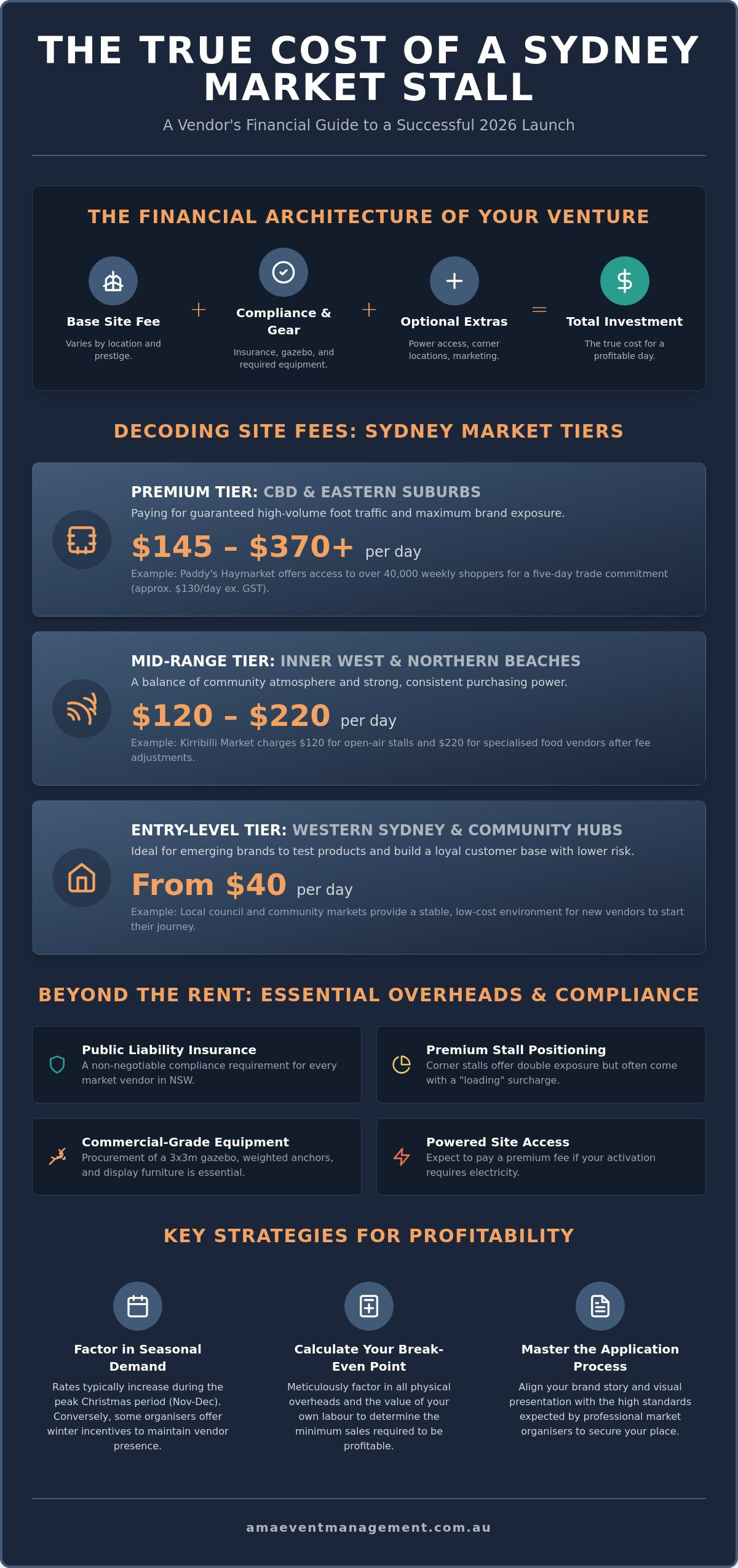
The base cost of a market stall Sydney is rarely a flat rate. Instead, it operates on a tiered system influenced by postcode prestige and seasonal demand. While a community market in Penrith may charge as little as $40 per day, premium CBD locations like Chinatown range from $145 to $370 depending on the footprint size. Understanding these tiers allows you to align your product’s price point with the expected purchasing power of the crowd.
Stall size is the primary architect of your daily fee. The industry standard is a 3m x 3m space, but many organisers offer flexibility for oversized activations. You must also account for seasonal fluctuations. Rates typically climb during the peak Christmas period from November to December, reflecting the surge in consumer spending. Conversely, some organisers offer winter incentives to maintain a consistent vendor presence during the colder months. Planning your annual calendar around these fluctuations is a hallmark of a well-organised retail operation.
Sydney Region Price Benchmarks
Eastern Suburbs and CBD: You are paying for volume in these zones. Paddy’s Haymarket, for instance, requires a commitment of $651 excluding GST per week for a five-day trade. This investment grants access to over 40,000 shoppers weekly.
Inner West and Northern Beaches: Markets like Kirribilli offer a middle ground. Following the fee adjustment in May 2026, open-air stalls here sit at $120, while specialised food vendor spots reach $220.
Western Sydney and Penrith: These remain the most accessible entry points for emerging brands. They provide a stable environment to build a customer base without high initial risk.
Add-on Costs for Premium Positioning
Beyond the base rate, specific logistical requirements can increase your daily spend. Corner stalls often carry a "loading" fee because they offer two sides of customer interaction. If your activation requires power, expect to pay a premium. Food vendors at Kirribilli already pay a higher base of $220 to account for these infrastructure needs. You must also consider the cost of digital payment processing. In 2026, providing a seamless Eftpos experience is a non-negotiable standard for professional trade. When the logistics of managing multiple sites become complex, many vendors rely on expert market management and vendor coordination to maintain their standards.
Storage and vehicle access fees during bump-in are other variables to monitor. Some high-density sites charge for dedicated parking or extended trolley hire, though Kirribilli currently offers trolley hire for free for the first 20 minutes. Integrating these small details into your budget is necessary to accurately forecast the cost of a market stall Sydney over a full financial year.
Beyond the Rent: Essential Hidden Costs and Compliance
While the daily site fee is the most visible expense, a professional activation requires a broader capital commitment to meet safety and legal standards. The total cost of a market stall Sydney includes the critical layer of public liability insurance, which most organisers set at a minimum of $10 million to $20 million in coverage. While markets like Kirribilli offer a per-day insurance option for $20, established vendors often find that a private annual policy provides better long-term value and flexibility across multiple locations.
Equipment procurement is another significant initial outlay. You must invest in a commercial-grade gazebo that can withstand the rigours of outdoor trade. To mitigate the risk of structural failure during unpredictable Sydney coastal winds, organisers strictly mandate the use of minimum 20kg weights secured to each leg of a 3m x 3m gazebo. Beyond shelter, your budget must account for professional display furniture, heavy-duty trolleys for bump-in, and weather-resistant storage containers to protect your inventory during transit.
Regulatory and Council Compliance
NSW food vendors face additional layers of scrutiny. You must obtain a Food Safety Supervisor (FSS) certification and register with the local council, such as the City of Sydney, to secure a temporary food stall permit. These certifications involve both initial training fees and recurring renewal costs. Many organisers also implement waste management levies to cover the professional disposal of packaging and greywater, ensuring the site remains compliant with environmental regulations.
The "Invisible" Startup Costs
Digital infrastructure is essential for modern trade. You will need reliable Point of Sale (POS) hardware and must factor in the percentage-based transaction fees that accompany every sale. Visual merchandising is equally vital; high-quality signage, branded tablecloths, and professional packaging are not optional extras if you intend to compete with seasoned vendors. Finally, consider the logistical reality of Sydney's geography. Secure storage for your equipment and the cost of parking or fuel for transport can quickly erode your margins if they aren't meticulously tracked from the outset.
If you are looking for unique products to stock or digital guides to help manage your business, you can visit Adamase to browse their diverse collection of high-quality items.
Public Liability: $10m-$20m cover is the standard entry requirement.
Safety Weights: 20kg per leg is mandatory for gazebo stability.
Food Certification: FSS training is a prerequisite for all NSW food vendors.
POS Systems: Factor in hardware costs and ongoing transaction percentages.
Strategic Budgeting: Forecasting Your Market Day ROI
Understanding the total cost of a market stall Sydney is only the first phase of a successful retail operation. To transition from a casual vendor to a profitable brand, you must apply a disciplined framework to your financial forecasting. This involves moving beyond a simple tally of daily takings and instead calculating your true Return on Investment (ROI). By treating each market day as a data-driven activation, you can identify which sites offer the most efficient path to growth and which are merely draining your resources.
The ROI Calculation Framework
Determining your Break-Even Point (BEP) is a non-negotiable step in your preparation. This requires a precise audit of three distinct financial layers:
Fixed Costs: These include your site fee, a portion of your annual insurance premium, transport fuel, and parking.
Variable Costs: Calculate your Cost of Goods Sold (COGS) for the inventory you expect to move, along with packaging and merchant transaction fees.
Labour Costs: You must assign a dollar value to your time. Failing to account for the hours spent on preparation, bump-in, and trade is a common oversight that masks the true viability of a business.
Once these figures are consolidated, you can estimate the required transaction volume. If your average customer spend is $30, how many individual sales are necessary just to cover your overheads? This clarity allows you to set realistic targets and adjust your sales tactics in real time during the event.
Maximising Value from Every Stall
A single stall often serves as the pilot phase for a more expansive themed brand activation Sydney, allowing you to test immersive storytelling on a smaller scale before committing to larger corporate programmes. We recommend the "Three-Market Rule" for assessing any new location. The first market is dedicated to logistics and layout refinement. The second market allows you to hone your customer engagement. By the third market, you will have sufficient data to judge if the site is a sustainable anchor for your brand.
Consistency is the foundation of success within the recurring markets NSW ecosystem. Beyond immediate sales, use your physical presence to collect customer data and conduct face-to-face market research. This direct feedback is invaluable for product development and building long-term brand loyalty. For vendors looking to scale their operations across multiple high-traffic locations, engaging with professional market management and vendor coordination can provide the strategic oversight needed to maintain a high-performing retail circuit.
Navigating the Application Process with Professional Oversight
Organisers aren't just looking for vendors; they are looking for partners who enhance the event atmosphere. A successful application requires more than just meeting the basic cost of a market stall Sydney; it requires a demonstration of professional readiness. Organisers prioritise high-quality photography and a cohesive brand story that aligns with the specific character of the event. If your visuals are cluttered or your narrative is vague, you risk immediate rejection, regardless of your product quality. Your application is your first opportunity to prove that you can manage a retail activation with the required level of discipline.
AMA Event Management understands the complexities of these requirements. We actively work to simplify the night market stallholder application process, ensuring that logistics and compliance are handled with meticulous care. Common pitfalls often include incomplete insurance documentation or a failure to provide a clear, professional stall layout. By addressing these details proactively, you position yourself as a reliable and desirable vendor who understands the high standards of Sydney's premier retail environments.
Curating a Winning Stall Presentation
Visual merchandising within a 3m x 3m space requires a strategic use of verticality and lighting. Theming is not merely decorative; it is a tool for differentiation in a crowded marketplace. When you work within the framework of professional community market management Australia, you gain access to a support system that values vendor growth and high-level execution. This partnership ensures your stall is not just a point of sale, but a compelling brand activation that invites customer interaction and builds long-term loyalty.
Next Steps: From Application to Activation
Major Sydney markets often have long lead times, with some high-demand sites booking out months in advance. Establish a clear timeline for your submissions and maintain open, professional communication with site coordinators. Preparing for your first bump-in with quiet confidence involves a thorough rehearsal of your setup and a deep understanding of the site's logistical flow. This thorough preparation ensures that the initial cost of a market stall Sydney translates into a sustainable and profitable retail presence. When every detail is organised, the transition from applicant to active vendor becomes a seamless, predictable progression.
Mastering Your Sydney Retail Activation
Success in the Sydney market scene requires a transition from casual trade to a disciplined retail activation. We've examined the layered financial architecture of these events, from decoding tiered site fees to accounting for mandatory safety compliance. Managing the total cost of a market stall Sydney effectively requires both a broad strategic view and an intense focus on operational details. By calculating your true ROI and investing in professional presentation, you ensure your brand remains a stable and profitable presence.
AMA Event Management brings over 20 years of event management experience across NSW and QLD to every partnership. We're specialists in recurring community and night markets, providing professional vendor coordination that ensures seamless logistics for every activation. Our methodical approach allows you to focus on your customers while we manage the complex moving parts of the event environment. Explore our upcoming market opportunities and apply today to begin your next chapter with confidence. We look forward to supporting your growth in Sydney's vibrant market landscape.
Frequently Asked Questions
How much does a casual stall at a Sydney market cost on average?
A casual stall typically ranges from $40 to $145 per trading day for standard community and suburban markets. In premium, high-traffic locations such as Kirribilli or Chinatown, you should expect to pay between $120 and $370 depending on the specific zone and footprint size. This base cost of a market stall Sydney generally covers the space only, requiring you to provide your own infrastructure and equipment.
Do I need my own insurance to have a market stall in Sydney?
Yes, public liability insurance is a non-negotiable requirement for trading at any reputable Sydney market. Most organisers mandate a minimum of $20 million in coverage to protect against potential claims or accidents on-site. While some markets allow you to pay a daily surcharge of $10 to $20 to be covered under their group policy, holding your own annual policy is often more cost-effective for regular vendors.
Can I share a market stall with another business to save on costs?
Stall sharing is often permitted, provided both businesses are formally disclosed in the initial application and meet the market's quality standards. This is a practical strategy to reduce the individual cost of a market stall Sydney while maintaining a professional presence. You must ensure that both brands align with the event's aesthetic and that your insurance documentation explicitly covers both parties involved in the trade.
What happens if the market is cancelled due to bad weather?
Refund policies regarding inclement weather vary significantly between organisers and are typically outlined in your vendor agreement. Some markets offer a credit for a future date if they cancel before the event begins, while many outdoor sites maintain a strict "no refund" policy once the market has commenced. It is essential to review these terms before committing your capital to ensure you can manage the financial risk of a lost trading day.
Do I need a business ABN to apply for a market stall in NSW?
You generally require an Australian Business Number (ABN) to apply for a stall at professional markets throughout New South Wales. Holding an ABN demonstrates that you are operating as a legitimate commercial entity rather than a hobbyist. Organisers use this information for tax compliance and to verify the professional standing of your business during the selection process.
How much should I budget for a professional-grade gazebo?
You should budget between $600 and $1,200 for a commercial-grade 3m x 3m gazebo and the necessary safety equipment. Entry-level retail models often lack the structural integrity required for recurring professional trade and may not meet organiser safety standards. Your budget must also include approximately $150 for four 20kg leg weights to ensure your setup remains secure during unpredictable coastal wind gusts.
Are there additional fees for selling food or alcohol at Sydney markets?
Food and alcohol vendors typically pay higher site fees to account for increased infrastructure requirements and compliance oversight. At Kirribilli, for example, food stalls in the "Eat Street" section are priced at $220, compared to $120 for open-air general stalls. You must also factor in the cost of temporary food stall permits from local councils and the expense of maintaining a Food Safety Supervisor certification.
How do I find the best performing markets for my specific product?
Identifying the right site requires a balance between pedestrian volume and demographic alignment. High-traffic locations like Paddy's Haymarket attract over 40,000 shoppers weekly, which is ideal for high-frequency retail. We recommend visiting several markets as a pedestrian first to observe the crowd's purchasing behaviour and ensure the environment matches your brand's price point and aesthetic before submitting an application.


Comments